







 Publish to Newswire
 Add an Event
From the Open-Publishing Calendar
From the Open-Publishing Newswire
Indybay Feature
One-Year Milestone for Treesit in Berkeley Oaks
Originally published in the EarthFirst! Journal, Brigid 2008
Who would have thought? A multitree treesit in one of the biggest urban areas in the country—the Berkeley-Oakland-San Francisco megalopolis—just celebrated its one-year anniversary!
Who would have thought? A multitree treesit in one of the biggest urban areas in the country—the Berkeley-Oakland-San Francisco megalopolis—just celebrated its one-year anniversary!
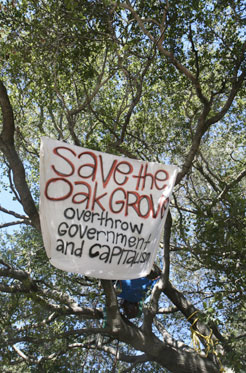
It was hard to see this far ahead when Native American activist Zachary Running Wolf, University of California-Berkeley (UCB) student Aaron Diek and new forest activist Jess Walsh hoisted themselves, in the dark of night, up into the branches of gnarly oak trees in a grove that includes nearly 40 old specimens of coast live oak (Quercus agrifolia), a towering redwood and cedars (see EF!J March-April 2007). They aimed to protect the trees from UCB, which plans to level the grove—which students, faculty and the public have used for decades as a respite from the urban chaos below—for a high-tech sports facility. The three activists climbed to their perches to make the point that, beyond inappropriateness, it is actually illegal to cut mature coast live oaks in Berkeley and, further, that people care enough about these trees to take direct action. But who thought we would find the support to maintain the action for a year and counting?
What began as a passionate act of daring has morphed into a nationally covered campaign, encompassing a conglomeration of issues, widely supported in the community, punctuated by more than 150 arrests and citations, and generating enough legal action to keep a couple dozen attorneys busy. The ecological underpinnings remain a primary rallying point and strong argument. The grove is a crucial link in the urban/wildlands interface, providing a wildlife corridor that connects pieces of the vast regional parkland in the Berkeley-Oakland hills above the UCB campus. The arboreal platforms also caused many curious visitors—dog walkers, football fans, baby-carriage pushers, classes of third graders, international tourists—to look upward as they entered the grove. This is a perspective not native to city-dwelling, appointment-hopping, fast-moving Homo sapiens. But oh, what a perspective it can be, as the abundant birds cruise in for a landing and squirrels lob acorns at heads below. Breathe deeply…. There’s a whole other world up there.
Additionally, this campaign has brought both treesitters and observers alike to an understanding of sacred space and its meaning in our lives and evolution. Thanks primarily to Running Wolf, the indigenous archaeological aspects of the campaign have been aggressively pursued. Early on, someone from the UBC Department of Archaeology covertly delivered a 1925 document to Running Wolf, verifying that bones had been discovered during construction of the adjacent football stadium. Back then, we didn’t have the National Environmental Protection Act and the California Environmental Quality Act, which require Environmental Impact Reports to take native burial sites into consideration during any new construction. But besides the nuts and bolts of getting the university to address these issues, there has evolved a mindset—among the sitters, the multiethnic student body, the mainstream Sierra Club types and everyone else involved—that sacred sites are essential to our well-being and must be protected with a reverence and ferociousness that has given this campaign tremendous strength. This is how we evolve as human beings.
During the many months that it took three lawsuits (one was even filed by the city of Berkeley!) challenging the university’s planning documents to come to court, many creative actions kept the campaign vibrant, growing and strong. The lawsuits finally came to court in September, culminating in a three-week trial during which the judge visited the grove. However, as we honor the treesitters and intrepid ground support on this one-year milestone, we are still waiting for the decision from Judge Barbara Miller as to whether UCB will be sent back to the drawing board.
Here are some highlights from the past year of what is probably the longest-running and most accessible urban treesit ever:
•In January 2007, legendary conservationist and Save the Bay founder Sylvia McLaughlin (age 90), City Councilwoman Betty Olds (age 86) and former Mayor Shirley Dean (age 71) ascended to a special platform to hold a press conference calling on the university to look at other sites for its project.
•In February 2007, more than 80 local residents—including grandmothers, a family of four, students and tenured professors—participated in a “24-hour community treesit,” trying out hourlong stints on a platform in the oak branches.
•On February 20, 2007, Native American leaders from around the area joined Running Wolf in a ceremony and press conference, calling attention to the fact that UCB’s plans would desecrate a native burial site.
•On a chilly March morning, 78 people removed their clothes and lay on the ground for a photo shoot by famed photographer Jack Gescheit. He did another photo shoot the following November, as naked hands and toes gripped the newly erected chain-link fence.
•UCB police harassment of the treesit escalated in the Spring, with many early morning raids; confiscations of support gear, literature and personal belongings; and citations and arrests. This lasted until the end of August, when crews moved in to construct a perimeter chain-link fence that was meant to cripple all resupplies of the sitters’ provisions. After an arrest for a food and water delivery, and a rash of negative publicity for the university, supply runs were resumed.
•In September, unable to suppress the treesit through arrests, harassment and supply blockades, UCB filed a civil lawsuit (essentially a SLAPP suit) against the treesitters and supporters, claiming it had the power to arrest even someone standing on the sidewalk hooting a warning of approaching police.
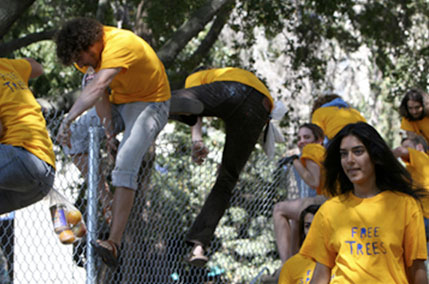
•Immediately after the filing of this lawsuit, around 40 UCB students in yellow T-shirts emblazoned with “Free Speech/Free Trees” joined with leaders of the 1964 Free Speech Movement to protest the fencing-in of the protest site. Students scaled the fence en masse, delivering food and water to the treesitters, resulting in 21 arrests. This also took the wind out of UCB’s argument that it is outsiders, rather than students, in the grove.
•In early November, as students began a treesit protest in the redwoods of UC-Santa Cruz, work crews in Berkeley arrived with heavy equipment to construct a bigger, taller, meaner fence around a much larger perimeter, topped with three strands of barbed wire. Nighttime harassment was stepped up, with bright stadium lights powered by noisy generators. Security guards also began filming the grove around the clock.
•As police selectively but broadly enforced the injunction against those “acting in concert” with the sitters—arresting people providing water, food and blankets to protesters—community voices were raised. In mid-November, about 45 treesit supporters—including many from the Native American community—turned out for a nighttime prayer vigil. Riot police moved in with batons, violently arresting four people while someone surreptitiously cut the fence in several places. This police action was quickly followed by more arrests of people walking away from the grove, students leaving blankets on a table and people supposedly caught on videotape talking to treesitters.
•As a response to the increased police action and the need for food and water, a Thanksgiving action by Berkeley Grandmothers for the Oaks delivered pies and other supplies to fenced-in treesitters. A tight circle of bodies prevented singling out as a treesitter, perched on a branch above the sidewalk, dropped a rope into the center of the circle and hoisted up supplies. Arrests were threatened but did not materialize.
•A similar food and water delivery was made at the one-year birthday celebration on December 2, with an even larger circle hiding those clipping the food bags to the sitter’s carabiner. Earlier in the day, six attorneys from the National Lawyers Guild—including famed attorneys Tony Serra and Dennis Cunningham—held a press conference in front of the grove, lambasting the university for trampling on protesters’ civil rights, as arrests and citations topped the 150 mark.
Wherever we go from here, it is clear that the campaign has brought together a diverse group of people who might not have otherwise collided on the political front. It has radicalized students, and it has opened people’s eyes and hearts to the concept of sacred sites and the sanctity of the lives of our fellow species. Even visiting football teams and their fans have been intrigued and perhaps inspired as they trooped past the arboreal village on their way to the UCB Bears’ stadium up the hill, realizing that we don’t have to make choices between sports facilities and trees, because, as the giant banner hung for the “big game” crowd proclaimed, “Bears Love Trees.”
For more information, contact info [at] saveoaks.com; http://www.saveoaks.com.
kp is an unapologetic treehugger who walks around with bark on her face.
What began as a passionate act of daring has morphed into a nationally covered campaign, encompassing a conglomeration of issues, widely supported in the community, punctuated by more than 150 arrests and citations, and generating enough legal action to keep a couple dozen attorneys busy. The ecological underpinnings remain a primary rallying point and strong argument. The grove is a crucial link in the urban/wildlands interface, providing a wildlife corridor that connects pieces of the vast regional parkland in the Berkeley-Oakland hills above the UCB campus. The arboreal platforms also caused many curious visitors—dog walkers, football fans, baby-carriage pushers, classes of third graders, international tourists—to look upward as they entered the grove. This is a perspective not native to city-dwelling, appointment-hopping, fast-moving Homo sapiens. But oh, what a perspective it can be, as the abundant birds cruise in for a landing and squirrels lob acorns at heads below. Breathe deeply…. There’s a whole other world up there.
Additionally, this campaign has brought both treesitters and observers alike to an understanding of sacred space and its meaning in our lives and evolution. Thanks primarily to Running Wolf, the indigenous archaeological aspects of the campaign have been aggressively pursued. Early on, someone from the UBC Department of Archaeology covertly delivered a 1925 document to Running Wolf, verifying that bones had been discovered during construction of the adjacent football stadium. Back then, we didn’t have the National Environmental Protection Act and the California Environmental Quality Act, which require Environmental Impact Reports to take native burial sites into consideration during any new construction. But besides the nuts and bolts of getting the university to address these issues, there has evolved a mindset—among the sitters, the multiethnic student body, the mainstream Sierra Club types and everyone else involved—that sacred sites are essential to our well-being and must be protected with a reverence and ferociousness that has given this campaign tremendous strength. This is how we evolve as human beings.
During the many months that it took three lawsuits (one was even filed by the city of Berkeley!) challenging the university’s planning documents to come to court, many creative actions kept the campaign vibrant, growing and strong. The lawsuits finally came to court in September, culminating in a three-week trial during which the judge visited the grove. However, as we honor the treesitters and intrepid ground support on this one-year milestone, we are still waiting for the decision from Judge Barbara Miller as to whether UCB will be sent back to the drawing board.
Here are some highlights from the past year of what is probably the longest-running and most accessible urban treesit ever:
•In January 2007, legendary conservationist and Save the Bay founder Sylvia McLaughlin (age 90), City Councilwoman Betty Olds (age 86) and former Mayor Shirley Dean (age 71) ascended to a special platform to hold a press conference calling on the university to look at other sites for its project.
•In February 2007, more than 80 local residents—including grandmothers, a family of four, students and tenured professors—participated in a “24-hour community treesit,” trying out hourlong stints on a platform in the oak branches.
•On February 20, 2007, Native American leaders from around the area joined Running Wolf in a ceremony and press conference, calling attention to the fact that UCB’s plans would desecrate a native burial site.
•On a chilly March morning, 78 people removed their clothes and lay on the ground for a photo shoot by famed photographer Jack Gescheit. He did another photo shoot the following November, as naked hands and toes gripped the newly erected chain-link fence.
•UCB police harassment of the treesit escalated in the Spring, with many early morning raids; confiscations of support gear, literature and personal belongings; and citations and arrests. This lasted until the end of August, when crews moved in to construct a perimeter chain-link fence that was meant to cripple all resupplies of the sitters’ provisions. After an arrest for a food and water delivery, and a rash of negative publicity for the university, supply runs were resumed.
•In September, unable to suppress the treesit through arrests, harassment and supply blockades, UCB filed a civil lawsuit (essentially a SLAPP suit) against the treesitters and supporters, claiming it had the power to arrest even someone standing on the sidewalk hooting a warning of approaching police.
•Immediately after the filing of this lawsuit, around 40 UCB students in yellow T-shirts emblazoned with “Free Speech/Free Trees” joined with leaders of the 1964 Free Speech Movement to protest the fencing-in of the protest site. Students scaled the fence en masse, delivering food and water to the treesitters, resulting in 21 arrests. This also took the wind out of UCB’s argument that it is outsiders, rather than students, in the grove.
•In early November, as students began a treesit protest in the redwoods of UC-Santa Cruz, work crews in Berkeley arrived with heavy equipment to construct a bigger, taller, meaner fence around a much larger perimeter, topped with three strands of barbed wire. Nighttime harassment was stepped up, with bright stadium lights powered by noisy generators. Security guards also began filming the grove around the clock.
•As police selectively but broadly enforced the injunction against those “acting in concert” with the sitters—arresting people providing water, food and blankets to protesters—community voices were raised. In mid-November, about 45 treesit supporters—including many from the Native American community—turned out for a nighttime prayer vigil. Riot police moved in with batons, violently arresting four people while someone surreptitiously cut the fence in several places. This police action was quickly followed by more arrests of people walking away from the grove, students leaving blankets on a table and people supposedly caught on videotape talking to treesitters.
•As a response to the increased police action and the need for food and water, a Thanksgiving action by Berkeley Grandmothers for the Oaks delivered pies and other supplies to fenced-in treesitters. A tight circle of bodies prevented singling out as a treesitter, perched on a branch above the sidewalk, dropped a rope into the center of the circle and hoisted up supplies. Arrests were threatened but did not materialize.
•A similar food and water delivery was made at the one-year birthday celebration on December 2, with an even larger circle hiding those clipping the food bags to the sitter’s carabiner. Earlier in the day, six attorneys from the National Lawyers Guild—including famed attorneys Tony Serra and Dennis Cunningham—held a press conference in front of the grove, lambasting the university for trampling on protesters’ civil rights, as arrests and citations topped the 150 mark.
Wherever we go from here, it is clear that the campaign has brought together a diverse group of people who might not have otherwise collided on the political front. It has radicalized students, and it has opened people’s eyes and hearts to the concept of sacred sites and the sanctity of the lives of our fellow species. Even visiting football teams and their fans have been intrigued and perhaps inspired as they trooped past the arboreal village on their way to the UCB Bears’ stadium up the hill, realizing that we don’t have to make choices between sports facilities and trees, because, as the giant banner hung for the “big game” crowd proclaimed, “Bears Love Trees.”
For more information, contact info [at] saveoaks.com; http://www.saveoaks.com.
kp is an unapologetic treehugger who walks around with bark on her face.
For more information:
http://www.earthfirstjournal.org/article.p...
Add Your Comments
We are 100% volunteer and depend on your participation to sustain our efforts!
Donate

$110.00 donated
in the past month
Get Involved
If you'd like to help with maintaining or developing the website, contact us.
Publish
Publish your stories and upcoming events on Indybay.
Topics
More
Search Indybay's Archives
Advanced Search
►
▼
IMC Network