







 Publish to Newswire
 Add an Event
From the Open-Publishing Calendar
From the Open-Publishing Newswire
Indybay Feature
Takin' It To the Trees in Santa Cruz
Originally published in the EarthFirst! Journal, Brigid 2008
In the early hours of November 7, people began hoisting climb lines and wooden platforms into three clusters of redwood trees at the University of California-Santa Cruz (UCSC). The trees and an adjoining parking lot are slated to become the site of UCSC’s new Biomedical Sciences Facility—the first project of the 2005 Long Range Development Plan (LRDP), which would replace 120 acres of forested land with student housing, recreational facilities, roads and research lab.
In the early hours of November 7, people began hoisting climb lines and wooden platforms into three clusters of redwood trees at the University of California-Santa Cruz (UCSC). The trees and an adjoining parking lot are slated to become the site of UCSC’s new Biomedical Sciences Facility—the first project of the 2005 Long Range Development Plan (LRDP), which would replace 120 acres of forested land with student housing, recreational facilities, roads and research lab.
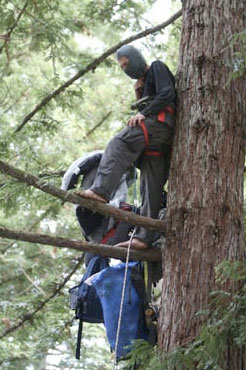
By 11 a.m., one person had been arrested, and three people were in redwood trees surrounded by the UCSC police, who had blocked off the entire area and confiscated anything left in the parking lot. The treesitters had been without food and water all night. One sitter, whose platform had been confiscated before it could be raised, sat in a redwood tree in only his climbing harness. Meanwhile, elsewhere on campus, a planned rally in opposition to the LRDP was well under way. Hundreds of students listened to speakers elucidating the numerous problems with UCSC’s expansion plans.
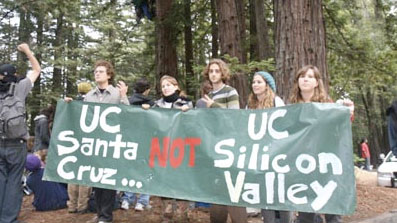
In a burst of energy, the rally morphed into a march to deliver supplies to the tree-sitters. Hundreds of supporters arrived at the treesit on Science Hill, armed with food and water. The first group of people to break police lines was tackled to the ground and arrested, but the crowd was not deterred. As they faced the police, they were met with pepper spray and batons. Regardless, they continued to move closer to the trees, reaching over the police to put food and water on the line dropped by a treesitter, while still under police attack. In a burst of success, the crowd pushed the police line back and surrounded one of the clusters of trees. Cheers went out as food and water were lifted into the trees. The police seemed powerless in the face of the determined crowd and eventually left, much to the surprise of the crowd.
And so began the organized on-campus resistance to UCSC’s 15-year expansion plan.
The LRDP maps out a rapid expansion of campus facilities over the next 13 years to accommodate up to 4,500 new full-time students. The plans include new buildings and roads on currently forested land in Santa Cruz, a community that is already completely “built out” and experiencing traffic congestion, water shortages and unaffordable housing.
UCSC is not your typical UC campus. Unlike UC Berkeley or UC LA, which are outgrowths of suburban sprawl surrounded by university-themed shopping centers, UCSC occupies a space made of meadows, chaparral, and mixed evergreen and redwood forests on a mountain above the city. Only about one third of the campus land is built upon. The north part of campus is undeveloped, with an impressive array of forest ecosystems crisscrossed by hiking trails and dirt roads. More than 500 distinct plant species and an equal number of mushroom species have been identified within campus boundaries. Furthermore, UCSC is surrounded by protected state and city park lands. Upper campus is an important wildlife corridor between the parks; contains the headwaters of three important watersheds that pass through wildlife preserves before draining into Monterey Bay.
All of these things are under threat from UCSC’s ambitious expansion plans. The academic consequences of the trajectory set by the LRDP will be far-reaching. UCSC is under pressure to give up its countercultural, liberal arts reputation and become an impersonal research institution with tall, glassy laboratories that can attract private funding and prestigious faculty. The university is becoming less of a place for intellectual growth and more of a place where one receives job training. The ecosystems that have always been so vital to both the campus and the surrounding community are now appreciated only for the “green aesthetic” that they lend to UCSC’s public image.
Opposition to the expansion has been fomenting from all quarters of Santa Cruz since the university began the planning process three years ago. The comment section of the LRDP’s Environmental Impact Report (EIR) is flooded with criticisms and concerns citing the inaccuracy of impact analysis and the inadequacy of proposed mitigations. The city of Santa Cruz, as well as county and community organizations, have filed dozens of lawsuits after having their concerns ignored by UCSC, which holds the authority of a state agency, but behaves as a private corporation. In August, a judge ruled that the university’s EIR did not adequately account for housing, traffic and water impacts. This lawsuit is currently stalled in attempts at out-of-court negotiations. The final outcome of these court cases is anyone’s guess, and UCSC is showing no intention of altering its plans. Before giving its final approval to the LRDP, in spite of the criticisms and exhortations of city officials and local residents, the only comment from the Board of Regents was to ask why the plans accommodated only 4,500 students and not more.
Students have heard little about the LRDP and had only the illusion of input in the process. Concerned students were told to submit comments or attend public comment hearings. On campus, little had been said about the LRDP since its final approval in 2006. But since November 7, all of campus has been buzzing with talk of the LRDP. It is now an issue that can’t be ignored. Forums and discussions are being held to further educate students and generate ideas that weren’t touched upon during the original planning process. Professors discuss the issues in their classes, anti-LRDP graffiti abounds, and the administration has devoted considerable resources to trying to repair its image after the police violence on November 7.
By the time the tree-sit had been up for three weeks, the parking lot below the trees had been fully transformed into an autonomous community space, with people camping out to hold it. The occupied space is a hub of activity, with people from many different perspectives united by their victory over the police. The occupied space hosts concerts, discussions, art classes, workshops, potlucks, movies and celebrations. Hundreds (if not thousands) of students and community members have passed through the site to attend events or just to check things out. Forest walks depart every Saturday, with guides discussing plants, animals and local history, while introducing people to the remarkable places that are threatened by the LRDP.
At UC Berkeley, treesitters are celebrating a year spent in the trees. In light of UCSC’s reluctance to respond to criticism, the UCSC treesitters are prepared for a long-term campaign that may take on many different forms before the expansion plans are called off. The forest at UCSC is worth the effort and energy that will be required. The treesitters see their struggle in the larger context of defending the few remaining wild areas that exist and opposing the profit-driven agenda that the LRDP represents.
For more information, visit http://www.lrdpresistance.org.
In a burst of energy, the rally morphed into a march to deliver supplies to the tree-sitters. Hundreds of supporters arrived at the treesit on Science Hill, armed with food and water. The first group of people to break police lines was tackled to the ground and arrested, but the crowd was not deterred. As they faced the police, they were met with pepper spray and batons. Regardless, they continued to move closer to the trees, reaching over the police to put food and water on the line dropped by a treesitter, while still under police attack. In a burst of success, the crowd pushed the police line back and surrounded one of the clusters of trees. Cheers went out as food and water were lifted into the trees. The police seemed powerless in the face of the determined crowd and eventually left, much to the surprise of the crowd.
And so began the organized on-campus resistance to UCSC’s 15-year expansion plan.
The LRDP maps out a rapid expansion of campus facilities over the next 13 years to accommodate up to 4,500 new full-time students. The plans include new buildings and roads on currently forested land in Santa Cruz, a community that is already completely “built out” and experiencing traffic congestion, water shortages and unaffordable housing.
UCSC is not your typical UC campus. Unlike UC Berkeley or UC LA, which are outgrowths of suburban sprawl surrounded by university-themed shopping centers, UCSC occupies a space made of meadows, chaparral, and mixed evergreen and redwood forests on a mountain above the city. Only about one third of the campus land is built upon. The north part of campus is undeveloped, with an impressive array of forest ecosystems crisscrossed by hiking trails and dirt roads. More than 500 distinct plant species and an equal number of mushroom species have been identified within campus boundaries. Furthermore, UCSC is surrounded by protected state and city park lands. Upper campus is an important wildlife corridor between the parks; contains the headwaters of three important watersheds that pass through wildlife preserves before draining into Monterey Bay.
All of these things are under threat from UCSC’s ambitious expansion plans. The academic consequences of the trajectory set by the LRDP will be far-reaching. UCSC is under pressure to give up its countercultural, liberal arts reputation and become an impersonal research institution with tall, glassy laboratories that can attract private funding and prestigious faculty. The university is becoming less of a place for intellectual growth and more of a place where one receives job training. The ecosystems that have always been so vital to both the campus and the surrounding community are now appreciated only for the “green aesthetic” that they lend to UCSC’s public image.
Opposition to the expansion has been fomenting from all quarters of Santa Cruz since the university began the planning process three years ago. The comment section of the LRDP’s Environmental Impact Report (EIR) is flooded with criticisms and concerns citing the inaccuracy of impact analysis and the inadequacy of proposed mitigations. The city of Santa Cruz, as well as county and community organizations, have filed dozens of lawsuits after having their concerns ignored by UCSC, which holds the authority of a state agency, but behaves as a private corporation. In August, a judge ruled that the university’s EIR did not adequately account for housing, traffic and water impacts. This lawsuit is currently stalled in attempts at out-of-court negotiations. The final outcome of these court cases is anyone’s guess, and UCSC is showing no intention of altering its plans. Before giving its final approval to the LRDP, in spite of the criticisms and exhortations of city officials and local residents, the only comment from the Board of Regents was to ask why the plans accommodated only 4,500 students and not more.
Students have heard little about the LRDP and had only the illusion of input in the process. Concerned students were told to submit comments or attend public comment hearings. On campus, little had been said about the LRDP since its final approval in 2006. But since November 7, all of campus has been buzzing with talk of the LRDP. It is now an issue that can’t be ignored. Forums and discussions are being held to further educate students and generate ideas that weren’t touched upon during the original planning process. Professors discuss the issues in their classes, anti-LRDP graffiti abounds, and the administration has devoted considerable resources to trying to repair its image after the police violence on November 7.
By the time the tree-sit had been up for three weeks, the parking lot below the trees had been fully transformed into an autonomous community space, with people camping out to hold it. The occupied space is a hub of activity, with people from many different perspectives united by their victory over the police. The occupied space hosts concerts, discussions, art classes, workshops, potlucks, movies and celebrations. Hundreds (if not thousands) of students and community members have passed through the site to attend events or just to check things out. Forest walks depart every Saturday, with guides discussing plants, animals and local history, while introducing people to the remarkable places that are threatened by the LRDP.
At UC Berkeley, treesitters are celebrating a year spent in the trees. In light of UCSC’s reluctance to respond to criticism, the UCSC treesitters are prepared for a long-term campaign that may take on many different forms before the expansion plans are called off. The forest at UCSC is worth the effort and energy that will be required. The treesitters see their struggle in the larger context of defending the few remaining wild areas that exist and opposing the profit-driven agenda that the LRDP represents.
For more information, visit http://www.lrdpresistance.org.
For more information:
http://www.earthfirstjournal.org/article.p...
Add Your Comments
Comments
(Hide Comments)
Are you Kidding me? UCSC is a great university - I cannot imagine a better university and campus to expand and make even more wonderful.
There are huge forrest areas all around the campus, and much undeveloped acreage on the campus. I say get the tree huggers out of the trees so the expansion can begin. Clearly the university has shown great sensitivity in the construction they've done so far. The campus is wonderfully integrated with the forrest it is situated in.
There are huge forrest areas all around the campus, and much undeveloped acreage on the campus. I say get the tree huggers out of the trees so the expansion can begin. Clearly the university has shown great sensitivity in the construction they've done so far. The campus is wonderfully integrated with the forrest it is situated in.
Like College 9 and 10?
With that attitude, there won't be any trees left. It will be one huge parking lot. If we cut a few trees here and there over time, someday we'll wake up and realize there are no substantial groves and open space left. I'm not a student at UCSC, and feel the community should be backing the LRDP protest more. Adding mass students is going to tax the community infrastructure, make more traffic, and continue to drive housing prices through the roof.
Just FYI, the UCSC campus is 2000 acres, and 600 of them are developed, but still have lots of trees. 1400 are undeveloped, also with lots of trees. The 2005 LRDP involves developing an additional 120 acres over the next 15 years. Yup, any day now there'll be no trees left on campus. But, other than counting trees, it's far more fun to make sure that people that want an education can't get one....
"UCSC is under pressure to give up its countercultural, liberal arts reputation and become an impersonal research institution with tall, glassy laboratories that can attract private funding and prestigious faculty."
Yes, God forbid the campus evolve into a broader, more diverse institution. The liberal arts rep had a few shortcomings, namely UCSC used to be the least ethnically diverse school in the UC system. Shifting towards degrees like business and engineering attract more students of color (like me). Liberal arts degrees are important (and I double majored in philosophy and physics) but it was eaiser to convince my family to let me go so school (second in my family after my sister) when they felt I could graduate with prospects.
Behind the tree sitter's masks, are there any non-white faces? Not allowing UCSC to grow means it will only be affordable for to wealthy, white kids. Like the UCSC of the past.
Yes, God forbid the campus evolve into a broader, more diverse institution. The liberal arts rep had a few shortcomings, namely UCSC used to be the least ethnically diverse school in the UC system. Shifting towards degrees like business and engineering attract more students of color (like me). Liberal arts degrees are important (and I double majored in philosophy and physics) but it was eaiser to convince my family to let me go so school (second in my family after my sister) when they felt I could graduate with prospects.
Behind the tree sitter's masks, are there any non-white faces? Not allowing UCSC to grow means it will only be affordable for to wealthy, white kids. Like the UCSC of the past.
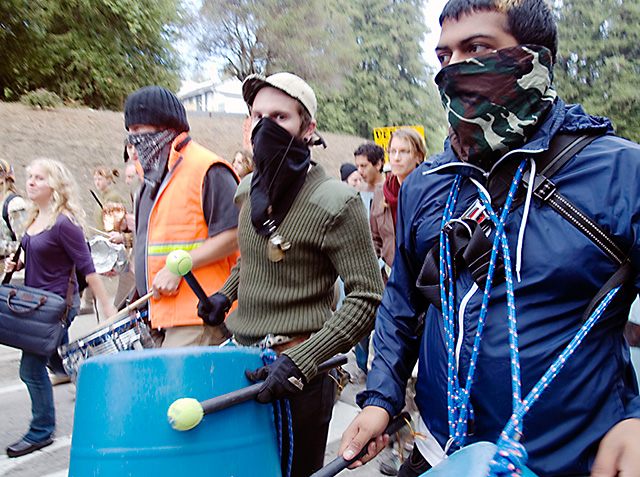
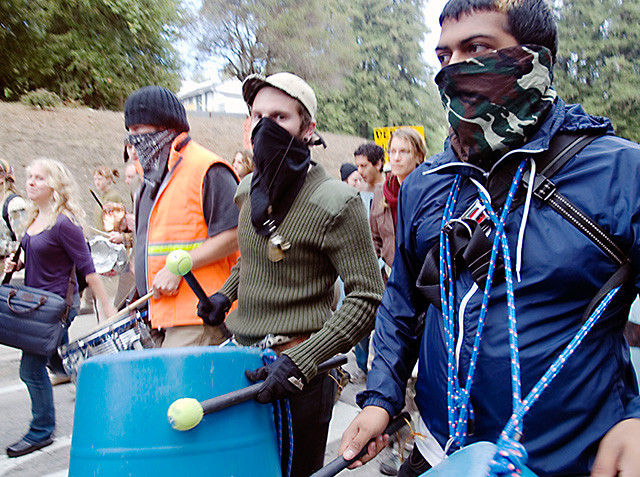
Oh, my goodness. There's a dude that might possibly be of Southern European descent among a sea of white faces. Is he of Greek or southern Italian descent? This proves, contrary to almost all visual and photographic evidence, that there's ethnic diversity among the tree sitters and their supporters. I am sooooo convinced by this wonderful show of broad-based support.
OMG. Can't fight empirical like this. LOL!
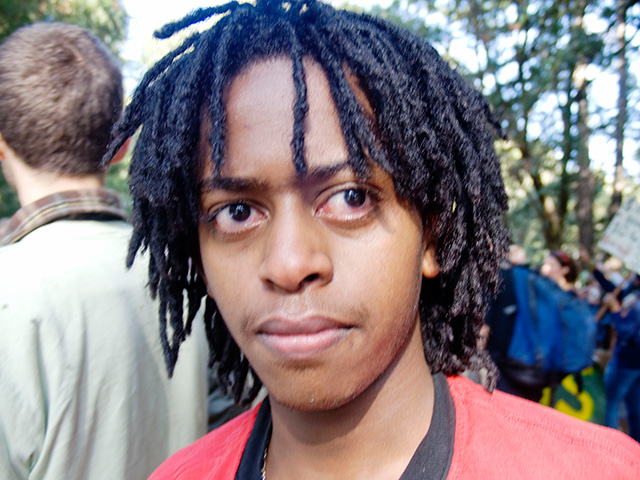
student protester pepper sprayed:
http://www.indybay.org/uploads/2007/11/09/eyes2_11-7-07.jpg
Another student protester pepper sprayed on Nov. 7th (He is both Persian & Pakastani):
http://www.indybay.org/uploads/2007/11/09/eyes4_11-7-07.jpg
http://www.indybay.org/uploads/2007/11/09/eyes2_11-7-07.jpg
Another student protester pepper sprayed on Nov. 7th (He is both Persian & Pakastani):
http://www.indybay.org/uploads/2007/11/09/eyes4_11-7-07.jpg
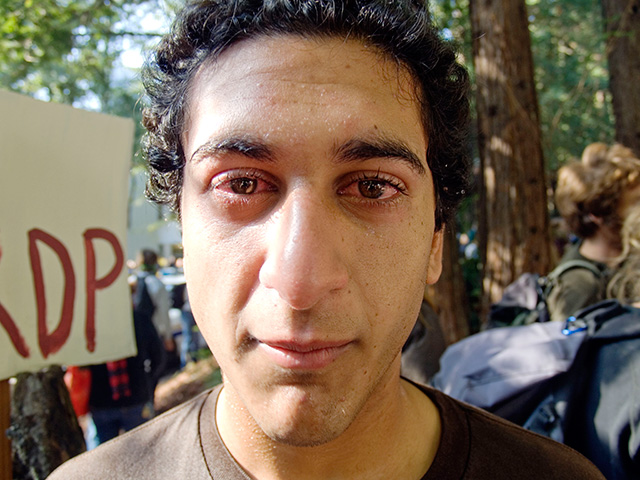
Oh, wow. Now everyone should be totally convinced. Two pictures of guys with red eyes; and the white dude, we are assured, is Persian/Pakastani (sic). It's a veritable cornucopia of ethnicity up there at the tree-sit. Could there possibly be other reasons their eyes might be red?
Tell me again why we aren't hiding the comments of the baiters and trolls?
When Indymedia comments becomes little more than dismissals and personal attacks, with no actual meaningful disucssion, I suppose I and many other people will stop reading Indymedia.
I'm already getting tired of it.
When Indymedia comments becomes little more than dismissals and personal attacks, with no actual meaningful disucssion, I suppose I and many other people will stop reading Indymedia.
I'm already getting tired of it.
Tim, Robert and Becky are among the people that feel it would be censorship to delete the negative vibes. They feel that, instead of being a radical, grassroots, independent news resource for community-based activists working against the state and corporate media, SC-IMC needs to be another soap box for Robert and Becky to dominate and dictate (and spread lies and exaggerations) and an easy medium for baiters and trolls working to fragment all social justice movements.
Tell me again why we aren't hiding the comments of the baiters and trolls?
It looks like just another of the many hough achievements.
Tell me again why we aren't hiding the comments of the baiters and trolls?
It looks like just another of the many hough achievements.
The simple points of the closing portion of this string are (1) that the tree sit is dominantly white kids whose desired effect is to curtail educational opportunities for those who haven't already arrived; and (2) the best efforts to show that it's not mostly white people are downright hilarious. But, it appears that all dissent from the prevailing paradigm MUST be shut down. Alternative viewpoints cannot, and should not be tolerated--they are far too dangerous! We always become what we hate, don't we? Just go stand by the border and yell "no more may enter--it will ruin our special place!"
Rico asks why the comments by "baiters" aren't being "hidden"? Dang, that's scary. That sounds just like what the establishment press is purported to do to dissenting voices. In which case, how would Indy be any different than the mainstream, or have any credibility?
I think Herrera raised a valid issue: the tree protesters are primarily white, and he feels that growth will benefit the educational opportuniteis of POC. To see someone refute that by posting pix of 2 individual POC to counter his statement smacks of tokenism to me.
(And even then, it wouldn't refute his point; he says that inhibiting growth inhibits the ability of POC to get into the school. Showing a picture of a POC who already got in but now wants growth to stop doesn't negate his point.)
I raised this same point in Nov. on Indy, and pointed out that the crowd appeared to be about 95% white, while the campus population overall is less than 50%. I agree with Herrera; the tree sitters and their supporters appear to be primarily white students, and not demographically representative of the student body that comprises UCSC. And I think that turning the argurment into "trees good - growth bad" oversimplifies the situation.
I think Herrera raised a valid issue: the tree protesters are primarily white, and he feels that growth will benefit the educational opportuniteis of POC. To see someone refute that by posting pix of 2 individual POC to counter his statement smacks of tokenism to me.
(And even then, it wouldn't refute his point; he says that inhibiting growth inhibits the ability of POC to get into the school. Showing a picture of a POC who already got in but now wants growth to stop doesn't negate his point.)
I raised this same point in Nov. on Indy, and pointed out that the crowd appeared to be about 95% white, while the campus population overall is less than 50%. I agree with Herrera; the tree sitters and their supporters appear to be primarily white students, and not demographically representative of the student body that comprises UCSC. And I think that turning the argurment into "trees good - growth bad" oversimplifies the situation.
Let's keep in mind that yes, UCSC is mostly compromised of white students so obviously there has been mostly white students supporting the students. However, there are student orgs on campus that want to be involved in some sort of resistance to the current draft of the LRDP, many of them being ethnic orgs such as Mecha (Chicano/a Student Movement of Aztlan)
***Mostly white students supporting the current methods of resistance (rally and tree sit)
UCSC's student demographics are available on the UCSC web-site--current student population is 51% white, as of the third week of fall quarter 2007. "The truth is sometimes uncomfortable" is spot-on.
We are 100% volunteer and depend on your participation to sustain our efforts!
Donate

$110.00 donated
in the past month
Get Involved
If you'd like to help with maintaining or developing the website, contact us.
Publish
Publish your stories and upcoming events on Indybay.
Topics
More
Search Indybay's Archives
Advanced Search
►
▼
IMC Network