







 Publish to Newswire
 Add an Event
PeaceTalks: FCC Chairman proposes relaxing ban on cross ownership rules in major markets
FCC Chairman Kevin Martin has portrayed his new media ownership rules as a “compromise” that would only remove the cross-ownership ban in the 20 largest media markets. However, a closer reading of the actual rule changes makes it clear that any company wanting to break the cross-ownership rule and form a combination of local TV stations and newspapers in any market needs only to apply for a “waiver.”
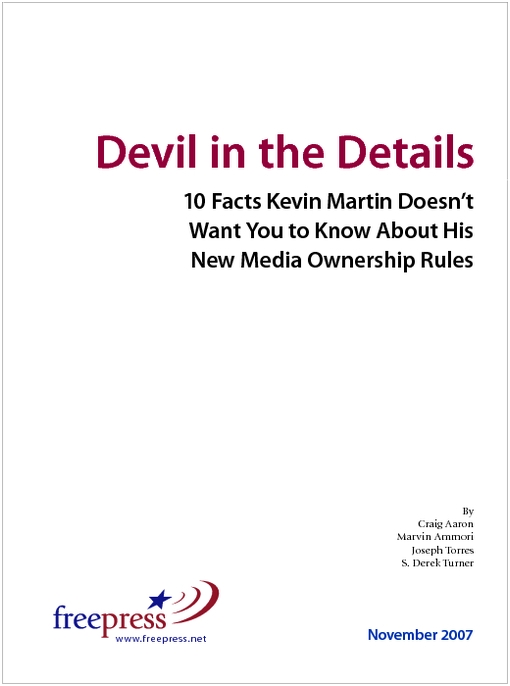
Over the next two weeks at StopBigMedia.com, we’ll be counting down the “10 Facts Kevin Martin Doesn’t Want You to Know” about his new media ownership rules, as exposed in our new report — Devil in the Details.
Fact No.2: Loopholes Open the Door to Cross-Ownership in any Market
To appreciate just how dramatically the standards would be relaxed under Martin’s new rules, consider that under the existing rules permanent waivers almost never have been issued. Since 1975, the FCC has granted permanent waivers just four times, and, in each instance, an outlet was at risk of going out of business entirely.
Under Martin’s new plan, however, cross-ownership is “presumed” to be in the public interest as long as it takes place in the top 20 markets; involves only one TV or radio station; at least eight other TV stations or “major” newspapers would remain after the deal; and the TV station is not among the four top-ranked stations in the market.
But that doesn’t prevent other mergers — potentially hundreds more — from taking place in smaller markets. In fact, such waiver requests will almost certainly be granted under the loose and vague language of Martin’s plan.
When the exception is the rule
That’s because there’s a giant loophole in the language of Martin’s proposal. In all markets outside the 20 largest, cross-ownership would be “presumed” unlawful. But the new waiver standard is so lax and ambiguous that it’s almost toothless.
When issuing unlimited permanent waivers, according to the text of the “proposed change” included with Martin’s press release, the FCC can still consider several factors (which themselves raise more than a few follow-up questions):
- Whether the company “will increase the local news disseminated through the affected media outlets in combination.” (Does that mean 10 minutes of news a day? a week? a year?)
- If each of the outlets would still “exercise its own independent news judgment.” (How much collaboration is too much?)
- How concentrated the market would become. (What measurement would the FCC use?)
- The newspaper’s “financial condition” and whether it’s in “distress.” (Does this mean a paper would have to be going out of business or just have had a bad year?)
Martin’s proposal outlines no benchmarks or process of verification. The first two criteria are so vague they could be met by any applicants who cross their hearts and promise to do more news. Once cross-ownership is permitted, there’s no way for the FCC to hold the companies accountable.
Furthermore, there’s no definition of which measure of concentration the FCC would use. It could be the “eight voices test” that the agency is applying to the top 20 markets, meaning that at least eight independently owned and operated full-power TV stations and major newspapers (with at least 5 percent of the market share) would remain after the outlets combined. This standard would allow mergers in hundreds of markets.
Finally, the standard of “financial distress” is incredibly vague. Previously, permanent waivers were only granted if an outlet was bankrupt and about to close its doors. But Martin’s murky language suggests a lowered bar. Would a bad quarter or two pave the way to more consolidation? With this loophole, it might.
Burden of proof
To stop a merger in the top 20 markets under Martin’s scheme, the burden of proof would rest with those opposing the deal. They would have to show that the proposed combination didn’t meet these criteria.
Outside the top 20 markets, the burden of proof would rest with a company’s lawyers, but the companies would control all the information and could make promises that would be almost impossible to enforce. Average citizens don’t have the resources to prove whether companies will increase news a little bit, and they would have a hard time accounting for claims of “financial distress.”
The bottom line: The waiver standard is so loose that cross-ownership in almost every market could be approved by the FCC.
Tomorrow: Loopholes open the door to cross-ownership in any market.

Donate

$110.00 donated
in the past month
Get Involved
If you'd like to help with maintaining or developing the website, contact us.
Publish
Publish your stories and upcoming events on Indybay.