







 Publish to Newswire
 Add an Event
From the Open-Publishing Calendar
From the Open-Publishing Newswire
Indybay Feature
Santa Cruz Indymedia
Education & Student Activism
Government & Elections
Health, Housing & Public Services
CDFA will spray your home with a biochemical pesticide. Nov 4-9
A flyer for your neighbors

CDFA will spray your home with a biochemical pesticide. Nov 4-9
Spraying will be from 8pm- 5am. It is advised you do not go outside. The spray will be released at
400 feet above the ground via airplane. It will come down like rain. Pets and their bedding should be
removed from the spray. Clothes that are left outside should be cleaned before use.
This spray is a new product and every caution should be used to avoid contact.
There are health forms, spray zone maps and additional information available at:
http://www.LBAMSPRAY.info
Spraying will be from 8pm- 5am. It is advised you do not go outside. The spray will be released at
400 feet above the ground via airplane. It will come down like rain. Pets and their bedding should be
removed from the spray. Clothes that are left outside should be cleaned before use.
This spray is a new product and every caution should be used to avoid contact.
There are health forms, spray zone maps and additional information available at:
http://www.LBAMSPRAY.info
Add Your Comments
Comments
(Hide Comments)

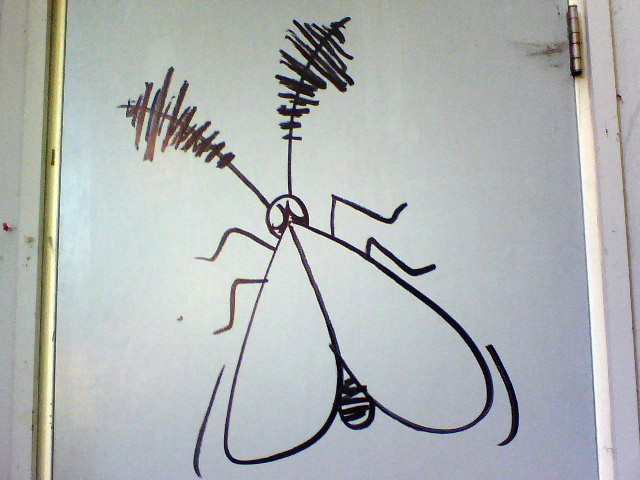

I'm declaring the First Annual Santa Cruz High Kite Flying and Balloon Release Day. This will be the same days as the aerial spraying and will create an airspace to dangerous to fly in. Get you helium and kites ready and buy some extra string!!!
For more information:
http://www.santacruzsentinel.com/archive/2...
yep, the whole problem with this is that if there were a spraying technique involving trucks going along spraying, everyone could go find the truck. Here, all you can do is shake a cane or your fist at the airplane flying overhead.
One thing to keep in mind is the extensive high-strength pesticides involved in regular Watsonville area agriculture, particularly strawberries. They typically have expendible workers applying this stuff, and if we demonstrate about the moth spraying, we should be putting some energy into the south county stuff as well. I was visiting a friend's farm plot (where they do all the work themselves, except a mowing task), and there was a scent in the air. Looking over, a worker was applying pesticide at a neighboring rice field, and it was so windy that it all was blowing over. A few days later, all the various butterflies and insects were dead on their land. My friend went over to tell him to stop it, and it was a worker with weak english skills, and the owner had given him a white suit to wear, but he had no gloves or mask. This was ridiculous, because your clothing would provide you the same protection as this suit, but it would be via inhalation or getting it on ones hands that you would be poisoned.
One thing to keep in mind is the extensive high-strength pesticides involved in regular Watsonville area agriculture, particularly strawberries. They typically have expendible workers applying this stuff, and if we demonstrate about the moth spraying, we should be putting some energy into the south county stuff as well. I was visiting a friend's farm plot (where they do all the work themselves, except a mowing task), and there was a scent in the air. Looking over, a worker was applying pesticide at a neighboring rice field, and it was so windy that it all was blowing over. A few days later, all the various butterflies and insects were dead on their land. My friend went over to tell him to stop it, and it was a worker with weak english skills, and the owner had given him a white suit to wear, but he had no gloves or mask. This was ridiculous, because your clothing would provide you the same protection as this suit, but it would be via inhalation or getting it on ones hands that you would be poisoned.
I just called the city, the governor's office and the pesticide company Suterra, makers of the shit that they will be bombing our houses with. Now I think it's time to think about some direct action. I've been trying to find out where the planes will be taking off from, with no luck. We could potentially shut down the airport.
This is a serious chemical, and I feel that it's an aerial assault on our community and should be met with nonviolent force.
This is a serious chemical, and I feel that it's an aerial assault on our community and should be met with nonviolent force.
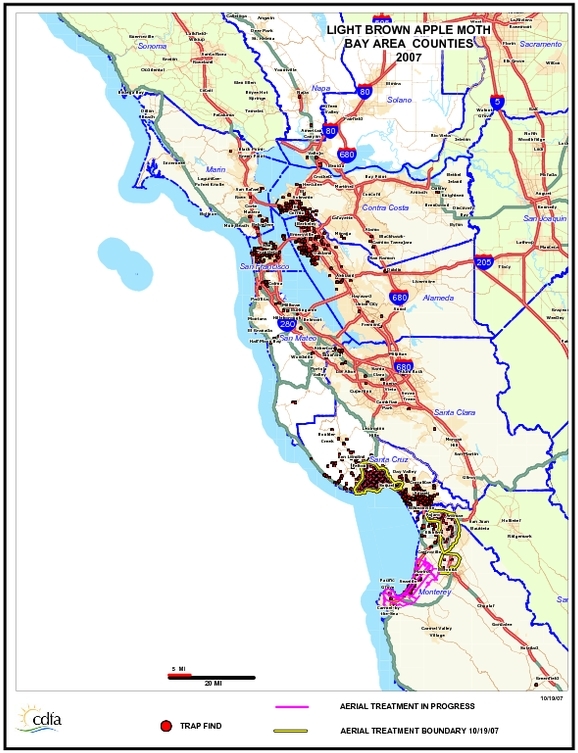
doesn't that map sort of suggest that they will try to spray San Francisco and Oakland soon? Why does this moth like to hang out near progressive centers - perhaps they have apple trees.
Balloons that are released end up in the ocean, where they kill turtles, birds and other critters that mistake them for food. I completely understand your outrage at the spraying (don't live in Santa Cruz anymore) but please don't think of releasing balloons as a good idea.
Administrative Message
November 2, 2007
Re: Updated information for UCSC community about apple moth aerial spraying
The California Department of Food and Agriculture (CDFA) continues to make plans to conduct aerial spraying of pheromone in Santa Cruz County as part of a program to eradicate the light brown apple moth. Applications are scheduled in Santa Cruz County on November 4 to 9.
For updated information about the project and for maps identifying the areas in which the night-time treatments will occur, please go to:
http://www.cdfa.ca.gov/phpps/PDEP/lbam/lbam_main.html.
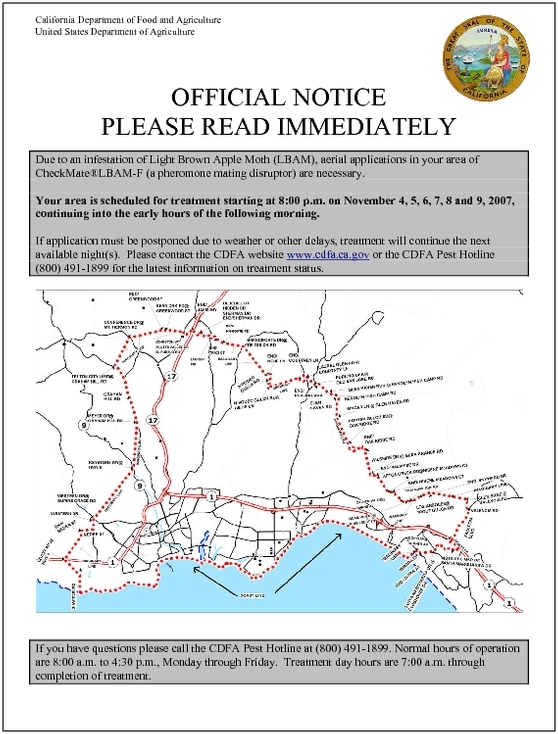
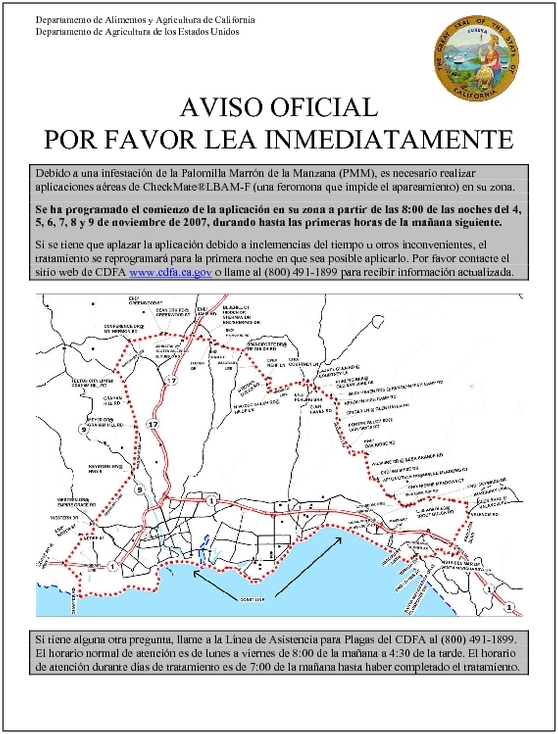
You may also download in English and in Spanish the currently posted Santa Cruz area treatment map. This map indicates that the Lower Campus (e.g., Faculty Housing, Cook House, Granary, Carriage House, Facilities, Police, and Parking) is in the treatment zone. So are UCSC operations in some off-campus locations (e.g., UCSC offices on Delaware Avenue).
As indicated on the currently posted Santa Cruz area treatment map, people who have questions about the affected areas and treatment schedule should call the CDFA Pest Hotline at (800) 491-1899.
The following e-mail was distributed to all UCSC students and posted in the Oct. 29-Nov. 4 edition of Currents Online for all members of the UCSC community:
October 23, 2007
To: UCSC Students
Fr: UCSC Office of Public Affairs
Re: Information about moth spraying
As you may already know, the California Department of Food and Agriculture (CDFA) is planning pheromone applications for the Santa Cruz area as part of a program to eradicate the light brown apple moth, a pest that damages crops and other plants. Insects use pheromones to attract mating partners, and the spraying is intended to prevent the moths from reproducing. Applications are scheduled in Santa Cruz County from November 4 to 9.
Information about the Light Brown Apple Moth Eradication Program is available on the CDFA web site at: http://www.cdfa.ca.gov/phpps/PDEP/lbam/lbam_main.html
Please feel free to share this information with any family members who may have concerns about the spraying.
In addition to the eradication program web site, above, the CDFA has provided the following as a "contact" e-mail address for people seeking more information: lbam [at] cdfa.ca.gov
November 2, 2007
Re: Updated information for UCSC community about apple moth aerial spraying
The California Department of Food and Agriculture (CDFA) continues to make plans to conduct aerial spraying of pheromone in Santa Cruz County as part of a program to eradicate the light brown apple moth. Applications are scheduled in Santa Cruz County on November 4 to 9.
For updated information about the project and for maps identifying the areas in which the night-time treatments will occur, please go to:
http://www.cdfa.ca.gov/phpps/PDEP/lbam/lbam_main.html.
You may also download in English and in Spanish the currently posted Santa Cruz area treatment map. This map indicates that the Lower Campus (e.g., Faculty Housing, Cook House, Granary, Carriage House, Facilities, Police, and Parking) is in the treatment zone. So are UCSC operations in some off-campus locations (e.g., UCSC offices on Delaware Avenue).
As indicated on the currently posted Santa Cruz area treatment map, people who have questions about the affected areas and treatment schedule should call the CDFA Pest Hotline at (800) 491-1899.
The following e-mail was distributed to all UCSC students and posted in the Oct. 29-Nov. 4 edition of Currents Online for all members of the UCSC community:
October 23, 2007
To: UCSC Students
Fr: UCSC Office of Public Affairs
Re: Information about moth spraying
As you may already know, the California Department of Food and Agriculture (CDFA) is planning pheromone applications for the Santa Cruz area as part of a program to eradicate the light brown apple moth, a pest that damages crops and other plants. Insects use pheromones to attract mating partners, and the spraying is intended to prevent the moths from reproducing. Applications are scheduled in Santa Cruz County from November 4 to 9.
Information about the Light Brown Apple Moth Eradication Program is available on the CDFA web site at: http://www.cdfa.ca.gov/phpps/PDEP/lbam/lbam_main.html
Please feel free to share this information with any family members who may have concerns about the spraying.
In addition to the eradication program web site, above, the CDFA has provided the following as a "contact" e-mail address for people seeking more information: lbam [at] cdfa.ca.gov
For more information:
http://messages.ucsc.edu/text.asp?pid=1710
We are 100% volunteer and depend on your participation to sustain our efforts!
Donate

$110.00 donated
in the past month
Get Involved
If you'd like to help with maintaining or developing the website, contact us.
Publish
Publish your stories and upcoming events on Indybay.
Topics
More
Search Indybay's Archives
Advanced Search
►
▼
IMC Network