







 Publish to Newswire
 Add an Event
From the Open-Publishing Calendar
From the Open-Publishing Newswire
Indybay Feature
Delta Flows: Schwarzenegger Pushes Dangerous Amendments to Perata's Water Bond Proposal
Governor Arnold Schwarzenegger, the "Fish Terminator," is pushing amendments to Senator Don Perata's water bond proposal that would authorize the construction of a peripheral canal to divert fresh water from the California Delta to water developers and agribusiness. Schwarzenegger's proposal would also strip the Delta of "Area of Origin" water user rights, opening Sacramento-San Joaquin Delta water to increasing water exports.
The Governor's dangerous proposal must be defeated because it would result in the destruction of a Delta already in severe ecological crisis. Four species of Delta pelagic species - delta smelt, longfin smelt, juvenile striped bass and threadfin shad - are in a precipitous decline resulting from increased water exports in recent years. Chinook salmon, steelhead, white sturgeon, green sturgeon, striped bass and other species are also imperiled by increasing water diversions. The last thing that the Delta needs now is more water exports at a time when saving the estuary's ecosystem depends upon reducing, not increasing, water diversions.
The Governor's dangerous proposal must be defeated because it would result in the destruction of a Delta already in severe ecological crisis. Four species of Delta pelagic species - delta smelt, longfin smelt, juvenile striped bass and threadfin shad - are in a precipitous decline resulting from increased water exports in recent years. Chinook salmon, steelhead, white sturgeon, green sturgeon, striped bass and other species are also imperiled by increasing water diversions. The last thing that the Delta needs now is more water exports at a time when saving the estuary's ecosystem depends upon reducing, not increasing, water diversions.
Delta Flows – Weekly Highlights from Restore the Delta for the Week of October 15, 2007
“Why, sir, most schemes of political improvement are very laughable things.”
--Samuel Johnson
The Governor, the Senate President pro Tem, the San Joaquin County Board of Supervisors, and Dying Fish in Stockton Waterways
Restore the Delta staff has been monitoring how the two special session water bonds SB2xx (Perata) and SB3xx (Cogdill), which were both defeated in the State Senate last week, will be repackaged and offered up to voters as initiatives in the months to come.
To date, we have heard mostly through the media that Senate President pro Tem, Don Perata, has suggested that specific surface water storage projects could be named and incorporated into his bond proposal. To date, this specific change seems to be all the Senate President pro Tem is willing to alter within his bond proposal.
However, new language, being pushed by Governor Schwarzenegger’s office as amendments to Senator Perata’s bond proposal, echoes what we found to be disturbing in Senator Cogdill’s SB 3xx. (Delta Flows readers will remember that Restore the Delta opposed Senator Cogdill’s bond proposal as it contained language giving authorization for funding the construction of an alternative conveyance system to divert fresh water away from entering the Delta.)
Restore the Delta Board Member, and Planning and Conservation League Water Expert, Mindy McIntyre, recently shared the following information regarding the Governor’s proposed amendments with Restore the Delta staff. (Comments in brackets and italics are information and commentary additions from Restore the Delta.)
-- The area of origin language explicitly excludes the Delta. (Laws pertaining to area of origin protect water user rights within California.) You can guess why the Governor would want to strip the Delta of Area of Origin. In addition, the language states that the area of origin as established in the bill (excluding the Delta) would have to have a two-thirds vote of the legislature to change or repeal. That would be nearly impossible. (In other words, if this language were to slide by voters in a bond initiative it would be nearly impossible to change or alter this language to protect local Delta water users through the legislative process.)
--The proposed language from the Governor’s office states that the Department Water Resources (DWR) has the existing authority to “implement” a conveyance and sustainability solution. Such language would become law and actually give DWR the authority to build the peripheral canal or pipe without legislative oversight. (Again, the Governor is seeking to work around rather than with the Delta Vision Process which he mandated.)
--The Governor strikes out important language in the Bay Delta Conservation Plan (BDCP) section. Essentially, the Governor’s amendments would eliminate the need for the BDCP to comply with California Endangered Species Act. This is important because it implies that BDCP will just be used like the Environmental Water Account and other “restoration” programs. Essentially these programs, rather than restoring the Delta, are used to set a (minimum) baseline level of (water) resources, and if the Delta, (a flexible ecosystem) needs more fresh water, then too bad. (Delta fresh water allocations would be set as static, when current science and water export records indicate that a good part of the Delta’s ecosystem problems have resulted from too much water being pumped out of the Delta in dry years. In addition, we once again see the Governor seeking to bypass working collaboratively with Delta stakeholders and environmental groups.)
Ms. McIntyre added, “The people in the Delta should know that this is what the Governor is pushing. Everyone else is focused on the dams, but this language would setup the final collapse of the Delta.”
Fortunately, Local Government Entities Are Stepping Up To Advocate For The Delta
At last week’s Natural Resources & Water Committee Hearing on the proposed water bonds by Senator Perata (SB2x) and Senator Cogdill (SB3x), San Joaquin County Supervisor Ken Vogel testified to the committee on the Board’s opposition to a peripheral canal or conveyance system, and the harm that it would bring to the Delta and San Joaquin County.
In fact, the San Joaquin County Board of Supervisors is one of the first local government entities within the Delta to recognize the threat that is being made to our community and to make such a formal statement in opposition to the peripheral canal. Moreover, the Board of Supervisors proclaimed their support for Tom Zuckerman’s plan for Regional Water Self-Sufficiency – one of the alternative visions for the Delta offered to the Blue Ribbon Task Force heading up the Delta Vision Process – a plan that Restore the Delta agrees would help to lessen water dependency on the Delta by other regions throughout the state.
Restore the Delta applauds the San Joaquin County Board of Supervisors for making their position on this critical Delta issue known, and encourages other local government entities throughout the Delta to make similar statements and proclamations regarding their opposition to the peripheral canal/pipe public. We are also encouraging local Delta stakeholders to begin working with local government entities to help bring about the creation of such public statements.
And While We All Talk, The Fish Keep Dying…
While the Restore the Delta campaign advocates primarily to restore and protect fresh water levels passing through the Delta, and maintains that adequate fresh water will do a great deal to help restore the Delta’ ecosystem, we are also concerned about pollutants that also degrade water quality. Restore the Delta affirms that not one industry or group is responsible for the degradation of Delta water quality. But rather, it is a collective problem that we need to solve together through cooperation, dialogue, and positive action with a sense of urgency.
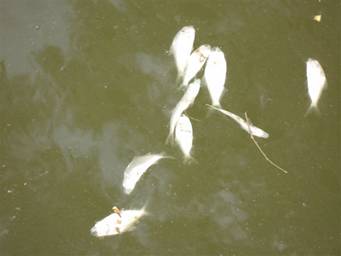
With that said, our friend and supporter, Bill Maxwell, who lives on Smith Canal sent us a disturbing series of pictures last week. After the first rain each autumn, the fish in their part of the Delta die. We have no commentary to add, as these pictures speak to us directly as to what is wrong with the Delta. But, as one child of Restore the
Delta staff asked, “Will there by any fish left?”
Barbara Barrigan-Parrilla
Campaign Director
Restore the Delta
Making the Delta fishable, swimmable, drinkable, and farmable by 2010!
Barbara [at] restorethedelta.org
http://www.restorethedelta.org
ph: 209-479-2053
PO Box 691088
Stockton, CA 95269
“Why, sir, most schemes of political improvement are very laughable things.”
--Samuel Johnson
The Governor, the Senate President pro Tem, the San Joaquin County Board of Supervisors, and Dying Fish in Stockton Waterways
Restore the Delta staff has been monitoring how the two special session water bonds SB2xx (Perata) and SB3xx (Cogdill), which were both defeated in the State Senate last week, will be repackaged and offered up to voters as initiatives in the months to come.
To date, we have heard mostly through the media that Senate President pro Tem, Don Perata, has suggested that specific surface water storage projects could be named and incorporated into his bond proposal. To date, this specific change seems to be all the Senate President pro Tem is willing to alter within his bond proposal.
However, new language, being pushed by Governor Schwarzenegger’s office as amendments to Senator Perata’s bond proposal, echoes what we found to be disturbing in Senator Cogdill’s SB 3xx. (Delta Flows readers will remember that Restore the Delta opposed Senator Cogdill’s bond proposal as it contained language giving authorization for funding the construction of an alternative conveyance system to divert fresh water away from entering the Delta.)
Restore the Delta Board Member, and Planning and Conservation League Water Expert, Mindy McIntyre, recently shared the following information regarding the Governor’s proposed amendments with Restore the Delta staff. (Comments in brackets and italics are information and commentary additions from Restore the Delta.)
-- The area of origin language explicitly excludes the Delta. (Laws pertaining to area of origin protect water user rights within California.) You can guess why the Governor would want to strip the Delta of Area of Origin. In addition, the language states that the area of origin as established in the bill (excluding the Delta) would have to have a two-thirds vote of the legislature to change or repeal. That would be nearly impossible. (In other words, if this language were to slide by voters in a bond initiative it would be nearly impossible to change or alter this language to protect local Delta water users through the legislative process.)
--The proposed language from the Governor’s office states that the Department Water Resources (DWR) has the existing authority to “implement” a conveyance and sustainability solution. Such language would become law and actually give DWR the authority to build the peripheral canal or pipe without legislative oversight. (Again, the Governor is seeking to work around rather than with the Delta Vision Process which he mandated.)
--The Governor strikes out important language in the Bay Delta Conservation Plan (BDCP) section. Essentially, the Governor’s amendments would eliminate the need for the BDCP to comply with California Endangered Species Act. This is important because it implies that BDCP will just be used like the Environmental Water Account and other “restoration” programs. Essentially these programs, rather than restoring the Delta, are used to set a (minimum) baseline level of (water) resources, and if the Delta, (a flexible ecosystem) needs more fresh water, then too bad. (Delta fresh water allocations would be set as static, when current science and water export records indicate that a good part of the Delta’s ecosystem problems have resulted from too much water being pumped out of the Delta in dry years. In addition, we once again see the Governor seeking to bypass working collaboratively with Delta stakeholders and environmental groups.)
Ms. McIntyre added, “The people in the Delta should know that this is what the Governor is pushing. Everyone else is focused on the dams, but this language would setup the final collapse of the Delta.”
Fortunately, Local Government Entities Are Stepping Up To Advocate For The Delta
At last week’s Natural Resources & Water Committee Hearing on the proposed water bonds by Senator Perata (SB2x) and Senator Cogdill (SB3x), San Joaquin County Supervisor Ken Vogel testified to the committee on the Board’s opposition to a peripheral canal or conveyance system, and the harm that it would bring to the Delta and San Joaquin County.
In fact, the San Joaquin County Board of Supervisors is one of the first local government entities within the Delta to recognize the threat that is being made to our community and to make such a formal statement in opposition to the peripheral canal. Moreover, the Board of Supervisors proclaimed their support for Tom Zuckerman’s plan for Regional Water Self-Sufficiency – one of the alternative visions for the Delta offered to the Blue Ribbon Task Force heading up the Delta Vision Process – a plan that Restore the Delta agrees would help to lessen water dependency on the Delta by other regions throughout the state.
Restore the Delta applauds the San Joaquin County Board of Supervisors for making their position on this critical Delta issue known, and encourages other local government entities throughout the Delta to make similar statements and proclamations regarding their opposition to the peripheral canal/pipe public. We are also encouraging local Delta stakeholders to begin working with local government entities to help bring about the creation of such public statements.
And While We All Talk, The Fish Keep Dying…
While the Restore the Delta campaign advocates primarily to restore and protect fresh water levels passing through the Delta, and maintains that adequate fresh water will do a great deal to help restore the Delta’ ecosystem, we are also concerned about pollutants that also degrade water quality. Restore the Delta affirms that not one industry or group is responsible for the degradation of Delta water quality. But rather, it is a collective problem that we need to solve together through cooperation, dialogue, and positive action with a sense of urgency.
With that said, our friend and supporter, Bill Maxwell, who lives on Smith Canal sent us a disturbing series of pictures last week. After the first rain each autumn, the fish in their part of the Delta die. We have no commentary to add, as these pictures speak to us directly as to what is wrong with the Delta. But, as one child of Restore the
Delta staff asked, “Will there by any fish left?”
Barbara Barrigan-Parrilla
Campaign Director
Restore the Delta
Making the Delta fishable, swimmable, drinkable, and farmable by 2010!
Barbara [at] restorethedelta.org
http://www.restorethedelta.org
ph: 209-479-2053
PO Box 691088
Stockton, CA 95269
Add Your Comments
Comments
(Hide Comments)
Rubbish. The Delta's problem is rubbish, too much pollution. The solution is not dilution, more and more water for less and less fish. The Solution is less Pollution.
I'm convinced the cause of the Bay Area Delta's crisis is simply too many people in too small an area using too many harmful chemicals. If you really want to save the Delta, Plan A is for you to MOVE! And take your house and business with you. If you can't or won't do that, then we must go to Plan B: Use less harmful chemicals. "Who, me? I'm using harmful chemicals?" Yes, you!
Most people today just don't realize how harmful our common useful chemicals are to our native fish. Take ethylene glycol for instance, the ordinary anti-freeze you use in your car. A single drop will kill a whole aquarium of many different kinds of fish. A few grams will kill a large animal within days. Thousands of children were even killed this year in and around Panama by a stupid, greedy, Chinese businessman who replaced the expensive glycerine sweetener in children's cough syrup with the much cheaper ethylene glycol. Other stupid Chinese manufactures were even using it to sweeten toothpaste!
My point is, 50 years ago nobody in warmer climates like California used ethylene glycol in their radiators. They just used water and were careful in very cold weather. Today everyone uses antifreeze, and we have many, many millions more cars. When you add motor oil and transmission fluid to the mix, in concentrated areas like around the Bay, it's a big problem.
But simply flushing the Bay with more and more water won't fix it. Your Bill Maxwell's observation is exactly right, "After the first rain each autumn, the fish in their part of the Delta die." The problem is that all summer long in the cities surrounding the Bay cars drop anti-freeze, motor oil, and trans fluid onto the highways. When the first rains hit, it all washes into the streams. The result: Toxic Shock.
So what's this pollution solution? The first thing I'd like to see is ethylene glycol replaced with a harmless substitute. There must be many benign substances that can be used to lower the freezing point of water in our radiators. It's time to find them and use them. Oil bath engines and transmissions will take much longer to phase out, but it will be done eventually. The ultimate automobile pollution solution may simply be all electric based cars, like the new one from Tesla Motors in South San Francisco. In the mean time, cities around the Bay should be looking at collecting and treating most of our storm drain runoff, especially in the first few hours of rainstorms.
I'm convinced the cause of the Bay Area Delta's crisis is simply too many people in too small an area using too many harmful chemicals. If you really want to save the Delta, Plan A is for you to MOVE! And take your house and business with you. If you can't or won't do that, then we must go to Plan B: Use less harmful chemicals. "Who, me? I'm using harmful chemicals?" Yes, you!
Most people today just don't realize how harmful our common useful chemicals are to our native fish. Take ethylene glycol for instance, the ordinary anti-freeze you use in your car. A single drop will kill a whole aquarium of many different kinds of fish. A few grams will kill a large animal within days. Thousands of children were even killed this year in and around Panama by a stupid, greedy, Chinese businessman who replaced the expensive glycerine sweetener in children's cough syrup with the much cheaper ethylene glycol. Other stupid Chinese manufactures were even using it to sweeten toothpaste!
My point is, 50 years ago nobody in warmer climates like California used ethylene glycol in their radiators. They just used water and were careful in very cold weather. Today everyone uses antifreeze, and we have many, many millions more cars. When you add motor oil and transmission fluid to the mix, in concentrated areas like around the Bay, it's a big problem.
But simply flushing the Bay with more and more water won't fix it. Your Bill Maxwell's observation is exactly right, "After the first rain each autumn, the fish in their part of the Delta die." The problem is that all summer long in the cities surrounding the Bay cars drop anti-freeze, motor oil, and trans fluid onto the highways. When the first rains hit, it all washes into the streams. The result: Toxic Shock.
So what's this pollution solution? The first thing I'd like to see is ethylene glycol replaced with a harmless substitute. There must be many benign substances that can be used to lower the freezing point of water in our radiators. It's time to find them and use them. Oil bath engines and transmissions will take much longer to phase out, but it will be done eventually. The ultimate automobile pollution solution may simply be all electric based cars, like the new one from Tesla Motors in South San Francisco. In the mean time, cities around the Bay should be looking at collecting and treating most of our storm drain runoff, especially in the first few hours of rainstorms.
Even if the pollution inputs of the delta were reduced to zero (a noble & worthy cause indeed), the delta smelt would likely continue to decline towards extinction if water exports from delta continued as current high volumes..
Salinity factors in alongside the dangerous pumps in the decline of delta smelt populations. Increased water exports out of the delta results in less fresh rio agua available to keep out the intrusions of excess salininty from sea water. Delta smelt require a mixture of fresh water that has lower levels of salinity. The current level of fresh water exports out of the delta has caused conditions as a reversal of the flow of the San Joaquin River. As the river flows backwards, there is openings in the delta for greater volumes of sea water and resulting increase in salinity..
"Throughout most of their lifespan, delta smelt inhabit low salinity habitat at the interface of inflowing fresh water from the Sacramento and San Joaquin Rivers and salt water from the Pacific Ocean.
Water diversions by the State Water Project, the federal Central Valley Project and private diversions in the Delta and its Sacramento and San Joaquin River watersheds take as much as 65 percent of the Delta’s total freshwater inflow during periods when the delta smelt population is distributed in the Delta. At times, pumping levels are so high they reverse the flow of the San Joaquin River, confusing and delaying up-migrating adult fish and impairing downstream transport of larval and juvenile delta smelt from the upper estuary where they were spawned to their brackish water rearing habitat."
more info @;
http://www.biologicaldiversity.org/swcbd/SPECIES/deltasmelt/index.html
So yes, pollution is indeed a problem, though lack of available fresh water in the delta is a significant problem. Salt water intrusion for longer periods of time (outside of normal summer season of increased salinity) is evidence of the problems caused by lack of fresh water outflow into the delta. This same situation of hypersalinity from excessive freshwater exports also occurs in the Gulf of the Colorado (Baja, MX) delta. Any natural fluctuations of the delta's salinity are amplified by lack of fresh water..
"However, salinity intrusion from the ocean or accumulation of minerals from farming discharged into Delta rivers remains a problem. The estuary generally becomes saltier during the summer and fall, but can be influenced in spring months when export pumps are running at full bore to capture runoff."
found @;
http://www.baydelta.org/salinity-agri-drainage.php
The steady and constant increase of fresh water flows into the delta will be the key ingredient to saving the delta smelt. This may not be what the agribusinesses of the valley want to hear, the truth seldom is very popular for corporations anyway..
Salinity factors in alongside the dangerous pumps in the decline of delta smelt populations. Increased water exports out of the delta results in less fresh rio agua available to keep out the intrusions of excess salininty from sea water. Delta smelt require a mixture of fresh water that has lower levels of salinity. The current level of fresh water exports out of the delta has caused conditions as a reversal of the flow of the San Joaquin River. As the river flows backwards, there is openings in the delta for greater volumes of sea water and resulting increase in salinity..
"Throughout most of their lifespan, delta smelt inhabit low salinity habitat at the interface of inflowing fresh water from the Sacramento and San Joaquin Rivers and salt water from the Pacific Ocean.
Water diversions by the State Water Project, the federal Central Valley Project and private diversions in the Delta and its Sacramento and San Joaquin River watersheds take as much as 65 percent of the Delta’s total freshwater inflow during periods when the delta smelt population is distributed in the Delta. At times, pumping levels are so high they reverse the flow of the San Joaquin River, confusing and delaying up-migrating adult fish and impairing downstream transport of larval and juvenile delta smelt from the upper estuary where they were spawned to their brackish water rearing habitat."
more info @;
http://www.biologicaldiversity.org/swcbd/SPECIES/deltasmelt/index.html
So yes, pollution is indeed a problem, though lack of available fresh water in the delta is a significant problem. Salt water intrusion for longer periods of time (outside of normal summer season of increased salinity) is evidence of the problems caused by lack of fresh water outflow into the delta. This same situation of hypersalinity from excessive freshwater exports also occurs in the Gulf of the Colorado (Baja, MX) delta. Any natural fluctuations of the delta's salinity are amplified by lack of fresh water..
"However, salinity intrusion from the ocean or accumulation of minerals from farming discharged into Delta rivers remains a problem. The estuary generally becomes saltier during the summer and fall, but can be influenced in spring months when export pumps are running at full bore to capture runoff."
found @;
http://www.baydelta.org/salinity-agri-drainage.php
The steady and constant increase of fresh water flows into the delta will be the key ingredient to saving the delta smelt. This may not be what the agribusinesses of the valley want to hear, the truth seldom is very popular for corporations anyway..
Interesting comment, Ms/Mr Delta Smelt Prefer, and it's certainly worth a try.
But permit me one crude anology. Simply flushing the Delta's toilet with ever more water, while at the same time dumping ever more polution into it, is doomed to fail.
The doom will be caused by the simple fact that the polution builds up all summer long, and is then flushed into the estuary all at once with the first rains. It's called toxic shock.
So I'll stick with the notion that the article's picture is worth a thousand words. You can flush it if you want, but as Bill Maxwell of Smith Canal observed, "After the first rain each autumn, the fish in [our] part of the Delta die."
The best solution is for you to move, Bill Maxwell, to a less environmentally sensitive area. And take your city with you.
If you won't do that, then stop using antifreeze.
But permit me one crude anology. Simply flushing the Delta's toilet with ever more water, while at the same time dumping ever more polution into it, is doomed to fail.
The doom will be caused by the simple fact that the polution builds up all summer long, and is then flushed into the estuary all at once with the first rains. It's called toxic shock.
So I'll stick with the notion that the article's picture is worth a thousand words. You can flush it if you want, but as Bill Maxwell of Smith Canal observed, "After the first rain each autumn, the fish in [our] part of the Delta die."
The best solution is for you to move, Bill Maxwell, to a less environmentally sensitive area. And take your city with you.
If you won't do that, then stop using antifreeze.
We are 100% volunteer and depend on your participation to sustain our efforts!
Donate

$140.00 donated
in the past month
Get Involved
If you'd like to help with maintaining or developing the website, contact us.
Publish
Publish your stories and upcoming events on Indybay.
Topics
More
Search Indybay's Archives
Advanced Search
►
▼
IMC Network