







 Publish to Newswire
 Add an Event
Australia: Climate Change to Hot for Bush and Howard
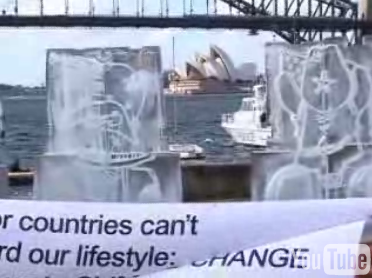
The ice sculptures (watch video)were made for Make Poverty History – a coalition of more than 60 aid agencies, community groups and religious organisations – to highlight its report on 'APEC: An End to Extreme Poverty – An Alternative APEC Agenda.' (PDF 1.1MB)
Make Poverty History co-chair, Andrew Hewett, said climate change is not simply an environmental or economic challenge. “It is a moral challenge, because those least responsible for causing the problem – the poorest people in the poorest countries of the world – will overwhelmingly pay the highest price as climate change begins to bite,” he said. “If Australia is serious about being a global leader as chair of APEC, we must do three things. First, join the rest of the international community in ratifying the Kyoto Protocol. Second, commit to deep cuts in greenhouse pollution. And third support the efforts of our neighbours and developing country partners in APEC to adapt to climate change and reduce poverty in an environmentally sustainable way.”
“It is clear that climate change is affecting the lives of the poorest people in our world. The monsoon season in our region and in South Asia has become shorter and more intense over the last decade, and so we can expect to see more people displaced by the kind of flooding we see right now in India, Pakistan, Nepal and Bangladesh. Crops are failing in the face of increasing temperatures and changing rainfall patterns. Millions of the poorest people in sub-Saharan Africa face water shortages. And sea level rise could potentially displace millions of people from small island nations in the Pacific, and low-lying coastal countries, over the next few decades.” “If we don’t get serious about tackling climate change, we won’t be talking about making poverty history, we’ll be making it permanent,” said Mr Hewett.
Australia and the US are the only two APEC countries that have not ratified the Kyoto Protocol. On a per capita basis, these countries are the largest APEC emitters of the greenhouse gas, carbon dioxide. Each year, Australians emit 18.8 tonnes of CO2 and Americans emit 20 tonnes per person. Developing country members of APEC have a much smaller climate impact. China’s per capita emissions of CO2 is 3.19 tonnes per year, while Vietnam’s is only 0.93 tonnes.
“Climate change is expected to substantially reduce freshwater availability in much of Asia, leading to widespread malnutrition and adversely affecting more than a billion people by the 2050s. In other places, more frequent flooding will lead to a large increase in deaths from diarrhoea and cholera,” warned Make Poverty History Co-Chair, Tim Costello.
“With projections that higher sea levels, floods and droughts could displace tens of millions of people, there is a risk of exacerbating tensions between different communities, precipitating territorial disputes and generating new waves of refugees. Put simply, if APEC takes its role to promote regional prosperity seriously, it must take swift, unified action to substantially reduce emissions and avert the worst effects of climate change.” Said Costello
Make Poverty History’s report further calls on APEC to adopt a poverty-reduction focus to its discussions of trade, human security and climate change.
Sources:
- Make Poverty History Media Release 6 Sep 2007 - Bush and Howard melting under climate change
- Make Poverty History Media Release 3 Sep 2007 - Risk of conflict, natural disasters and disease if APEC fails to act on climate change
- Youtube video by GreenpeaceAustralia, 6 Sep 2007 - Ice Sculptures
Donate

$110.00 donated
in the past month
Get Involved
If you'd like to help with maintaining or developing the website, contact us.
Publish
Publish your stories and upcoming events on Indybay.