







 Publish to Newswire
 Add an Event
Pentagon IG Report Details Central Role of Psychologists in Detainee Interrogations and Abuse
By STEPHEN SOLDZ
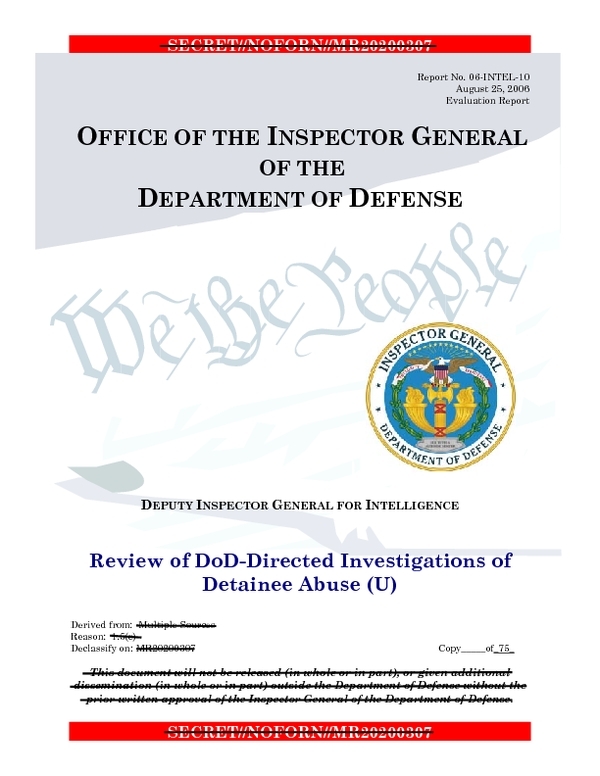
The Defense Department (DoD) has just declassified a report from their Inspector General (OIG) looking at the various investigations that the Department has conducted into repeated claims of detainee abuse--a.k.a. "torture" and "cruel, inhuman, or degrading treatment"--banned by international and United States law. The report documents that the various DoD "investigations were, individually and in total, inadequate:
Allegations of detainee abuse were not consistently reported, investigated, or managed in an effective, systematic, and timely manner. Multiple reporting channels were available for reporting allegations and, once reported, command discretion could be used in determining the action to be taken on the reported allegation. We did not identify any specific allegations that were not reported or reported and not investigated. Nevertheless, no single entity within any level of command was aware of the scope and breadth of detainee abuse.
SERE
Perhaps the most important information in this report, however, is that it provides further documentation that psychologists were central to the development of the abusive interrogation paradigm developed at Guantanamo and migrated to Abu Ghraib and other Iraqi prisons. In particular, the OIG provides concrete evidence that techniques developed in the US military's SERE (Survival, Evasion, Resistance, and Escape) program to help US troops at high risk of becoming POWs evade capture and resist breaking under abusive interrogations were systematically imported to Guantanamo and, less systematically, to Iraq and Afghanistan. As the report describes:
"DoD SERE training, sometimes referred to as code of conduct training, prepares select military personnel with survival and evasion techniques in case they are isolated from friendly forces. The schools also teach resistance techniques that are designed to provide U.S. military members, who may be captured or detained, with the physical and mental tools to survive a hostile interrogation and deny the enemy the information they wish to obtain. SERE training incorporates physical and psychological pressures, which act as counterresistance techniques, to replicate harsh conditions that the Service member might encounter if they are held by forces that do not abide by the Geneva Conventions." (p. 23)
As part of the SERE program, trainees are subjected to abuse, including sleep deprivation, sexual and cultural humiliation, and, in some instances, waterboarding, described by one SERE graduate thus:
"[Y]ou are strapped to a board, a washcloth or other article covers your face, and water is continuously poured, depriving you of air, and suffocating you until it is removed, and/or inducing you to ingest water. We were carefully monitored (although how they determined these limits is beyond me), but it was a most unpleasant experience, and its threat alone was sufficient to induce compliance, unless one was so deprived of water that it would be an unintentional means to nourishment.
Former Air Force officer and now psychoanalyst Eric Anders described his SERE training experience thusly:
"I remember a variety of sadistic abuses, often in the form of mind games and humiliation. It was a horrible experience, but I imagine it might have prepared me to be in the position some of the Iraqi prisoners have unfortunately found themselves in."
READ MORE
Donate

$95.00 donated
in the past month
Get Involved
If you'd like to help with maintaining or developing the website, contact us.
Publish
Publish your stories and upcoming events on Indybay.