







 Publish to Newswire
 Add an Event
From the Open-Publishing Calendar
From the Open-Publishing Newswire
Indybay Feature
Root Force in Watsonville: Take Down the System
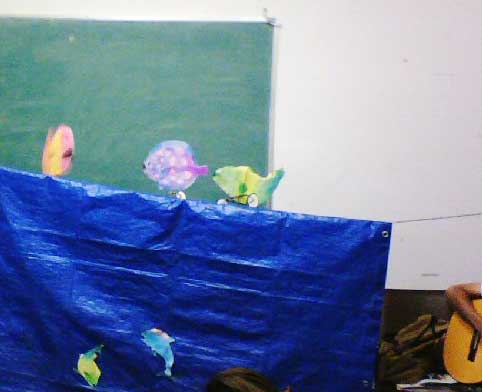
Root Force swept through Watsonville on Thursday night for the first stop of their tour through the greater Bay Area! Following a meeting of the Watsonville Brown Berets, Root Force gave a presentation on the direct action campaign in solidarity with communities in Guerrero, Mexico and San Salvador, the capital city of El Salvador, who are resisting massive infrastructure expansion projects which are causing ecological devastation, massive dislocation and cultural disruption. As advertised, the evening was very entertaining with live music, puppets (pictured below), an excerpt from a film and a slideshow.
We are armed with information and have no excuse to remain passive while our herman@s are fighting every single day for "sustainability," which in most of the world means only one thing, survival. Get creative. Think of what you can do to take down the system. These communities are fighting for survival; let's take strategic direct action to put some force behind our solidarity. We threaten systems of power when we take autonomous direct action.
Days of Action against La Parota Dam: May Day to Cinco de Mayo
We are armed with information and have no excuse to remain passive while our herman@s are fighting every single day for "sustainability," which in most of the world means only one thing, survival. Get creative. Think of what you can do to take down the system. These communities are fighting for survival; let's take strategic direct action to put some force behind our solidarity. We threaten systems of power when we take autonomous direct action.
Days of Action against La Parota Dam: May Day to Cinco de Mayo
The following is copied from Root Force, but you should check the website for much more information!
Root Force (Fuerza Raíz) is a campaign that recognizes the fundamental connection between the oppression of the Earth and the oppression of its people. The precursor to ecocide and genocide is the separation of people from the land so that both can be exploited. Thus Root Force is a biocentric campaign, asserting that no oppression can be overcome without addressing the relationship a society has with the Earth. To achieve either social or ecological justice, we must achieve both.
Therefore, Root Force aims to help dismantle the system that is killing and enslaving our planet and its people. This will be achieved by (1) identifying the system's strategic weak points, and (2) targeting those points, thus providing an offensive component to existing ecodefense, international solidarity, and anti-colonialist efforts.
One strategic weak point is the U.S. dependence on the resources of Latin America. The exploitation of these resources is dependent on transportation, energy, and communications infrastructure. Hence this U.S.-based campaign will focus its efforts on infrastructure expansion projects in Latin America, such as Plan Puebla Panama and the South American Regional Infrastructure Integration Initiative (IIRSA).
The campaign provides a framework for people to take effective action in solidarity with local resistance to these projects without traveling to Latin America. It is structured to allow for a diversity of tactics, to be undertaken by a wide network of autonomous individuals and groups.
The Root Force Road Show continues on through the greater Bay Area!
Root Force (Fuerza Raíz) is a campaign that recognizes the fundamental connection between the oppression of the Earth and the oppression of its people. The precursor to ecocide and genocide is the separation of people from the land so that both can be exploited. Thus Root Force is a biocentric campaign, asserting that no oppression can be overcome without addressing the relationship a society has with the Earth. To achieve either social or ecological justice, we must achieve both.
Therefore, Root Force aims to help dismantle the system that is killing and enslaving our planet and its people. This will be achieved by (1) identifying the system's strategic weak points, and (2) targeting those points, thus providing an offensive component to existing ecodefense, international solidarity, and anti-colonialist efforts.
One strategic weak point is the U.S. dependence on the resources of Latin America. The exploitation of these resources is dependent on transportation, energy, and communications infrastructure. Hence this U.S.-based campaign will focus its efforts on infrastructure expansion projects in Latin America, such as Plan Puebla Panama and the South American Regional Infrastructure Integration Initiative (IIRSA).
The campaign provides a framework for people to take effective action in solidarity with local resistance to these projects without traveling to Latin America. It is structured to allow for a diversity of tactics, to be undertaken by a wide network of autonomous individuals and groups.
The Root Force Road Show continues on through the greater Bay Area!
- 4/27: Santa Cruz
- 4/29: Berkeley
- 4/30: San Francisco
- 5/1: San Jose
- 5/2: Santa Rosa
For more information:
http://rootforce.org
Add Your Comments
Comments
(Hide Comments)
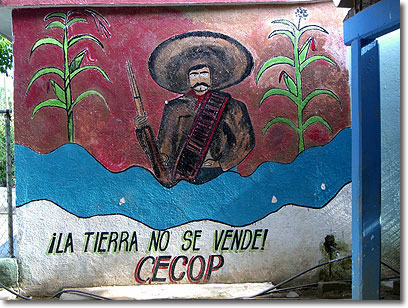
“The relocation of these (indigenous) peoples. . . shall take place only with their willing and informed consent”
(Article 16.2, Convention 169 on indigenous peoples and tribes of independent nations, ILO)
In 1976, the Federal Electrical Commission (CFE) initiated technical studies in “La Parota,” near Acapulco, for the construction of a hydroelectric dam. In 2004, the CFE undertook a study of preconstruction needs and technical and economic feasibility.
The building of this hydroelectric dam in the ejidal lands of La Parota, on the PapagayoRiver, would mean the following:
+ the flooding of 13 towns
+ the relocation of more than 20,000 habitants forced to abandon their homes (of whom 76% are farmers)
+ the flooding of 14,213 hectares, causing grave environmental deterioration
+ the disappearance of the phreatic mantles which supply water to the Port of Acapulco
+ a reservoir of water covering 13,728,000 hectares of land
+ a dam with a height of 162 meters
+ 5 years of work
+ 8 billion pesos
According to the Center for Economic and Political Research for Community Action (CIEPAC), the goal of the dam is to supply energy to maquiladoras (sweatshops), big tourist centers, cities and the extraction industry, among others, but not for the development and the needs of communities. Other purposes of the dam are to supply the southern United States with electrical energy and to become a part of the national and Central American electrical network.
Read more...
http://www.sipaz.org/gro_problem/parota0608_e.htm
(Article 16.2, Convention 169 on indigenous peoples and tribes of independent nations, ILO)
In 1976, the Federal Electrical Commission (CFE) initiated technical studies in “La Parota,” near Acapulco, for the construction of a hydroelectric dam. In 2004, the CFE undertook a study of preconstruction needs and technical and economic feasibility.
The building of this hydroelectric dam in the ejidal lands of La Parota, on the PapagayoRiver, would mean the following:
+ the flooding of 13 towns
+ the relocation of more than 20,000 habitants forced to abandon their homes (of whom 76% are farmers)
+ the flooding of 14,213 hectares, causing grave environmental deterioration
+ the disappearance of the phreatic mantles which supply water to the Port of Acapulco
+ a reservoir of water covering 13,728,000 hectares of land
+ a dam with a height of 162 meters
+ 5 years of work
+ 8 billion pesos
According to the Center for Economic and Political Research for Community Action (CIEPAC), the goal of the dam is to supply energy to maquiladoras (sweatshops), big tourist centers, cities and the extraction industry, among others, but not for the development and the needs of communities. Other purposes of the dam are to supply the southern United States with electrical energy and to become a part of the national and Central American electrical network.
Read more...
http://www.sipaz.org/gro_problem/parota0608_e.htm
The hydroelectric dam project, La Parota, was developed by the Mexican government more than 30 years ago. The dam would affect 21 communities, including 17 communal ejido lands and 3 common lands (bienes comunales), and becoming one of the largest in the entire world. It would flood 17,300 hectares of productive lands. More than 100,000 people would be affected by the dam. According to the Human Rights Center Montaña Tlachinollán, more than 25,000 people would be displaced as their lands would be flooded (the Federal Commission of Electricity, CFE, only recognizes that there would be 3,000 people directly affected.) Furthermore, the redirecting of the river would deprive 75,000 people of their water, including rural workers that need it for their crops (the Federal Commission of Electricity, CFE, didn't plan any compensation for those indirectly affected.)(1)
According to the Center for Economic and Political Research and Community Action (CIEPAC), the objective of the dam project is to provide energy to the maquiladoras, to the large tourist centers, to the cities (primarily Acapulco) and the mining industry, among others, and not to promote development and attend the needs of the rural sector. It would also supply electricity to the South of the United States and connect to the national and Central American electric grid.
In recent years, the division and polarization that have arisen because of the project have provoked a number of deaths, grave injuries and detentions. Confrontations during assemblies have also provoked a number of injuries.
The Legal Battle since 2005
In 2005 various assemblies in communal ejido lands were carried out to determine whether or not to permit the project from being carried out. Nevertheless, in 4 communities where the rural workers had supposedly agreed to the expropriation of their lands - Cacahuatepec, Los Huajes, La Palma and Dos Arroyos - the decision was later challenged. The resolutions of 3 of them are still pending, but the assembly in Cacahuatepec of March 27th 2007 was recognized to be illegal. In a hurried manner, a new assembly was called in Cacahuatepec on May 6th 2007, which SIPAZ attended as part of an observation mission.
The activists of the Council of Ejidos and Communities Opposing La Parota (CECOP) are demanding that a consultation process be carried out that includes all of those affected by the project, and not only the ones that appear on the voting rolls of the community assemblies, but also those in neighboring communities and landholdings, and that they be provided with exact and impartial information regarding the impact of the dam and that all of those affected be compensated. In the framework of the demands to nullify the 4 supposedly irregular assemblies, various resolutions were enacted in favor of CECOP in September of 2006, preventing the CFE and any other state or federal authority from entering the lands of those 4 communities to carry out any work relating to the hydroelectric project as long as the respective legal processes have not been finalized. In spite of this, the first highways are being constructed in the zones where the possible dam construction is foreseen.
Various actors strongly criticized the ejido assemblies founded by the state and federal governments, denouncing that it amounted to a mechanism for the imposition of the hydroelectric project and not a true mechanism of consultation in violation of the Agrarian Law.
Reactions by International Organizations
In March of 2006, the CECOP presented their case before the Latin American Water Tribunal (TLA), which judged against the construction of the dam project and recommended its suspension. Various instances of the United Nations have demonstrated their preoccupation and have denounced irregularities in the project. Rodolfo Stavenhagen, the Special Rapporteur for the Situation of Human Rights and Fundamental Liberties of Indigenous People, denounced the "abuses and violations of the indigenous rural workers in the state of Guerrero opposed to the construction of the dam La Parota in their territories, which the State insists and carrying out without the free will of the population."
In May of 2006, the Committee for the Economic, Social and Cultural Rights of the United Nations, declared their preoccupation before the lack of consultation of the indigenous communities, as well as the environmental deterioration that would result from the project. In the beginning of March, Mexico's representative to the United Nations High Commission of Human Rights, Amerigo Incalcaterra, visited the territories of La Parota to meet with the affected population in the communities of Garrapatas and Tasajeras, affirming the lack of information and transparent consultation in this project.
Since 2004, Amnesty International has been documenting the violence surrounded in the La Parota dam project, particularly the homicides of three people and the injuries and death threats of a local activist. The organization does not have any knowledge that any progress has been made in official investigations about these incidents.
On May 2nd 2007, Amnesty International declared that they "feared for the security" of the members of the CECOP, and that their lives "may be in danger" because of their resistance to the dam project promoted by the government. It questions in advance the consultation that was just realized in Cacahuatepec on May 6th and foresees violent actions towards those opposing the project.
Talchinollán
^^^TOP
Press Release from the Civil Observation Mission
to the Assembly on La Parota, May 6th, 2007-05-12
ANTECEDENTS
The Civil Observation Mission to "La Parota", a collective made up of 36 people from 16 organizations, national and international networks, was present in the zone affected by the construction of the "La Parota" dam on the 5th and 6th of May and wishes to express publicly observations from the assembly:
According to the Council of Ejidos and Communities Opposing "La Parota" (CECOP), the agrarian assembly convened for this May 6th in San Juan Grande, in the Municipality of Acapulco, had the objective of legitimizing the expropriation of communal lands in order to begin construction of the hydroelectric 'mega-project' "La Parota". This assembly was another attempt of that which was carried out in San Marcos on August 23, 2005, which was recently annulled (March 27, 2007) by the United Agrarian Tribunal in favor of the opposition.
Before this assembly and the possible repression or provocation by the authorities, we are carrying out this civil observation mission in order to verify the proceedings of this agrarian assembly. The mission comes as an answer to the national and international alerts put out by the CECOP and was set in motion by 47 organizations from civil society, national and international networks.
OBSERVATIONS
The civil mission observed the following:
1.- To begin, it should be pointed out that this is an assembly whose convening is irregular for the following reasons:
First, through various testimonies from different communal authorities, we were informed that the call for the assembly was not posted in the most visible places of the common lands (bienes comunales) as demanded by article 25 of the Agrarian Law.
Second, that the assembly was convened in a different place than that recognized by the traditional laws (usos y costumbres) of the inhabitants of communal lands. These are traditionally carried out in the municipal seat of the common lands of Cacahuatepec.
2.- As far as the assembly itself we state the following:
The table was not set up because the Commissioner did not bring the official rolls containing the names of inhabitants of communal lands, contrary to the indications of the Agrarian Law.
Nevertheless the agrarian authority asked that the registration begin and only two people signed in without any identification or document accrediting them as inhabitants of communal lands.
Immediately after, the Commissioner, without having passed the roll, suspended the Assembly saying that there was not sufficient quorum, with only 543 inhabitants of communal lands - a number impossible to corroborate since the rolls were never passed.
Fifteen minutes after having arrived, the officials left, and on their way out signed and posted a call for a second assembly, apparently planned beforehand. The proof lies in the fact that in the call for the second assembly, the annulment of the first assembly is justified by the "violent events". Here it is important to point out that, in the entire process, there was not any violence nor attempted physical aggression by the present groups, as shown in the photographs, videos and testimonies collected by the Civil Observation Mission. That represents a contradiction with the arguments of the Commissioner to nullify the assembly.
CONCLUSIONS AND RECOMMENDATIONS
The mission considers that assemblies of this nature do not constitute an adequate mechanism of consultation as determined by agreement 169 of the OIT, since according to the information we have there are 43,000 inhabitants of the common lands of Cacahuatepec, and the lists only register 7,280; because of this it is clear that these assemblies exclude the majority of the affected population.
It is stated that the assembly was irregular for the aforementioned reasons.
The Civil Observation Mission expresses its concern that the assembly was not organized in good spirit and that it could have the objective of tiring the movement opposing the dam, criminalize it and in this form justify the possible use of violence and repression. Furthermore, with this, the presence of public forces is justified in future assemblies in order to impose the project.
It worries us that with the annulment of the communal assembly, the ensuing assemblies will require a lower quorum in order to be valid, something that could be used as a strategy by the authorities to facilitate the imposition of the project.
We restate that there was no violence by any participating party, and that the opposition movement has continued its peaceful and legal struggle to defend their rights as people.
We view with concern that behind the false claims of violence by the opposition that harassment, threats and repression could be justified by the authorities.
We ask all of the communities affected by the construction of the hydroelectric dam project "La Parota" be guaranteed complete, exact and impartial information about the project and the available compensations, and that the opposition not suffer threats and intimidation as well as carry out legitimate protests against the construction of the dam. Also the fulfillment of the international treaties and agreements on human rights signed and ratified by Mexico.
We recommend that the upcoming assemblies be public, as laid out in the Agrarian Law, allowing national and international civil society to observe the proceedings.
The observation mission is concerned that communal assemblies carried out in this manner may be a factor leading to intercommunal violence and confrontations in the upcoming assemblies between the opposition and those in favor.
The civil mission commits to continue with this project for the next assembly on May 20th, and makes a strong call to public opinion and civil society more generally to remain alert and aware of the situation arising from the imposition of the hydroelectric project "La Parota".
Civil Observation Mission: Espacio por los derechos Económicos, Sociales y Culturales, Servicios y Asesoría para la Paz (SERAPAZ), Amnistía Internacional – Sección Canada, Servicio Internacional para la Paz (SIPAZ), Red de organismos civiles de Derechos humanos “Todos los derechos para Todos y Todas”, Liga Mexicana de Defensa de los Derechos Humanos (LIMEDDH), Centro Ollin Mexica, Centro de Estudios Sociales y Culturales Antonio de Montesinos (CAM), ADHEM, Food First International Action network ofna. México (FIAN), RADAR, Red Género y Comercio (REDGE), Calpulli Tlatoani, Unión Popular Revolucionaria Emiliano Zapata (UPREZ), Asociación de Familiares de Detenidos Desaparecidos y Victimas de Violaciones a los Derechos Humanos en México (AFADEM), Hijas de la Caridad de San Vicente de Paul, Álvaro Urreta (comunero de Tlanepantla, Morelos), Paulina Fernández (Investigadora y académica de la UNAM).
According to the Center for Economic and Political Research and Community Action (CIEPAC), the objective of the dam project is to provide energy to the maquiladoras, to the large tourist centers, to the cities (primarily Acapulco) and the mining industry, among others, and not to promote development and attend the needs of the rural sector. It would also supply electricity to the South of the United States and connect to the national and Central American electric grid.
In recent years, the division and polarization that have arisen because of the project have provoked a number of deaths, grave injuries and detentions. Confrontations during assemblies have also provoked a number of injuries.
The Legal Battle since 2005
In 2005 various assemblies in communal ejido lands were carried out to determine whether or not to permit the project from being carried out. Nevertheless, in 4 communities where the rural workers had supposedly agreed to the expropriation of their lands - Cacahuatepec, Los Huajes, La Palma and Dos Arroyos - the decision was later challenged. The resolutions of 3 of them are still pending, but the assembly in Cacahuatepec of March 27th 2007 was recognized to be illegal. In a hurried manner, a new assembly was called in Cacahuatepec on May 6th 2007, which SIPAZ attended as part of an observation mission.
The activists of the Council of Ejidos and Communities Opposing La Parota (CECOP) are demanding that a consultation process be carried out that includes all of those affected by the project, and not only the ones that appear on the voting rolls of the community assemblies, but also those in neighboring communities and landholdings, and that they be provided with exact and impartial information regarding the impact of the dam and that all of those affected be compensated. In the framework of the demands to nullify the 4 supposedly irregular assemblies, various resolutions were enacted in favor of CECOP in September of 2006, preventing the CFE and any other state or federal authority from entering the lands of those 4 communities to carry out any work relating to the hydroelectric project as long as the respective legal processes have not been finalized. In spite of this, the first highways are being constructed in the zones where the possible dam construction is foreseen.
Various actors strongly criticized the ejido assemblies founded by the state and federal governments, denouncing that it amounted to a mechanism for the imposition of the hydroelectric project and not a true mechanism of consultation in violation of the Agrarian Law.
Reactions by International Organizations
In March of 2006, the CECOP presented their case before the Latin American Water Tribunal (TLA), which judged against the construction of the dam project and recommended its suspension. Various instances of the United Nations have demonstrated their preoccupation and have denounced irregularities in the project. Rodolfo Stavenhagen, the Special Rapporteur for the Situation of Human Rights and Fundamental Liberties of Indigenous People, denounced the "abuses and violations of the indigenous rural workers in the state of Guerrero opposed to the construction of the dam La Parota in their territories, which the State insists and carrying out without the free will of the population."
In May of 2006, the Committee for the Economic, Social and Cultural Rights of the United Nations, declared their preoccupation before the lack of consultation of the indigenous communities, as well as the environmental deterioration that would result from the project. In the beginning of March, Mexico's representative to the United Nations High Commission of Human Rights, Amerigo Incalcaterra, visited the territories of La Parota to meet with the affected population in the communities of Garrapatas and Tasajeras, affirming the lack of information and transparent consultation in this project.
Since 2004, Amnesty International has been documenting the violence surrounded in the La Parota dam project, particularly the homicides of three people and the injuries and death threats of a local activist. The organization does not have any knowledge that any progress has been made in official investigations about these incidents.
On May 2nd 2007, Amnesty International declared that they "feared for the security" of the members of the CECOP, and that their lives "may be in danger" because of their resistance to the dam project promoted by the government. It questions in advance the consultation that was just realized in Cacahuatepec on May 6th and foresees violent actions towards those opposing the project.
Talchinollán
^^^TOP
Press Release from the Civil Observation Mission
to the Assembly on La Parota, May 6th, 2007-05-12
ANTECEDENTS
The Civil Observation Mission to "La Parota", a collective made up of 36 people from 16 organizations, national and international networks, was present in the zone affected by the construction of the "La Parota" dam on the 5th and 6th of May and wishes to express publicly observations from the assembly:
According to the Council of Ejidos and Communities Opposing "La Parota" (CECOP), the agrarian assembly convened for this May 6th in San Juan Grande, in the Municipality of Acapulco, had the objective of legitimizing the expropriation of communal lands in order to begin construction of the hydroelectric 'mega-project' "La Parota". This assembly was another attempt of that which was carried out in San Marcos on August 23, 2005, which was recently annulled (March 27, 2007) by the United Agrarian Tribunal in favor of the opposition.
Before this assembly and the possible repression or provocation by the authorities, we are carrying out this civil observation mission in order to verify the proceedings of this agrarian assembly. The mission comes as an answer to the national and international alerts put out by the CECOP and was set in motion by 47 organizations from civil society, national and international networks.
OBSERVATIONS
The civil mission observed the following:
1.- To begin, it should be pointed out that this is an assembly whose convening is irregular for the following reasons:
First, through various testimonies from different communal authorities, we were informed that the call for the assembly was not posted in the most visible places of the common lands (bienes comunales) as demanded by article 25 of the Agrarian Law.
Second, that the assembly was convened in a different place than that recognized by the traditional laws (usos y costumbres) of the inhabitants of communal lands. These are traditionally carried out in the municipal seat of the common lands of Cacahuatepec.
2.- As far as the assembly itself we state the following:
The table was not set up because the Commissioner did not bring the official rolls containing the names of inhabitants of communal lands, contrary to the indications of the Agrarian Law.
Nevertheless the agrarian authority asked that the registration begin and only two people signed in without any identification or document accrediting them as inhabitants of communal lands.
Immediately after, the Commissioner, without having passed the roll, suspended the Assembly saying that there was not sufficient quorum, with only 543 inhabitants of communal lands - a number impossible to corroborate since the rolls were never passed.
Fifteen minutes after having arrived, the officials left, and on their way out signed and posted a call for a second assembly, apparently planned beforehand. The proof lies in the fact that in the call for the second assembly, the annulment of the first assembly is justified by the "violent events". Here it is important to point out that, in the entire process, there was not any violence nor attempted physical aggression by the present groups, as shown in the photographs, videos and testimonies collected by the Civil Observation Mission. That represents a contradiction with the arguments of the Commissioner to nullify the assembly.
CONCLUSIONS AND RECOMMENDATIONS
The mission considers that assemblies of this nature do not constitute an adequate mechanism of consultation as determined by agreement 169 of the OIT, since according to the information we have there are 43,000 inhabitants of the common lands of Cacahuatepec, and the lists only register 7,280; because of this it is clear that these assemblies exclude the majority of the affected population.
It is stated that the assembly was irregular for the aforementioned reasons.
The Civil Observation Mission expresses its concern that the assembly was not organized in good spirit and that it could have the objective of tiring the movement opposing the dam, criminalize it and in this form justify the possible use of violence and repression. Furthermore, with this, the presence of public forces is justified in future assemblies in order to impose the project.
It worries us that with the annulment of the communal assembly, the ensuing assemblies will require a lower quorum in order to be valid, something that could be used as a strategy by the authorities to facilitate the imposition of the project.
We restate that there was no violence by any participating party, and that the opposition movement has continued its peaceful and legal struggle to defend their rights as people.
We view with concern that behind the false claims of violence by the opposition that harassment, threats and repression could be justified by the authorities.
We ask all of the communities affected by the construction of the hydroelectric dam project "La Parota" be guaranteed complete, exact and impartial information about the project and the available compensations, and that the opposition not suffer threats and intimidation as well as carry out legitimate protests against the construction of the dam. Also the fulfillment of the international treaties and agreements on human rights signed and ratified by Mexico.
We recommend that the upcoming assemblies be public, as laid out in the Agrarian Law, allowing national and international civil society to observe the proceedings.
The observation mission is concerned that communal assemblies carried out in this manner may be a factor leading to intercommunal violence and confrontations in the upcoming assemblies between the opposition and those in favor.
The civil mission commits to continue with this project for the next assembly on May 20th, and makes a strong call to public opinion and civil society more generally to remain alert and aware of the situation arising from the imposition of the hydroelectric project "La Parota".
Civil Observation Mission: Espacio por los derechos Económicos, Sociales y Culturales, Servicios y Asesoría para la Paz (SERAPAZ), Amnistía Internacional – Sección Canada, Servicio Internacional para la Paz (SIPAZ), Red de organismos civiles de Derechos humanos “Todos los derechos para Todos y Todas”, Liga Mexicana de Defensa de los Derechos Humanos (LIMEDDH), Centro Ollin Mexica, Centro de Estudios Sociales y Culturales Antonio de Montesinos (CAM), ADHEM, Food First International Action network ofna. México (FIAN), RADAR, Red Género y Comercio (REDGE), Calpulli Tlatoani, Unión Popular Revolucionaria Emiliano Zapata (UPREZ), Asociación de Familiares de Detenidos Desaparecidos y Victimas de Violaciones a los Derechos Humanos en México (AFADEM), Hijas de la Caridad de San Vicente de Paul, Álvaro Urreta (comunero de Tlanepantla, Morelos), Paulina Fernández (Investigadora y académica de la UNAM).
We are 100% volunteer and depend on your participation to sustain our efforts!
Donate

$115.00 donated
in the past month
Get Involved
If you'd like to help with maintaining or developing the website, contact us.
Publish
Publish your stories and upcoming events on Indybay.
Topics
More
Search Indybay's Archives
Advanced Search
►
▼
IMC Network