







 Publish to Newswire
 Add an Event
From the Open-Publishing Calendar
From the Open-Publishing Newswire
Indybay Feature
4/21 SF Screening Of "Carry On Ken" and "Rebel County"
Two films about Ken Loach and the making of "The Wind That Shakes The Barley" will be
screened in SF on April 21.
screened in SF on April 21.
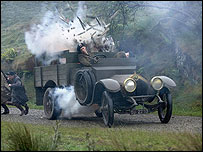
First US Screening Of
"Carry On Ken" and "Rebel County"
LaborFest will be having a benefit screening of two new films on the life of working class film director Ken Loach and a film about the background to his latest film "The Wind That Shakes The Barley".
New College Theater
Saturday April 21, 2006 6:00 PM
777 Valencia St. San Francisco
$8.00 Donation For LaborFest
CARRY ON KEN
is a documentary tribute to the life and work of acclaimed
British film director Ken Loach. The film is part of Ken Loach's 70th
birthday celebrations and coincides with the release of his latest Palme
D'Or winning film, THE WIND THAT SHAKES THE BARLEY. This documentary charts
his career and his working methods through film clips and interviews with
many of his collaborators including Robert Carlyle, Cillian Murphy, Brian
Cox, Ricky Tomlinson and Peter Mullan. It premiered on More4 on Sat 17th
June 2006 and is currently being broadcast in a number of European
countries.
Rebel County
Rebel County uses the shooting of the Ken Loach film The Wind that Shakes
the Barley as a springboard from which to explore the real life events of
The War of Independence in the South West of the country.
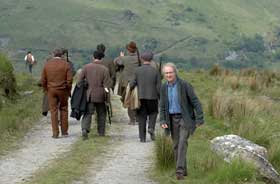
Rebel County features observational behind-the-scenes material of Ken Loach
interacting with cast and crew, key ambush scenes, Black & Tan raids, behind
the scenes historical discussions between Loach and cast members and
includes clips of the completed film. The documentary strikes a creative
and natural balance between the exploration of the film-making process and
the real stories from that period.
It uses some of the film’s key locations (Bandon, Buttevant and Clonakilty
in West Cork) as a way of exploring what it was like for the ordinary
inhabitants of Cork living through the traumatic events of the time. It
explores the origins of the War of Independence, tracing the influence of
1798 and family and parish connections on the revolutionary period. It also
explores the nature of society before independence and the influence of
garrison towns, the impact of World War I and the competing allegiances in
towns and villages like Bandon and Buttevant.
Harvest Films 2006 52 mins
Sponsored by LaborFest, co-sponsored by New College Irish Studies Program and New College Media Studies Department
For more information go to
LaborFest
(415)642-8066
laborfest [at] laborfest.net
http://www.laborfest.net
"The Wind That Shakes The Barley" Opens In San Francisco On
4/6/2007
San Francisco, CA
Embarcadero
Landmark Theater
http://www.nytimes.com/2007/03/04/movies/04full.html
March 4, 2007
Film
In This Corner, a Leftist, Riling the Right Again
By GRAHAM FULLER
IN Ken Loach’s 1975 mini-series “Days of Hope,” drunken British soldiers billeted at an Irish farmhouse in 1916 harass a young woman into singing for them. She renders a republican song so plaintively that they fall silent. They have a sense of shame “that is stronger than the drink,” Mr. Loach later commented. “And in a way she reminds them of who they are and where they come from and their own families. It was important there to break the stereotypes of soldiers as brutes.”
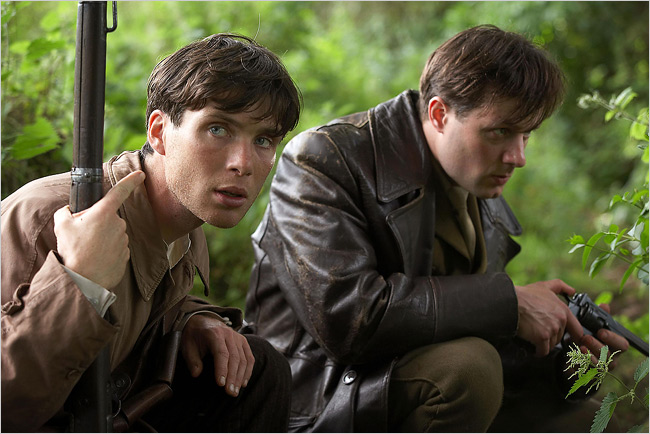
His new film, “The Wind That Shakes the Barley,” which is set to open March 16, also shows British soldiers interacting with rural Irish people but is less sparing of the brutishness. A narrative of the war of independence, it begins with a platoon of Black and Tans, the mostly English recruits who augmented the Royal Irish Constabulary, beating a young farm worker to death while training their rifles on his mother, grandmother and sister. Damien (Cillian Murphy), a student doctor who has joined an Irish Republican Army flying column and been arrested, listens to the screams from an adjoining cell as his brother Teddy’s fingernails are torn off during interrogation.
In a recent telephone interview Mr. Loach said that the barbarities perpetrated in Ireland by the Tans and the Auxiliaries, Churchill’s elite “gendarmerie,” are well documented. “We could have made it far more brutal,” he added. “We could have shown teeth being pulled out, but that would have filled the screen with blood. There is correspondence from that time about the brutality the British were importing into Ireland.”
In condemning the British cabinet’s sanctioning of ferocious tactics in Ireland in 1920, two years after Sinn Fein won a democratic mandate to form a republican parliament, Mr. Loach and the screenwriter Paul Laverty adopt a clear ideological position. Some British critics have been outraged that the filmmakers would besmirch the name of the empire with the torture scenes and have suggested that they romanticize the Irish guerrillas.
The film does depict their raids with élan and makes a martyr of more than one of them, but it doesn’t skimp on their bloodletting. “If they bring their savagery over here, we will meet it with a savagery of our own,” the leader of the flying column announces after it has massacred the Auxies in the pivotal Kilmichael Ambush. There’s nothing romantic about Damien’s execution of an Anglo-Irish landlord and a young republican informer.
Notwithstanding the film’s depiction of these reprisals, its winning of the Palme d’Or, the top prize at Cannes, last May provoked the conservative British press into an “apoplectic” reaction, as Mr. Laverty described it. A columnist for The Times of London provocatively compared Mr. Loach to Leni Riefenstahl, the Nazi propagandist filmmaker. The Daily Mail’s film reviewer quipped that this was a harsh judgment since “Riefenstahl was far more visually talented.”
In an article headlined “Why Does Ken Loach Loathe His Country So Much?” another Mail writer observed, “By use of what can only be described as a mélange of half-truths, he hopes he can persuade British politicians to ‘confront,’ and then apologize for, the Empire.” Mr. Loach has earned more scorn by frequently comparing the occupied Ireland of 1920-21 with modern Iraq.
Reminded of these opinions Mr. Loach said: “It’s good that they are so hostile because it shows that the film smoked them out. How obsessed are they that they have no sense of balance? There’s a kind of paranoia there. The moment you present an alternative view of history, they can’t discuss the merits of it but rise to the bait and go in for this abuse.”
Mr. Loach, now 70, has been a thorn in the side of the right for over four decades. His work has consistently probed the class struggle and the exploitation of ordinary people by those in positions of authority. These include dismissive schoolteachers (“Kes”), a bullying mother (“Family Life”), unfeeling social service employees (“Cathy Come Home”; “Ladybird, Ladybird”) and employers who exploit and endanger workers (“Riff Raff,” “Bread and Roses,” “The Navigators”). He previously championed revolutionaries in “Land and Freedom,” which showed how the Marxist cause was betrayed by the Stalinists during the Spanish Civil War, and “Carla’s Song,” which grappled with the atrocities committed against the Nicaraguan Sandinistas by the Pentagon-backed contras.
In “Carla’s Song” a C.I.A. man jumps ship rather than further bloody his hands. In “Days of Hope” a British soldier deserts rather than fight the Irish. In “Hidden Agenda,” which condemns the Royal Ulster Constabulary’s shoot-to-kill policy, a rogue agent informs on British “dirty tricks” in Northern Ireland; the film was derided by a Conservative member of Parliament, Ivor Stanbrook, as “the I.R.A. entry” at Cannes in 1990.
“The Wind That Shakes the Barley” is sympathetic to a British officer unhinged by his experiences at the Somme, and a Scots-Irish soldier is so appalled by the torture of Teddy (Padraic Delaney) and his comrades that he springs them from jail. These aren’t sops to conservatives, but an admission by Mr. Loach that not everyone on “the wrong side” can be tarred with the same brush.
“You could tell a tremendous story about some of the young lads in the Black and Tans,” Mr. Laverty said. “But by telling the story we did, it gave us a way of examining, in a much richer sense, the contradictions within the flying column and the different perceptions of what Ireland could achieve.”
Mr. Loach’s films are often described as didactic for the way they show ordinary people heatedly debating what they must do to organize — whether as union members or resistance fighters — to overcome oppression. In “The Wind That Shakes the Barley” a republican court hearing to resolve a dispute between a usurious merchant and an old woman over unpaid grocery bills evolves into a larger issue.
Teddy supports the merchant, who helps provide arms for the I.R.A.; Damien sides with his socialist mentor, Dan (Liam Cunningham), who castigates the I.R.A.’s backing of local bigwigs at the expense of the poor. A subsequent debate, held in the wake of the Anglo-Irish Treaty, which created the Irish Free State as a self-governing dominion of the empire, further polarizes the brothers, with tragic consequences. Their sundering prefigures the Irish Civil War of 1922-23.
Mr. Laverty said that it is the cogency of the republicans’ arguments that offended the right-wing press: “They were furious that ordinary people could be so articulate about what they are fighting for. To be truthful to the times during those debates, we researched all the arguments that were made and tried to imagine what they would have actually felt, not what they should have felt or debated.”
Roy Foster, Carroll professor of Irish history at Oxford, wrote in The Dublin Review that he admired these debates, but he criticized the film’s abandonment of “characterization for didactics.” He said in a recent e-mail message that its “history was badly skewed — particularly the idea that opposition to the Treaty was based on the wish to complete a socialist revolution, a feeling shared by very few of the revolutionaries.”
Mr. Loach countered, “We saw papers in the course of our research that said the opposite.” He cited republican socialist leaders like James Connolly (who was executed for fomenting the 1916 Easter Rising against the British), Liam Mellows, Peadar O’Donnell and their followers. Surely Professor Foster isn’t saying that those people “had suddenly vanished from the face of the earth,” Mr. Loach said, “and that they didn’t carry their experiences in the labor movement into the struggle. Of course they did.” Mr. Loach said that he didn’t think that socialism was the dominant idea in the republican movement, however, “and it isn’t in the film, I would argue.”
“The slogan of the time was ‘Labor Must Wait,’ ” he added, “and the labor leaders consciously decided to put their demands on the back burner. But there were people who objected to that. We wanted to make certain that that point, which was largely ignored by the establishment historians, had an outlet through characters like Dan and Damien.”
Asked if the “didactic” brickbat irritates him, Mr. Loach laughed and said: “Profoundly — because the people who say it are also saying that a clash of ideas is not suitable for a film. I was brought up on Shakespeare’s history plays, which are full of debates about kingship, divine right and the rights of the subject. I’m not making any other comparisons, but I think those scenes are intensely dramatic.”
"Carry On Ken" and "Rebel County"
LaborFest will be having a benefit screening of two new films on the life of working class film director Ken Loach and a film about the background to his latest film "The Wind That Shakes The Barley".
New College Theater
Saturday April 21, 2006 6:00 PM
777 Valencia St. San Francisco
$8.00 Donation For LaborFest
CARRY ON KEN
is a documentary tribute to the life and work of acclaimed
British film director Ken Loach. The film is part of Ken Loach's 70th
birthday celebrations and coincides with the release of his latest Palme
D'Or winning film, THE WIND THAT SHAKES THE BARLEY. This documentary charts
his career and his working methods through film clips and interviews with
many of his collaborators including Robert Carlyle, Cillian Murphy, Brian
Cox, Ricky Tomlinson and Peter Mullan. It premiered on More4 on Sat 17th
June 2006 and is currently being broadcast in a number of European
countries.
Rebel County
Rebel County uses the shooting of the Ken Loach film The Wind that Shakes
the Barley as a springboard from which to explore the real life events of
The War of Independence in the South West of the country.
Rebel County features observational behind-the-scenes material of Ken Loach
interacting with cast and crew, key ambush scenes, Black & Tan raids, behind
the scenes historical discussions between Loach and cast members and
includes clips of the completed film. The documentary strikes a creative
and natural balance between the exploration of the film-making process and
the real stories from that period.
It uses some of the film’s key locations (Bandon, Buttevant and Clonakilty
in West Cork) as a way of exploring what it was like for the ordinary
inhabitants of Cork living through the traumatic events of the time. It
explores the origins of the War of Independence, tracing the influence of
1798 and family and parish connections on the revolutionary period. It also
explores the nature of society before independence and the influence of
garrison towns, the impact of World War I and the competing allegiances in
towns and villages like Bandon and Buttevant.
Harvest Films 2006 52 mins
Sponsored by LaborFest, co-sponsored by New College Irish Studies Program and New College Media Studies Department
For more information go to
LaborFest
(415)642-8066
laborfest [at] laborfest.net
http://www.laborfest.net
"The Wind That Shakes The Barley" Opens In San Francisco On
4/6/2007
San Francisco, CA
Embarcadero
Landmark Theater
http://www.nytimes.com/2007/03/04/movies/04full.html
March 4, 2007
Film
In This Corner, a Leftist, Riling the Right Again
By GRAHAM FULLER
IN Ken Loach’s 1975 mini-series “Days of Hope,” drunken British soldiers billeted at an Irish farmhouse in 1916 harass a young woman into singing for them. She renders a republican song so plaintively that they fall silent. They have a sense of shame “that is stronger than the drink,” Mr. Loach later commented. “And in a way she reminds them of who they are and where they come from and their own families. It was important there to break the stereotypes of soldiers as brutes.”
His new film, “The Wind That Shakes the Barley,” which is set to open March 16, also shows British soldiers interacting with rural Irish people but is less sparing of the brutishness. A narrative of the war of independence, it begins with a platoon of Black and Tans, the mostly English recruits who augmented the Royal Irish Constabulary, beating a young farm worker to death while training their rifles on his mother, grandmother and sister. Damien (Cillian Murphy), a student doctor who has joined an Irish Republican Army flying column and been arrested, listens to the screams from an adjoining cell as his brother Teddy’s fingernails are torn off during interrogation.
In a recent telephone interview Mr. Loach said that the barbarities perpetrated in Ireland by the Tans and the Auxiliaries, Churchill’s elite “gendarmerie,” are well documented. “We could have made it far more brutal,” he added. “We could have shown teeth being pulled out, but that would have filled the screen with blood. There is correspondence from that time about the brutality the British were importing into Ireland.”
In condemning the British cabinet’s sanctioning of ferocious tactics in Ireland in 1920, two years after Sinn Fein won a democratic mandate to form a republican parliament, Mr. Loach and the screenwriter Paul Laverty adopt a clear ideological position. Some British critics have been outraged that the filmmakers would besmirch the name of the empire with the torture scenes and have suggested that they romanticize the Irish guerrillas.
The film does depict their raids with élan and makes a martyr of more than one of them, but it doesn’t skimp on their bloodletting. “If they bring their savagery over here, we will meet it with a savagery of our own,” the leader of the flying column announces after it has massacred the Auxies in the pivotal Kilmichael Ambush. There’s nothing romantic about Damien’s execution of an Anglo-Irish landlord and a young republican informer.
Notwithstanding the film’s depiction of these reprisals, its winning of the Palme d’Or, the top prize at Cannes, last May provoked the conservative British press into an “apoplectic” reaction, as Mr. Laverty described it. A columnist for The Times of London provocatively compared Mr. Loach to Leni Riefenstahl, the Nazi propagandist filmmaker. The Daily Mail’s film reviewer quipped that this was a harsh judgment since “Riefenstahl was far more visually talented.”
In an article headlined “Why Does Ken Loach Loathe His Country So Much?” another Mail writer observed, “By use of what can only be described as a mélange of half-truths, he hopes he can persuade British politicians to ‘confront,’ and then apologize for, the Empire.” Mr. Loach has earned more scorn by frequently comparing the occupied Ireland of 1920-21 with modern Iraq.
Reminded of these opinions Mr. Loach said: “It’s good that they are so hostile because it shows that the film smoked them out. How obsessed are they that they have no sense of balance? There’s a kind of paranoia there. The moment you present an alternative view of history, they can’t discuss the merits of it but rise to the bait and go in for this abuse.”
Mr. Loach, now 70, has been a thorn in the side of the right for over four decades. His work has consistently probed the class struggle and the exploitation of ordinary people by those in positions of authority. These include dismissive schoolteachers (“Kes”), a bullying mother (“Family Life”), unfeeling social service employees (“Cathy Come Home”; “Ladybird, Ladybird”) and employers who exploit and endanger workers (“Riff Raff,” “Bread and Roses,” “The Navigators”). He previously championed revolutionaries in “Land and Freedom,” which showed how the Marxist cause was betrayed by the Stalinists during the Spanish Civil War, and “Carla’s Song,” which grappled with the atrocities committed against the Nicaraguan Sandinistas by the Pentagon-backed contras.
In “Carla’s Song” a C.I.A. man jumps ship rather than further bloody his hands. In “Days of Hope” a British soldier deserts rather than fight the Irish. In “Hidden Agenda,” which condemns the Royal Ulster Constabulary’s shoot-to-kill policy, a rogue agent informs on British “dirty tricks” in Northern Ireland; the film was derided by a Conservative member of Parliament, Ivor Stanbrook, as “the I.R.A. entry” at Cannes in 1990.
“The Wind That Shakes the Barley” is sympathetic to a British officer unhinged by his experiences at the Somme, and a Scots-Irish soldier is so appalled by the torture of Teddy (Padraic Delaney) and his comrades that he springs them from jail. These aren’t sops to conservatives, but an admission by Mr. Loach that not everyone on “the wrong side” can be tarred with the same brush.
“You could tell a tremendous story about some of the young lads in the Black and Tans,” Mr. Laverty said. “But by telling the story we did, it gave us a way of examining, in a much richer sense, the contradictions within the flying column and the different perceptions of what Ireland could achieve.”
Mr. Loach’s films are often described as didactic for the way they show ordinary people heatedly debating what they must do to organize — whether as union members or resistance fighters — to overcome oppression. In “The Wind That Shakes the Barley” a republican court hearing to resolve a dispute between a usurious merchant and an old woman over unpaid grocery bills evolves into a larger issue.
Teddy supports the merchant, who helps provide arms for the I.R.A.; Damien sides with his socialist mentor, Dan (Liam Cunningham), who castigates the I.R.A.’s backing of local bigwigs at the expense of the poor. A subsequent debate, held in the wake of the Anglo-Irish Treaty, which created the Irish Free State as a self-governing dominion of the empire, further polarizes the brothers, with tragic consequences. Their sundering prefigures the Irish Civil War of 1922-23.
Mr. Laverty said that it is the cogency of the republicans’ arguments that offended the right-wing press: “They were furious that ordinary people could be so articulate about what they are fighting for. To be truthful to the times during those debates, we researched all the arguments that were made and tried to imagine what they would have actually felt, not what they should have felt or debated.”
Roy Foster, Carroll professor of Irish history at Oxford, wrote in The Dublin Review that he admired these debates, but he criticized the film’s abandonment of “characterization for didactics.” He said in a recent e-mail message that its “history was badly skewed — particularly the idea that opposition to the Treaty was based on the wish to complete a socialist revolution, a feeling shared by very few of the revolutionaries.”
Mr. Loach countered, “We saw papers in the course of our research that said the opposite.” He cited republican socialist leaders like James Connolly (who was executed for fomenting the 1916 Easter Rising against the British), Liam Mellows, Peadar O’Donnell and their followers. Surely Professor Foster isn’t saying that those people “had suddenly vanished from the face of the earth,” Mr. Loach said, “and that they didn’t carry their experiences in the labor movement into the struggle. Of course they did.” Mr. Loach said that he didn’t think that socialism was the dominant idea in the republican movement, however, “and it isn’t in the film, I would argue.”
“The slogan of the time was ‘Labor Must Wait,’ ” he added, “and the labor leaders consciously decided to put their demands on the back burner. But there were people who objected to that. We wanted to make certain that that point, which was largely ignored by the establishment historians, had an outlet through characters like Dan and Damien.”
Asked if the “didactic” brickbat irritates him, Mr. Loach laughed and said: “Profoundly — because the people who say it are also saying that a clash of ideas is not suitable for a film. I was brought up on Shakespeare’s history plays, which are full of debates about kingship, divine right and the rights of the subject. I’m not making any other comparisons, but I think those scenes are intensely dramatic.”
For more information:
http://www.laborfest.net
Add Your Comments
We are 100% volunteer and depend on your participation to sustain our efforts!
Donate

$110.00 donated
in the past month
Get Involved
If you'd like to help with maintaining or developing the website, contact us.
Publish
Publish your stories and upcoming events on Indybay.
Topics
More
Search Indybay's Archives
Advanced Search
►
▼
IMC Network