







 Publish to Newswire
 Add an Event
From the Open-Publishing Calendar
From the Open-Publishing Newswire
Indybay Feature
Environmentalist and Activist is this week's guest on McChesney's Media Matters
This week's guest on Media Matters has not yet been announced, save that the guest is an enviornmentalist.
Bob McChesney is a research professor in the Institute of Communications Research and the Graduate School of Information and Library Science at the University of Illinois at Urbana-Champaign. “The media are central to all our lives,” he says. “Yet the media are the most frequently misunderstood parts of our lives. We want to help people understand the role of media in society.”
Bob McChesney is a research professor in the Institute of Communications Research and the Graduate School of Information and Library Science at the University of Illinois at Urbana-Champaign. “The media are central to all our lives,” he says. “Yet the media are the most frequently misunderstood parts of our lives. We want to help people understand the role of media in society.”
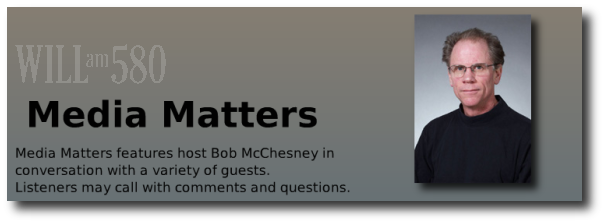
Media Matters features host Bob McChesney in conversation with a variety of guests.
Sunday morning's audio stream will be accessible on the internet at 11 am Pacific Time, and the archived program should be available with along with past programs beginning tomorrow.
(Media Matters broadcasts Sundays from 1 to 2 pm Central; 11 am to 12 pm Pacific; 1900 to 2000 UTC.)
If this is a live show, listeners may call with comments or questions. The toll-free telephone number is 1-800-222-9455.
LAST WEEK'S GUEST ON MEDIA MATTERS
------------------------------------
Last week's guests was Dan Schiller, author of "How to Think About Information."
http://www.indybay.org/newsitems/2007/01/14/18346915.php
More Indybay Citations of Media Matters Programs:
http://www.indybay.org/search/search_results.php?page_number=0&search=McChesney
TODAY'S PROGRAM AND ALL PAST SHOWS ARE AVAILABLE AT THE MEDIA MATTERS WEB SITE:
http://www.will.uiuc.edu/am/mediamatters/
(Look at the top of the Media Matters website and click on "Listen". A page will load with instructions for Realplay or Windows streaming. Open Source Streaming in Ogg Vorbis or other Free, non-proprietary audio codecs is not yet available.
To Listen to Media Matters:
Sunday morning's audio stream will be accessible on the internet at 11 am Pacific Time, and the archived program should be available with along with past programs beginning tomorrow.
(Media Matters broadcasts Sundays from 1 to 2 pm Central; 11 am to 12 pm Pacific; 1900 to 2000 UTC.)
If this is a live show, listeners may call with comments or questions. The toll-free telephone number is 1-800-222-9455.
LAST WEEK'S GUEST ON MEDIA MATTERS
------------------------------------
Last week's guests was Dan Schiller, author of "How to Think About Information."
http://www.indybay.org/newsitems/2007/01/14/18346915.php
More Indybay Citations of Media Matters Programs:
http://www.indybay.org/search/search_results.php?page_number=0&search=McChesney
TODAY'S PROGRAM AND ALL PAST SHOWS ARE AVAILABLE AT THE MEDIA MATTERS WEB SITE:
http://www.will.uiuc.edu/am/mediamatters/
(Look at the top of the Media Matters website and click on "Listen". A page will load with instructions for Realplay or Windows streaming. Open Source Streaming in Ogg Vorbis or other Free, non-proprietary audio codecs is not yet available.
To Listen to Media Matters:
For more information:
http://www.will.uiuc.edu/am/mediamatters/
Add Your Comments
Comments
(Hide Comments)
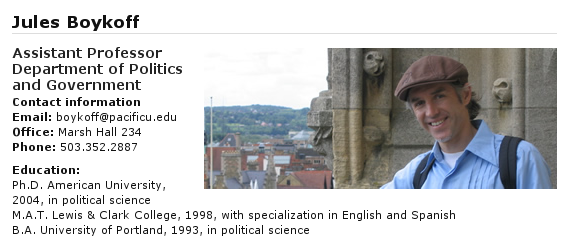
This week's guest on Media Matters Jules Boycoff, author of the $80 book called "The Suppression of Dissent: How the State and Mass Media Squelch USAmerican Social Movements (New Approaches in Sociology: Studies in Social Inequality, Social Changes, and Social Justice)."
http://tinyurl.com/22qmj9
He has a (hopefully more affordable) book coming out this year called "Beyond Bullets."
Book Description at amazon.com:
"Despite longstanding traditions of tolerance, inclusion, and democracy in the United States, dissident citizens and social movements have experienced significant and sustained--although often subtle and difficult-to-observe--suppression in this country. Using mechanism-based social-movement theory, this book explores a wide range of twentieth-century episodes of contention, involving such groups as mid-century communists, the Black Panther Party, the American Indian Movement, and the modern-day globalization movement. First it delineates a typology of actions the state and mass media engage in that suppress dissent. Then it shifts analytically from these twelve Modes of Suppression to the five interactive Mechanisms of Suppression that animate demobilization: Resource Depletion, Stigmatization, Divisive Disruption, Intimidation, and Emulation. Acting individually or in concert, these Mechanisms of Suppression operate across time and place.
Drawing from mass-media accounts, Federal Bureau of Investigation (FBI) documents, secondary histories, and other data sources, Boykoff explains how the state and mass media have engaged in activity that--operating through social mechanisms--inhibits the preconditions for collective action, either through raising the costs or minimizing the benefits of mobilization."
http://tinyurl.com/22ny7d
The show was pre-recorded so no calls will be taken.
Boycoff is Assistant Professor, Department of Politics and Government, at Pacific University
http://www.pacificu.edu/as/politics/faculty/jules-boykoff.cfm
http://tinyurl.com/22qmj9
He has a (hopefully more affordable) book coming out this year called "Beyond Bullets."
Book Description at amazon.com:
"Despite longstanding traditions of tolerance, inclusion, and democracy in the United States, dissident citizens and social movements have experienced significant and sustained--although often subtle and difficult-to-observe--suppression in this country. Using mechanism-based social-movement theory, this book explores a wide range of twentieth-century episodes of contention, involving such groups as mid-century communists, the Black Panther Party, the American Indian Movement, and the modern-day globalization movement. First it delineates a typology of actions the state and mass media engage in that suppress dissent. Then it shifts analytically from these twelve Modes of Suppression to the five interactive Mechanisms of Suppression that animate demobilization: Resource Depletion, Stigmatization, Divisive Disruption, Intimidation, and Emulation. Acting individually or in concert, these Mechanisms of Suppression operate across time and place.
Drawing from mass-media accounts, Federal Bureau of Investigation (FBI) documents, secondary histories, and other data sources, Boykoff explains how the state and mass media have engaged in activity that--operating through social mechanisms--inhibits the preconditions for collective action, either through raising the costs or minimizing the benefits of mobilization."
http://tinyurl.com/22ny7d
The show was pre-recorded so no calls will be taken.
Boycoff is Assistant Professor, Department of Politics and Government, at Pacific University
http://www.pacificu.edu/as/politics/faculty/jules-boykoff.cfm
Jules Boycoff Suggested Listeners Learn more about Dissent issues from these sources:
War at Home
Covert Action Against U.S. Activists and What We Can Do About It
by
Brian Glick
http://www.southendpress.org/2004/items/WarAtHome
Kim Marks
http://www.earthfirstjournal.org/
CLDC
Civil Liberties Defense Center
http://www.cldc.org/
War at Home
Covert Action Against U.S. Activists and What We Can Do About It
by
Brian Glick
http://www.southendpress.org/2004/items/WarAtHome
Kim Marks
http://www.earthfirstjournal.org/
CLDC
Civil Liberties Defense Center
http://www.cldc.org/
We are 100% volunteer and depend on your participation to sustain our efforts!
Donate

$95.00 donated
in the past month
Get Involved
If you'd like to help with maintaining or developing the website, contact us.
Publish
Publish your stories and upcoming events on Indybay.
Topics
More
Search Indybay's Archives
Advanced Search
►
▼
IMC Network