







 Publish to Newswire
 Add an Event
From the Open-Publishing Calendar
From the Open-Publishing Newswire
Indybay Feature
Tariq Ali: Back in San Francisco
Tariq Ali continues his tour of America.
Two days ago, he was in San Francisco being interviewed by David Barsamian (http://tinyurl.com/yds32h). Yesterday he was in Los Angeles (http://tinyurl.com/y38l2t).
Today he was back again in San Francisco.
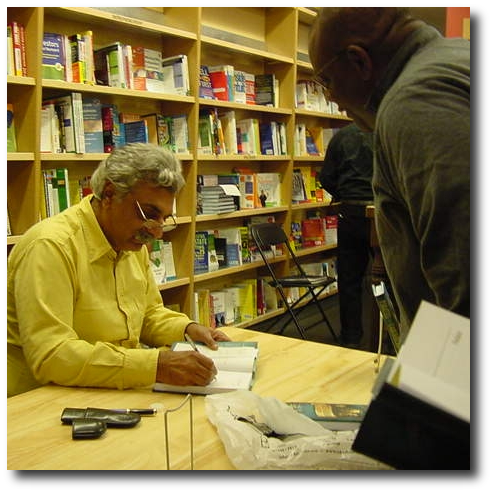
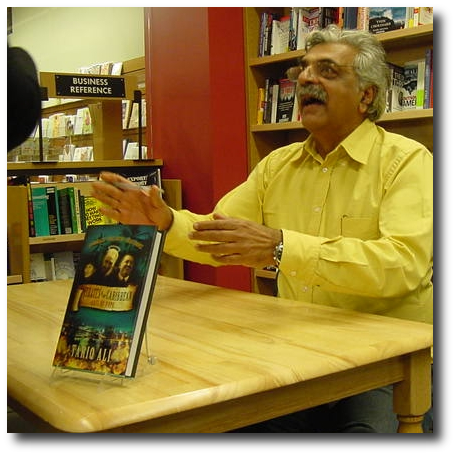
The occasion this evening was a booksigning and presentation about his latest book at Cody's Bookstore on Stockton Street near Market.
Two days ago, he was in San Francisco being interviewed by David Barsamian (http://tinyurl.com/yds32h). Yesterday he was in Los Angeles (http://tinyurl.com/y38l2t).
Today he was back again in San Francisco.
The occasion this evening was a booksigning and presentation about his latest book at Cody's Bookstore on Stockton Street near Market.
San Francisco
October 27, 2006
The crescent moon had put on a little weight since Tariq Ali was in San Francisco last. Close outside of San Francisco's Cody's Books, thousands of revel ling bicyclists celebrated their monthly tradition called "Critical Mass"-- taking over the streets in open and joyous rebellion against an automobile dominated consumer society. For blocks around, confounded drivers stewed, while waves of pedal-powered vehicles sailed freely up Market Street toward the Castro. Asked if he had seen the ritual demonstration, Tariq Ali answered affirmatively, clearly delighted.
From a podium set somewhat incongruously (one person pointed out) in the bookstore's Business section, Ali described his latest book about revolutionary change in Latin America called Pirates of the Caribbean: Axis of Hope.
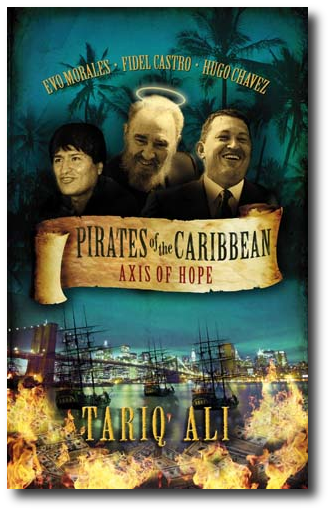
He began by describing how Verso, his publisher in London, went into "mega-panic" about the book's design when Fidel Castro fell ill. The cover wrapper shows portraits of the three "pirates" of Latin America, Evo Morales, Fidel Castro, and Hugo Chávez. "What if Fidel dies?" some were asking. Ali's answer was "Look don't panic, just put a halo around him!" (Which they did-- suiting everyone.)
Ali introduced his book by explaining his purpose for calling the three leaders "pirates". Like pirates, he said, Morales, Castro, and Chávez are considered villains by powerful nation states that fear losing any of their power. The three modern "pirates" are widely slandered and feared, not for being outlaws, but rather for building more democratic and egalitarian societies for their peoples-- acts which threaten the authority of powerful selfish interests in the world.
Tariq Ali discussed the main topic of his book-- Venezuela, an ignored country until Chávez was elected. He described how Venezuela's Bolivarian Revolutionary Movement grew out of a defeat.
Briefly, in 1989 Venezuela's President, Carlos Andrés Pérez of the social democratic party (Acción Democrática), caved to IMF demands for implementing harsh economic policies. Venezuelans took to the streets to protest in a "semi-insurrection" (called the caracazo, it was hardly reported). Two to three thousand people were shot dead in the streets-- and buried in mass graves).
With others, the lieutenant colonel and paratrooper, Hugo Chávez argued that the purpose of the military was to defend Venezuela from foreign invasion-- not to shoot its own people.
After conspiring in a failed attempt to overthrow the government in 1992, Chávez did something quite exceptional, according to Ali: Chávez went on television to call for a ceasefire and added, "I am really sorry we botched this. I accept responsibility."
Outside of Venezuela's ruling oligarchy, Chávez's popularity soared. In a thoroughly corrupt society, his act of taking responsibility was hardly known or expected.
Then, according to Ali, two things happened.
First, Fidel Castro took notice of Chávez and invited him to give a lecture in Cuba. Although Chávez felt barely noticed on his first trip there, Castro had carefully sized him up and was impressed by his timbre. Chávez had won a trustworthy ally who would afterwards come to his aid when in need.
Second, after being released from prison (for his part in the failed coup), Bolivarians put Hugo Chávez up for a presidential election which he won. Chávez pledged to use Venezuela's oil wealth to change the conditions of its poor-- and then by slowly and cautiously working within the system as it existed, he "did it."
Rather than being outrageous, Ali said Chávez's government policies are best described as being like a combination of Franklin Roosevelt's New Deal policies and Leftist Social Democratic policies implemented in Europe after World War II.
Chávez (paraphrasing Ali) has "not taken property away from the wealthy." Nor has Chávez has disrupted or fettered privately owned (mostly monopolized) media which is largely against him.
Within his country and without, Chávez is for many (paraphrasing) "the only political leader today who speaks for those who are without speech or representation."
"When will the Arab world produce a Chávez?" asked Tariq Ali rhetorically.
The answer to that question, he suggested, goes to the heart of what preys on the minds of many in the Arab World and those who fear their arousal. If Chávez can use his oil to help his people-- why can't an Arab leader do the same? The fact that Muslims are paying attention to an infidel is itself quite extraordinary. Ali cited the example of Hassan Nasrallah's statement of gratitude to Venezuela when Chávez withdrew his ambassador from Israel after Israel invaded Lebanon this year.
Ali briefly mentioned Brazilian and Mexican politics vis-à-vis Venezuela's Revolution and Washington's interpretation of it. He described Washington's appreciation of Brazil in terms of "Lula-Good, Chávez-Bad." [Brazil's president, Luiz Inácio Lula da Silva, is understood to have servilely implemented harsh austerity measures against his people to comply with IMF and World Bank debt restructuring demands, whereas Chávez has put his people first by convincing international petroleum corporations to accept lower profits if they want to do business in Venezuela.]
Mexico's Andrés Manuel López Obrador should have won Mexico's recent election, said Ali, even though only his foreign policy might have challenged the status quo. Still, that was threat enough to the powers that be-- and the status quo ensured his opponent's victory-- by theft.
Tariq Ali went on to describe how Washington was mortified by Chávez's political reforms and plotted with accomplices in Venezuela to engineer a coup d'état.
In 2002, Chávez was arrested, and his daughter revealed that he had not resigned as his captors alleged.
Mass demonstrations and mayhem ensued and people surrounded Miraflores, the Venezuelan "White House".
Confronted with popular mass mobilization and a mutiny of the Venezuelan army and its junior officers, the "oligarchy realized its failure."
Chávez was reinstated as President but his troubles were not over.
Tariq Ali explained that the oligarchy continued to continually harass him by masterminding resistance in every way conceivable.
Rather than react by clamping down on his opponents when they produced forged recall petitions in 2003, Chávez accepted a Constitutionally prescribed referendum election which drew many international observers. When the election was over, said Ali, one observer, former U.S. president Jimmy Carter, had declared, "This is the freest and most honest election I have ever witnessed." Eliciting much laughter from his listeners, Ali quipped (paraphrasing), "I wonder what Carter thought of all those elections he himself had ever participated in?"
Tariq Ali then described how he learned from conversing with Hugo Chávez that the leader was more troubled by the strikes his opponents had fomented among the middle classes against him than by the election his opponents had foisted on him. The strikes hurt him most because of the hardships they incurred on the poor who supported him. Tariq quoted Chávez:
"I remember one day I got fed up of sitting in this place [Miraflores]. I decided to go to the barrios on the hills and with one guard and two comrades I drove out to listen to people and breathe better air. The response moved me greatly. A woman came up to me and said, 'Chávez, follow me, I want to show you something.' I followed her to her tiny dwelling . Inside the room her children and husband were waiting for the soup to be cooked. 'Look at what I am using for fuel', she said to me. 'The back of our bed. Tomorrow I'll burn the legs, the day after the table, then the chairs and the doors. We will survive, but don't give up now.' On my way out the kids from the gangs came and shook hands. 'We can live without beer. You make sure you screw these...' People were very angry, but they knew who was responsible and we were getting similar reports from all over the country. The middle classes hurt themselves a great deal by that strike."
During the strike, Cuba flew in fourteen and a half thousand doctors to tend to the people's ills, while Chávez crafted ways to reorganize Venezuelan society to alleviate poverty without alienating the haves.
Tariq Ali continued his presentation at Cody's by assessing the reaction of others to Chávez's Bolivarian Revolution.
Freshly arrived from Los Angeles where he had yesterday spoken at the UCLA Latin American Center, Ali professed how the Revolution was having a "big effect" on growing numbers of Americans who speak Spanish-- much to the consternation of people like the political scientist Samuel P. Huntington (who believes immigrants are a threat to the U.S. ruling elite), and Pat Robertson (a "kooky Republican" who had called for Chávez's assassination).
Tariq concluded his talk by quoting a memorandum written in 1783 (the year Simón Bolívar, the Latin American hero from whom the Bolivarian Movement takes its name, was born) by a thoughtful Spaniard to advise his king:
"Great possessions cannot be held forever. The present situation is rendered more difficult by the enormous distances, which hampers the dispatch of help, by the slowness of the authorities and the selfishness of the government... That pygmy republic (U.S.), which today needs France and Spain to exist at all, will one day grow into a colossus, will forget all the benefits it has received at the hands of both powers and will dream only of might. The freedom of the conscience, the growth of a huge population in that vast territory, the advantages of the new government, will draw workmen and peasants from all countries, for men pursue success, and the time will come when we shall painfully feel the tyranny of the giant. It will then attempt to get Florida and the Gulf of Mexico into its power, will hamper our trade with New Spain and endeavor to conquer it, since the two countries are strong and adjacent, while we shall hardly be able to defend it. These apprehensions, Sire, are only too well founded, unless their realization is forestalled by other, yet graver changes in our parts of America. Everything will combine to urge our subjects to fight for their independence at the earliest opportunity.
We should therefore give up all our possessions, retaining only Cuba and Puerto Rico in the north and a small part of the south to provide us with ports for our trade. To realize this great idea in a way worthy of Spain, three Infantes should be made kings of Mexico, Peru, and the Costa Ferma, Your Majesty receiving the title of Emperor. Trade should be built up on terms of perfect equality. The four nations must feel themselves bound by an alliance, offensive and defensive, for their common welfare. Since our industry is unable to provide America with all necessities, France must send them; England on the other hand must be rigorously excluded..."
The king dismissed the author's advice said Ali, "but his predictions became absolutely true."
Could it be that here is a lesson today for people trying to understand some of the more hopeful changes taking place in the world?
Tariq then informally addressed various questions from the modest audience.
[Abbreviated:]
Iraq?
Tariq Ali: A total disaster.
American politics?
Tariq Ali: There is no worthy opposition party.
What will happen when Fidel Castro dies?
Tariq Ali: The U.S. will pour money into Cuba and hope that Cubans will cut some sort of deal. Cubans will be wary because they have seen what has happened to Russia and Eastern Europe. They should try to hold on to what is best in their society (education, medicine). As the workshop of the world, China can supply Cuba.
TeleSur?
Tariq Ali: An alternative to taking over existing television networks. Ali said that he had once suggested that the network be named "Al-Bolivar".
Other questions asked which drew thoughtful discussion:
What has become of the American Left?
Where was it in the years when Hugo Chávez was oppressed (before the 2004 Referendum election)?
Tariq Ali related how many leftists could not relate to Chávez because he came from the military, a prejudiced notion.
How many terms does Chávez have? Ali said he did not know.
[The 1999 Venezuelan Constitution increased the presidential term of office from five to six years, and allows two consecutive presidential terms.]
Tariq Ali noted that Venezuela has seven consulates in the U.S. where probably about half are filled with people who do not eagerly support him.
One woman related her work in the barrios in Venezuela and exclaimed her surprise over people's recent and widespread interest in reading history and literature, to which Ali remarked how on the 400th anniversary of the book Don Quixote by Miguel de Cervantes-- the Venezuelan government gave an edition to every household.
"Free!" exclaimed the woman.
"Yes, free." (Replied Ali.)
"How much longer do you think you will be allowed to travel to America?" asked one wag.
That would depend on Homeland Security-- Ali chuckled, "if David Horowitz and Christopher Hitchens could have their way!"
Then, in mutually felt good spirits, Tariq Ali autographed books for those who had them.
Useful links:
Tariq Ali
http://www.tariqali.org/
Pirates of the Caribbean: Axis of Hope
Cody's Bookstore
http://www.codysbooks.com/index.jsp
Critical Mass
http://en.wikipedia.org/wiki/Critical_Mass
This report is lightly edited.
Please direct corrections and criticisms to the comments below.
October 27, 2006
The crescent moon had put on a little weight since Tariq Ali was in San Francisco last. Close outside of San Francisco's Cody's Books, thousands of revel ling bicyclists celebrated their monthly tradition called "Critical Mass"-- taking over the streets in open and joyous rebellion against an automobile dominated consumer society. For blocks around, confounded drivers stewed, while waves of pedal-powered vehicles sailed freely up Market Street toward the Castro. Asked if he had seen the ritual demonstration, Tariq Ali answered affirmatively, clearly delighted.
From a podium set somewhat incongruously (one person pointed out) in the bookstore's Business section, Ali described his latest book about revolutionary change in Latin America called Pirates of the Caribbean: Axis of Hope.
He began by describing how Verso, his publisher in London, went into "mega-panic" about the book's design when Fidel Castro fell ill. The cover wrapper shows portraits of the three "pirates" of Latin America, Evo Morales, Fidel Castro, and Hugo Chávez. "What if Fidel dies?" some were asking. Ali's answer was "Look don't panic, just put a halo around him!" (Which they did-- suiting everyone.)
Ali introduced his book by explaining his purpose for calling the three leaders "pirates". Like pirates, he said, Morales, Castro, and Chávez are considered villains by powerful nation states that fear losing any of their power. The three modern "pirates" are widely slandered and feared, not for being outlaws, but rather for building more democratic and egalitarian societies for their peoples-- acts which threaten the authority of powerful selfish interests in the world.
Tariq Ali discussed the main topic of his book-- Venezuela, an ignored country until Chávez was elected. He described how Venezuela's Bolivarian Revolutionary Movement grew out of a defeat.
Briefly, in 1989 Venezuela's President, Carlos Andrés Pérez of the social democratic party (Acción Democrática), caved to IMF demands for implementing harsh economic policies. Venezuelans took to the streets to protest in a "semi-insurrection" (called the caracazo, it was hardly reported). Two to three thousand people were shot dead in the streets-- and buried in mass graves).
With others, the lieutenant colonel and paratrooper, Hugo Chávez argued that the purpose of the military was to defend Venezuela from foreign invasion-- not to shoot its own people.
After conspiring in a failed attempt to overthrow the government in 1992, Chávez did something quite exceptional, according to Ali: Chávez went on television to call for a ceasefire and added, "I am really sorry we botched this. I accept responsibility."
Outside of Venezuela's ruling oligarchy, Chávez's popularity soared. In a thoroughly corrupt society, his act of taking responsibility was hardly known or expected.
Then, according to Ali, two things happened.
First, Fidel Castro took notice of Chávez and invited him to give a lecture in Cuba. Although Chávez felt barely noticed on his first trip there, Castro had carefully sized him up and was impressed by his timbre. Chávez had won a trustworthy ally who would afterwards come to his aid when in need.
Second, after being released from prison (for his part in the failed coup), Bolivarians put Hugo Chávez up for a presidential election which he won. Chávez pledged to use Venezuela's oil wealth to change the conditions of its poor-- and then by slowly and cautiously working within the system as it existed, he "did it."
Rather than being outrageous, Ali said Chávez's government policies are best described as being like a combination of Franklin Roosevelt's New Deal policies and Leftist Social Democratic policies implemented in Europe after World War II.
Chávez (paraphrasing Ali) has "not taken property away from the wealthy." Nor has Chávez has disrupted or fettered privately owned (mostly monopolized) media which is largely against him.
Within his country and without, Chávez is for many (paraphrasing) "the only political leader today who speaks for those who are without speech or representation."
"When will the Arab world produce a Chávez?" asked Tariq Ali rhetorically.
The answer to that question, he suggested, goes to the heart of what preys on the minds of many in the Arab World and those who fear their arousal. If Chávez can use his oil to help his people-- why can't an Arab leader do the same? The fact that Muslims are paying attention to an infidel is itself quite extraordinary. Ali cited the example of Hassan Nasrallah's statement of gratitude to Venezuela when Chávez withdrew his ambassador from Israel after Israel invaded Lebanon this year.
Ali briefly mentioned Brazilian and Mexican politics vis-à-vis Venezuela's Revolution and Washington's interpretation of it. He described Washington's appreciation of Brazil in terms of "Lula-Good, Chávez-Bad." [Brazil's president, Luiz Inácio Lula da Silva, is understood to have servilely implemented harsh austerity measures against his people to comply with IMF and World Bank debt restructuring demands, whereas Chávez has put his people first by convincing international petroleum corporations to accept lower profits if they want to do business in Venezuela.]
Mexico's Andrés Manuel López Obrador should have won Mexico's recent election, said Ali, even though only his foreign policy might have challenged the status quo. Still, that was threat enough to the powers that be-- and the status quo ensured his opponent's victory-- by theft.
Tariq Ali went on to describe how Washington was mortified by Chávez's political reforms and plotted with accomplices in Venezuela to engineer a coup d'état.
In 2002, Chávez was arrested, and his daughter revealed that he had not resigned as his captors alleged.
Mass demonstrations and mayhem ensued and people surrounded Miraflores, the Venezuelan "White House".
Confronted with popular mass mobilization and a mutiny of the Venezuelan army and its junior officers, the "oligarchy realized its failure."
Chávez was reinstated as President but his troubles were not over.
Tariq Ali explained that the oligarchy continued to continually harass him by masterminding resistance in every way conceivable.
Rather than react by clamping down on his opponents when they produced forged recall petitions in 2003, Chávez accepted a Constitutionally prescribed referendum election which drew many international observers. When the election was over, said Ali, one observer, former U.S. president Jimmy Carter, had declared, "This is the freest and most honest election I have ever witnessed." Eliciting much laughter from his listeners, Ali quipped (paraphrasing), "I wonder what Carter thought of all those elections he himself had ever participated in?"
Tariq Ali then described how he learned from conversing with Hugo Chávez that the leader was more troubled by the strikes his opponents had fomented among the middle classes against him than by the election his opponents had foisted on him. The strikes hurt him most because of the hardships they incurred on the poor who supported him. Tariq quoted Chávez:
"I remember one day I got fed up of sitting in this place [Miraflores]. I decided to go to the barrios on the hills and with one guard and two comrades I drove out to listen to people and breathe better air. The response moved me greatly. A woman came up to me and said, 'Chávez, follow me, I want to show you something.' I followed her to her tiny dwelling . Inside the room her children and husband were waiting for the soup to be cooked. 'Look at what I am using for fuel', she said to me. 'The back of our bed. Tomorrow I'll burn the legs, the day after the table, then the chairs and the doors. We will survive, but don't give up now.' On my way out the kids from the gangs came and shook hands. 'We can live without beer. You make sure you screw these...' People were very angry, but they knew who was responsible and we were getting similar reports from all over the country. The middle classes hurt themselves a great deal by that strike."
During the strike, Cuba flew in fourteen and a half thousand doctors to tend to the people's ills, while Chávez crafted ways to reorganize Venezuelan society to alleviate poverty without alienating the haves.
Tariq Ali continued his presentation at Cody's by assessing the reaction of others to Chávez's Bolivarian Revolution.
Freshly arrived from Los Angeles where he had yesterday spoken at the UCLA Latin American Center, Ali professed how the Revolution was having a "big effect" on growing numbers of Americans who speak Spanish-- much to the consternation of people like the political scientist Samuel P. Huntington (who believes immigrants are a threat to the U.S. ruling elite), and Pat Robertson (a "kooky Republican" who had called for Chávez's assassination).
Tariq concluded his talk by quoting a memorandum written in 1783 (the year Simón Bolívar, the Latin American hero from whom the Bolivarian Movement takes its name, was born) by a thoughtful Spaniard to advise his king:
"Great possessions cannot be held forever. The present situation is rendered more difficult by the enormous distances, which hampers the dispatch of help, by the slowness of the authorities and the selfishness of the government... That pygmy republic (U.S.), which today needs France and Spain to exist at all, will one day grow into a colossus, will forget all the benefits it has received at the hands of both powers and will dream only of might. The freedom of the conscience, the growth of a huge population in that vast territory, the advantages of the new government, will draw workmen and peasants from all countries, for men pursue success, and the time will come when we shall painfully feel the tyranny of the giant. It will then attempt to get Florida and the Gulf of Mexico into its power, will hamper our trade with New Spain and endeavor to conquer it, since the two countries are strong and adjacent, while we shall hardly be able to defend it. These apprehensions, Sire, are only too well founded, unless their realization is forestalled by other, yet graver changes in our parts of America. Everything will combine to urge our subjects to fight for their independence at the earliest opportunity.
We should therefore give up all our possessions, retaining only Cuba and Puerto Rico in the north and a small part of the south to provide us with ports for our trade. To realize this great idea in a way worthy of Spain, three Infantes should be made kings of Mexico, Peru, and the Costa Ferma, Your Majesty receiving the title of Emperor. Trade should be built up on terms of perfect equality. The four nations must feel themselves bound by an alliance, offensive and defensive, for their common welfare. Since our industry is unable to provide America with all necessities, France must send them; England on the other hand must be rigorously excluded..."
The king dismissed the author's advice said Ali, "but his predictions became absolutely true."
Could it be that here is a lesson today for people trying to understand some of the more hopeful changes taking place in the world?
Tariq then informally addressed various questions from the modest audience.
[Abbreviated:]
Iraq?
Tariq Ali: A total disaster.
American politics?
Tariq Ali: There is no worthy opposition party.
What will happen when Fidel Castro dies?
Tariq Ali: The U.S. will pour money into Cuba and hope that Cubans will cut some sort of deal. Cubans will be wary because they have seen what has happened to Russia and Eastern Europe. They should try to hold on to what is best in their society (education, medicine). As the workshop of the world, China can supply Cuba.
TeleSur?
Tariq Ali: An alternative to taking over existing television networks. Ali said that he had once suggested that the network be named "Al-Bolivar".
Other questions asked which drew thoughtful discussion:
What has become of the American Left?
Where was it in the years when Hugo Chávez was oppressed (before the 2004 Referendum election)?
Tariq Ali related how many leftists could not relate to Chávez because he came from the military, a prejudiced notion.
How many terms does Chávez have? Ali said he did not know.
[The 1999 Venezuelan Constitution increased the presidential term of office from five to six years, and allows two consecutive presidential terms.]
Tariq Ali noted that Venezuela has seven consulates in the U.S. where probably about half are filled with people who do not eagerly support him.
One woman related her work in the barrios in Venezuela and exclaimed her surprise over people's recent and widespread interest in reading history and literature, to which Ali remarked how on the 400th anniversary of the book Don Quixote by Miguel de Cervantes-- the Venezuelan government gave an edition to every household.
"Free!" exclaimed the woman.
"Yes, free." (Replied Ali.)
"How much longer do you think you will be allowed to travel to America?" asked one wag.
That would depend on Homeland Security-- Ali chuckled, "if David Horowitz and Christopher Hitchens could have their way!"
Then, in mutually felt good spirits, Tariq Ali autographed books for those who had them.
Useful links:
Tariq Ali
http://www.tariqali.org/
Pirates of the Caribbean: Axis of Hope
Cody's Bookstore
http://www.codysbooks.com/index.jsp
Critical Mass
http://en.wikipedia.org/wiki/Critical_Mass
This report is lightly edited.
Please direct corrections and criticisms to the comments below.
For more information:
http://tinyurl.com/y7u989
Add Your Comments
Comments
(Hide Comments)
Here is a link to get the book by Tariq Ali:
For more information:
http://www.codysbooks.com/product/info.jsp...
Tariq Ali recommended this incredible film as a "must see."
The Revolution Will Not Be Televised
A film by Kim Bartley and Donnacha O'Briain
Information Clearinghouse describes it:
[This] film records what was probably history's shortest-lived coup d'état. It's a unique document about political muscle and an extraordinary portrait of the man The Wall Street Journal credits with making Venezuela "Washington's biggest Latin American headache after the old standby, Cuba."
Chavez, elected president of Venezuela in 1988, is a colorful folk hero, beloved by his nation's working class and a tough-as-nails, quixotic opponent to the power structure that would see him deposed. Two independent filmmakers were inside the presidential palace on April 11, 2002, when he was forcibly removed from office. They were also present 48 hours later when, remarkably, he returned to power amid cheering aides.
The Revolution Will Not Be Televised
A film by Kim Bartley and Donnacha O'Briain
Information Clearinghouse describes it:
[This] film records what was probably history's shortest-lived coup d'état. It's a unique document about political muscle and an extraordinary portrait of the man The Wall Street Journal credits with making Venezuela "Washington's biggest Latin American headache after the old standby, Cuba."
Chavez, elected president of Venezuela in 1988, is a colorful folk hero, beloved by his nation's working class and a tough-as-nails, quixotic opponent to the power structure that would see him deposed. Two independent filmmakers were inside the presidential palace on April 11, 2002, when he was forcibly removed from office. They were also present 48 hours later when, remarkably, he returned to power amid cheering aides.
For more information:
http://www.informationclearinghouse.info/a...
Brazil's working class leader wins landslide second term victory
· Lula's aid for poor helps dispel graft allegations
· Leftwingers hope for more radical change
Tom Phillips om Novo Progresso
Monday October 30, 2006
EXCERPT:
In recent weeks, however, Lula has managed to steer the political agenda away from graft allegations, instead focusing on his government's achievements in reducing poverty.
In Brazil's impoverished rural areas, where government officials say welfare projects such as Bolsa Familia (family grant) have reached around 11 million families, such a message has struck a chord. "No president has ever done so much for the poor," said Antonio Ferreira de Almeida Silva, a rural workers' leader in the isolated south of the Amazonian state of Para. "No, it hasn't been perfect, but at least he wants to help us."
Meanwhile, cabinet members have promised a dramatic post-election change in economic policy. Yesterday the minister for institutional relations, Tarso Genro, told reporters to expect a departure from an orthodox economic policy that had been widely criticised by leftwingers hoping for more radical change following Lula's historic election in 2002.
"The Palocci era is over in Brazil," Mr Genro said, in reference to Antonio Palocci, Lula's former finance minister, who was widely seen as the architect of the country's conservative economic policy. "[Low] growth rates, a neurotic preoccupation with inflation, without thinking about income distribution and growth - this is over."
· Lula's aid for poor helps dispel graft allegations
· Leftwingers hope for more radical change
Tom Phillips om Novo Progresso
Monday October 30, 2006
EXCERPT:
In recent weeks, however, Lula has managed to steer the political agenda away from graft allegations, instead focusing on his government's achievements in reducing poverty.
In Brazil's impoverished rural areas, where government officials say welfare projects such as Bolsa Familia (family grant) have reached around 11 million families, such a message has struck a chord. "No president has ever done so much for the poor," said Antonio Ferreira de Almeida Silva, a rural workers' leader in the isolated south of the Amazonian state of Para. "No, it hasn't been perfect, but at least he wants to help us."
Meanwhile, cabinet members have promised a dramatic post-election change in economic policy. Yesterday the minister for institutional relations, Tarso Genro, told reporters to expect a departure from an orthodox economic policy that had been widely criticised by leftwingers hoping for more radical change following Lula's historic election in 2002.
"The Palocci era is over in Brazil," Mr Genro said, in reference to Antonio Palocci, Lula's former finance minister, who was widely seen as the architect of the country's conservative economic policy. "[Low] growth rates, a neurotic preoccupation with inflation, without thinking about income distribution and growth - this is over."
For more information:
http://www.guardian.co.uk/brazil/story/0,,...
L.A. Sound Posse: Tariq Ali: The Latin American Challenge: Chavez, Morales, Castro
Introduced by Dr. Robert Brenner, Tariq Ali speaks on "The Latin American Challenge: Chavez, Morales, Castro" and a broad range events surrounding his most current book: "Pirates of the Caribbean: Axis of Hope".
Credits: L.A. Sound Posse
Notes: Tariq Ali speaks on "The Latin American Challenge: Chavez, Morales, Castro" and a broad range events surrounding his most current book: "Pirates of the Caribbean: Axis of Hope". Co-sponsored by The Center for Social Theory and Comparative History and the U.C.L.A. Latin American Center.
The talk runs for 38 minutes followed by rich q+a.
Author most recently of: Bush in Babylon (Verso, 2002) A Clash of Fundamentalisms: Crusades, Jihads, and Modernity (Verso, 2003) Pirates of the Caribbean: The Axis of Hope (Verso 2006)
A revolution is moving across Latin America.
Since 1998, the Bolivarian revolution in Venezuela has brought Hugo Chavez to world attention as the foremost challenger of the neoliberal consensus and American foreign policy. While Chavez's radical social-democratic reforms have brought him worldwide acclaim among the poor, he has attracted intense hostility from Venezuelan elites and Western governments.
Drawing on first-hand experience of Venezuela and meetings with Chavez, Tariq Ali shows how Chavez's views have polarized Latin America and examines the aggression directed against his administration. Ali discusses the enormous influence of Fidel Castro on both Chavez and Evo Morales, the newly elected President of Bolivia and, reflecting on a recent trip to Havana, contrasts the Cuban and Venezuelan revolutionary processes.
Pirates of the Caribbean guides us through a world divided between privilege and poverty, a continent that is once again on the march.
links:
Center for Social Theory and Comparative History
http://www.sscnet.ucla.edu/issr/cstch/
This program was produced by the L.A. Sound Posse and is licensed under
a Creative Commons, attribution, non-commercial, share alike, 2.5 license to ensure the ongoing public availability of these recordings. It is available for non-commercial
distribution. Please copy and share it with others, thus directly participating in a civic media distribution system. We seek and invite all forms of distribution, so contact us for any and all other opportunities.
If you air our recordings, we would very much like to know. Please email
us at
posse [at] lasoundposse.org
Link to Downloadable audio (mp3):
Introduced by Dr. Robert Brenner, Tariq Ali speaks on "The Latin American Challenge: Chavez, Morales, Castro" and a broad range events surrounding his most current book: "Pirates of the Caribbean: Axis of Hope".
Credits: L.A. Sound Posse
Notes: Tariq Ali speaks on "The Latin American Challenge: Chavez, Morales, Castro" and a broad range events surrounding his most current book: "Pirates of the Caribbean: Axis of Hope". Co-sponsored by The Center for Social Theory and Comparative History and the U.C.L.A. Latin American Center.
The talk runs for 38 minutes followed by rich q+a.
Author most recently of: Bush in Babylon (Verso, 2002) A Clash of Fundamentalisms: Crusades, Jihads, and Modernity (Verso, 2003) Pirates of the Caribbean: The Axis of Hope (Verso 2006)
A revolution is moving across Latin America.
Since 1998, the Bolivarian revolution in Venezuela has brought Hugo Chavez to world attention as the foremost challenger of the neoliberal consensus and American foreign policy. While Chavez's radical social-democratic reforms have brought him worldwide acclaim among the poor, he has attracted intense hostility from Venezuelan elites and Western governments.
Drawing on first-hand experience of Venezuela and meetings with Chavez, Tariq Ali shows how Chavez's views have polarized Latin America and examines the aggression directed against his administration. Ali discusses the enormous influence of Fidel Castro on both Chavez and Evo Morales, the newly elected President of Bolivia and, reflecting on a recent trip to Havana, contrasts the Cuban and Venezuelan revolutionary processes.
Pirates of the Caribbean guides us through a world divided between privilege and poverty, a continent that is once again on the march.
links:
Center for Social Theory and Comparative History
http://www.sscnet.ucla.edu/issr/cstch/
This program was produced by the L.A. Sound Posse and is licensed under
a Creative Commons, attribution, non-commercial, share alike, 2.5 license to ensure the ongoing public availability of these recordings. It is available for non-commercial
distribution. Please copy and share it with others, thus directly participating in a civic media distribution system. We seek and invite all forms of distribution, so contact us for any and all other opportunities.
If you air our recordings, we would very much like to know. Please email
us at
posse [at] lasoundposse.org
Link to Downloadable audio (mp3):
For more information:
http://www.radio4all.net/index.php?op=prog...
The excellent program Against the Grain which aire at 12 noon Pacific time Mondays, Tuesdays, and Wednesdays has just provided a recording of Tariq Ali's presentation at Cody's Bookstore which anyone can listen to via KPFA's archived programs and from the webpage for Against the Grain.
direct mp3 download:
http://www.againstthegrain.org/audio2.05.07.mp3
Website for Against the Grain:
direct mp3 download:
http://www.againstthegrain.org/audio2.05.07.mp3
Website for Against the Grain:
For more information:
http://www.againstthegrain.org/
An Interview with Tariq Ali
Latin America and Its Axis of Hope
By RODRIGO ACUÑA
In late 2006 I reviewed Tariq Ali's new book Pirates of the Caribbean: Axis of Hope, which aims to explain the new rise of the political left in Latin America. On June 27 this year, I had the chance to interview Ali in Sydney, Australia around the issues raised in his book. Ali's links to Latin America stretch back four decades as in 1967, he travelled to Bolivia as a member of the Bertrand Russell Peace Foundation to observe the trial of Régis Debray as Che Guevara aimed to create a new revolution.
A current member of the advisory board of TeleSur, a joint venture by Venezuela, Argentina , Cuba, Uruguay, Bolivia and now Ecuador, to establish a television network to counter US hegemony, Ali has held numerous conversations with the Venezuelan President Hugo Chávez, as well as other high-ranking officials in Cuba, Bolivia and Ecuador. An author of almost thirty books, Tariq Ali is also an editor of the New Left Review. The following is a complete transcript of my interview with Ali:
[Read it all at this link:]
Latin America and Its Axis of Hope
By RODRIGO ACUÑA
In late 2006 I reviewed Tariq Ali's new book Pirates of the Caribbean: Axis of Hope, which aims to explain the new rise of the political left in Latin America. On June 27 this year, I had the chance to interview Ali in Sydney, Australia around the issues raised in his book. Ali's links to Latin America stretch back four decades as in 1967, he travelled to Bolivia as a member of the Bertrand Russell Peace Foundation to observe the trial of Régis Debray as Che Guevara aimed to create a new revolution.
A current member of the advisory board of TeleSur, a joint venture by Venezuela, Argentina , Cuba, Uruguay, Bolivia and now Ecuador, to establish a television network to counter US hegemony, Ali has held numerous conversations with the Venezuelan President Hugo Chávez, as well as other high-ranking officials in Cuba, Bolivia and Ecuador. An author of almost thirty books, Tariq Ali is also an editor of the New Left Review. The following is a complete transcript of my interview with Ali:
[Read it all at this link:]
For more information:
http://www.counterpunch.org/acuna07052007....
We are 100% volunteer and depend on your participation to sustain our efforts!
Donate

$110.00 donated
in the past month
Get Involved
If you'd like to help with maintaining or developing the website, contact us.
Publish
Publish your stories and upcoming events on Indybay.
Topics
More
Search Indybay's Archives
Advanced Search
►
▼
IMC Network