







 Publish to Newswire
 Add an Event
From the Open-Publishing Calendar
From the Open-Publishing Newswire
Indybay Feature
'655,000 Iraqis killed since invasion'
The death toll among Iraqis as a result of the US-led invasion has now reached an estimated 655,000, a study in the Lancet medical journal reports today.
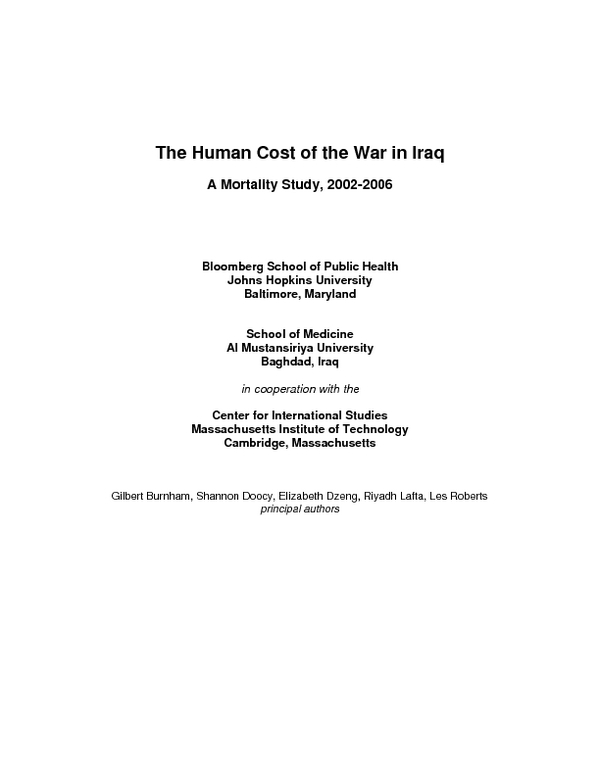
The figure for the number of deaths attributable to the conflict - which amounts to around 2.5% of the population - is at odds with figures cited by the US and UK governments and will cause a storm, but the Lancet says the work, from the Johns Hopkins Bloomberg School of Public Health in Baltimore, has been examined and validated by four separate independent experts who all urged publication.
In October 2004, the same researchers published a study estimating that 100,000 Iraqis had died as a result of the war since the beginning of the March 2003 invasion, a figure that was hugely controversial. Their new study, they say, reaffirms the accuracy of their survey of two years ago and moves it on.
"Although such death rates might be common in times of war, the combination of a long duration and tens of millions of people affected has made this the deadliest international conflict of the 21st century and should be of grave concern to everyone," write the authors, Gilbert Burnham and colleagues.
"At the conclusion of our 2004 study we urged that an independent body assess the excess mortality that we saw in Iraq. This has not happened. We continue to believe that an independent international body to monitor compliance with the Geneva conventions and other humanitarian standards in conflict is urgently needed. With reliable data, those voices that speak out for civilians trapped in conflict might be able to lessen the tragic human cost of future wars."
Read More
http://www.guardian.co.uk/Iraq/Story/0,,1892888,00.html
In October 2004, the same researchers published a study estimating that 100,000 Iraqis had died as a result of the war since the beginning of the March 2003 invasion, a figure that was hugely controversial. Their new study, they say, reaffirms the accuracy of their survey of two years ago and moves it on.
"Although such death rates might be common in times of war, the combination of a long duration and tens of millions of people affected has made this the deadliest international conflict of the 21st century and should be of grave concern to everyone," write the authors, Gilbert Burnham and colleagues.
"At the conclusion of our 2004 study we urged that an independent body assess the excess mortality that we saw in Iraq. This has not happened. We continue to believe that an independent international body to monitor compliance with the Geneva conventions and other humanitarian standards in conflict is urgently needed. With reliable data, those voices that speak out for civilians trapped in conflict might be able to lessen the tragic human cost of future wars."
Read More
http://www.guardian.co.uk/Iraq/Story/0,,1892888,00.html
We are 100% volunteer and depend on your participation to sustain our efforts!
Donate

$85.00 donated
in the past month
Get Involved
If you'd like to help with maintaining or developing the website, contact us.
Publish
Publish your stories and upcoming events on Indybay.
Topics
More
Search Indybay's Archives
Advanced Search
►
▼
IMC Network
The research compares mortality rates before and after the invasion from 47 randomly chosen areas in Iraq.
The figure is considerably higher than estimates by official sources or the number of deaths reported in the media.
Critics have dismissed the findings because they are based on a statistical prediction rather than body counts.
Dr Gilbert Burnham of the John Hopkins Bloomberg School of Public Heath, based in Baltimore, says this method is more reliable, given the dangers of conducting thorough research in strife-torn Iraq.
The estimated death toll is equal to about 2.5% of Iraq's population, and averages out at more than 500 additional deaths a day since the start of the invasion.
Sharp rise
Researchers spoke to nearly 1,850 families, comprising more than 12,800 people in dozens of 40-household clusters around the country.
Of the 629 deaths they recorded among these families, 13% took place in the 14 months before the invasion and 87% in the 40 months afterwards.
Such a trend repeated nationwide would indicate a rise in annual death rates from 5.5 per 1,000 to 13.3 per 1,000.
The researchers say that in nearly 80% of the individual cases, family members produced death certificates to support their answers.
Reliable data is very hard to obtain in Iraq, where anti-US insurgents and sectarian death squads pose a grave danger to civilian researchers.
The survey updates earlier research using the same "cluster" technique which indicated that 100,000 Iraqis had died between the invasion and April 2004 - a figure that was also dismissed by many supporters of the US-led coalition.
More
http://news.bbc.co.uk/2/hi/middle_east/6040054.stm
Violence including gunfire and bombs caused the majority of deaths but thousands of people died from worsening health and environmental conditions directly related to the conflict that began in 2003, U.S. and Iraqi public health researchers said.
"Since March 2003, an additional 2.5 percent of Iraq's population have died above what would have occurred without conflict," according to the survey of Iraqi households, titled "The Human Cost of the War in Iraq."
More
http://www.cnn.com/2006/WORLD/meast/10/11/iraq.deaths/index.html