From the Open-Publishing Calendar
From the Open-Publishing Newswire
Indybay Feature
Israel steals the Palestinian's water then sells it back to them at 15 times the price the illegal Israeli settlers pay
The World Health Organization and the United States Agency for International Development (USAID) recommend 100 liters of water per person per day as the minimum quantity for basic consumption.
The average per-person use in the Occupied Territories is 70 liters a day.
In Israel and the settlements, average water consumption per person is 348 liters a day.
Municipal water consumption of Israeli settlers in the Gaza Strip is 584 liters per person a day, almost seven times greater than comparable consumption among Palestinians in the Gaza Strip.
Three Features of the Water Shortage in the Occupied Territories:
1.) Lack of a Water Network
Among those particularly suffering from the water shortage are residents of villages and refugee camps in the Occupied Territories not connected to a running-water network. In the West Bank alone, as of June 2000, the number of such residents amounted to at least 215,000 persons living in more than 150 villages.
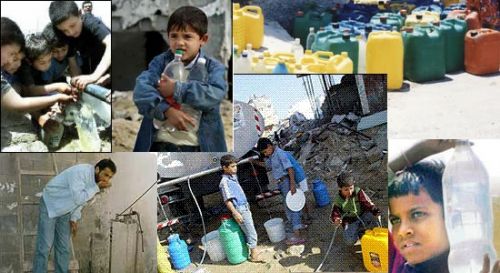
The principal water source for these people is rainwater, which is collected on rooftops and stored in cisterns near each house. This source meets their water-consumption needs for only a few months, generally from November to May. In the summer, these residents must collect water from nearby springs (if such exist) in plastic bottles and jerricans, and purchase water from private dealers at high prices.
2.) Discriminatory and Insufficient Supply of Water
When there is increased demand for water during the hot seasons for both Palestinians and Israeli settlers, Mekorot (the Israeli water company) discriminates and increases the amount of water supplied to the settlers, at the expense of supply to Palestinian towns. Reduction at times when water consumption increases is accomplished by closing the valve of the main water pipelines which direct water to Palestinian towns.
3.) Poor Water Quality
Unlike the West Bank, the worst problem in the Gaza Strip's water sector is not the shortage or irregular supply during the summer, but the poor quality of water flowing through the pipes. The poor condition of the water seriously affects the quality of life of the local residents and exposes them to severe heath risks. The sole local water source is the Gaza Aquifer, from which 96 percent of the water is drawn. Since the 1950s, this aquifer has become polluted and salinated, a process that has worsened with the increased consumption and pumping of water.
The main reason for the increased salt content of the aquifer is "overpumping." What occurs is that the amount of water pumped is appreciably greater than the rainfall that replenishes the aquifer's reserves.
Israel's control of the water sector in the Occupied Territories during the occupation entails violations of human rights and international law ;
1.) Violation of the right to proper subsistence and housing
2.) Violation of the right to health, resulting from the negative public health effect of the water shortage and consumption of poor-quality water
3.) Illegal exploitation of water resources of the Occupied Territories to benefit the settlements
4.) Implementation of a policy of discrimination between Palestinians and settlers in the supply of water.
Israel's water resources lie mainly under Palestinian land.
Villagers drink from wells and collect rain in rooftop tanks for washing.
In the dry summers, they buy water that is often polluted at exorbitant prices from green tractor trucks.
About 130,000 religious Jews live on West Bank land amid two million Palestinians. They make up less than 10 % of the population, but use 80 % of the water
"There is no single Israeli settlement without water, and they have good water and good pipes."
Palestinians say land is inseparable from the water that lies beneath it. They say the water is theirs.
But Israelis say they have a historical right to the water, which they have been tapping for decades.
Economic hardships for Palestinians
The water shortage has created an economic crisis for Arab villages in Gaza and the West Bank, which now cultivate only three percent of their farmland, down from more than a quarter 30 years ago, the Palestinian Hydrology Group said.
The well water is drying up slowly, and Palestinians depend on a new Israeli-Palestinian water committee to get permission to dig new wells.
But that committee has not met since last February, and no new wells have been dug.
"Water is not the dream any more. The approval to find water is the dream now," Tamimi said. "They (the Israelis) reduced the opportunities for self-sufficiency in food."
The decrease in cultivated land comes as travel restrictions imposed by Israel have forced unemployment rates to nearly 40 percent in the West Bank and 60 percent in Gaza, according to the Palestinian Monetary Authority.
Most Palestinians, who make an average $652 a year, cannot afford to buy $13 tanks of water every two weeks.
Not only is tank water expensive, it could be dangerous. In Gaza, Tamimi said, the fresh water isn't much better.
"Gaza is a disaster area. They drink water unfit for human beings, and even in some areas like Khan Yunis, they drink water unfit for agriculture," he said, adding that it was polluted with chemicals and pesticides.
Israel's annual consumption rate of water has grown tremendously due to the extended drought and its natural population growth combined with an additional one million immigrants who have come to Israel over the last decade. Shortage of water is probably the most crucial environmental problem facing Israel today, and new solutions must be found and applied to address the dwindling water supply. This also has a direct impact on relations with neighboring Arab countries who are suffering from a similar reality while vying for the shared water resources this challenge while resources continue to decrease due to drought and overuse.
Israel's Appropriation of Arab Water: An Obstacle to Peace
"Israel's designs on Lebanese water," MEI, 10 September 93 [No. 458] p. 18.)
50% or more of the water that Israel uses is unilaterally appropriated from water that should fairly go to its Arab neighbors. Even the New York Times used the word "theft" when quoting an "Arab" in connection with Israel's appropriation of regional water resources. ("Hurdle to Peace: Parting the Mideast's Waters" by Alan Cowell NYT, 10.10.93 p. 1)
Israeli work on diverting the water of the Jordan River was only temporarily suspended -- perhaps for as long as two years. By 1960, however, the diversion project -- which came to be known as the National Water Carrier -- was complete and in fact was the target of the PLO's first (and unsuccessful) attack in 1964.
Jordan and Syria strongly protested Israel's unilateral appropriation of their water because Israel's diversion made local agricultural activity impossible.
Before the Israeli diversion, the U.S. plan apportioned 33% of Jordan River water for Israel's use. As Stephen Green points out, the significance of this figure is that only 23% of the flow of the Jordan River originates in Israel. The Israelis, however, wanted more than 33%. Today, Israel takes virtually all of the Jordan River flow leaving only brackish, unusable water for the Syrians and Jordanians.
THE WEST BANK AND GAZA
Ever since the Israelis captured the West Bank and Gaza in the Six-Day War in 1967, they have strictly controlled the water resources in the territories largely because they have become so dependent on Palestinian water emanating from underground aquifers on the West Bank.
West Bank water not only makes up 30% of the water in Tel Aviv households but also is critical to preserving the pressure balance which keeps the salt water of the Mediterranean from invading the coastal aquifers.
Israel has permitted no new drilling of agricultural wells for water for the Palestinians in the territories and has permitted fewer than a dozen for domestic use. Moreover, the Israelis charge the Palestinians fees that are three times higher than they charge Israelis for water for domestic use (with even higher relative charges in Gaza).
As Sharif Elmusa points out: "in terms of relative GNP per capita, Palestinians pay a minimum of fifteen times more than Israeli consumers -- a phenomenal difference for water systems managed by the same company."
("Dividing the Common Palestinian-Israeli Waters: An International Water Law Approach" in Journal of Palestine Studies, Spring 1993, No. 87, p. 63. See also note 11, p. 74.)
Even in Gaza where the Arab population outnumbers the approximately 5,000 Jewish settlers by more than 170 to 1, the Israeli government appropriates 10-25% of Gaza water for Jews. (see Elmusa, pp. 61)
Amery's analysis suggests that Israel's interest in Lebanon is -- along with its political goals -- to maintain and/or establish control over as much of Lebanese water as possible.
The exclusively Israeli settlements are built on what the international community has recognized as Palestinian land. These gated settlement communities are composed of hundreds of small suburban houses, some with lawns, but all with vegetation and trees surrounding them.
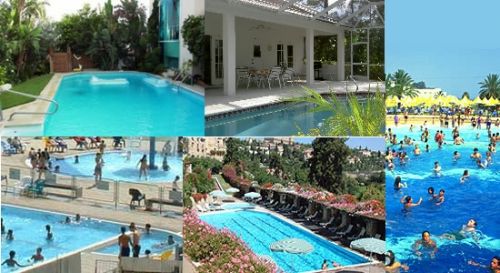
In many settlements you will even see fountains and swimming pools. It is cheap to live in the settlements, as they are heavily subsidized by the Israeli government. Beneath the construction of this settlement are winding paved settler roads. Palestinians are expressly forbidden to use these roads and are forbidden from building within 150 meters of these roads as well.
There are an estimated 400,000 Israelis living in settlements on the West Bank. About two million Palestinians live in the West Bank. In the Gaza Strip there are 1.2 million Palestinians and 5,000 Israeli settlers. These 5,000 settlers, guarded by Israeli military, take fully one-third of the 140-square mile land.
Palestinians view Israeli’s new security fence as further confiscation of their lands. Originally, the route of the fence was along the border between Israel and Palestine, also referred to as the Green Line or the 1967 border. Due to pressure from Israeli settlers, the route now curves deep into Palestinian territory, cutting off more than 85 percent of the West Bank’s agriculture from most of the outlying villages.
Israel allocates approximately 90% of this amount to itself, leaving the Palestinian population just over 10%. If water resources were divided into equal per capita shares, Palestinians would receive approximately 45%.
As a consequence of the Israeli restrictions the Palestinians (3.3 millions) who live in the Occupied Palestinian Territories receive 57-76 litters per capita per day for all uses. But the Israelis use 353 litters of water per day.
Palestinians suffer a severe water shortage due to the Occupation.
Since 1967, the Israeli government has been stealing up to 80% of the groundwater from the"Mountain Reservoir," a group of groundwater aquifers located underneath the mountains of the Occupied West Bank of Palestine, lincluding the Occupied Jerusalem. The Palestinian people are allowed no control of these extensive water resources.
Currently, Israel consumes more than 80 percent of Palestinian ground water and denies Palestinians their rightful utilization of the Jordan River.
Its swimming pools are in glaring contrast to the situation for Palestinians living a few miles down the road, struggling with seven times less water.
Half of those in the poor and densely populated community are children. Many can be seen at the water point, filling bottles and jerry cans. Children like Mahmoud Abdullah, 13, help as best they can with the severe shortage of safe water.
“We are filling water bottles because we have no drinkable water at home, and if water is available it is salty”
Destruction of Water Network
Destruction of Roof Tanks
Destruction of Cisterns
Destruction of Wells
Destruction of Reservoirs
Destruction of Treatment Units
Stopping of Water Supply
Pollution of Water Sources
Exposure of Sewage and Cesspits
Inaccessibility to Medical Care
Inability to Dispose of Solid Waste
Palestinians are punished in four ways over water by Israel:
1.) taking control over Palestinian water.
2.) siphoning away Palestinian water and denying the Palestinians their own resources.
3.) selling the water back to the Palestinians, which is Palestinian in the first place, at fifteen times the rate they sale it to the Israelis.
4.) The quality of water supplied to Palestinians is sub standard and a danger to health.
* Resolution 106: " 'condemns' Israel for Gaza raid".
* Resolution 111: " 'condemns' Israel for raid on Syria that killed fifty-six people".
* Resolution 127: " 'recommends' Israel suspends it's 'no-man's zone' in Jerusalem".
* Resolution 162: " 'urges' Israel to comply with UN decisions".
* Resolution 171: " 'determines' flagrant violations by Israel in its attack on Syria".
* Resolution 228: " 'censures' Israel for its attack on Samu in the West Bank, then under Jordanian control".
* Resolution 237: " 'urges' Israel to allow return of new 1967 Palestinian refugees".
* Resolution 248: " 'condemns' Israel for its massive attack on Karameh in Jordan".
* Resolution 250: " 'calls' on Israel to refrain from holding military parade in Jerusalem".
* Resolution 251: " 'deeply deplores' Israeli military parade in Jerusalem in defiance of
Resolution 250".
* Resolution 252: " 'declares invalid' Israel's acts to unify Jerusalem as Jewish capital".
* Resolution 256: " 'condemns' Israeli raids on Jordan as 'flagrant violation".
* Resolution 259: " 'deplores' Israel's refusal to accept UN mission to probe occupation".
* Resolution 262: " 'condemns' Israel for attack on Beirut airport".
* Resolution 265: " 'condemns' Israel for air attacks for Salt in Jordan".
* Resolution 267: " 'censures' Israel for administrative acts to change the status of Jerusalem".
* Resolution 270: " 'condemns' Israel for air attacks on villages in southern Lebanon".
* Resolution 271: " 'condemns' Israel's failure to obey UN resolutions on Jerusalem".
* Resolution 279: " 'demands' withdrawal of Israeli forces from Lebanon".
* Resolution 280: " 'condemns' Israeli's attacks against Lebanon".
* Resolution 285: " 'demands' immediate Israeli withdrawal form Lebanon".
* Resolution 298: " 'deplores' Israel's changing of the status of Jerusalem".
* Resolution 313: " 'demands' that Israel stop attacks against Lebanon".
* Resolution 316: " 'condemns' Israel for repeated attacks on Lebanon".
* Resolution 317: " 'deplores' Israel's refusal to release Arabs abducted in Lebanon".
* Resolution 332: " 'condemns' Israel's repeated attacks against Lebanon".
* Resolution 337: " 'condemns' Israel for violating Lebanon's sovereignty".
* Resolution 347: " 'condemns' Israeli attacks on Lebanon".
* Resolution 425: " 'calls' on Israel to withdraw its forces from Lebanon".
* Resolution 427: " 'calls' on Israel to complete its withdrawal from Lebanon.
* Resolution 444: " 'deplores' Israel's lack of cooperation with UN peacekeeping forces".
* Resolution 446: " 'determines' that Israeli settlements are a 'serious obstruction' to peace and calls on Israel to abide by the Fourth Geneva Convention".
* Resolution 450: " 'calls' on Israel to stop attacking Lebanon".
* Resolution 452: " 'calls' on Israel to cease building settlements in occupied territories".
* Resolution 465: " 'deplores' Israel's settlements and asks all member states not to assist Israel's settlements program".
* Resolution 467: " 'strongly deplores' Israel's military intervention in Lebanon".
* Resolution 468: " 'calls' on Israel to rescind illegal expulsions of two Palestinian mayors and a judge and to facilitate their return".
* Resolution 469: " 'strongly deplores' Israel's failure to observe the council's order not to deport Palestinians".
* Resolution 471: " 'expresses deep concern' at Israel's failure to abide by the Fourth Geneva Convention".
* Resolution 476: " 'reiterates' that Israel's claim to Jerusalem are 'null and void'".
* Resolution 478: " 'censures (Israel) in the strongest terms' for its claim to Jerusalem in its 'Basic Law'".
* Resolution 484: " 'declares it imperative' that Israel re-admit two deported Palestinian mayors".
* Resolution 487: " 'strongly condemns' Israel for its attack on Iraq's nuclear facility".
* Resolution 497: " 'decides' that Israel's annexation of Syria's Golan Heights is 'null and void' and demands that Israel rescinds its decision forthwith".
* Resolution 498: " 'calls' on Israel to withdraw from Lebanon".
* Resolution 501: " 'calls' on Israel to stop attacks against Lebanon and withdraw its troops".
* Resolution 509: " 'demands' that Israel withdraw its forces forthwith and unconditionally from Lebanon".
* Resolution 515: " 'demands' that Israel lift its siege of Beirut and allow food supplies to be brought in".
* Resolution 517: " 'censures' Israel for failing to obey UN resolutions and demands that Israel withdraw its forces from Lebanon".
* Resolution 518: " 'demands' that Israel cooperate fully with UN forces in Lebanon".
* Resolution 520: " 'condemns' Israel's attack into West Beirut".
* Resolution 573: " 'condemns' Israel 'vigorously' for bombing Tunisia in attack on PLO headquarters.
* Resolution 587: " 'takes note' of previous calls on Israel to withdraw its forces from Lebanon and urges all parties to withdraw".
* Resolution 592: " 'strongly deplores' the killing of Palestinian students at Bir Zeit University by Israeli troops".
* Resolution 605: " 'strongly deplores' Israel's policies and practices denying the human rights of Palestinians.
* Resolution 607: " 'calls' on Israel not to deport Palestinians and strongly requests it to abide by the Fourth Geneva Convention.
* Resolution 608: " 'deeply regrets' that Israel has defied the United Nations and deported Palestinian civilians".
* Resolution 636: " 'deeply regrets' Israeli deportation of Palestinian civilians.
* Resolution 641: " 'deplores' Israel's continuing deportation of Palestinians.
* Resolution 672: " 'condemns' Israel for violence against Palestinians at the Haram al-Sharif/Temple Mount.
* Resolution 673: " 'deplores' Israel's refusal to cooperate with the United Nations.
* Resolution 681: " 'deplores' Israel's resumption of the deportation of Palestinians.
* Resolution 694: " 'deplores' Israel's deportation of Palestinians and calls on it to ensure their safe and immediate return.
* Resolution 726: " 'strongly condemns' Israel's deportation of Palestinians.
* Resolution 799: " 'strongly condemns' Israel's deportation of 413 Palestinians and calls for their immediate return.
When Palestinians do have the occasion to build new homes with what should be running water the Israeli's cut them off rendering the plumbing useless
The Israeli's intentionally keep them without running water as another form of control and punishment..
While only a few thousand feet away in some cases the illegal Israeli settlers enjoy swimming pools and water fountains then claim there is a "water shortage"
We are 100% volunteer and depend on your participation to sustain our efforts!
Donate

$95.00 donated
in the past month
Get Involved
If you'd like to help with maintaining or developing the website, contact us.








 Publish to Newswire
 Add an Event