







 Publish to Newswire
 Add an Event
From the Open-Publishing Calendar
From the Open-Publishing Newswire
Indybay Feature
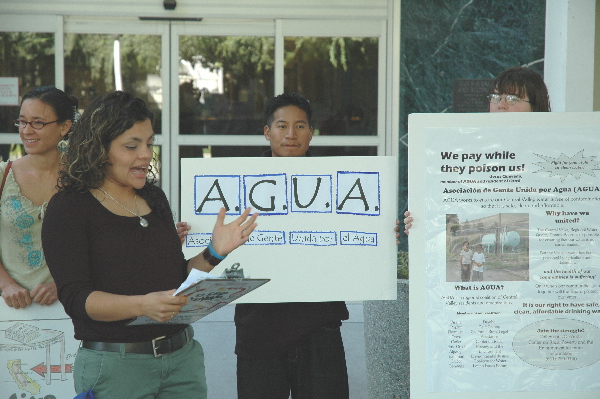
Rural Central Valley Community Members Demand Clean Drinking Water
La Asociacion de la Gente Unida por el Agua (AGUA) has submitted a petition to the Central Valley Regional Water Quality Board demanding that it live up to its mandate under California law to protect groundwater.
MEDIA ADVISORY AUGUST 4th 2006
Susana De Anda 661-586-2611
Laurel Firestone 661-586-2622
Rural Communities Demand Clean Drinking Water
Grassroots coalition exposes failures of Regional Water Board to fulfill legal obligations
WHAT: Press conference to announce petition that demands the Central Valley Regional Water Quality Control Board fulfill its legal mandate to protect California groundwater.
WHO: Central Valley-wide grassroots coalition Asociacion de Gente Unida por el Agua (AGUA) and Assemblymember Juan Arambula.
WHEN: Saturday, August 5th, 2006 10:00 am
WHERE: 2550 Mariposa Mall, Fresno, in front of the Hugh Burns State Building
Members of the AGUA coalition and Assemblymember Juan Arambula Saturday will address the Central Valley’s need for a practical, effective, comprehensive groundwater protection program.
AGUA is a coalition of communities impacted by contaminated drinking water that has come together to hold the Regional Board accountable for widespread fertilizer and pesticide pollution in groundwater. Years of unregulated pollution has led to toxic groundwater, which over ninety percent of communities in the Central Valley drink. AGUA is submitting a legal petition that demands the Regional Board start regulating the 1600 dairies in the Central Valley, one of the sources of pollution contaminating drinking water source.
Environmental Justice Coalition for Water
654 13th Street
Oakland CA 94612
(510) 286-8400
http://www.ejcw.org
PRESS RELEASE
For More Information: FOR IMMEDIATE RELEASE
Contacts: Susana De Anda 661-586-2611, Laurel Firestone 661-586-2622
Rural Community Members Demand Clean Drinking Water
Grassroots Coalition exposes failures of Regional Water Board to fulfill legal obligations
Fresno, CA – A new coalition of communities who suffer from contaminated drinking water are outraged at the failure of the Central Valley Regional Water Quality Control Board (Board) to protect groundwater. The Association of People United for Safe Water, or, La Asociacion de la Gente Unida por el Agua (AGUA) submitted a legal petition to the Board demanding the agency live up to its mandate under California law to protect groundwater throughout the Central Valley.
Representing 10 rural San Joaquin Valley communities and 5 State-wide advocacy organizations, the AGUA coalition has a disarmingly simple request: clean, safe, affordable drinking water. But their success is hindered by what AGUA calls the “cycle of poison:” as the Board fails to properly regulate industry, groundwater is polluted, and communities are forced to pay for and drink contaminated water.
In an effort to break this cycle, AGUA filed a legal petition on Friday, demanding the Board stop granting special breaks to the dairy industry, a leading groundwater polluter. The Board has been allowing dairies to discharge for years without permits, and their own studies show that the old regulations on the books are inadequate to protect groundwater. Since waivers for dairies expired in 2003, the Board has failed to comply with California law by not setting permit requirements (called WDRs) to any of the over 1600 dairies it oversees. The board seems to have spent three years working on a general Permit behind closed doors with the dairy industry. But despite its numerous meeting with industry, the board has yet to release a draft to the public.
The legal petition submitted on behalf of AGUA demands that the Board begin issuing waste discharge requirements and make any draft general permits open for public review. “Without any permit in place, the board cannot protect the groundwater that communities rely on for drinking water from further degradation,” says Laurel Firestone, an attorney with the Center on Race, Poverty & the Environment who filed the petition with the Board.
While the Board continues to waive pollution restrictions and deliberates over their general permitting process, hundreds of rural communities throughout the Central Valley can’t even fill a glass of tap water without fear of health problems. Over ninety percent of communities in the Central Valley receive poisoned groundwater through their taps. The Central Valley now boasts the state’s most toxic groundwater.
“People living in communities like mine are paying with their health because this agency has failed, and we will no longer stand for it ,” said AGUA member Jesus Quevedo from Cutler. “We are simply asking the Regional Board to do its job.”
Assemblymember Juan Arambula has stated, “We need a comprehensive regional groundwater monitoring and regulation program that is practical and effective. The Central Valley has gone too long without properly protecting precious water resources for its rural communities. It is the Regional Board’s legal responsibility to protect the quality of Central Valley’s groundwater.”
In June, the Board renewed the controversial agricultural waiver program, despite protests from AGUA and other members of the public. This program waives monitoring and protection requirements for all water flowing off fields and into groundwater. Irrigated run-off contains high concentrations of pesticides and fertilizers, which lead to nitrate and pesticide contamination of sources many communities rely on for drinking water. As a result, rural counties such as Tulare have the highest number of well closures due to nitrate and pesticide contamination.
Small, rural communities like those represented in AGUA pay as much as 2 to 6 percent of their income for undrinkable water. Many residents drive 30 to 50 miles each week just to buy bottled water, effectively paying twice for a vital resource. When wells fail, most small communities must shoulder the costs all by themselves, paying for expensive treatment and well operations from a base of only a couple hundred, often low-income, people. In both 2003 and 2004, almost 40,000 people were impacted by tap water that regularly exceeded state health limits.
“It is tragic and unacceptable that the communities that can least afford it are paying some of the highest water rates in California,” said Laurel Firestone, attorney with Delano-based Center on Race, Poverty and the Environment. “Mendota, Parlier, East Orosi, Cutler, Alpaugh, Tooleville – these are some of California’s poorest communities, and they all have severe water contamination. While industry gets a green light to pollute, rural communities pay.”
“The current Board doesn’t seem to listen to voices from people like myself – they certainly didn’t listen when we traveled over 600 miles to testify at the agricultural waiver hearing,” says Ruth Martinez, resident of Ducor, CA, and a member of AGUA. “AGUA has united to demand the Board actually serve the public like it’s supposed to. And as the public, we are saying we need our groundwater cleaned up.”
Firestone adds, “The dairy permitting process is a chance for the Board to show it is proactively addressing groundwater contamination.”
###
August 3, 2006
Senator Pro Temp Don Perata
Chair
Senate Rules Committee
State Capitol
Room 400
Sacramento, CA 95814
RE: Appointments to the Central Valley Regional Water Quality Control Board
Dear Senator Perata,
We are writing on behalf of low-income rural communities and communities of color in the Central Valley in strong opposition to the continued lack of compliance with state law regarding the required appointments for the Central Valley Regional Water Quality Control Board (CVRWQCB).
Water Code Section 13201(a)(7) requires not only that every regional board have three appointees 'not specifically associated with any of the foregoing categories,' which include water supply, irrigated agriculture, county government, municipal government, fish and wildlife, or industrial water use; but also that two of these three appointees "shall have special competence in areas related to water quality problems." Hence, not only should three board appointments be unrelated to irrigated agriculture or water supply, but at least two of them are supposed to be particularly knowledgeable on water quality problems.
As currently appointed by the Governor, only one appointment has specific knowledge of water quality problems and is not associated with one of the other discharger categories, Mr. Robert Schneider. Instead of following the requirements of the California Water Code, the Governor has appointed two seats to represent water supply and has appointed a person associated with irrigated agriculture to fill one of the Public Seats. [Please see attached for more detail.]
Although as a ranch owner, Ms. Sopac Mulholland may have knowledge regarding the water supply and agricultural needs of the Central Valley, those perspectives are already over represented on the board with the Irrigated Agriculture Seat [Paul Betancourt[1]] and the Water Supply Seat [Alson Brizard, farmer]; and further indirectly represented by the other Water Supply Seat [Karl Longley] and the existing vacant seat for Industrial Water Use, which has traditionally also gone to agricultural interests.
In fact, Ms. Sopac Mulholland is herself a discharger that had to be excused from voting on the agricultural conditional waiver decision because of conflicts. This vote and others like it require a public voice! The water code has provisions to ensure that this seat is for a public member who will not have this conflict and will in fact have knowledge of the water quality problems in our Valley.
Like many of the Regional Water Quality Control Boards, the Central Valley Board is not representative of the communities it serves. Given that the Board is responsible for establishing, issuing and enforcing requirements on dischargers in order to protect the beneficial uses of the Central Valley’s surface and groundwater, it is imperative that communities that are dependent on their enforcement have a seat on the Board as is required by existing law, most notably communities with water quality problems.
Moreover, according to the California Code of Regulations Section 98101(f), “it is a discriminatory practice for a recipient [of state funds] to fail to make reasonable efforts to achieve a representative board.” While this does not impose a quota, it does mandate that the Governor, in order to comply with the civil rights requirements of Government Code Section 11135, take steps to ensure that appointed boards are representative of the demographic of its jurisdiction. Thus far, the Governor has failed to do so based on race and income. Thirty-two percent of the Central Valley Region is Latino, yet the Governor has failed to appoint a single Latino member. Nor are there any low-income persons appointed to this board to represent the Central Valley where close to a quarter of the population lives in poverty.
Confirming this Public Seat appointee would be unlawful and affirming the Governor’s appointees that are not in accordance with existing law that governs the make of the CVRWQCB. On behalf of low income and people of color in the Central Valley, we urge the Governor to appoint individuals who are truly representative of the communities’ interests and demographics.
Sincerely,
Deborah Davis
Environmental Justice Coalition for Water
Laurel Firestone
Center on Race, Poverty and the Environment
Martha Guzman
California Rural Legal Assistance Foundation
Stephanie Camoroda
Latino Issues Forum
Cc: Senator Gilbert Cedillo
Senator Deborah Bowen
Assembly Member Juan Arambula
Dennis Albiani, Governor’s Office
Susana De Anda 661-586-2611
Laurel Firestone 661-586-2622
Rural Communities Demand Clean Drinking Water
Grassroots coalition exposes failures of Regional Water Board to fulfill legal obligations
WHAT: Press conference to announce petition that demands the Central Valley Regional Water Quality Control Board fulfill its legal mandate to protect California groundwater.
WHO: Central Valley-wide grassroots coalition Asociacion de Gente Unida por el Agua (AGUA) and Assemblymember Juan Arambula.
WHEN: Saturday, August 5th, 2006 10:00 am
WHERE: 2550 Mariposa Mall, Fresno, in front of the Hugh Burns State Building
Members of the AGUA coalition and Assemblymember Juan Arambula Saturday will address the Central Valley’s need for a practical, effective, comprehensive groundwater protection program.
AGUA is a coalition of communities impacted by contaminated drinking water that has come together to hold the Regional Board accountable for widespread fertilizer and pesticide pollution in groundwater. Years of unregulated pollution has led to toxic groundwater, which over ninety percent of communities in the Central Valley drink. AGUA is submitting a legal petition that demands the Regional Board start regulating the 1600 dairies in the Central Valley, one of the sources of pollution contaminating drinking water source.
Environmental Justice Coalition for Water
654 13th Street
Oakland CA 94612
(510) 286-8400
http://www.ejcw.org
PRESS RELEASE
For More Information: FOR IMMEDIATE RELEASE
Contacts: Susana De Anda 661-586-2611, Laurel Firestone 661-586-2622
Rural Community Members Demand Clean Drinking Water
Grassroots Coalition exposes failures of Regional Water Board to fulfill legal obligations
Fresno, CA – A new coalition of communities who suffer from contaminated drinking water are outraged at the failure of the Central Valley Regional Water Quality Control Board (Board) to protect groundwater. The Association of People United for Safe Water, or, La Asociacion de la Gente Unida por el Agua (AGUA) submitted a legal petition to the Board demanding the agency live up to its mandate under California law to protect groundwater throughout the Central Valley.
Representing 10 rural San Joaquin Valley communities and 5 State-wide advocacy organizations, the AGUA coalition has a disarmingly simple request: clean, safe, affordable drinking water. But their success is hindered by what AGUA calls the “cycle of poison:” as the Board fails to properly regulate industry, groundwater is polluted, and communities are forced to pay for and drink contaminated water.
In an effort to break this cycle, AGUA filed a legal petition on Friday, demanding the Board stop granting special breaks to the dairy industry, a leading groundwater polluter. The Board has been allowing dairies to discharge for years without permits, and their own studies show that the old regulations on the books are inadequate to protect groundwater. Since waivers for dairies expired in 2003, the Board has failed to comply with California law by not setting permit requirements (called WDRs) to any of the over 1600 dairies it oversees. The board seems to have spent three years working on a general Permit behind closed doors with the dairy industry. But despite its numerous meeting with industry, the board has yet to release a draft to the public.
The legal petition submitted on behalf of AGUA demands that the Board begin issuing waste discharge requirements and make any draft general permits open for public review. “Without any permit in place, the board cannot protect the groundwater that communities rely on for drinking water from further degradation,” says Laurel Firestone, an attorney with the Center on Race, Poverty & the Environment who filed the petition with the Board.
While the Board continues to waive pollution restrictions and deliberates over their general permitting process, hundreds of rural communities throughout the Central Valley can’t even fill a glass of tap water without fear of health problems. Over ninety percent of communities in the Central Valley receive poisoned groundwater through their taps. The Central Valley now boasts the state’s most toxic groundwater.
“People living in communities like mine are paying with their health because this agency has failed, and we will no longer stand for it ,” said AGUA member Jesus Quevedo from Cutler. “We are simply asking the Regional Board to do its job.”
Assemblymember Juan Arambula has stated, “We need a comprehensive regional groundwater monitoring and regulation program that is practical and effective. The Central Valley has gone too long without properly protecting precious water resources for its rural communities. It is the Regional Board’s legal responsibility to protect the quality of Central Valley’s groundwater.”
In June, the Board renewed the controversial agricultural waiver program, despite protests from AGUA and other members of the public. This program waives monitoring and protection requirements for all water flowing off fields and into groundwater. Irrigated run-off contains high concentrations of pesticides and fertilizers, which lead to nitrate and pesticide contamination of sources many communities rely on for drinking water. As a result, rural counties such as Tulare have the highest number of well closures due to nitrate and pesticide contamination.
Small, rural communities like those represented in AGUA pay as much as 2 to 6 percent of their income for undrinkable water. Many residents drive 30 to 50 miles each week just to buy bottled water, effectively paying twice for a vital resource. When wells fail, most small communities must shoulder the costs all by themselves, paying for expensive treatment and well operations from a base of only a couple hundred, often low-income, people. In both 2003 and 2004, almost 40,000 people were impacted by tap water that regularly exceeded state health limits.
“It is tragic and unacceptable that the communities that can least afford it are paying some of the highest water rates in California,” said Laurel Firestone, attorney with Delano-based Center on Race, Poverty and the Environment. “Mendota, Parlier, East Orosi, Cutler, Alpaugh, Tooleville – these are some of California’s poorest communities, and they all have severe water contamination. While industry gets a green light to pollute, rural communities pay.”
“The current Board doesn’t seem to listen to voices from people like myself – they certainly didn’t listen when we traveled over 600 miles to testify at the agricultural waiver hearing,” says Ruth Martinez, resident of Ducor, CA, and a member of AGUA. “AGUA has united to demand the Board actually serve the public like it’s supposed to. And as the public, we are saying we need our groundwater cleaned up.”
Firestone adds, “The dairy permitting process is a chance for the Board to show it is proactively addressing groundwater contamination.”
###
August 3, 2006
Senator Pro Temp Don Perata
Chair
Senate Rules Committee
State Capitol
Room 400
Sacramento, CA 95814
RE: Appointments to the Central Valley Regional Water Quality Control Board
Dear Senator Perata,
We are writing on behalf of low-income rural communities and communities of color in the Central Valley in strong opposition to the continued lack of compliance with state law regarding the required appointments for the Central Valley Regional Water Quality Control Board (CVRWQCB).
Water Code Section 13201(a)(7) requires not only that every regional board have three appointees 'not specifically associated with any of the foregoing categories,' which include water supply, irrigated agriculture, county government, municipal government, fish and wildlife, or industrial water use; but also that two of these three appointees "shall have special competence in areas related to water quality problems." Hence, not only should three board appointments be unrelated to irrigated agriculture or water supply, but at least two of them are supposed to be particularly knowledgeable on water quality problems.
As currently appointed by the Governor, only one appointment has specific knowledge of water quality problems and is not associated with one of the other discharger categories, Mr. Robert Schneider. Instead of following the requirements of the California Water Code, the Governor has appointed two seats to represent water supply and has appointed a person associated with irrigated agriculture to fill one of the Public Seats. [Please see attached for more detail.]
Although as a ranch owner, Ms. Sopac Mulholland may have knowledge regarding the water supply and agricultural needs of the Central Valley, those perspectives are already over represented on the board with the Irrigated Agriculture Seat [Paul Betancourt[1]] and the Water Supply Seat [Alson Brizard, farmer]; and further indirectly represented by the other Water Supply Seat [Karl Longley] and the existing vacant seat for Industrial Water Use, which has traditionally also gone to agricultural interests.
In fact, Ms. Sopac Mulholland is herself a discharger that had to be excused from voting on the agricultural conditional waiver decision because of conflicts. This vote and others like it require a public voice! The water code has provisions to ensure that this seat is for a public member who will not have this conflict and will in fact have knowledge of the water quality problems in our Valley.
Like many of the Regional Water Quality Control Boards, the Central Valley Board is not representative of the communities it serves. Given that the Board is responsible for establishing, issuing and enforcing requirements on dischargers in order to protect the beneficial uses of the Central Valley’s surface and groundwater, it is imperative that communities that are dependent on their enforcement have a seat on the Board as is required by existing law, most notably communities with water quality problems.
Moreover, according to the California Code of Regulations Section 98101(f), “it is a discriminatory practice for a recipient [of state funds] to fail to make reasonable efforts to achieve a representative board.” While this does not impose a quota, it does mandate that the Governor, in order to comply with the civil rights requirements of Government Code Section 11135, take steps to ensure that appointed boards are representative of the demographic of its jurisdiction. Thus far, the Governor has failed to do so based on race and income. Thirty-two percent of the Central Valley Region is Latino, yet the Governor has failed to appoint a single Latino member. Nor are there any low-income persons appointed to this board to represent the Central Valley where close to a quarter of the population lives in poverty.
Confirming this Public Seat appointee would be unlawful and affirming the Governor’s appointees that are not in accordance with existing law that governs the make of the CVRWQCB. On behalf of low income and people of color in the Central Valley, we urge the Governor to appoint individuals who are truly representative of the communities’ interests and demographics.
Sincerely,
Deborah Davis
Environmental Justice Coalition for Water
Laurel Firestone
Center on Race, Poverty and the Environment
Martha Guzman
California Rural Legal Assistance Foundation
Stephanie Camoroda
Latino Issues Forum
Cc: Senator Gilbert Cedillo
Senator Deborah Bowen
Assembly Member Juan Arambula
Dennis Albiani, Governor’s Office
Add Your Comments
Comments
(Hide Comments)
Solid carbon block technology is considered the most effective method for reducing contaminants of health concern. In addition to the removal of cysts, a solid carbon block filter also reduces:
· chemicals;
· pesticides;
· herbicides;
· disinfection byproducts;
· heavy metals;
· cysts;
· asbestos
· particulates
· chlorine.
. Arsenic
NSF International, The Public Health and Safety Company™, a not-for-profit, non-governmental organization, is the world leader in standards development, product certification, education, and risk-management for public health and safety. For more than 59 years, NSF has been committed to public health, safety, and protection of the environment. While focusing on food, water, indoor air, and the environment, NSF develops national standards, provides learning opportunities through its Center for Public Health Education, and provides third-party conformity assessment services while representing the interests of all stakeholders. The primary stakeholder groups include industry, the regulatory community, and the public at large.
Do your home work! Make a good choice for your drinking water needs. Visit NSF below:
http://www.nsf.org/consumer/drinking_water/dw_treatment.asp?program=WaterTre
The Importance of Certification
In the last decade, interest in home water treatment products has grown tremendously. Unfortunately, it isn't always easy for consumers to know whether or not a particular product will actually be as safe and effective as the manufacturer claims at reducing various contaminants from your water supply.
NSF has a long history of developing and running independent product testing programs. In fact, we are the leading independent tester of home water treatment products on the market today. With our state-of-the-art laboratories and highly skilled staff, we have the knowledge and expertise to effectively evaluate water treatment products, including:
Adsorption filters (i.e. carbon, charcoal, KDF, ceramic)
Reverse osmosis systems
Water softeners
Distillation systems
Ultraviolet disinfection products.
As an added assurance for consumers, NSF requires that all products meet annual re-certification requirements. Unannounced plant inspections and periodic retesting of all certified products are required of all NSF-listed companies. This unique requirement allows us to ensure that the products we certify continue to meet all stated requirements year after year.
Note: NSF has tested & certified over 4000 different filters. It’s important to understand we have 400 plus manufacturers of water filters alone world wide. Having said this “why” would you purchase a water filter that is NOT tested & certified by NSF. It all comes down to this: Talk is cheap and facts are hard to find in the drinking water filtration industry! NSF is were you will get the facts.
Ultimately it comes down to this: What does the filter do & how much does it cost?
NSF Data performance sheets is were to find “what it does”.
Price: For a $1.00 a week you can have pure healthy drinking water. If you are spending “more” it’s costing you too much.
Book mark my site for future use:
www.solidcarbonblock..NET
Thank you for your time and consideration,
Chris Anderson
waterfilters@gmail.com
10 years Independent distributor Multipure Drinking Water Systems
#223193
www.multipureusa.com/canderson
For more information:
http://www.solidcarbonblock.net
Thanks for putting up the photo of the press conference - this wonderful coalition needs to get lots of support in their struggle for clean drinking water. I wasn't able to go to the press conference because of another previous committment, but I'm glad that you were able to attend.
There are many alternatives to spray applications of petrochemically derived pesticides (Monsanto, Dow, DuPont, Bayer/Aventis, etc..) that increase human and ecosystem health risks (cancer, hormone disruption, etc..). The examples of crop biodiversity combined with native plants and trees in greenway corridors (aka hedgerows) could increase habitat for beneficial predator insects and birds, bats, etc..
Community Alliance for Family Farmers (No, not "Focus on the family", family farmers refers to non-corporate, small scale agriculture) has more detailed info on planting with biodiverse hedgerows and greenway corridors..
"Increasing Farm Biodiversity with Hedgerows
Alternative planting of hedgerows on farms is expanding the concept of 'clean' farming to new limits.
"Clean farming means weed free, not vegetation free," Sam Earnshaw says. Earnshaw is the Central Coast Regional Coordinator for the Community Alliance with Family Farmers. CAFF has hedgerow farmscaping projects in three regions of the state.
Defined as lines or groups of trees, shrubs, perennial and annual forbs and grasses, hedgerows serve a number of functions including:
beneficial /pollinator insect habitat
erosion control
weed control
reduction of non-point source water pollution
riparian stabilization
wildlife habitat
windbreak and climate modification
aesthetic value
increases in local and regional biodiversity
create buffers
small bird habitat
"But that doesn't mean you should run right out and start planting," Earnshaw says. "A good starting point in farmscaping should be a farm plan that has a site inventory that lists and describes all aspects of your farm (buildings, topography, hydrology and drainage, cropped areas, views, etc) with maps and aerial photos if you have them.
He says the plan should also contain farm system goals that address things like pest control, land and soil management, climate modification, wildlife habitat enhancement and increasing biodiversity.
Earnshaw stresses that knowing your local ecosystem is critical to successful farmscaping.
"Our farms occur within the context of natural ecosystems," he says. "Learning about those ecosystems allows us to make educated choices regarding which plants to use."
Many of the plants being used in hedgerows have a wide distribution throughout California, including Baccharis (coyote brush), Ceanothus (California lilac ), toyon, coffeeberry, perennial buckwheats, yarrow and deergrass."
more info on biodiverse famring methods @;
http://www.caff.org/programs/farmscaping/hedgerowart.shtml
That being said we need to understand why we're caught up in the "pesticide treadmill" of repeated applications of petroleum derived peaticides/fertilizers. Following WW2 a surplus of DuPont (finicail supporter of Hitler) chemical weapons were structurally altered and sold to the US public and farmers as pesticides/herbicides. The destructive dependency of industrial agriculture's toxic pesticide applications on the central valley appears in repeating spray applications seasonally. The continued applications of pesticides destroy the beneficial predator insects at greater rates than the pest insects. Pest insects are one level lower on the food chain and usually have shorter life cycles, thus improving their chances of developing genetic resistance to the pesticides applied. Each season newer variations of generic pesticides are marketed by pesticide manufactureres under different brand names (Round-up, Suspend, etc..). Ironically we witness the same process with pharmaceutical products that can be ineffective on treating human diseases over continued usage. Sometimes the same corporation (Bayer/Aventis) markets both pesticides that induce cancer in humans and also the chemotherapy used to treat the specific cancer induced by the pesticide exposure..
Needless to say this presents a conflict of interest, though under the current Bush/Cheney petroliogarchy the corporatist (aka fascist) pattern of corporations imposing their will on the people will likely continue despite public opposition. After all, we realize the loudest and most effective critics of the current petroleum dependent Bush/Cheney regime have either sold out and/or quit (and survived), committed 'suicide' or been disappeared into the massive prison industrial complex. Here and there a few outspoken critics are allowed to continue addressing the malcontents form their ivory towers of academia provided that they don't cross certain invisible lines (Don't you DARE question the official 9/11 version Herr Chomsky!!)..
One of those invisible lines is the myth that petrochemical pesticides/fertilizers are required to provide enough food for the human population. This dates back to cold war propaganda with US/Soviet competition in industrial agriculture. A great deal of food is wasted in the US daily. The problems of starvation are linked to class based poverty and unequal distribution of food, not the lack of quantity. Quality of food is another issue entirely, expecting populations to survive and remain healthy off of nutritionally deficient refined wheat flour products is another impossibility..
In addition to hedgerows, the south central farm is another example of what type of agricultural method we should be practicing and increasing in today's society. The photo documentation of the sc farm prior to destruction by Caterpillar bulldozers (under orders of Libaw-Horowitz development corporation) shows crop diversity with different heights and varieties of plants symbiotically existing nearby one another. South central community farms represents a living green oasis in an otherwise barren concrete sprawl..
http://www.southcentralfarmers.com/
Community Alliance for Family Farmers (No, not "Focus on the family", family farmers refers to non-corporate, small scale agriculture) has more detailed info on planting with biodiverse hedgerows and greenway corridors..
"Increasing Farm Biodiversity with Hedgerows
Alternative planting of hedgerows on farms is expanding the concept of 'clean' farming to new limits.
"Clean farming means weed free, not vegetation free," Sam Earnshaw says. Earnshaw is the Central Coast Regional Coordinator for the Community Alliance with Family Farmers. CAFF has hedgerow farmscaping projects in three regions of the state.
Defined as lines or groups of trees, shrubs, perennial and annual forbs and grasses, hedgerows serve a number of functions including:
beneficial /pollinator insect habitat
erosion control
weed control
reduction of non-point source water pollution
riparian stabilization
wildlife habitat
windbreak and climate modification
aesthetic value
increases in local and regional biodiversity
create buffers
small bird habitat
"But that doesn't mean you should run right out and start planting," Earnshaw says. "A good starting point in farmscaping should be a farm plan that has a site inventory that lists and describes all aspects of your farm (buildings, topography, hydrology and drainage, cropped areas, views, etc) with maps and aerial photos if you have them.
He says the plan should also contain farm system goals that address things like pest control, land and soil management, climate modification, wildlife habitat enhancement and increasing biodiversity.
Earnshaw stresses that knowing your local ecosystem is critical to successful farmscaping.
"Our farms occur within the context of natural ecosystems," he says. "Learning about those ecosystems allows us to make educated choices regarding which plants to use."
Many of the plants being used in hedgerows have a wide distribution throughout California, including Baccharis (coyote brush), Ceanothus (California lilac ), toyon, coffeeberry, perennial buckwheats, yarrow and deergrass."
more info on biodiverse famring methods @;
http://www.caff.org/programs/farmscaping/hedgerowart.shtml
That being said we need to understand why we're caught up in the "pesticide treadmill" of repeated applications of petroleum derived peaticides/fertilizers. Following WW2 a surplus of DuPont (finicail supporter of Hitler) chemical weapons were structurally altered and sold to the US public and farmers as pesticides/herbicides. The destructive dependency of industrial agriculture's toxic pesticide applications on the central valley appears in repeating spray applications seasonally. The continued applications of pesticides destroy the beneficial predator insects at greater rates than the pest insects. Pest insects are one level lower on the food chain and usually have shorter life cycles, thus improving their chances of developing genetic resistance to the pesticides applied. Each season newer variations of generic pesticides are marketed by pesticide manufactureres under different brand names (Round-up, Suspend, etc..). Ironically we witness the same process with pharmaceutical products that can be ineffective on treating human diseases over continued usage. Sometimes the same corporation (Bayer/Aventis) markets both pesticides that induce cancer in humans and also the chemotherapy used to treat the specific cancer induced by the pesticide exposure..
Needless to say this presents a conflict of interest, though under the current Bush/Cheney petroliogarchy the corporatist (aka fascist) pattern of corporations imposing their will on the people will likely continue despite public opposition. After all, we realize the loudest and most effective critics of the current petroleum dependent Bush/Cheney regime have either sold out and/or quit (and survived), committed 'suicide' or been disappeared into the massive prison industrial complex. Here and there a few outspoken critics are allowed to continue addressing the malcontents form their ivory towers of academia provided that they don't cross certain invisible lines (Don't you DARE question the official 9/11 version Herr Chomsky!!)..
One of those invisible lines is the myth that petrochemical pesticides/fertilizers are required to provide enough food for the human population. This dates back to cold war propaganda with US/Soviet competition in industrial agriculture. A great deal of food is wasted in the US daily. The problems of starvation are linked to class based poverty and unequal distribution of food, not the lack of quantity. Quality of food is another issue entirely, expecting populations to survive and remain healthy off of nutritionally deficient refined wheat flour products is another impossibility..
In addition to hedgerows, the south central farm is another example of what type of agricultural method we should be practicing and increasing in today's society. The photo documentation of the sc farm prior to destruction by Caterpillar bulldozers (under orders of Libaw-Horowitz development corporation) shows crop diversity with different heights and varieties of plants symbiotically existing nearby one another. South central community farms represents a living green oasis in an otherwise barren concrete sprawl..
http://www.southcentralfarmers.com/
Since we're on the subject of pesticides the UFW has an action link to protect farm workers and their ecosystem from some known toxic pesticides..
"Please e-mail the Environmental Protection Agency today to help protect farm workers from two very toxic pesticides that poison workers.
Five years ago, the EPA found that two highly toxic organophosphate neurotoxins pesticides--azinphos methyl and phosmet--pose "unacceptable" poisoning risks to workers who are exposed to them. Organophosphate pesticides, derived from nerve agents used by the Nazis during World War II, attack the human nervous system. Exposure can cause nausea, dizziness, vomiting, seizures, paralysis, loss of mental function and even death. Farm workers returning home from the fields expose family members and other residents to organophosphates through their clothing, cars and skin.
When the EPA allowed continued use of these pesticides, the United Farm Workers joined Earth Justice and numerous other environmental and farm worker groups in filling a lawsuit to challenge the Bush administration over this decision. To settle the lawsuit, the EPA agreed to reconsider its decision to allow continued use of these toxins.
Now the EPA has announced it is planning to allow further use of one of the pesticides, phosmet, without sufficient restrictions to prevent worker poisonings. The EPA is proposing to phase out the other pesticide, azinphos methyl, over the next four years.
This is unacceptable. It’s already been five years since the EPA admitted both pesticides pose "unacceptable" risks. It’s time to stop putting workers in danger. Tell EPA to immediately ban the use of these toxic pesticides and stop playing political games that put farm workers and their families at risk.
The EPA is accepting comments through Aug. 8, 2006. It is vital for farm workers and their children that you send a message ASAP and tell your friends to do the same. We expect growers to urge the EPA to back down from the proposed phase out of azinphos methyl. It is critical that the EPA hear from people who support the phase out and believe it does not go far enough. Please send your e-mail today!"
more info @;
http://www.ufwaction.org/campaign/EPA806?rk=N7z5xzs1KqI7W
"Please e-mail the Environmental Protection Agency today to help protect farm workers from two very toxic pesticides that poison workers.
Five years ago, the EPA found that two highly toxic organophosphate neurotoxins pesticides--azinphos methyl and phosmet--pose "unacceptable" poisoning risks to workers who are exposed to them. Organophosphate pesticides, derived from nerve agents used by the Nazis during World War II, attack the human nervous system. Exposure can cause nausea, dizziness, vomiting, seizures, paralysis, loss of mental function and even death. Farm workers returning home from the fields expose family members and other residents to organophosphates through their clothing, cars and skin.
When the EPA allowed continued use of these pesticides, the United Farm Workers joined Earth Justice and numerous other environmental and farm worker groups in filling a lawsuit to challenge the Bush administration over this decision. To settle the lawsuit, the EPA agreed to reconsider its decision to allow continued use of these toxins.
Now the EPA has announced it is planning to allow further use of one of the pesticides, phosmet, without sufficient restrictions to prevent worker poisonings. The EPA is proposing to phase out the other pesticide, azinphos methyl, over the next four years.
This is unacceptable. It’s already been five years since the EPA admitted both pesticides pose "unacceptable" risks. It’s time to stop putting workers in danger. Tell EPA to immediately ban the use of these toxic pesticides and stop playing political games that put farm workers and their families at risk.
The EPA is accepting comments through Aug. 8, 2006. It is vital for farm workers and their children that you send a message ASAP and tell your friends to do the same. We expect growers to urge the EPA to back down from the proposed phase out of azinphos methyl. It is critical that the EPA hear from people who support the phase out and believe it does not go far enough. Please send your e-mail today!"
more info @;
http://www.ufwaction.org/campaign/EPA806?rk=N7z5xzs1KqI7W
We are 100% volunteer and depend on your participation to sustain our efforts!
Donate

$115.00 donated
in the past month
Get Involved
If you'd like to help with maintaining or developing the website, contact us.
Publish
Publish your stories and upcoming events on Indybay.
Topics
More
Search Indybay's Archives
Advanced Search
►
▼
IMC Network