







 Publish to Newswire
 Add an Event
From the Open-Publishing Calendar
From the Open-Publishing Newswire
Indybay Feature
California
Central Valley
East Bay
San Francisco
Santa Cruz Indymedia
Anti-War
Education & Student Activism
Police State & Prisons
ACLU Report Documents Government Monitoring of Lawful Protest
Federal, state and local agencies have infiltrated or monitored the political activity of Californians throughout central and northern California in what has become a disturbing trend, according to an ACLU-NC report released today.
FOR IMMEDIATE RELEASE:
Thursday, July 27, 2006
PRESS CONTACT:
Stella Richardson (415) 621-2493
ACLU REPORT DOCUMENTS GOVERNMENT MONITORING OF LAWFUL PROTEST AND LACK OF REGULATIONS
Calls for Guidelines to Protect Free Speech and Privacy Rights of Californians
For the full report visit http://www.aclunc.org/surveillance_report
SAN FRANCISCO – Federal, state and local agencies have infiltrated or monitored the political activity of Californians throughout central and northern California in what has become a disturbing trend, according to an ACLU-NC report released today. From the stories of grandmothers opposing the war in Iraq to anti-war protestors at the Port of Oakland, the 35-page report tells the compelling stories of individuals and groups that were targets of government surveillance because of their political activity.
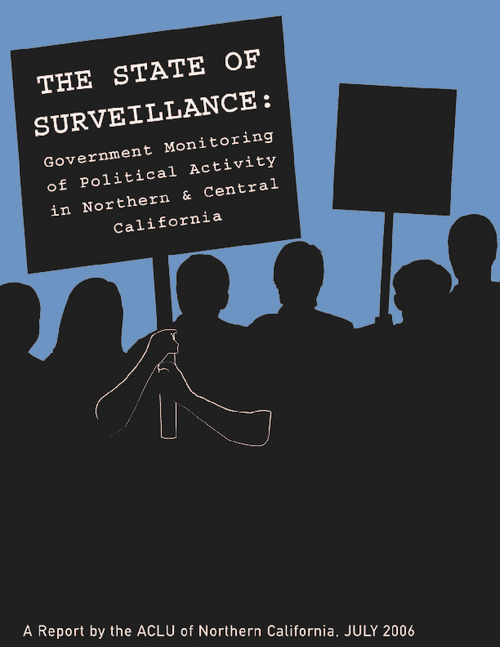
The report entitled The State of Surveillance: Government Monitoring of Political Activity in Northern and Central California also illustrates the lack of enforcement of current regulations and recommends specific policy reforms to safeguard Californians’ rights to privacy and free speech.
“The incidents in this report represent a disturbing trend in law enforcement that is fueled by greater funding of federal, state and local intelligence agencies, a national climate of fear, and a troubling lack of regulation,” said Mark Schlosberg, author of the report and Police Practices Policy Director of the ACLU-NC.
Since September 11, 2001, dozens of organizations have had their protests monitored by intelligence agencies. Peaceful protests were included in anti-terrorism bulletins and databases and undercover officers have posed as activists to gather information and influence decisions, according to the report.
The ACLU makes several policy recommendations including state legislation regulating the National Guard, the State Terrorism Threat Assessment Center, and the state Office of Homeland Security. The California Attorney General should also issue specific guidelines to local law enforcement agencies and state law should require regular reporting on surveillance activities to the Legislative Analyst’s Office.
“We applaud those that refuse to be silenced, but fear that for others, government surveillance of political activity will have a chilling effect,” said Dorothy Ehrlich, executive director of the ACLU-NC. “Free speech, political dissent, and rigorous public debate are the foundation of a strong democracy and that is why it is so important to preserve these precious rights in times of crisis. If history is any guide, the stories documented in this report represent only the tip of the iceberg.”
DOCUMENTS
*
Download the report, The State of Surveillance: Government Monitoring of Political Activity in Northern and Central California
*
Timeline of Government Surveillance
*
Profiles of Speakers
*
Natalie Wormeli Statement
*
Donna Hardina Statement
*
Camille Russell Statement
*
Jack Heyman Statement
*
Matthew Taylor Statement
*
Ruth Obel-Jorgenson Statement
*
Dan Yaseen Statement
Thursday, July 27, 2006
PRESS CONTACT:
Stella Richardson (415) 621-2493
ACLU REPORT DOCUMENTS GOVERNMENT MONITORING OF LAWFUL PROTEST AND LACK OF REGULATIONS
Calls for Guidelines to Protect Free Speech and Privacy Rights of Californians
For the full report visit http://www.aclunc.org/surveillance_report
SAN FRANCISCO – Federal, state and local agencies have infiltrated or monitored the political activity of Californians throughout central and northern California in what has become a disturbing trend, according to an ACLU-NC report released today. From the stories of grandmothers opposing the war in Iraq to anti-war protestors at the Port of Oakland, the 35-page report tells the compelling stories of individuals and groups that were targets of government surveillance because of their political activity.
The report entitled The State of Surveillance: Government Monitoring of Political Activity in Northern and Central California also illustrates the lack of enforcement of current regulations and recommends specific policy reforms to safeguard Californians’ rights to privacy and free speech.
“The incidents in this report represent a disturbing trend in law enforcement that is fueled by greater funding of federal, state and local intelligence agencies, a national climate of fear, and a troubling lack of regulation,” said Mark Schlosberg, author of the report and Police Practices Policy Director of the ACLU-NC.
Since September 11, 2001, dozens of organizations have had their protests monitored by intelligence agencies. Peaceful protests were included in anti-terrorism bulletins and databases and undercover officers have posed as activists to gather information and influence decisions, according to the report.
The ACLU makes several policy recommendations including state legislation regulating the National Guard, the State Terrorism Threat Assessment Center, and the state Office of Homeland Security. The California Attorney General should also issue specific guidelines to local law enforcement agencies and state law should require regular reporting on surveillance activities to the Legislative Analyst’s Office.
“We applaud those that refuse to be silenced, but fear that for others, government surveillance of political activity will have a chilling effect,” said Dorothy Ehrlich, executive director of the ACLU-NC. “Free speech, political dissent, and rigorous public debate are the foundation of a strong democracy and that is why it is so important to preserve these precious rights in times of crisis. If history is any guide, the stories documented in this report represent only the tip of the iceberg.”
DOCUMENTS
*
Download the report, The State of Surveillance: Government Monitoring of Political Activity in Northern and Central California
*
Timeline of Government Surveillance
*
Profiles of Speakers
*
Natalie Wormeli Statement
*
Donna Hardina Statement
*
Camille Russell Statement
*
Jack Heyman Statement
*
Matthew Taylor Statement
*
Ruth Obel-Jorgenson Statement
*
Dan Yaseen Statement
For more information:
http://aclunc.org/pressrel/060727-surveill...
Add Your Comments
Comments
(Hide Comments)
OAKLAND
Police spies chosen to lead war protest
- Demian Bulwa, Chronicle Staff Writer
Friday, July 28, 2006
Two Oakland police officers working undercover at an anti-war protest in May 2003 got themselves elected to leadership positions in an effort to influence the demonstration, documents released Thursday show.
The department assigned the officers to join activists protesting the U.S. war in Iraq and the tactics that police had used at a demonstration a month earlier, a police official said last year in a sworn deposition.
At the first demonstration, police fired nonlethal bullets and bean bags at demonstrators who blocked the Port of Oakland's entrance in a protest against two shipping companies they said were helping the war effort. Dozens of activists and longshoremen on their way to work suffered injuries ranging from welts to broken bones and have won nearly $2 million in legal settlements from the city.
The extent of the officers' involvement in the subsequent march May 12, 2003, led by Direct Action to Stop the War and others, is unclear. But in a deposition related to a lawsuit filed by protesters, Deputy Police Chief Howard Jordan said activists had elected the undercover officers to "plan the route of the march and decide I guess where it would end up and some of the places that it would go."
It was revealed later that the California Anti-Terrorism Information Center, which was established by the state attorney general's office to help local police agencies fight terrorism, had posted an alert about the April protest. Oakland police had also monitored online postings by the longshoremen's union regarding its opposition to the war.
The documents showing that police subsequently tried to influence a demonstration were released Thursday by the American Civil Liberties Union, as part of a report criticizing government surveillance of political activists since the terrorist attacks of Sept. 11, 2001. The ACLU said the documents came from the lawsuit over the police use of force.
Jordan, in his deposition in April 2005, said under questioning by plaintiffs' attorney Jim Chanin that undercover Officers Nobuko Biechler and Mark Turpin had been elected to be leaders in the May 12 demonstration an hour after meeting protesters that day.
Asked who had ordered the officers to infiltrate the group, Jordan said, "I don't know if there is one particular person, but I think together we probably all decided it would be a good idea to have some undercover officers there."
Several months after the rally, Jordan told a city police review board examining the April 2003 port clash that "our ability to gather intelligence on these groups and this type of operation needs to be improved," according to a transcript provided by the ACLU.
"I don't mean same-day intelligence," Jordan told the civilian review panel. "I'm talking about long-term intelligence gathering."
He noted that "two of our officers were elected leaders within an hour on May 12." The idea was "to gather the information and maybe even direct them to do something that we want them to do," Jordan said.
"I call that being totalitarian," said Jack Heyman, a longshoremen's union member who took part in the May 12 march. He said he was not certain whether he had any contact with the officers that day.
Jordan declined to comment when reached at his office Thursday. In his deposition, he said the Police Department no longer allows such undercover work.
City Attorney John Russo said he was not familiar with the police infiltration of the protest, but said the city had made "significant changes" in its approach toward demonstrations after the port incident. Police enacted a new crowd-control policy limiting the use of nonlethal force in 2004.
The ACLU said the Oakland case was one of several instances in which police agencies had spied on legitimate political activity since 2001.
Mark Schlosberg, who directs the ACLU's police policy work and wrote the report released Thursday, cited previously reported instances of spying on groups in Santa Cruz and Fresno in addition to the Oakland case. He called on state Attorney General Bill Lockyer and local police to ensure that law-abiding activist groups don't come under government investigation.
"It's very important that there be regulation up front to prevent these kinds of abuses from occurring," Schlosberg said at a news conference.
Schlosberg said the state needs an independent inspector looking into complaints and keeping an eye on intelligence gathering at such agencies as the California National Guard and the state Department of Homeland Security.
Tom Dresslar, a spokesman for Lockyer, said the attorney general had not yet read the ACLU report. But he said his boss "won't abide violations of civil liberties. There's no room in this state or anywhere in this country for monitoring the activity of groups merely because they have a political viewpoint."
Following the Oakland port protest and disclosures about the monitoring of activists, Lockyer issued guidelines in 2003 stating that police must suspect that a crime has been committed before collecting intelligence on activist groups.
But Schlosberg said the ACLU had surveyed 94 law enforcement agencies last year and found that just eight were aware of the guidelines. Only six had written policies restricting surveillance activities, he said.
Page B - 1
URL: http://sfgate.com/cgi-bin/article.cgi?file=/c/a/2006/07/28/SURVEILLANCE.TMP
Police spies chosen to lead war protest
- Demian Bulwa, Chronicle Staff Writer
Friday, July 28, 2006
Two Oakland police officers working undercover at an anti-war protest in May 2003 got themselves elected to leadership positions in an effort to influence the demonstration, documents released Thursday show.
The department assigned the officers to join activists protesting the U.S. war in Iraq and the tactics that police had used at a demonstration a month earlier, a police official said last year in a sworn deposition.
At the first demonstration, police fired nonlethal bullets and bean bags at demonstrators who blocked the Port of Oakland's entrance in a protest against two shipping companies they said were helping the war effort. Dozens of activists and longshoremen on their way to work suffered injuries ranging from welts to broken bones and have won nearly $2 million in legal settlements from the city.
The extent of the officers' involvement in the subsequent march May 12, 2003, led by Direct Action to Stop the War and others, is unclear. But in a deposition related to a lawsuit filed by protesters, Deputy Police Chief Howard Jordan said activists had elected the undercover officers to "plan the route of the march and decide I guess where it would end up and some of the places that it would go."
It was revealed later that the California Anti-Terrorism Information Center, which was established by the state attorney general's office to help local police agencies fight terrorism, had posted an alert about the April protest. Oakland police had also monitored online postings by the longshoremen's union regarding its opposition to the war.
The documents showing that police subsequently tried to influence a demonstration were released Thursday by the American Civil Liberties Union, as part of a report criticizing government surveillance of political activists since the terrorist attacks of Sept. 11, 2001. The ACLU said the documents came from the lawsuit over the police use of force.
Jordan, in his deposition in April 2005, said under questioning by plaintiffs' attorney Jim Chanin that undercover Officers Nobuko Biechler and Mark Turpin had been elected to be leaders in the May 12 demonstration an hour after meeting protesters that day.
Asked who had ordered the officers to infiltrate the group, Jordan said, "I don't know if there is one particular person, but I think together we probably all decided it would be a good idea to have some undercover officers there."
Several months after the rally, Jordan told a city police review board examining the April 2003 port clash that "our ability to gather intelligence on these groups and this type of operation needs to be improved," according to a transcript provided by the ACLU.
"I don't mean same-day intelligence," Jordan told the civilian review panel. "I'm talking about long-term intelligence gathering."
He noted that "two of our officers were elected leaders within an hour on May 12." The idea was "to gather the information and maybe even direct them to do something that we want them to do," Jordan said.
"I call that being totalitarian," said Jack Heyman, a longshoremen's union member who took part in the May 12 march. He said he was not certain whether he had any contact with the officers that day.
Jordan declined to comment when reached at his office Thursday. In his deposition, he said the Police Department no longer allows such undercover work.
City Attorney John Russo said he was not familiar with the police infiltration of the protest, but said the city had made "significant changes" in its approach toward demonstrations after the port incident. Police enacted a new crowd-control policy limiting the use of nonlethal force in 2004.
The ACLU said the Oakland case was one of several instances in which police agencies had spied on legitimate political activity since 2001.
Mark Schlosberg, who directs the ACLU's police policy work and wrote the report released Thursday, cited previously reported instances of spying on groups in Santa Cruz and Fresno in addition to the Oakland case. He called on state Attorney General Bill Lockyer and local police to ensure that law-abiding activist groups don't come under government investigation.
"It's very important that there be regulation up front to prevent these kinds of abuses from occurring," Schlosberg said at a news conference.
Schlosberg said the state needs an independent inspector looking into complaints and keeping an eye on intelligence gathering at such agencies as the California National Guard and the state Department of Homeland Security.
Tom Dresslar, a spokesman for Lockyer, said the attorney general had not yet read the ACLU report. But he said his boss "won't abide violations of civil liberties. There's no room in this state or anywhere in this country for monitoring the activity of groups merely because they have a political viewpoint."
Following the Oakland port protest and disclosures about the monitoring of activists, Lockyer issued guidelines in 2003 stating that police must suspect that a crime has been committed before collecting intelligence on activist groups.
But Schlosberg said the ACLU had surveyed 94 law enforcement agencies last year and found that just eight were aware of the guidelines. Only six had written policies restricting surveillance activities, he said.
Page B - 1
URL: http://sfgate.com/cgi-bin/article.cgi?file=/c/a/2006/07/28/SURVEILLANCE.TMP
Scope and Methodology
Since September 11, 2001, the ACLU-NC has raised concerns regarding government surveillance of constitutionally protected political activity by law enforcement. Over the past several years, we have learned of incidents at the federal, state, and local levels affecting Californians.
This report is not intended to be a comprehensive and all-encompassing account of surveillance activity in Northern and Central California. Rather, it highlights a number of cases that the ACLU-NC has been actively involved in that we believe are representative of a larger trend.
The nature of the incidents led us to conduct a public records survey to determine the extent to which local police and sheriff's departments have policies protecting individuals engaging in First Amendment protected activity from monitoring, investigation, or infiltration.
In June, 2005, the ACLU-NC sent out public records requests to agencies throughout the state. A copy of the records request is available in the Primary Documents section of this website. In January 2006, we sent requests to additional agencies in San Diego and Imperial Counties. In total, we surveyed 103 agencies. A complete list of the agencies surveyed is available (http://aclunc.org/surveillance_report/List_of_Departments_Surveyed.pdf).
The information included in the report is derived from the results we received from those agencies at the time we received them. Since that time, some agencies may have modified their policies in some manner; however, those changes are not included in the statistical section. (For example, the Santa Cruz Police Department recently adopted a new policy regulating the use of undercover officers to gather information about organizations engaged in First Amendment activity, but it is not included in the statistical analysis.) The information contained in the survey section of the report represents the state of regulation at the time we issued the request.
The most recent updates and corrections for the report are available (http://aclunc.org/surveillance_report/SurveillanceReport_CorrectionsUpdates.pdf).
Since September 11, 2001, the ACLU-NC has raised concerns regarding government surveillance of constitutionally protected political activity by law enforcement. Over the past several years, we have learned of incidents at the federal, state, and local levels affecting Californians.
This report is not intended to be a comprehensive and all-encompassing account of surveillance activity in Northern and Central California. Rather, it highlights a number of cases that the ACLU-NC has been actively involved in that we believe are representative of a larger trend.
The nature of the incidents led us to conduct a public records survey to determine the extent to which local police and sheriff's departments have policies protecting individuals engaging in First Amendment protected activity from monitoring, investigation, or infiltration.
In June, 2005, the ACLU-NC sent out public records requests to agencies throughout the state. A copy of the records request is available in the Primary Documents section of this website. In January 2006, we sent requests to additional agencies in San Diego and Imperial Counties. In total, we surveyed 103 agencies. A complete list of the agencies surveyed is available (http://aclunc.org/surveillance_report/List_of_Departments_Surveyed.pdf).
The information included in the report is derived from the results we received from those agencies at the time we received them. Since that time, some agencies may have modified their policies in some manner; however, those changes are not included in the statistical section. (For example, the Santa Cruz Police Department recently adopted a new policy regulating the use of undercover officers to gather information about organizations engaged in First Amendment activity, but it is not included in the statistical analysis.) The information contained in the survey section of the report represents the state of regulation at the time we issued the request.
The most recent updates and corrections for the report are available (http://aclunc.org/surveillance_report/SurveillanceReport_CorrectionsUpdates.pdf).
We are 100% volunteer and depend on your participation to sustain our efforts!
Donate

$90.00 donated
in the past month
Get Involved
If you'd like to help with maintaining or developing the website, contact us.
Publish
Publish your stories and upcoming events on Indybay.
Topics
More
Search Indybay's Archives
Advanced Search
►
▼
IMC Network