







 Publish to Newswire
 Add an Event
Nonviolent Anti-War Protests Close Recruitment Office
Nonviolent Anti-War Protests Close Recruitment Office
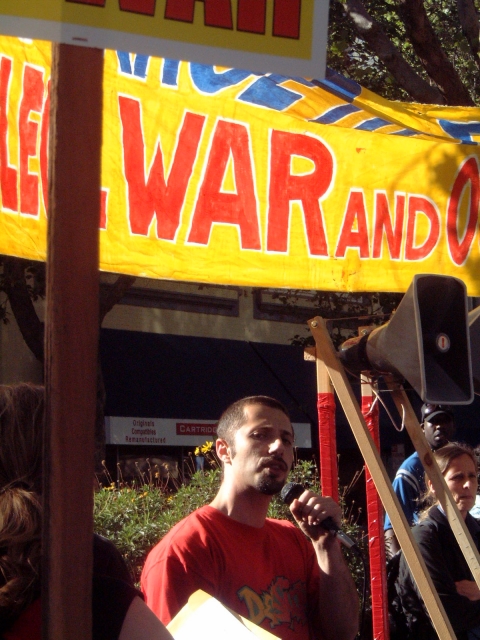
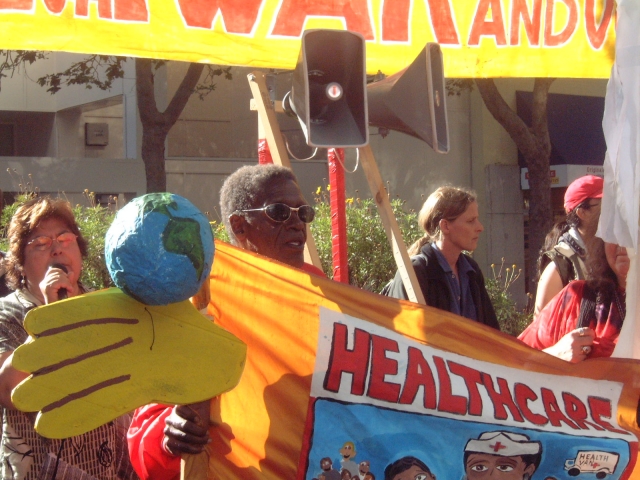
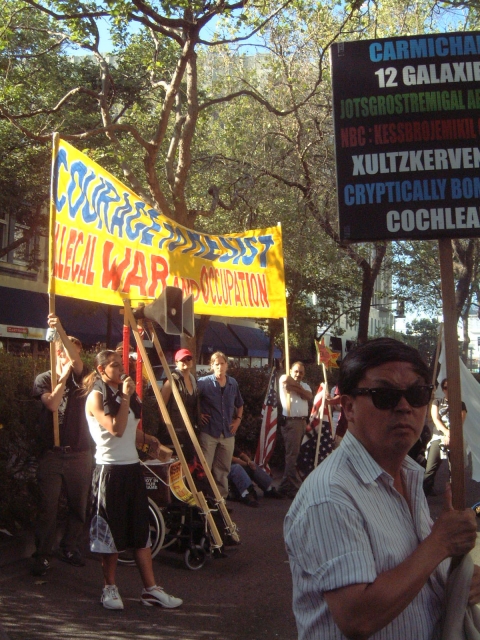
On May 15th, the close of business in Downtown Oakland was accompanied by a rally, march and nonviolent direct action, bringing a vibrant and diverse crowd of at least 100 from Oakland City Center to the Military Recruiting Station at 21st and Broadway.
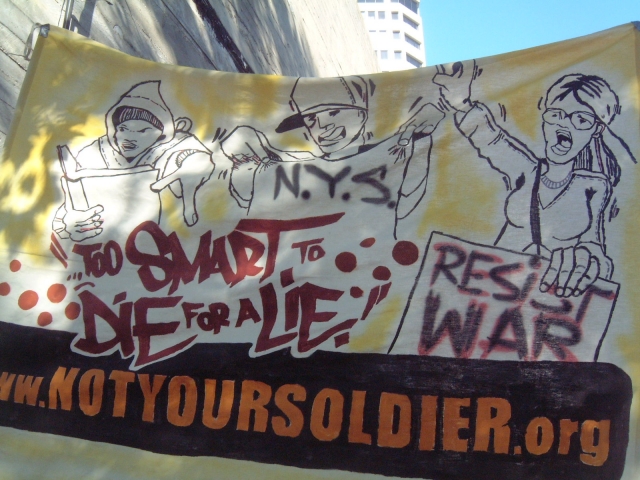
Marchers included members of Code Pink, Not in Our Name, Not Your Soldier, Grandmothers Against War, Act Against Torture, the Bateria Lucha drummers, the International Capoeira Angola Foundation as well as youth and families from the surrounding community.
The groups came together to commemorate International Conscientious Objector's Day by shutting down the local Recruitment Office as similar actions were undertaken in New York and Washington D.C.
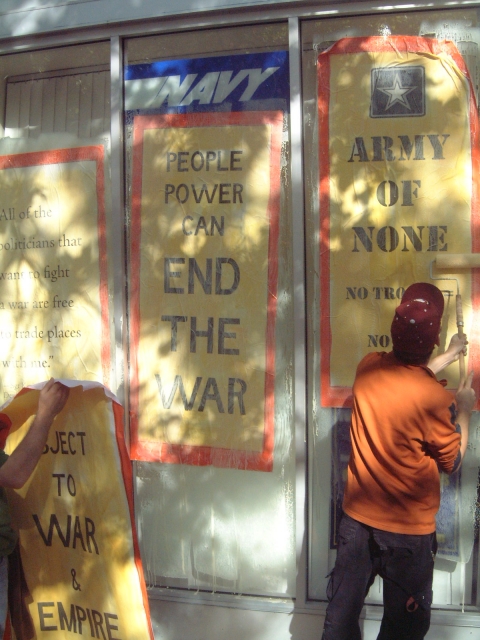
The protesters, escorted by several armed police officers, stopped Northbound traffic on Broadway for 9 blocks during their march to the station, where several participants wheatpasted antiwar banners over windows already filled with recruitment propaganda.
Oakland has a history of fighting militarism, from the draft of the 60's to recruitment efforts today. This is part of the reason Oakland's Aimee Alison, community organizer and candidate for City Council, chose to attend the demonstration. She says she is also concerned with the methods used to attract young people to the armed forces.
Alison, an Army veteran turned
conscientious objector, says she was recruited at this same Oakland
recruitment office with "soft promises" from recruiters. She
says she objects to the war partially because she disagrees with
tactics used to recruit young people. "The military is willing to
lie" she says, in order to attract young people. "Resources are
shrinking", she adds, and many youth look at the military as the
only way to escape poverty.
In an effort to teach his child a
different way of living as early as possible, Oakland resident Gopal
came to voice his opposition to "war and empire" with 22
month-old daughter, Ila. The rally's youngest participant posed and
smiled in front of a sign posted on the Recruitment Office stating
opposition to all wars.
This was an opportunity for their family to create historic record of their opposition to the war and to commemorate the struggle to end it.
As in a previous direct action at the same Recruitment Office in September 2005, the police were unwilling to arrest any of the activists engaged in nonviolent civil disobedience. Attendees attributed this to the broad coalition of public support for the actions.
Ryan Harvey, a member of the anarchist folk collective RiotFolk, observed that such actions can only happen safely during the day as a group action with public support. "Any one person here alone at night would be arrested." he says.
Jeff Paterson linked the success of the event to the inclusion of people from many different backgrounds and ages, from youth to grandmothers. Paterson is a staff member with the national office of Not In Our Name, whose mission is "to build, strengthen and expand resistance to stop the U.S. government's entire course of war and repression being waged in the name of 'fighting terrorism.'"
For more information folow these links:
http://www.indybay.org/news/2006/05/1821082.php
http://www.notinourname.net/about.html
http://rwor.org/a/v22/1080-89/1087/jeff_paterson.htm
http://www.speakoutnow.org/People/headRush.html
http://www.riotfolk.org/
The Iraq war is more unpopular that ever and that's one reason there isnt the same will to protest as there was two years ago, since its now more a matter of getting a message to those in power than to the public and large protests are mainly a matter of rallying the public.
No successful movement has made changes without demonstrations and direct action. I think the goal of the day was to complement the important ongoing counter military recruitiment and GI resistance support campaigns that do have the potential to stop the war and the empire behind it-- and from what I know the turnout was about what the organizers had hoped for and represented a lot of communities.
We've had millions in the streets, we have public opinion and even military servicepeople opinion against the war. Now, how do we translate that into a campaign that can actualy assert our power to make the changes the politicians and ceo's won't. Shutting off the supply of recruits through counter-recruitment and supporting the folks who can shut down the war as they did with Viet Nam (see SirNoSir.com) can do this. No, these deeper challenges to war and empire may not involve millions in the streets, but they have the benefit of being able to force changes when the big demonstrations are not listend to. Perhaps the better way to measure a movment is not soming out to a big demo every few months, but the week by week, day to day grassroots organizing growing allover the US.
hope and resistance!
Direct action gets the goods.
A Workers' Guide to Direct Action
The indignity of working-for-a-living is well-known to anyone who ever has. Democracy, the great principle on which our society is supposedly founded, is thrown out the window as soon as we punch the time clock at work. With no say over what we produce, or how that production is organised, and with only a small portion of that product's value finding its way into our paychecks, we have every right to be pissed off at our bosses.
Ultimately, of course, we need to create a society in which working people make all the decisions about the production and distribution of goods and services. Harmful or useless industries, such as arms and chemical manufacturing, or the banking and insurance scams, would be eliminated. The real essentials, like food, shelter, and clothing, could be produced by everyone working just a few hours each week.
In the meantime, however, we need to develop strategies that both prefigure this utopia AND counteract the day to day drudgery of contemporary wage-slavery.
The IWW believes that direct action in the workplace is the key to achieving both these goals. But what do we mean by direct action?
Direct action is any form of guerrilla warfare that cripples the boss' ability to make a profit and makes him/her cave in to the workers' demands. The best-known form of direct action is the strike, in which workers simply walk off their jobs and refuse to produce profits for the boss until they get what they want. This is the preferred tactic of the ACTU "business unions," but is one of the least effective ways of confronting the boss.
The bosses, with their large financial reserves, are better able to withstand a long drawn-out strike than the workers. In many cases, court injuctions will freeze or confiscate the union's strike funds. And worst of all, a long walk-out only gives the boss a chance to replace striking workers with a scab (replacement) workforce.
Workers are far more effective when they take direct action while still on the job. By deliberately reducing the boss' profits while continuing to collect wages, you can cripple the boss without giving some scab the opportunity to take your job. Direct action, by definition, means those tactics workers can undertake themselves, without the help of government agencies, union bureaucrats, or high-priced lawyers. Running to the Industrial Relations Commission for help may be appropriate in some cases, but it is NOT a form of direct action.
What follows are some of the most popular forms of direct action that workers have used to get what they wanted. Yet nearly every one of these tactics is, technically speaking, illegal. Every major victory won by Labour over the years was achieved with militant direct actions that were, in their time, illegal and subject to police repression. After all, until the 1930's, the laws surrounding labor unions were simple -- there were none. Most courts held labour unions to be illegal conspiracies in restraint of "free trade," and strikers were routinely beaten and shot by police, state militia, Federal troops, and private security goons.
The legal right of workers to organise is now officially recognized, yet so many restrictions exist that effective action is as difficult as ever. For this reason, any worker contemplating direct action on the job -- bypassing the legal system and hitting the boss where s/he is weakest -- should be fully aware of labor law, how it is applied, and how it may be used against labor activists. At the same time, workers must realize that the struggle between the bosses and the workers is not a badminton match -- it is war. Under these circumstances, workers must use what works, whether the bosses (and their courts) like it or not.
Here, then, are the most useful forms of direct action:
Slowdown
The Slowdown has a long and honorable history. In 1899, the organized dock workers of Glasgow, Scotland, demanded a 10% increase in wages, but met with refusal by the bosses and went on strike. Strike-breakers were brought in from among the agricultural workers, and the dockers had to acknowledge defeat and return to work under the old wages. But before they went back to work, they heard this from the secretary of their union:
"You are going back to work at the old wage. The employers have repeated time and again that they were delighted with the work of the agricultural laborers who have taken our place for several weeks during the strike. But we have seen them at work. We have seen that they could not even walk a vessel and that they dropped half the merchandise they carried; in short, that two of them could hardly do the work of one of us. Nevertheless, the employers have declared themselves enchanted with the work of these fellows. Well, then, there is nothing for us to do but the same. Work as the agricultural laborers worked."
This order was obeyed to the letter. After a few days the contractors sent for the union secretary and begged him to tell the dockworkers to work as before, and that they were willing to grant the 10% pay increase.
At the turn of the century, a gang of section men working on a railroad in Indiana were notified of a cut in their wages. The workers immediately took their shovels to the blacksmith shop and cut two inches from the scoops. Returning to work they told the boss "short pay, short shovels."
Or imagine this. BART train operators are allowed to ask for ``10-501s'' (bathroom breaks) anywhere along the mainline, and Central Control cannot deny them. In reality, this rarely happens. But what would management do if suddenly everytrain operator began taking extended 10-501s on each trip they made across the Bay?
Work to Rule
Almost every job is covered by a maze of rules, regulations, standing orders, and so on, many of them completely unworkable and generally ignored. Workers often violate orders, resort to their own techniques of doing things, and disregard lines of authority simply to meet the goals of the company. There is often a tacit understanding, even by the managers whose job it is to enforce the rules, that these shortcuts must be taken in order to meet production quotas on time.
But what would happen if each of these rules and regulations were followed to the letter? Confusion would result -- production and morale would plummet. And best of all, the workers can't get in trouble with the tactic because they are, after all, "just following the rules."
Under nationalization, French railroad strikes were forbidden. Nonetheless, railroad workers found other ways of expressing their grievances. One French law requires the engineer to assure the safety of any bridge over which the train must pass. If after a personal examination he is still doubtful, then he must consult other members of the train crew. Of course, every bridge was so inspected, every crew was so consulted, and none of the trains ran on time.
In order to gain certain demands without losing their jobs, the Austrian postal workers strictly observed the rule that all mail must be weighed to see if the proper postage was affixed. Formerly they had passed without weighing all those letters and parcels which were clearly underweight, thus living up to the spirit of the regulation but not to its exact wording. By taking each separate piece of mail to the scales, carefully weighing it, and then returning it to its proper place, the postal workers had the office congested with unweighed mail on the second day.
Good Work Strike
One of the biggest problems for service industry workers is that many forms of direct action, such as Slowdowns, end up hurting the consumer (mostly fellow workers) more than the boss. One way around this is to provide better or cheaper service -- at the boss' expense, of course.
Workers at Mercy Hospital in France, who were afraid that patients would go untreated if they went on strike, instead refused to file the billing slips for drugs, lab tests, treatments, and therapy. As a result, the patients got better care (since time was being spent caring for them instead of doing paperwork), for free. The hospital's income was cut in half, and panic-stricken administrators gave in to all of the workers' demands after three days.
In 1968, Lisbon bus and train workers gave free rides to all passengers to protest a denial of wage increases. Conductors and drivers arrived for work as usual, but the conductors did not pick up their money satchels. Needless to say, public support was solidly behind these take-no-fare strikers.
In New York City, USA, IWW restaurant workers, after losing a strike, won some of their demands by heeding the advice of IWW organizers to "pile up the plates, give 'em double helpings, and figure the checks on the low side."
Sitdown Strikes
A strike doesn't have to be long to be effective. Timed and executed right, a strike can be won in minutes. Such strikes are ``sitdowns'' when everyone just stops work and sits tight, or ``mass grievances'' when everybody leaves work to go to the boss' office to discuss some matter of importance.
The Detroit IWW employed the Sitdown to good effect at the Hudson Motor Car Company between 1932 and 1934. ``Sit down and watch your pay go up'' was the message that rolled down the assembly line on strickers that had been fastened to pieces of work. The steady practice of the sitdown raised wages 100% (from $.75 an hour to $1.50) in the middle of a depression.
I.W.W. theater extras, facing a 50% pay cut, waited for the right time to strike. The play had 150 extras dressed as Roman soldiers to carry the Queen on and off the stage. When the cue for the Queen's entrance came, the extras surrounded the Queen and refused to budge until the pay was not only restored, but tripled.
Sitdown occupations are still powerful weapons. In 1980, the KKR Corporation announced that it was going to close its Houdaille plant in Ontario and move it to South Carolina. The workers responded by occupying the plant for two weeks. KKR was forced to negotiate fair terms for the plant closing, including full pensions, severance pay, and payment towards health insurance premiums.
Selective Strikes
Unpredictability is a great weapon in the hands of the workers. Pennsylvania teachers used the Selective Strike to great effect in 1991, when they walked a picketline on Monday and Tuesday, reported for work on Wednesday, struck again on Thursday, and reported for work on Friday and Monday.
This on-again, off-again tactic not only prevented the administrators from hiring scabs to replace the teachers, but also forced administrators who hadn't been in a classroom for years to staff the schools while the teachers were out. The tactic was so effective that the Pennsylvania legislature promptly introduced bills that would outlaw selective strikes.
Whistle Blowing (The Open Mouth)
Sometimes simply telling people the truth about what goes on at work can put a lot of pressure on the boss. Consumer industries like restaurants and packing plants are the most vulnerable. And again, as in the case of the Good Work Strike, you'll be gaining the support of the public, whose patronage can make or break a business.
Whistle Blowing can be as simple as a face-to-face conversation with a customer, or it can be as dramatic as the P.G.&E. engineer who revealed that the blueprints to the Diablo Canyon nuclear reactor had been reversed. Upton Sinclair's novel The Jungle blew the lid off the scandalous health standards and working conditions of the meatpacking industry when it was published earlier this century.
Waiters can tell their restaurant clients about the various shortcuts and substitutions that go into creating the faux-haute cuisine being served to them. Just as Work to Rule puts an end to the usual relaxation of standards, Whistle Blowing reveals it for all to know.
Sick-In
The Sick-In is a good way to strike without striking. The idea is to cripple your workplace by having all or most of the workers call in sick on the same day or days. Unlike the formal walkout, it can be used effectively by single departments and work areas, and can often be successfully used even without a formal union organization. It is the traditional method of direct action for public employee unions, which are legally prevented from striking.
At a New England mental hospital, just the thought of a Sick-In got results. A shop steward, talking to a supervisor about a fired union member, casually mentioned that there was a lot of flu going around, and wouldn't it be too bad if there weren't enough healthy people to staff the wards. At the same time -- completely by coincidence, of course -- dozens of people were calling the personnel office to see how much sick time they had left. The supervisor got the message, and the union member was rehired.
Dual Power (Ignoring the Boss)
The best way to get something done is simply organize and do it ourselves. Rather than wait for the boss to give in to our demands and institute long-sought change, we often have the power to institute those changes on our own, without the boss' approval.
The owner of a San Francisco coffeehouse was a poor money manager, and one week the paychecks didn't arrive. The manager kept assuring the workers that the checks would be coming soon, but eventually the workers took things into their own hands. They began to pay themselves on a day-to-day basis straight out of the cash register, leaving receipts for the amounts advanced so that everything was on the up-and-up. An uproar ensued, but the checks always arrived on time after that.
In a small printing shop in San Francisco's financial district, an old decrepit offset press was finally removed from service and pushed to the side of the press room. It was replaced with a brand new machine, and the manager stated his intention to use the old press "for envelopes only." It began to be cannibalized for spare parts by the press operators, though, just to keep some of the other presses running. Soon enough, it was obvious to everyone but the manager that this press would never see service again.
The printers asked the manager to move it upstairs to the storage room, since by now it merely took up valuable space in an already crowded press room. He hemmed and hawed and never seemed to get around to it. Finally, one afternoon after the printers had punched out for the day, they got a moving dolly and wrestled the press onto the elevator to take it upstairs. The manager found them just as they got it into the elevator, and though he turned livid at this blatant usurpation of his authority, he never mentioned the incident to them. The space where the press had been was converted to an "employee lounge," with several chairs and a magazine rack.
Monkey-Wrenching
Monkey-wrenching is the generic term for a whole host of tricks, deviltry, and assorted nastiness that can remind the boss how much he needs his workers (and how little the workers need him/her). While all these monkey-wrenching tactics are non-violent, most of them are major social no-nos. They should be used only in the most heated of battles, where it is open wholesale class warfare between the workers and the bosses.
Disrupting magnetically-stored information (such as cassette tapes, floppy discs and poorly-shielded hard drives) can be done by exposing them to a strong magnetic field. Of course, it would be just as simple to ``misplace'' the discs and tapes that contain such vital information. Restaurant workers can buy a bunch of live crickets or mice at the neighborhood pet shop, and liberate them in a convenient place. For bigger laughs, give the Board of Health an anonymous tip.
One thing that always haunts a strike call is the question of scabs and strike breakers. In a railroad strike in 1886, the scab problem was solved by strikers who took ``souvenirs'' from work home with them. Oddly enough, the trains wouldn't run without these small, crucial pieces, and the scabs found themselves with nothing to do. Of course, nowadays, it may be safer for workers to simply hide these pieces in a secure place at the jobsite, rather than trying to smuggle them out of the plant.
Use the boss' letterhead to order a ton of unwanted office supplies and have it delivered to the office. If your company has an 800 number, have all your friends jam the phone lines with angry calls about the current situation. Be creative with your use of superglue. The possibilities are endless.
Solidarity
The best weapon is, of course, organization. If one worker stands up and protests, the bosses will squash him or her like a bug. Squashed bugs are obviously of little use to their families, friends, and social movements in general. But if all the workers stand up together, the boss will have no choice but to take you seriously. S/he can fire any individual worker who makes a fuss, but s/he might find it difficult to fire their entire workforce.
All of the tactics discussed here depend for their success on solidarity, on the coordinated actions of a large number of workers. Individual acts of sabotage offer little more than a fleeting sense of revenge, which may admittedly be all that keeps you sane on a bad day at work. But for a real feeling of collective empowerment, there's nothing quite like direct action by a large number of disgruntled workers to make your day.
There was a attempt to bring about the first political strike against the war earlier this month .
Several delegates to the International Longshore and Warehouse Union Convention in Vancouver, British Columbia brought forward a resolution calling for the entire union (Longshore, Boatmen, Warehouse workers. Hotel Workers who are members of I.L.W.U. in Hawaii . Canadian Cannery workers etc. ) to go out on a 48 hr , strike against the war .Sadly though it received some support it didn't make it out of the resolution's committee. Several other antiwar resolutions did and were approved by the general body but not the only one calling for direct action . A s for ''another long time activist'' 's assertion that the turnout fot the Oakland anti-military rally was ''what the organizers had hoped for '' i don't believe that ! I maybe a hundred posters urging people to attend , Are you saying that the organizers ''hoped '' that say one person per poster would attend ? Please , don;t deny reality
Donate

$110.00 donated
in the past month
Get Involved
If you'd like to help with maintaining or developing the website, contact us.
Publish
Publish your stories and upcoming events on Indybay.