







 Publish to Newswire
 Add an Event
From the Open-Publishing Calendar
From the Open-Publishing Newswire
Indybay Feature
WAJE Hands Over 6,000 Petition Signatures
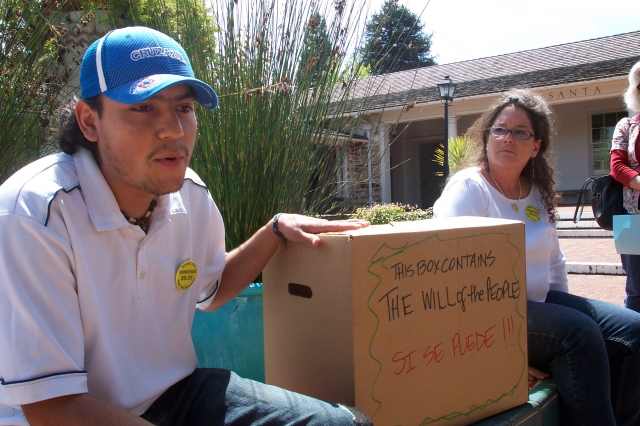
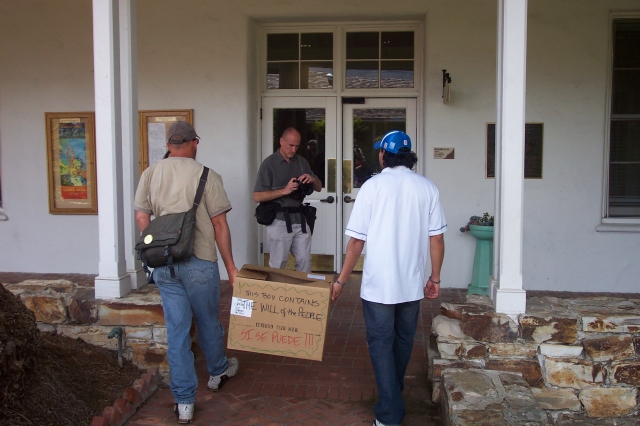
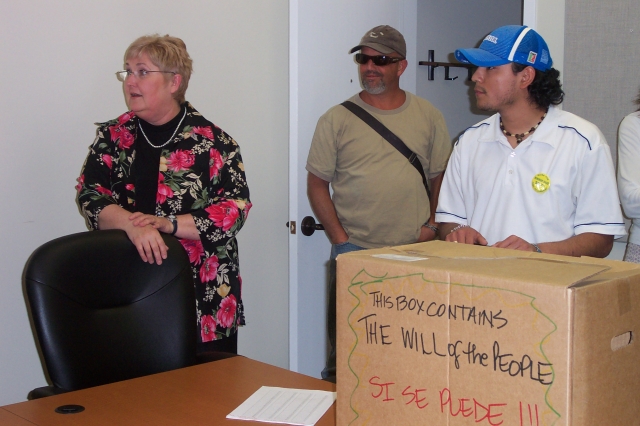
Photos & Audio (3 min 12 sec) of Nora Hochman and Victor Medina from the Working Alliance for a Just Economy (WAJE) as the group turned over thousands of signatures at City Hall to be verified in the ballot initiative process. If enough signatures qualify, the minimum wage hike will go before the voters in November.
Listen now:
Fotos y audio (3 min 12 sec) de Nora Hochman y Victor Medina de la Alianza Trabajando por una Economia Justa (WAJE, por las siglas en ingles). El grupo llevo miles de firmas en la Municipalidad para que las puedan verificar en el proceso de votación. Si tengan bastante, la aumentación del salario minimo será en frente del público en Noviembre.

Add Your Comments
Comments
(Hide Comments)
It's not easy collecting 6,000 signatures of registered voters in the City of Santa Cruz to qualify for the November ballot. And when City leaders, such as Neal Coonerty come forward and denounce raising the minimum wage in Santa Cruz to $9.25/hr., it makes signature gathering that much more difficult!
We hope and expect that the required number of valid signatures will be confirmed guaranteeing a position on the November ballot for the voters of Santa Cruz to decide.
The City Council of Santa Cruz is already planning a $29,000 -- $45,000 "study" which will only poll business owners to throw an obstacle in the path of passage of the ordinance, by weighting the discussion in favor of the views of business owners.
While I personally have a great deal of sympathy for business owners attempting to operate in the black in downtown Santa Cruz, the biggest obstacle to profitability is NOT the wages of its workers. Indeed, those businesses who emply minimum wage workers, have consistently derived their profits from the depressed wages of their workers. The largest obstacle to profitability downtown is the high cost of commercial rents rather than workers wages.
Councilmember Mike Rotkin asserted that the effect on the revenues to the city would be "immense" if the ordinance were to pass. I challenged Rotkin in saying that the profit margins that would be narrowed by higher overhead costs from having to pay workers a higher wage, would be balanced against the higher spending capacity of those workers.
I was unable, in the time allowed to follow-up on that logic, by saying that many business owners take their profits out of the City and sometimes even out of state. But the workers who live nearby are MORE likely to spend those dollars locally and enhance the revenue of the City.
Rotkin's proposed study would undoubtedly include a compaction model in which they would rate the cost of also increasing the salaries of workers who are currently earning more than minimum wage workers due to their higher skill level, years of experience, or greater responsibility in their job description. These become very theoretical numbers and greatly amplify what the actual costs to the businesses would be should the minimum wage be raised from $6.75/hr to $9.25/hr.
It should also be pointed out the the City's own Living Wage ordinance rated a living wage in Santa Cruz at $11.71/hr with benefits or $12.71/hr without benefits. $9.25/hr is not even a living wage according to their own ordinance!!
Neal Coonerty's comments at oral communication stating that he might be forced to cut health benefits to his workers if the minimum wage increase were to pass should be judged in context. Coonerty is one of the very few employers who pays health care benefits to his low-wage earning employees, a benefit he is not obligated by law to do.
He is threatening to cut these benefits to his own employees punitively should the law pass, in an act that could not be duplicated at very many other downtown businesses, since so few provide health care anyway.
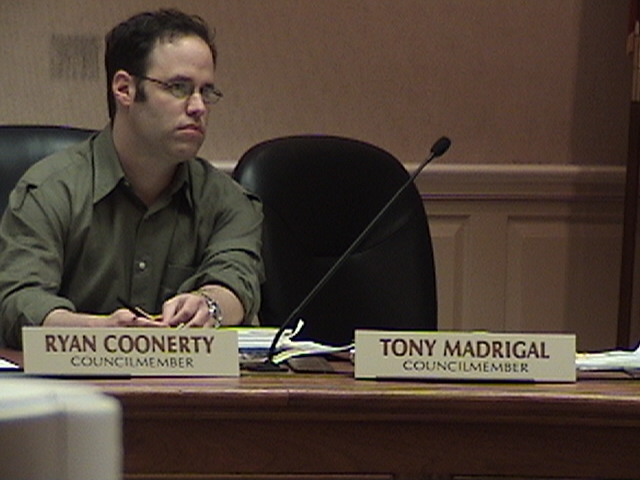
Councilmember Ryan Coonerty should have recused himself when he voted on the minimum wage study, since as co-owner of Bookshop Santa Cruz which employs workers whose wages would be subject to increases should the law pass, his business would be directly affected by passage of the law. But Coonerty, a state-board certified attorney himself, didn't think their was a conflict of interest.
The ultimate result of passage of the minimum wage increase will be that very impoverished workers will have a little bit more money to spend locally. The entire community benefits from their services now as busboys, dishwashers, janitors, and hotel cleaners. The quality of life for our community overall will increase as these workers improve their wages.
We hope and expect that the required number of valid signatures will be confirmed guaranteeing a position on the November ballot for the voters of Santa Cruz to decide.
The City Council of Santa Cruz is already planning a $29,000 -- $45,000 "study" which will only poll business owners to throw an obstacle in the path of passage of the ordinance, by weighting the discussion in favor of the views of business owners.
While I personally have a great deal of sympathy for business owners attempting to operate in the black in downtown Santa Cruz, the biggest obstacle to profitability is NOT the wages of its workers. Indeed, those businesses who emply minimum wage workers, have consistently derived their profits from the depressed wages of their workers. The largest obstacle to profitability downtown is the high cost of commercial rents rather than workers wages.
Councilmember Mike Rotkin asserted that the effect on the revenues to the city would be "immense" if the ordinance were to pass. I challenged Rotkin in saying that the profit margins that would be narrowed by higher overhead costs from having to pay workers a higher wage, would be balanced against the higher spending capacity of those workers.
I was unable, in the time allowed to follow-up on that logic, by saying that many business owners take their profits out of the City and sometimes even out of state. But the workers who live nearby are MORE likely to spend those dollars locally and enhance the revenue of the City.
Rotkin's proposed study would undoubtedly include a compaction model in which they would rate the cost of also increasing the salaries of workers who are currently earning more than minimum wage workers due to their higher skill level, years of experience, or greater responsibility in their job description. These become very theoretical numbers and greatly amplify what the actual costs to the businesses would be should the minimum wage be raised from $6.75/hr to $9.25/hr.
It should also be pointed out the the City's own Living Wage ordinance rated a living wage in Santa Cruz at $11.71/hr with benefits or $12.71/hr without benefits. $9.25/hr is not even a living wage according to their own ordinance!!
Neal Coonerty's comments at oral communication stating that he might be forced to cut health benefits to his workers if the minimum wage increase were to pass should be judged in context. Coonerty is one of the very few employers who pays health care benefits to his low-wage earning employees, a benefit he is not obligated by law to do.
He is threatening to cut these benefits to his own employees punitively should the law pass, in an act that could not be duplicated at very many other downtown businesses, since so few provide health care anyway.
Councilmember Ryan Coonerty should have recused himself when he voted on the minimum wage study, since as co-owner of Bookshop Santa Cruz which employs workers whose wages would be subject to increases should the law pass, his business would be directly affected by passage of the law. But Coonerty, a state-board certified attorney himself, didn't think their was a conflict of interest.
The ultimate result of passage of the minimum wage increase will be that very impoverished workers will have a little bit more money to spend locally. The entire community benefits from their services now as busboys, dishwashers, janitors, and hotel cleaners. The quality of life for our community overall will increase as these workers improve their wages.
1. The vast majority of economists believe the minimum wage law costs the economy thousands of jobs. The most fundamental principle of economics is 'supply and demand'. In the case of labor, this means that the supply of workers goes up as wage goes up, and the demand for workers by employers goes down as the wage goes up. For example, imagine a janitorial job was advertised for hire. If the wage is $100 per hour, thousands of people would want the job. If the wage was $1 per hour, you probably wouldn't find anyone to do it. Conversely, if the government forced the employer to pay at least $7 per hour, the employer might decide not to hire a janitor at all, instead opting to have other staff pick up the duties. Thus, a job would be lost because of the minimum wage. Another example is restaurant employment. A manager might have $10,000 in her monthly budget to hire bus persons. If the wage is set at $7 per hour, the manager may only be able to hire 10 bus people instead of 15. Setting a mandated wage limit disrupts market forces of supply and demand. Just because there is no minimum wage doesn't mean companies can pay whatever they want. Would you work a dishwashing job that paid 25 cents per hour? Would anyone? If they raised the wage to $4 per hour, they might be able to hire a high school student. Consider some highly skilled jobs such as accountant, lawyer, and engineer. Do these people make $5.15 an hour? Obviously, the answer is no. Market factors of supply and demand determine how many jobs are available and what each job would pay. In summary, as the minimum wage goes up, the number of people employed goes down. When the minimum wage goes down, the number of people employed goes up. Keep in mind: the minimum wage only applies if someone is employed.
2. Teenagers, workers in training, college students, interns, and part-time workers all have their options and opportunities limited by the minimum wage. Over 95 percent of minimum wage jobs are taken by the groups named above. You cannot make a living and support a family on a minimum wage job. These jobs are typically positions requiring little or no training that can be filled by almost anyone. Many students, part-timers, and other young workers are willing to take much less than minimum wage, especially if it is a fun or educational job. We all know that having a paying job when you're young teaches values such as discipline, hard work, and responsibility. It teaches young workers how to handle money and deal with other people. Thus, as a society we want to maximize the number of young people that work, even if it's for small wages. In fact, earning low wages provides extra motivation to go to college or acquire advanced job skills by some other method. Raising the minimum wage to $7 or more will definitely help some people trying to support a family, but it will hurt the group that holds almost all minimum wage positions. It will simply mean fewer low-skill jobs for those that actually need them.
3. A low-paying job remains an entry point for those with few marketable skills. Almost no one wants to work a minimum wage job for the rest of their lives. We all want the higher paying and more interesting jobs. But how do you get one? Even if you've acquired a college or technical degree, you may not be able to get the job you want. The most common question in a job interview is "What experience do you have?" Jobseekers are then faced with the no-win situation "I can't get a job without experience, but how can I get experience without a job?" If you allow businesses to pay smaller entry wages, they will offer more opportunities to jobseekers with no experience. Thus, it's a win-win situation. The business can take on additional workers for a reasonable price. The jobseeker can gain valuable experience that can be used to get a decent, high-paying job later on. In the next decade we face a major shortage of highly skilled workers in technology, health care, and other complex fields. We need to provide people as many opportunities to learn and gain experience as possible.
4. Abolishing the minimum wage will allow businesses to achieve greater efficiency and lower prices. Anytime you give businesses more flexibility, you will increase efficiency and lower prices. Let me give you some examples. Say a McDonald's franchise has a budget of $70 per hour to pay worker wages (without considering benefits and taxes). If that McDonald's must pay $7 per hour, it can hire 10 workers. If it must only pay $5 per hour, it can hire 14 workers. If you go to get a burger, in which situation are you more likely to get it faster? Consider the same situations for a Wal-Mart. In which case are you most likely to find an employee that can take you to an item or answer questions? Thus, businesses can be more efficient and provide better customer service with a lower wage. Another example: imagine three competing coffee shops. All three need to make a certain profit margin to stay in business and make their effort worthwhile. So they all will lower their prices as much as possible while still covering that necessary profit margin. If one of them tries to charge more, customers will simply go to the competitor shops. Now assume the minimum wage is eliminated and each shop can now reduce labor costs by 25 percent. If each doesn't reduce its coffee prices by a proportional amount, it will lose customers to the other two competitors. So by lowering the minimum wage, the public now has to pay less for their espressos. This is obviously a simplistic example, but the principle applies to all businesses. A company cannot simply charge whatever it wants for a product or service. It must always charge a reasonable multiple of its cost; otherwise, it is heading for bankruptcy.
5. When you force American companies to pay a certain wage, you increase the likelihood that those companies will outsource jobs to foreign workers, where labor is much cheaper. There has been a lot of attention lately on the subject of job "outsourcing", where U.S. companies hire foreign workers instead of Americans. When businesses outsource American jobs, they're not doing it because they hate America; they're doing it because they're trying to cut costs. When you increase the price of labor in America, you create an additional incentive for businesses to hire Canadian, Mexican, or other foreign workers. The best way to stop outsourcing of jobs is to provide the best conditions for doing business in America. A minimum wage just makes things tougher for companies to do business in America.
6. Non-profit charitable organizations are hurt by the minimum wage. Keep in mind that minimum wage laws apply to more than big businesses, they apply to government and non-profit organizations. Charitable organizations are among those most likely to benefit from the elimination of the minimum wage. Let's take an example. Consider a domestic violence shelter. This type of shelter normally needs workers to clean, collect & organize donations, counsel & assist residents, monitor help-lines, provide legal assistance in such things as obtaining restraining orders, and so on. Volunteers help relieve some of the duties, but it's often tough to find dedicated ongoing volunteers to do the job. After all, volunteers still have to earn a living, raise a family, etc. However, if the charitable organization were able to pay some amount, even a few dollars an hour, it would better be able to build a more steady set of workers. A non-profit organization may simply not be able to afford a $7 per hour pay rate. Thus, non-profits have only two solutions: dissolve their organizations or hire fewer people to provide the charitable service.
7. The minimum wage can drive some small companies out of business. Many people believe businesses have endless supplies of cash and can easily withstand minimum wage increases or other cost increases. Unfortunately, that's simply not the case. Over 90 percent of businesses fold within the first few years. Every time there is a recession, thousands of businesses go under. Restaurants, which pay wages at or near the minimum wage level, have the highest rate of failure of any business type. Anytime you increase the costs of businesses, you push them closer to the edge. Let's take an example. Imagine a small neighborhood hardware store. This hardware store isn't going to have the logistics and economy of scale advantages of say, Wal-Mart; thus, it must charge more. It probably makes up the price difference with better service. When you raise the minimum wage, it increases the operating costs for that hardware store even more. Thus, it must raise it's prices to cover costs. Eventually, prices get so high that customers conclude that shopping there isn't worth the additional cost. Slowly, the local hardware store is driven out of business.
8. A minimum wage gives businesses an additional incentive to mechanize duties previously held by humans. Most businesses, especially in the manufacturing and retailing area, have many mundane tasks that need to be done, such as running a cash register or tightening a bolt on an assembly line. One of the reasons the manufacturing sector has not been part of the job recovery is that businesses have found it's much cheaper to use machines to do tasks that were previously done by people. Whenever businesses automate any task, they usually must spend a lot of upfront money and time in order to save down the line. Because of the minimum wage, spending the upfront time & money seems more worthwhile. For example, Wal-Mart is in the process of adding automated check-outs to almost all of its stores. Thus, all those cashier jobs will disappear. Imagine what would happen if the minimum wage was raised to $7 or more, as some politicians want. Do you think Wal-Mart will be more willing or less willing to add more automated checkouts?
We are 100% volunteer and depend on your participation to sustain our efforts!
Donate

$90.00 donated
in the past month
Get Involved
If you'd like to help with maintaining or developing the website, contact us.
Publish
Publish your stories and upcoming events on Indybay.
Topics
More
Search Indybay's Archives
Advanced Search
►
▼
IMC Network