







 Publish to Newswire
 Add an Event
From the Open-Publishing Calendar
From the Open-Publishing Newswire
Indybay Feature
AFSCME Workers Take Struggle to UCSC Chancellor's Doorstep
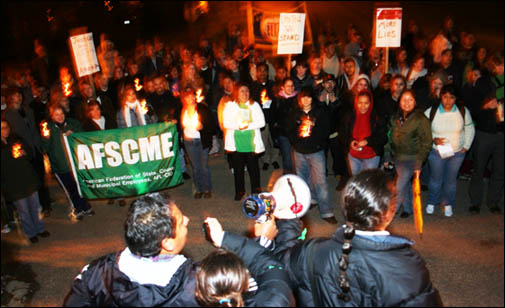
On the night of March 7, custodians of AFSCME 3299 and their families, along with student and worker supporters, marched to the gates of UC Santa Cruz Chancellor Denice Denton's on-campus home. The more than 200-strong crowd demanded the Chancellor support workers' struggles for dignity and justice, including wage parity with other regional colleges where workers make dollars more per hour for the same (or less) work.
The march, organized by AFSCME 3299 in coordination with MEChA de UCSC and the Student and Worker Coalition for Justice (SWCJ) continues the legacy of labor struggle at the UC Santa Cruz campus. On April 14 of last year, over 1,000 students and workers shut down the campus for the day as a part of a state-wide AFSCME strike for justice. Days later, the workers won a significantly better contract.
In the past year, student and worker solidarity and militancy has lead to significant gains for AFSCME, CUE (clericals), and Santa Cruz County bus drivers, represented by UTU. The struggle continues...
The march, organized by AFSCME 3299 in coordination with MEChA de UCSC and the Student and Worker Coalition for Justice (SWCJ) continues the legacy of labor struggle at the UC Santa Cruz campus. On April 14 of last year, over 1,000 students and workers shut down the campus for the day as a part of a state-wide AFSCME strike for justice. Days later, the workers won a significantly better contract.
In the past year, student and worker solidarity and militancy has lead to significant gains for AFSCME, CUE (clericals), and Santa Cruz County bus drivers, represented by UTU. The struggle continues...

All photos are free and available for use by members of AFSCME 3299, MEChA, and the Student and Worker Coalition for Justice. For additional photos, and/or to reprint, please contact sugarloaf [at] riseup.net. Thanks!
For more information:
http://www.afscme3299.org


















Add Your Comments
Comments
(Hide Comments)
Students should put this to a vote. If you decide that the unions should receive a pay increase, then it should come out of tuition. Yes yes yes, I know the argument that the Chancellor gets paid too much, but even if you cut her pay by half, it would not cover the union’s desired increase.
There is no easy answer to this issue. If you think they should get paid me, be prepared to pay more to go to school.
There is no easy answer to this issue. If you think they should get paid me, be prepared to pay more to go to school.
These janitors get $2000 per month starting pay. This is more than other jobs outside the uc system. The workers should be greatful they are not working at mc donalds at $6.75 per hour. These people are just plain greedy and jealous of fellow workers making a buck more than they do. What happened to the noble lefty goal of working together for the common good with disregard to capital earnings??
Top UC-administrators and high-wage faculty received almost a billion dollars in perks, according to the SF Chronicle. That's where this money should come from. That money could also roll back all the student fee increases. There's also thousands of UC employees making more than $200,000 a year, far too much money to know what to do with.
If you think $24,000/yr is more than enough to live in (many workers don't even make that, having to work 2 or 3 jobs to make ends meet for their families), how 'bout everyone lives on that. No one more, no one less. The Chancellor can say goodbye to her $300k+, her free home, and her 24 hour security service. All the owners of businesses won't make more than that. Just give us your bank account # and code, and we'll make it happen for you right now, C831!
Sounds exciting huh? Must feel good to hate workers, eh?
If you think $24,000/yr is more than enough to live in (many workers don't even make that, having to work 2 or 3 jobs to make ends meet for their families), how 'bout everyone lives on that. No one more, no one less. The Chancellor can say goodbye to her $300k+, her free home, and her 24 hour security service. All the owners of businesses won't make more than that. Just give us your bank account # and code, and we'll make it happen for you right now, C831!
Sounds exciting huh? Must feel good to hate workers, eh?
The name is chicano831, do you have some sort of racial problem or what?
As for your claim The UC administration is getting billions in perks, post some evidence, put up or shut up in simple terms. Did you consider that the reason these upper level workers are getting way more money than the janitors is because they hold something the low level workers do not its called a PHD. Did you also consider that if you lower the earnings of upper level workers that they will simply leave for better position in the private sector, be that other occupations or other schools (i.e. stanford, hardward, tech schools).
As for your claim The UC administration is getting billions in perks, post some evidence, put up or shut up in simple terms. Did you consider that the reason these upper level workers are getting way more money than the janitors is because they hold something the low level workers do not its called a PHD. Did you also consider that if you lower the earnings of upper level workers that they will simply leave for better position in the private sector, be that other occupations or other schools (i.e. stanford, hardward, tech schools).
Don't you pay attention to the news? You're smart enough, go look for the link yourself, it was in the SF Chronicle.
Are you moving back from your argument that $24k/yr is more than enough? Don't have anything to respond with? Or are you too busy trying to cause flamewars to actually research the issue you're talking about?
Do you have some sort of racial problem? You obviously think that poor workers of color deserve to live in poverty while rich, predominately white administrators should fill their pockets off their labor.
All the administrators who refuse to work for a reasonable wage can leave for all I care. Students, faculty, and workers could run the system better than them. In fact, we already do.
Are you moving back from your argument that $24k/yr is more than enough? Don't have anything to respond with? Or are you too busy trying to cause flamewars to actually research the issue you're talking about?
Do you have some sort of racial problem? You obviously think that poor workers of color deserve to live in poverty while rich, predominately white administrators should fill their pockets off their labor.
All the administrators who refuse to work for a reasonable wage can leave for all I care. Students, faculty, and workers could run the system better than them. In fact, we already do.
Essentially you have no proof to back up your allegation that the administration is getting billions in perks which is an obvious blown up figure.
"Are you moving back from your argument that $24k/yr is more than enough? Don't have anything to respond with? Or are you too busy trying to cause flamewars to actually research the issue you're talking about?"
I'm not moving back from that figure since I know first hand that a person can live on that. Not a life of luxgery but enough to live one.
"Do you have some sort of racial problem? You obviously think that poor workers of color deserve to live in poverty while rich, predominately white administrators should fill their pockets off their labor."
Didnt you read my aurthor tag, I'm chicano, how can i have a racial problem. Don't try to play the race card on me buddy. I have no problem with workers making an honest wage for an honest days work. The problem is using taxpayer money to overpay for a service. Remember these people are janitors not teachers or administration. If they want a higher earning position, they should go back to school. You will find very few Phds moping floors. Mop work is worth no more than 10 bucks an hour, thats the market rate. If they don't like it, they should not take the job. Just for informational purposes how much do you feel they should earn? Are you willing to pay more in student fees?
"All the administrators who refuse to work for a reasonable wage can leave for all I care. Students, faculty, and workers could run the system better than them. In fact, we already do."
ah so you are a student? Would it be far fetched to assume you never held a hard working job in young life? Take it from some one who has worked, if a job does not pay enough don't take. You have free will to decline any position you do not like. You also have free will to quit a job at any given time.
"Are you moving back from your argument that $24k/yr is more than enough? Don't have anything to respond with? Or are you too busy trying to cause flamewars to actually research the issue you're talking about?"
I'm not moving back from that figure since I know first hand that a person can live on that. Not a life of luxgery but enough to live one.
"Do you have some sort of racial problem? You obviously think that poor workers of color deserve to live in poverty while rich, predominately white administrators should fill their pockets off their labor."
Didnt you read my aurthor tag, I'm chicano, how can i have a racial problem. Don't try to play the race card on me buddy. I have no problem with workers making an honest wage for an honest days work. The problem is using taxpayer money to overpay for a service. Remember these people are janitors not teachers or administration. If they want a higher earning position, they should go back to school. You will find very few Phds moping floors. Mop work is worth no more than 10 bucks an hour, thats the market rate. If they don't like it, they should not take the job. Just for informational purposes how much do you feel they should earn? Are you willing to pay more in student fees?
"All the administrators who refuse to work for a reasonable wage can leave for all I care. Students, faculty, and workers could run the system better than them. In fact, we already do."
ah so you are a student? Would it be far fetched to assume you never held a hard working job in young life? Take it from some one who has worked, if a job does not pay enough don't take. You have free will to decline any position you do not like. You also have free will to quit a job at any given time.
chicano831 wrote:
"As for your claim The UC administration is getting billions in perks, post some evidence, put up or shut up in simple terms."
Below is the SF Chronicle article.
Chicano831: Wrote
"Did you consider that the reason these upper level workers are getting way more money than the janitors is because they hold something the low level workers do not its called a PHD."
Of course administrators will be paid more than janitors. Thats not the point. The question is are the workers and the union greedy and irrational
or are they being shafted? The first point would be to notice that administrators dont just make alot. But that they have been making more and more these last couple of years even though they claim there is a financial crisis. What this means is they construct a crisis in order to justify what they want to cut, most notably at UCSC has been languages. If you see the article below, you will notice in the last two years that there has been raises for administrators and wage decreases for custodians. The second point would be looking at the decision making process behind this situation. You might think its justifiable for MIT PhD graduates to make 300,000 a year, but is it justifiable that the decision making process is set up in a way where they can conjour up a crisis and at the same time vote to give themselves rasies while everyone else is subjected to cuts?
The way that these proffessionals defend such a system is based on their "expertise" that is validated by their degrees and resumes.
In other articles on this matter, independent economist have stated the UC system as a whole has 5 billion dollars in unrestricted funds. Why would they not use this money to save languages, hire workers with living wages, and so on? Becuase the UC system has a corporate logic that they only want to fund what is going to generate more funds later i.e. capital investment.
In a more macro sense, If California was a country, it would have the 5th strongest economy in the world, stronger than Italy. The multi-industrious economy is competitive in every major financial sphere. The public sphere, education, government jobs, welfare, in California has been systematically attacked since 1973 by being defunded or even privatized. Look at the school district takeovers in Oakland and Richmond that have happenend in the last couple of years. But back to California's economy, could their be a living wage for workers in the UCs in the context of California's economy? Well I dont know, thats a bit complicated. Can rabbits eat carrots? It doesn't take an economist to figure this one out. But whenever attacks on the public sphere or on the working class take place, its justified through individualist solutions. If you dont like your job, go to school. If you dont like your school, go to another one that has what you want offered. Healthcare is a privalidge not a right (even though 100,000 people die a year in the US from not being able to access healthcare). With the contemporary trajectory, of attacks on wages, pensions, healthcare, public education, there wont be any accessibility to these things for 90% of the population. Look at the latino immigrant community that drops out of k-12 at 37% rate. Chicano831, why dont you ask, in this sub-working class community, why dont you just go to school to fix your problems? It wont be difficult to do this becuase many of them work at UCSC.
Cheers,
Javier
---------------------------------------------------------------------
Sunday, November 13, 2005 (SF Chronicle)
UC piling extra cash on top of pay/8,500 top staffers pulling down at
least
$20,000 each in bonuses, compensation
Tanya Schevitz, Todd Wallack, Chronicle Staff Writers
When the University of California hired David Kessler as dean of
the
UCSF
School of Medicine two years ago, the university announced he would
receive "total compensation" of $540,000 a year.
Turns out he actually got much more.
In addition to his salary, he received a one-time relocation
allowance of
$125,000, plus $30,000 for six months' rent and a low-interest home
loan.
There was more. He was reimbursed for his actual moving costs from
Connecticut, and his family received round-trip airline tickets to go
house-hunting in the Bay Area.
Kessler is hardly unique. Despite UC's complaints that it has been
squeezed by cuts in state funding and forced to raise student fees, many
university faculty members and administrators get paid far more than is
publicly reported.
In addition to salaries and overtime, payroll records obtained by The
Chronicle show that employees received a total of $871 million in
bonuses,
administrative stipends, relocation packages and other forms of cash
compensation last fiscal year. That was more than enough to cover the 79
percent hike in student fees that UC has imposed over the past few
years.
The bulk of the last year's extra compensation, roughly $599
million, went
to more than 8,500 employees who each got at least $20,000 over their
regular salaries. And that doesn't include an impressive array of other
perks for selected top administrators, ranging from free housing to
concert tickets.
None of that was mentioned in a consultant's report the university
released in September saying UC executives' salaries are 15 percent
below
those of their peers at other major universities. The report, by Mercer
Human Resource Consulting, was part of a proposal to UC's Board of
Regents
to consider management, faculty and staff pay raises.
"Oh, my word," said Faith Raider, a research analyst for the American
Federation of State, County and Municipal Employees Local 3299, when
told
of The Chronicle's payroll findings. "I follow this stuff pretty
closely,
and I am astounded at some of these figures. I think it's been a closely
held secret."
Her union represents 17,000 custodians, food workers and other
lower-paid
employees within the 10-campus university system.
"If most people knew about this type of spending, they'd be
outraged,"
Raider said.
Such extra compensation is not uncommon in higher education or
private
enterprise. Like big companies, elite universities around the country
give
top employees bonuses and other compensation.
UC officials say the university relies on its payments to attract
talented
researchers and administrators and needs to make the payments to compete
with other colleges around the world.
"Given today's fierce competition for talent, getting and keeping
the best
people for certain positions sometimes requires compensation packages
that
may look excessive on the outside, but that reflect true competitive
realities," said UC President Robert Dynes. "In many cases, these offers
include one-time funding that should not be confused with ongoing
compensation."
UC spokesman Paul Schwartz also noted that UC funds its payroll
from
a
variety of sources, including state funding, research grants, private
donations, medical fees and tuition.
But some observers say a public college system, like UC, could be
more
public about its pay. For instance, when UC appoints new administrators,
it normally only reports the base salary -- excluding moving stipends,
housing allowances, car allowances and other forms of pay.
"In my mind, there is absolutely no question it should be
disclosed," said
UC Regent John Moores, owner of the San Diego Padres baseball team. "The
university should be transparent. We are not transparent."
Another regent said the idea is at least worth considering.
"Maybe we should disclose that," said Regent Judith Hopkinson, "but
we
have not in the past."
In September, UC released the Mercer report, which university
officials
said proves their employees are underpaid in salary. But the study
focused
on employees' base salary, and excluded some other forms of cash
compensation -- such as relocation stipends and administrative stipends.
"We should be comparing full compensation, including the perks, not
just
the salary, because when you look across the country, you shouldn't be
comparing apples to oranges," said Velma Montoya, an economist who
served
on the UC Board of Regents for 11 years until her term ended in January.
UC officials said bonuses, relocation allowances and other
compensation
are found in at least 20 individual categories, but couldn't break down
the amounts handed out from each category. Nor could officials say how
much came from tax dollars or from other sources, such as private
research
grants. The university's payroll database lists each employee's base
salary and total extra compensation, but does not show what the extra
compensation was for.
"It seems to me that UC should be willing to account for that,"
said
UC
Davis law school Professor Daniel Simmons, a former chairman of UC's
Academic Council. "There should be oversight."
Even UC regents typically don't find out about the extra pay.
Though
UC
policy generally requires regents to approve salaries above $168,000 at
public meetings, UC administrators are usually free to give employees
other compensation on their own.
UC's payroll database, however, shows that 4 in 10 employees
receive
some
form of extra pay on top of salaries and overtime -- from a student at
UC
San Diego who earned an extra penny to two UCSF doctors who received
more
than $1.4 million each.
Examples of typical forms of extra compensation are:
-- Bonuses -- Judith Rothman, an associate vice chancellor and dean
at
UCLA, received a $37,000 "campus incentive award" on top of her $183,400
salary last year. UCLA officials said Rothman, who earned a similar
award
the previous year, received extra money because she took on additional
work when the university left another position vacant. There hasn't
been a
study of bonuses throughout the UC system, but officials said they are
granted for extra duties or for meeting or exceeding established goals.
Critics say many of the university's low-paid employees have to take on
extra work without additional compensation.
-- Relocation allowances -- Michael Schill, dean of UCLA's law
school, was
given an annual salary of $290,000 and then received a $270,000 housing
allowance when he arrived from New York University in August 2004. UC
also
paid his actual moving expenses. UC administrators say they need to
offer
such allowances to recruit the best employees and to speed their
transition to UC jobs.
-- Housing/car allowances -- When Lynn Boland became acting human
resources director at Los Alamos National Laboratory last year, UC gave
her $83,383 to cover her rent, car lease and other living expenses. That
was on top of her $161,000 in salary and other cash compensation. A UC
spokesman said Boland was reimbursed for "taxable out-of-pocket
expenses."
Like other major university systems, UC generally gives senior employees
auto allowances, currently totaling $8,916 per year.
-- Administrative stipends -- Even as the UC system was hit with
allegations of mismanagement in its oversight of the nation's weapons
laboratories, it handed out administrative stipends to officials for
their
work on lab issues. Two UC public relations executives, Michael Reese
and
Scott Sudduth, each got annual stipends of $18,000 for "additional
responsibilities" -- bringing their pay to $200,000 each. The stipends,
which went into effect January 2003, were originally approved by the UC
president and the regents' chair for six months. But nearly three years
later, both executives are continuing to receive the extra pay. UC
explained that such stipends, like bonuses, are compensation for extra
responsibilities assumed by the employee. Critics say that such stipends
were not given to faculty who have been asked to teach more classes as
enrollment outpaced hiring, or to low-paid staff who have had to pick up
extra responsibilities to cover for unfilled positions.
-- Revenue-sharing -- In addition to their base salaries, which are
comparatively low, some UC physicians also receive a percentage of the
money generated from seeing patients. Two skin pathologists at UCSF, for
instance, each earned more than $1.5 million last year, largely by
analyzing tens of thousands of skin samples underneath a microscope to
look for cancer and other diseases. UC officials said the duo -- Drs.
Philip E. LeBoit and Timothy H. McCalmont, oversee a thriving practice
that generated $10 million in revenue, largely profit, and drew patients
from around the world.
-- Outside income -- In addition to the pay from UC, the university's
prestige and flexible schedules allow many top employees to add to their
earnings with outside lectures, consultant and board positions --
including work done during their normal workweek.
For example, UCSF Dean David Kessler, a former commissioner of the
U.S.
Food and Drug Administration, earns tens of thousands of dollars serving
on advisory boards for several firms, including Fleishman-Hillard, the
public relations firm. And his colleague, UCSF Chancellor Michael
Bishop,
had more than a dozen sources of moonlighting income -- including
lectures, research and consulting -- in addition to his annual
university
pay of $358,899.
UC policy allows faculty and some other senior employees to spend
up
to 48
workdays a year (nearly 10 weeks) on outside paid work without having to
take vacation time. UC says such work benefits the university because
its
employees are educating the public about the university and making
important contacts that could lead to donations and support.
Meanwhile, the university system's 208,000 students are paying more
than
ever. Student fees over the last four years have jumped from $3,429 a
year
to $6,141. The UC Regents are expected to vote Wednesday on a proposal
to
raise fees an additional 8 percent or $492 for next year.
"It's ludicrous to increase student fees ... when you're talking
about
executive officers making this much money, and no one knowing about it,"
said Anu Joshi, a UC Berkeley graduate student and president of the
systemwide UC Student Association.
CHART (1):
E-mail the writers at tschevitz [at] sfchronicle.com or
twallack [at] sfchronicle.com. Bringing in the big bucks
Here are UC's highest-paid
employees based on total compensation. Base salary is a small fraction
of their
total pay.
Top paid UC employees/Title Campus Salary '04-'05 total
pay
Jeff Tedford
Football coach Berkeley $152,590.14
$1,562,453.14
Philip E. LeBoit
Professor of medicine San Francisco $91,306.44
$1,516,450.75
Ronald W. Busuttil
Professor of medicine Los Angeles $246,415.08
$1,507,289.12
Timothy H. McCalmont
Professor of medicine San Francisco $78,496.44
$1,502,671.20
Benjamin Howland
Basketball coach Los Angeles $150,000.00
$1,020,000.00
Tom R. Karl
Professor of medicine San Francisco $90,752.88
$906,508.37
Jan Paul Muizelaar
Professor of medicine Davis $116,600.04
$857,054.14
Ben Braun
Basketball coach Berkeley $147,500.00
$847,333.37
Kee D. Kim
Asst. professor of medicine Davis $63,200.04
$776,942.64
Robert N. Weinreb
Professor of medicine San Diego $129,882.54
$732,688.57
Khalil M. Tabsh
Professor of medicine Los Angeles $139,584.00
$720,000.00
.
Top paid UC administrators Title '04-'05 total pay
Robert C. Dynes President $403,916.16
M.R.C. Greenwood * Provost $520,069.26
Joseph Mullinix Senior vice president $381,165.92
Bruce Darling Senior vice president $277,916.16
Lawrence C. Hershman VP - Budget $216,016.08
W.R. Gomes VP - Agriculture $236,115.96
Michael V. Drake** VP - Health $358,915.92
S. Robert Foley VP - Labs $364,949.35
Linda M. Williams Associate president $208,970.00
* - recently resigned
** - Made chancellor of UC Irvine in July 2005
.
'04-'05 '02-'03
UC's median payrolls median median Change %
Chancellor $307,066 $280,066 10%
Professor $136,100 $130,000 5%
Director $99,966 $97,194 3%
Associate professor $85,629 $82,440 4%
Assistant professor $80,000 $77,866 3%
Clinical nurse $64,983 $60,117 8%
Electrician $60,761 $58,691 4%
Administrative specialist $42,695 $42,853 0%
Custodian $22,867 $24,159 -5%
<BR><HR>
CHART (2):
OVERALL PAYROLL
Over the last few years there has been an increase in the UC?s
payroll.
2002-03
Total: $8.55 billion
Base pay: $7.69 billion
Overtime: $109 million
Other*: $756 million
.
2003-04
Total: $8.91 billion
Base pay: $7.99 billion
Overtime: $108 million
Other*: $810 million
.
2004-05
Total: $9.23 billion
Base pay: $8.24 billion
Overtime: $114 million
Other*: $871 million
* Includes bonuses, auto allowances, housing allowances and other pay
The Chronicle
----------------------------------------------------------------------
Copyright 2005 SF Chronicle
"As for your claim The UC administration is getting billions in perks, post some evidence, put up or shut up in simple terms."
Below is the SF Chronicle article.
Chicano831: Wrote
"Did you consider that the reason these upper level workers are getting way more money than the janitors is because they hold something the low level workers do not its called a PHD."
Of course administrators will be paid more than janitors. Thats not the point. The question is are the workers and the union greedy and irrational
or are they being shafted? The first point would be to notice that administrators dont just make alot. But that they have been making more and more these last couple of years even though they claim there is a financial crisis. What this means is they construct a crisis in order to justify what they want to cut, most notably at UCSC has been languages. If you see the article below, you will notice in the last two years that there has been raises for administrators and wage decreases for custodians. The second point would be looking at the decision making process behind this situation. You might think its justifiable for MIT PhD graduates to make 300,000 a year, but is it justifiable that the decision making process is set up in a way where they can conjour up a crisis and at the same time vote to give themselves rasies while everyone else is subjected to cuts?
The way that these proffessionals defend such a system is based on their "expertise" that is validated by their degrees and resumes.
In other articles on this matter, independent economist have stated the UC system as a whole has 5 billion dollars in unrestricted funds. Why would they not use this money to save languages, hire workers with living wages, and so on? Becuase the UC system has a corporate logic that they only want to fund what is going to generate more funds later i.e. capital investment.
In a more macro sense, If California was a country, it would have the 5th strongest economy in the world, stronger than Italy. The multi-industrious economy is competitive in every major financial sphere. The public sphere, education, government jobs, welfare, in California has been systematically attacked since 1973 by being defunded or even privatized. Look at the school district takeovers in Oakland and Richmond that have happenend in the last couple of years. But back to California's economy, could their be a living wage for workers in the UCs in the context of California's economy? Well I dont know, thats a bit complicated. Can rabbits eat carrots? It doesn't take an economist to figure this one out. But whenever attacks on the public sphere or on the working class take place, its justified through individualist solutions. If you dont like your job, go to school. If you dont like your school, go to another one that has what you want offered. Healthcare is a privalidge not a right (even though 100,000 people die a year in the US from not being able to access healthcare). With the contemporary trajectory, of attacks on wages, pensions, healthcare, public education, there wont be any accessibility to these things for 90% of the population. Look at the latino immigrant community that drops out of k-12 at 37% rate. Chicano831, why dont you ask, in this sub-working class community, why dont you just go to school to fix your problems? It wont be difficult to do this becuase many of them work at UCSC.
Cheers,
Javier
---------------------------------------------------------------------
Sunday, November 13, 2005 (SF Chronicle)
UC piling extra cash on top of pay/8,500 top staffers pulling down at
least
$20,000 each in bonuses, compensation
Tanya Schevitz, Todd Wallack, Chronicle Staff Writers
When the University of California hired David Kessler as dean of
the
UCSF
School of Medicine two years ago, the university announced he would
receive "total compensation" of $540,000 a year.
Turns out he actually got much more.
In addition to his salary, he received a one-time relocation
allowance of
$125,000, plus $30,000 for six months' rent and a low-interest home
loan.
There was more. He was reimbursed for his actual moving costs from
Connecticut, and his family received round-trip airline tickets to go
house-hunting in the Bay Area.
Kessler is hardly unique. Despite UC's complaints that it has been
squeezed by cuts in state funding and forced to raise student fees, many
university faculty members and administrators get paid far more than is
publicly reported.
In addition to salaries and overtime, payroll records obtained by The
Chronicle show that employees received a total of $871 million in
bonuses,
administrative stipends, relocation packages and other forms of cash
compensation last fiscal year. That was more than enough to cover the 79
percent hike in student fees that UC has imposed over the past few
years.
The bulk of the last year's extra compensation, roughly $599
million, went
to more than 8,500 employees who each got at least $20,000 over their
regular salaries. And that doesn't include an impressive array of other
perks for selected top administrators, ranging from free housing to
concert tickets.
None of that was mentioned in a consultant's report the university
released in September saying UC executives' salaries are 15 percent
below
those of their peers at other major universities. The report, by Mercer
Human Resource Consulting, was part of a proposal to UC's Board of
Regents
to consider management, faculty and staff pay raises.
"Oh, my word," said Faith Raider, a research analyst for the American
Federation of State, County and Municipal Employees Local 3299, when
told
of The Chronicle's payroll findings. "I follow this stuff pretty
closely,
and I am astounded at some of these figures. I think it's been a closely
held secret."
Her union represents 17,000 custodians, food workers and other
lower-paid
employees within the 10-campus university system.
"If most people knew about this type of spending, they'd be
outraged,"
Raider said.
Such extra compensation is not uncommon in higher education or
private
enterprise. Like big companies, elite universities around the country
give
top employees bonuses and other compensation.
UC officials say the university relies on its payments to attract
talented
researchers and administrators and needs to make the payments to compete
with other colleges around the world.
"Given today's fierce competition for talent, getting and keeping
the best
people for certain positions sometimes requires compensation packages
that
may look excessive on the outside, but that reflect true competitive
realities," said UC President Robert Dynes. "In many cases, these offers
include one-time funding that should not be confused with ongoing
compensation."
UC spokesman Paul Schwartz also noted that UC funds its payroll
from
a
variety of sources, including state funding, research grants, private
donations, medical fees and tuition.
But some observers say a public college system, like UC, could be
more
public about its pay. For instance, when UC appoints new administrators,
it normally only reports the base salary -- excluding moving stipends,
housing allowances, car allowances and other forms of pay.
"In my mind, there is absolutely no question it should be
disclosed," said
UC Regent John Moores, owner of the San Diego Padres baseball team. "The
university should be transparent. We are not transparent."
Another regent said the idea is at least worth considering.
"Maybe we should disclose that," said Regent Judith Hopkinson, "but
we
have not in the past."
In September, UC released the Mercer report, which university
officials
said proves their employees are underpaid in salary. But the study
focused
on employees' base salary, and excluded some other forms of cash
compensation -- such as relocation stipends and administrative stipends.
"We should be comparing full compensation, including the perks, not
just
the salary, because when you look across the country, you shouldn't be
comparing apples to oranges," said Velma Montoya, an economist who
served
on the UC Board of Regents for 11 years until her term ended in January.
UC officials said bonuses, relocation allowances and other
compensation
are found in at least 20 individual categories, but couldn't break down
the amounts handed out from each category. Nor could officials say how
much came from tax dollars or from other sources, such as private
research
grants. The university's payroll database lists each employee's base
salary and total extra compensation, but does not show what the extra
compensation was for.
"It seems to me that UC should be willing to account for that,"
said
UC
Davis law school Professor Daniel Simmons, a former chairman of UC's
Academic Council. "There should be oversight."
Even UC regents typically don't find out about the extra pay.
Though
UC
policy generally requires regents to approve salaries above $168,000 at
public meetings, UC administrators are usually free to give employees
other compensation on their own.
UC's payroll database, however, shows that 4 in 10 employees
receive
some
form of extra pay on top of salaries and overtime -- from a student at
UC
San Diego who earned an extra penny to two UCSF doctors who received
more
than $1.4 million each.
Examples of typical forms of extra compensation are:
-- Bonuses -- Judith Rothman, an associate vice chancellor and dean
at
UCLA, received a $37,000 "campus incentive award" on top of her $183,400
salary last year. UCLA officials said Rothman, who earned a similar
award
the previous year, received extra money because she took on additional
work when the university left another position vacant. There hasn't
been a
study of bonuses throughout the UC system, but officials said they are
granted for extra duties or for meeting or exceeding established goals.
Critics say many of the university's low-paid employees have to take on
extra work without additional compensation.
-- Relocation allowances -- Michael Schill, dean of UCLA's law
school, was
given an annual salary of $290,000 and then received a $270,000 housing
allowance when he arrived from New York University in August 2004. UC
also
paid his actual moving expenses. UC administrators say they need to
offer
such allowances to recruit the best employees and to speed their
transition to UC jobs.
-- Housing/car allowances -- When Lynn Boland became acting human
resources director at Los Alamos National Laboratory last year, UC gave
her $83,383 to cover her rent, car lease and other living expenses. That
was on top of her $161,000 in salary and other cash compensation. A UC
spokesman said Boland was reimbursed for "taxable out-of-pocket
expenses."
Like other major university systems, UC generally gives senior employees
auto allowances, currently totaling $8,916 per year.
-- Administrative stipends -- Even as the UC system was hit with
allegations of mismanagement in its oversight of the nation's weapons
laboratories, it handed out administrative stipends to officials for
their
work on lab issues. Two UC public relations executives, Michael Reese
and
Scott Sudduth, each got annual stipends of $18,000 for "additional
responsibilities" -- bringing their pay to $200,000 each. The stipends,
which went into effect January 2003, were originally approved by the UC
president and the regents' chair for six months. But nearly three years
later, both executives are continuing to receive the extra pay. UC
explained that such stipends, like bonuses, are compensation for extra
responsibilities assumed by the employee. Critics say that such stipends
were not given to faculty who have been asked to teach more classes as
enrollment outpaced hiring, or to low-paid staff who have had to pick up
extra responsibilities to cover for unfilled positions.
-- Revenue-sharing -- In addition to their base salaries, which are
comparatively low, some UC physicians also receive a percentage of the
money generated from seeing patients. Two skin pathologists at UCSF, for
instance, each earned more than $1.5 million last year, largely by
analyzing tens of thousands of skin samples underneath a microscope to
look for cancer and other diseases. UC officials said the duo -- Drs.
Philip E. LeBoit and Timothy H. McCalmont, oversee a thriving practice
that generated $10 million in revenue, largely profit, and drew patients
from around the world.
-- Outside income -- In addition to the pay from UC, the university's
prestige and flexible schedules allow many top employees to add to their
earnings with outside lectures, consultant and board positions --
including work done during their normal workweek.
For example, UCSF Dean David Kessler, a former commissioner of the
U.S.
Food and Drug Administration, earns tens of thousands of dollars serving
on advisory boards for several firms, including Fleishman-Hillard, the
public relations firm. And his colleague, UCSF Chancellor Michael
Bishop,
had more than a dozen sources of moonlighting income -- including
lectures, research and consulting -- in addition to his annual
university
pay of $358,899.
UC policy allows faculty and some other senior employees to spend
up
to 48
workdays a year (nearly 10 weeks) on outside paid work without having to
take vacation time. UC says such work benefits the university because
its
employees are educating the public about the university and making
important contacts that could lead to donations and support.
Meanwhile, the university system's 208,000 students are paying more
than
ever. Student fees over the last four years have jumped from $3,429 a
year
to $6,141. The UC Regents are expected to vote Wednesday on a proposal
to
raise fees an additional 8 percent or $492 for next year.
"It's ludicrous to increase student fees ... when you're talking
about
executive officers making this much money, and no one knowing about it,"
said Anu Joshi, a UC Berkeley graduate student and president of the
systemwide UC Student Association.
CHART (1):
E-mail the writers at tschevitz [at] sfchronicle.com or
twallack [at] sfchronicle.com. Bringing in the big bucks
Here are UC's highest-paid
employees based on total compensation. Base salary is a small fraction
of their
total pay.
Top paid UC employees/Title Campus Salary '04-'05 total
pay
Jeff Tedford
Football coach Berkeley $152,590.14
$1,562,453.14
Philip E. LeBoit
Professor of medicine San Francisco $91,306.44
$1,516,450.75
Ronald W. Busuttil
Professor of medicine Los Angeles $246,415.08
$1,507,289.12
Timothy H. McCalmont
Professor of medicine San Francisco $78,496.44
$1,502,671.20
Benjamin Howland
Basketball coach Los Angeles $150,000.00
$1,020,000.00
Tom R. Karl
Professor of medicine San Francisco $90,752.88
$906,508.37
Jan Paul Muizelaar
Professor of medicine Davis $116,600.04
$857,054.14
Ben Braun
Basketball coach Berkeley $147,500.00
$847,333.37
Kee D. Kim
Asst. professor of medicine Davis $63,200.04
$776,942.64
Robert N. Weinreb
Professor of medicine San Diego $129,882.54
$732,688.57
Khalil M. Tabsh
Professor of medicine Los Angeles $139,584.00
$720,000.00
.
Top paid UC administrators Title '04-'05 total pay
Robert C. Dynes President $403,916.16
M.R.C. Greenwood * Provost $520,069.26
Joseph Mullinix Senior vice president $381,165.92
Bruce Darling Senior vice president $277,916.16
Lawrence C. Hershman VP - Budget $216,016.08
W.R. Gomes VP - Agriculture $236,115.96
Michael V. Drake** VP - Health $358,915.92
S. Robert Foley VP - Labs $364,949.35
Linda M. Williams Associate president $208,970.00
* - recently resigned
** - Made chancellor of UC Irvine in July 2005
.
'04-'05 '02-'03
UC's median payrolls median median Change %
Chancellor $307,066 $280,066 10%
Professor $136,100 $130,000 5%
Director $99,966 $97,194 3%
Associate professor $85,629 $82,440 4%
Assistant professor $80,000 $77,866 3%
Clinical nurse $64,983 $60,117 8%
Electrician $60,761 $58,691 4%
Administrative specialist $42,695 $42,853 0%
Custodian $22,867 $24,159 -5%
<BR><HR>
CHART (2):
OVERALL PAYROLL
Over the last few years there has been an increase in the UC?s
payroll.
2002-03
Total: $8.55 billion
Base pay: $7.69 billion
Overtime: $109 million
Other*: $756 million
.
2003-04
Total: $8.91 billion
Base pay: $7.99 billion
Overtime: $108 million
Other*: $810 million
.
2004-05
Total: $9.23 billion
Base pay: $8.24 billion
Overtime: $114 million
Other*: $871 million
* Includes bonuses, auto allowances, housing allowances and other pay
The Chronicle
----------------------------------------------------------------------
Copyright 2005 SF Chronicle
Excellent reply Javier, I found it very informative.
“Of course administrators will be paid more than janitors. Thats not the point. The question is are the workers and the union greedy and irrational
or are they being shafted? “
This is a very good question, but to judge it based on the earnings of a non equal position does not make sense to me. If the union wishes to make the claim that the janitors are being shafted provide a comparative earnings analysis of that particular role in both the private and public sector. The market basically determines what these workers should earn. Theres no real difference between a janitor working at MacDonald's, a grammar school, or an ivy league school. It just a cleaning job, granted the different employers have different working budgets but the role is pretty much the same across the board. Should these individuals make a “living wage”? This is hard to tell since the terms are usually kept vague and rarely if ever is a dollar figure mentioned by union reps. Withholding the exact figures is a strategic maneuver on their part, so next time contracts are up for renegotiation the union can once again claim the workers are not earning a “living wage”. .How can they expect to be taken seriously playing a broken record? What is the actual truth of the situation? If you wish to make the claim that the UC system can afford top level market rates for the janitor positions, then we are in agreement. There is definitely some positions in your article that seem outrageously paid.
“Of course administrators will be paid more than janitors. Thats not the point. The question is are the workers and the union greedy and irrational
or are they being shafted? “
This is a very good question, but to judge it based on the earnings of a non equal position does not make sense to me. If the union wishes to make the claim that the janitors are being shafted provide a comparative earnings analysis of that particular role in both the private and public sector. The market basically determines what these workers should earn. Theres no real difference between a janitor working at MacDonald's, a grammar school, or an ivy league school. It just a cleaning job, granted the different employers have different working budgets but the role is pretty much the same across the board. Should these individuals make a “living wage”? This is hard to tell since the terms are usually kept vague and rarely if ever is a dollar figure mentioned by union reps. Withholding the exact figures is a strategic maneuver on their part, so next time contracts are up for renegotiation the union can once again claim the workers are not earning a “living wage”. .How can they expect to be taken seriously playing a broken record? What is the actual truth of the situation? If you wish to make the claim that the UC system can afford top level market rates for the janitor positions, then we are in agreement. There is definitely some positions in your article that seem outrageously paid.
Noticed one of the pictures asking for $9.25 /hr minimum wage. Get out your calculators people because at $2000/month starting pay these janitors are making more than that.
Chicano, even when you are abrasive, you are right. Those in favor of pay raises need to put THIER money where their mouthes are. Increase tuition by a vote!
1) Tim Fitzmaurice was at the rally in solidarity with workers on campus. To my knowledge, the 9.25 minimum wage would not affect employees of UCSC. AFSCME workers are waging their own living wage campaign, seperate, but in solidarity with Working Alliance for a Just Economy (WAJE).
2) Ok, let's raise tuition. But a different kind of tuition. A tuition for the rich to pay for the luxury they are given as a result of exploiting the poor. This is a tuition for Denton. A tuition for Dynes. A tuition for Arnold. Their tuition will allow for the working class and their children to go to college for free, to afford healthcare, and to ensure that food is always on the table. This is one tuition I'll agree to.
2) Ok, let's raise tuition. But a different kind of tuition. A tuition for the rich to pay for the luxury they are given as a result of exploiting the poor. This is a tuition for Denton. A tuition for Dynes. A tuition for Arnold. Their tuition will allow for the working class and their children to go to college for free, to afford healthcare, and to ensure that food is always on the table. This is one tuition I'll agree to.
“2) Ok, let's raise tuition. But a different kind of tuition. A tuition for the rich to pay for the luxury they are given as a result of exploiting the poor. This is a tuition for Denton. A tuition for Dynes. A tuition for Arnold. Their tuition will allow for the working class and their children to go to college for free, to afford healthcare, and to ensure that food is always on the table. This is one tuition I'll agree to.”
Nope, not good enough. If you plan to go to the school and use its resources, you should help pay for this pay increase. We already have an income tax in this country. I have no doubt that students would vote in the increase in tuition so that AFSCME could get its raise. They of course will turn around and complain about the price of tuition.
There is not right or wrong to this issue in my opinion. But the students who claim to stand up in solidarity need to put their pockets where their mouths are. And if you are a poorer student who can not deal with an increase in tuition, then take a stand against this kind of hick.
Nope, not good enough. If you plan to go to the school and use its resources, you should help pay for this pay increase. We already have an income tax in this country. I have no doubt that students would vote in the increase in tuition so that AFSCME could get its raise. They of course will turn around and complain about the price of tuition.
There is not right or wrong to this issue in my opinion. But the students who claim to stand up in solidarity need to put their pockets where their mouths are. And if you are a poorer student who can not deal with an increase in tuition, then take a stand against this kind of hick.
We are 100% volunteer and depend on your participation to sustain our efforts!
Donate

$85.00 donated
in the past month
Get Involved
If you'd like to help with maintaining or developing the website, contact us.
Publish
Publish your stories and upcoming events on Indybay.
Topics
More
Search Indybay's Archives
Advanced Search
►
▼
IMC Network