







 Publish to Newswire
 Add an Event
From the Open-Publishing Calendar
From the Open-Publishing Newswire
Indybay Feature
Bolivarian Revolution Marches Forward, ‘Untelevised’
Recently, I was among the many visitors to Venezuela, mostly leftovers from the Sixth (and the first held in a Revolutionary setting) World Social Forum (WSF), who stuck around after the forum to get to know the Bolivarian Revolution a little better. For me, this time, however short and insufficient, was educational, inspiring, and empowering, culminating in the greatest single day mobilization of people I have ever experienced.

ZNet | Venezuela
Bolivarian Revolution Marches Forward, ‘Untelevised’
by Yolanda Tsangarakis; February 16, 2006
Recently, I was among the many visitors to Venezuela, mostly leftovers from the Sixth (and the first held in a Revolutionary setting) World Social Forum (WSF), who stuck around after the forum to get to know the Bolivarian Revolution a little better. For me, this time, however short and insufficient, was educational, inspiring, and empowering, culminating in the greatest single day mobilization of people I have ever experienced.
My general impression finds that it was a privilege to march with hundreds of thousands if not over one million Venezuelans who were celebrating the 14th anniversary of the Uprising Day for Dignity, in commemoration of the February 4, 1992 attempted coup led by the Commander of the Bolivarian Military Movement, Lt. Col. Hugo Chavez. At that time President George Bush Sr. called the audacious act an “""outrageous, illegal military coup,' against then President Carlos Andres Perez, who he described as “one of the great democratic leaders in our hemisphere,” asserting that “"the United States supports democracy in Venezuela.”
On national television after being captured, Chavez famously declared, “"New and better opportunities will emerge for us in the future.” He was right, and Bush was lying.
Indeed, the United States supports a certain kind of “democracy” for Venezuela and everywhere, one that is narrow and in the interests of U.S., global elites, transnational capital. Perez was an “asset,” a “true democrat,” having been such an avid supporter of the effort to destabilize and undermine the Sandanistan Revolution in Nicaraugua in the 80s and early 90s. Accordingly, the Perez government had excellent relations with the Bush, Sr. administration and “democracy promotion” agencies such as the National Endowment for Democracy, helping to foment the Contras counter-revolution.
Since the NED’s subversive and counter-revolutionary activities have been exposed so effectively over the years, and more recently through Freedom of Information Act by the likes of Eva Golinger’s “The Chavez Code,” the U.S., other foreign governments, and their Venezuelan oligarchic allies are devising new ways to try and subvert the Bolivarian process. As the foreign reporting of the February 4th march proved, one crucial organ that the agents of subversion can always rely on to assist their nefarious activities is the global elite-owned media.
The propaganda function of the international media oligopoly was on fine display in their coverage of the Feb. 4th march in support of the Bolivarian Revolution.
Effectively but predictably, the media narrowed the parameters of discourse in order to characterize the march along a Venezuela vs. the U.S. dichotomy. For example, the featured event of the winding march, a festive 16 kilometer route, approximately 5km of which were taken up by people at any one time, was a speech by President Chavez. This was generally depicted by the media as a “sparring session” between the governments of Venezuela and the U.S. The dichotomy is a false one because it favors the U.S. perception of Venezuela-U.S. relations, which distorts the antagonistic nature of the former toward the latter.
In so doing, the majority of mainstream media coverage of the pro-Chavez march missed the mark on three key points; historical context of the celebration, overall depiction of the event, and participant numbers.
To minimize or omit the historical significance of February 4th 1992 by the mainstream media inhibits a broader understanding of this large-scale mobilization of the Venezuelan people. Chavez was a young paratrooper when he led the failed but popular ‘Bolivarian Movement’ military rebellion on February 4, 1992. He served two years in prison before rising to political power on a promise to better the lives of the impoverished majority.
Chavez was then described as “a type of Saddam Hussein, not bright but very determined, a "Rambo” among “anachronistic nationalists with fascist tendencies and no defined ideology,” according to retired General Carlos Julio Penaloza, the army's former commander general until June 1991(IPS, Feb 5th, 1993). Later, the BBC would characterize Chavez and the Bolivarian movement with the label that would stick, that of their having “ultra-leftist leanings.”
Although the trajectory of Chavez’s political endeavors was hindered, it would only be for a short period:
“Comrades: unfortunately, for the moment, the objectives that we had set ourselves have not been achieved in the capital…those of us here in Caracas have not been able to seize power,” said Chavez on National television after surrendering. It is also apposite to mention the words of Vice President Vincent Rangel, who marched alongside the people and would precede Chavez with a short and inspirational speech on February 4th, 2006.
Striking a prophetic chord, in 1992 Rangel defended the actions of Chavez and his young Bolivarian Movement, "This crisis should not be considered over because the uprising has been crushed. To think that way would be an illusion," wrote El Diario de Caracas, quoting Rangel - cited in AP, February 5th, 1992, 'Coup Struck a Chord in Economically Ailing Venezuela'
It was on this historic day that the Bolivarian Revolution was sparked and has since resulted in over a dozen popular democratic ratifications of the Movement. The Presidential elections scheduled for late 2006 will only be the latest in a long process of popular consolidation of the Revolution, the thing that the NED and its State Department overseers fear the most: the ever-looming threat of a good example.
In this vein, the Revolution itself has thus far achieved significant social, humanitarian, and economic gains for the mass of Venezuelans who inhabit the underserved and impoverished barrios. People representing all sectors of society, varying in gender and age were determined to mobilize in support and in celebration of the immense social changes. Along the entire stretch of the march people were shouting out their support of the social projects and thousands of banners and placards were on display to show support for the revolution.
Within many of the barrios all over the country, the Chavez government has set up ‘missiones’, special projects beyond the control of the old state machine which have transpired into real and tangible reforms in health, education and housing. Mission Barrio Adentro ("Mission Inside the Neighborhood") is a series of initiatives deployed in three distinct stages: I, II, and III to provide free, comprehensive, and high-quality community health care. Prior to this social service, the majority of Venezuelans living in the barrios would have little to no access to healthcare. Mission Barrio Adentro is result of one of the key manifestations of the solidarity of the Cuban Revolution. Several thousands of doctors work on this missione.
Through Missions Robinson, Ribas and Sucre, over a million children from the shanty-towns and the poorest villages now obtain a free education; 1.2 million illiterate adults have been taught to read and write; secondary education has been made available to 250,000 children whose social status excluded them from this privilege during the previous regimes; many new university campuses have been constructed offering free access to higher education. Mission Habitat has constructed thousands of new housing units for the poor. This program also seeks to develop agreeable and integrated housing zones that make available a full range of social services. Many other social programs have been implemented to offer an array of services to the people of Venezuela. Mission Guaicaipuro, carried out by the Venezuelan Ministry of Environment and Natural Resources, seeks to restore communal land titles and human rights to Venezuela's numerous indigenous communities, in addition to defending these rights against resource and financial speculation by the dominant culture. There is also a comprehensive land expropriation and redistribution program that mainly benefits poor Venezuelans called Mission Zamora.
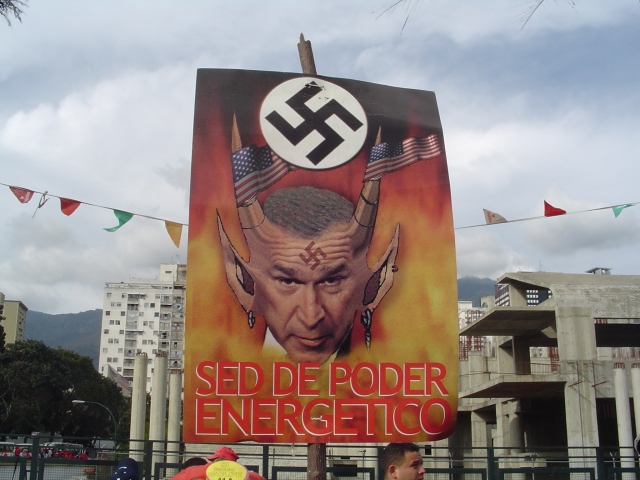
Void in most English-speaking media reports was mention of these significant social advancements made by the government of Venezuela, impelled by the people, and the precise reason why people mobilized in such large numbers. Instead, the headlines of most of the mainstream media honed in on the nature of relations between the U.S and Venezuelan governments and how Chavez is using ‘oil money’ to fund his socialist agenda. The purpose of the march itself was taken entirely out of context. The Associated Press focused their reporting on comments made by Hugo Chavez during his speech:
“…President Hugo Chavez told a rally yesterday that U.S. President George W. Bush was worse than Hitler.”
“…He also vowed to buy more arms to defend his nation as their diplomatic relations deteriorated.”
"The imperialist, genocidal, fascist attitude of the U.S. president has no limits. I think Hitler would be like a suckling baby next to George W. Bush," Chavez said.
By contrast, the considerable Venezuelan television coverage of the march featured numerous interviews with participants in the march, focusing in most cases on the very achievements that the foreign media ignored.
The overall characterization of the February 4th event was an ‘us versus them’ depiction. Most media reports neglected to mention the reason why so many Venezuelans mobilized. Rather, the reports were framed so as to give equal weight to the massive Chavista march and the exponentially smaller opposition march. Both marches were simultaneously broadcasted by television stations with overhead cameras. There was scant mention of how hundreds of thousands of Venezuelans mobilized in solidarity to challenge bourgeois power. Nor was there mention of how that power is being challenged by the emergence of a counter-power of the working classes, peasants, students and seniors. Mainstream media reports failed to reference the intense sentiment of the Chavez supporters. This is largely left to the reporting of the independent media. From the perspective of the mainstream media and the ruling elite interests it serves, these are “inconvenient facts” that we need not concern ourselves with. In short, there were far more messages, proportionately, of positive messages about the Revolutionary process, including the widespread call for 10 million votes for Chavez in Presidential elections to be held in December of this year. Thousands of signs, songs, and words from the pro-Chavez march reflected why they were supporting Hugo Chavez and his social reforms: “…schools, clinics, affordable food, our constitution, our democracy and for the first time, the oil money is going to us." “the poor of Venezuela understand the real grimace of imperialism and we reject it….”
"With the Bolivarian Revolution…Now communities are waking up to their role, to their power."
Naturally, Associated Press wire stories gave the few anti-Chavez demonstrators equal representation, and allowed them to voice their complaints about the Chavista march: “Members of the anti-Chavez march pointed out that they had mobilized "without buses", referring to the hundreds of public transport vehicles used to bring in Chavez supporters from around the country. (“Chavez taunts Washington as he launches re-election bid, Agence France Presse -- February 5, 2006) In order to better depict imagery of extreme polarization, the international media downplayed the number of participants at the pro-Chavez march. English-language media reported within predictably limited parameters referring to the “mass rally” of “Chavez supporters,” varying between “thousands” and “tens of thousands.” None of the reports came close to depicting the actual numbers, which were captured by credible eye-witness and video documented sources, including regular helicopter fly-over images that were played repeatedly on numerous Venezuelan television channels. Despite the clear evidence of a rally easily in the high hundreds of thousands, the media oligopoly couched their ultra-conservatively:
“Chavez spoke to thousands of red-clad supporters who thronged downtown Caracas rallying for "ten million votes" to re-elect their populist leader for six more years come December. (Agence France Presse -- English, February 5, 2006) In some cases, equal weight was given to the opposition, affirming similar numbers:
“At the opposite end of the city, thousands of Chavez opponents dressed in white shirts and carrying Venezuelan flags mounted a miles-long (kilometers-long) march of their own. The two marches did not cross paths. (Agence France Presse -- English, February 5, 2006) Now I return home to a place where popular democracy does not exist and where the society find itself in a predicament of “consensual domination” under the very forces that are attempting to subvert the Revolutionary process in Venezuela and elsewhere. In the name of real democracy and in solidarity with the Bolivarian Revolution, one can only share such an experience of these realities and proceed to work at exposing how the imperialists are working to undermine this and other similar processes. Experiencing first hand such massively unified popular expression motivates continued work to support this and other popular movements, including those that the flames of revolutions happening in other parts of the world might help to spark within the imperialist countries themselves.
Tsangarakis reports for Co-op radio in Vancouver, B.C. (http://www.wakeupwithcoop.org) and is a member of In the Name of Democracy (http://www.inthenameofdemocracy.org ). Feedback is welcome. She can be reached at yolandatsangarakis [at] hotmail.com .
Bolivarian Revolution Marches Forward, ‘Untelevised’
by Yolanda Tsangarakis; February 16, 2006
Recently, I was among the many visitors to Venezuela, mostly leftovers from the Sixth (and the first held in a Revolutionary setting) World Social Forum (WSF), who stuck around after the forum to get to know the Bolivarian Revolution a little better. For me, this time, however short and insufficient, was educational, inspiring, and empowering, culminating in the greatest single day mobilization of people I have ever experienced.
My general impression finds that it was a privilege to march with hundreds of thousands if not over one million Venezuelans who were celebrating the 14th anniversary of the Uprising Day for Dignity, in commemoration of the February 4, 1992 attempted coup led by the Commander of the Bolivarian Military Movement, Lt. Col. Hugo Chavez. At that time President George Bush Sr. called the audacious act an “""outrageous, illegal military coup,' against then President Carlos Andres Perez, who he described as “one of the great democratic leaders in our hemisphere,” asserting that “"the United States supports democracy in Venezuela.”
On national television after being captured, Chavez famously declared, “"New and better opportunities will emerge for us in the future.” He was right, and Bush was lying.
Indeed, the United States supports a certain kind of “democracy” for Venezuela and everywhere, one that is narrow and in the interests of U.S., global elites, transnational capital. Perez was an “asset,” a “true democrat,” having been such an avid supporter of the effort to destabilize and undermine the Sandanistan Revolution in Nicaraugua in the 80s and early 90s. Accordingly, the Perez government had excellent relations with the Bush, Sr. administration and “democracy promotion” agencies such as the National Endowment for Democracy, helping to foment the Contras counter-revolution.
Since the NED’s subversive and counter-revolutionary activities have been exposed so effectively over the years, and more recently through Freedom of Information Act by the likes of Eva Golinger’s “The Chavez Code,” the U.S., other foreign governments, and their Venezuelan oligarchic allies are devising new ways to try and subvert the Bolivarian process. As the foreign reporting of the February 4th march proved, one crucial organ that the agents of subversion can always rely on to assist their nefarious activities is the global elite-owned media.
The propaganda function of the international media oligopoly was on fine display in their coverage of the Feb. 4th march in support of the Bolivarian Revolution.
Effectively but predictably, the media narrowed the parameters of discourse in order to characterize the march along a Venezuela vs. the U.S. dichotomy. For example, the featured event of the winding march, a festive 16 kilometer route, approximately 5km of which were taken up by people at any one time, was a speech by President Chavez. This was generally depicted by the media as a “sparring session” between the governments of Venezuela and the U.S. The dichotomy is a false one because it favors the U.S. perception of Venezuela-U.S. relations, which distorts the antagonistic nature of the former toward the latter.
In so doing, the majority of mainstream media coverage of the pro-Chavez march missed the mark on three key points; historical context of the celebration, overall depiction of the event, and participant numbers.
To minimize or omit the historical significance of February 4th 1992 by the mainstream media inhibits a broader understanding of this large-scale mobilization of the Venezuelan people. Chavez was a young paratrooper when he led the failed but popular ‘Bolivarian Movement’ military rebellion on February 4, 1992. He served two years in prison before rising to political power on a promise to better the lives of the impoverished majority.
Chavez was then described as “a type of Saddam Hussein, not bright but very determined, a "Rambo” among “anachronistic nationalists with fascist tendencies and no defined ideology,” according to retired General Carlos Julio Penaloza, the army's former commander general until June 1991(IPS, Feb 5th, 1993). Later, the BBC would characterize Chavez and the Bolivarian movement with the label that would stick, that of their having “ultra-leftist leanings.”
Although the trajectory of Chavez’s political endeavors was hindered, it would only be for a short period:
“Comrades: unfortunately, for the moment, the objectives that we had set ourselves have not been achieved in the capital…those of us here in Caracas have not been able to seize power,” said Chavez on National television after surrendering. It is also apposite to mention the words of Vice President Vincent Rangel, who marched alongside the people and would precede Chavez with a short and inspirational speech on February 4th, 2006.
Striking a prophetic chord, in 1992 Rangel defended the actions of Chavez and his young Bolivarian Movement, "This crisis should not be considered over because the uprising has been crushed. To think that way would be an illusion," wrote El Diario de Caracas, quoting Rangel - cited in AP, February 5th, 1992, 'Coup Struck a Chord in Economically Ailing Venezuela'
It was on this historic day that the Bolivarian Revolution was sparked and has since resulted in over a dozen popular democratic ratifications of the Movement. The Presidential elections scheduled for late 2006 will only be the latest in a long process of popular consolidation of the Revolution, the thing that the NED and its State Department overseers fear the most: the ever-looming threat of a good example.
In this vein, the Revolution itself has thus far achieved significant social, humanitarian, and economic gains for the mass of Venezuelans who inhabit the underserved and impoverished barrios. People representing all sectors of society, varying in gender and age were determined to mobilize in support and in celebration of the immense social changes. Along the entire stretch of the march people were shouting out their support of the social projects and thousands of banners and placards were on display to show support for the revolution.
Within many of the barrios all over the country, the Chavez government has set up ‘missiones’, special projects beyond the control of the old state machine which have transpired into real and tangible reforms in health, education and housing. Mission Barrio Adentro ("Mission Inside the Neighborhood") is a series of initiatives deployed in three distinct stages: I, II, and III to provide free, comprehensive, and high-quality community health care. Prior to this social service, the majority of Venezuelans living in the barrios would have little to no access to healthcare. Mission Barrio Adentro is result of one of the key manifestations of the solidarity of the Cuban Revolution. Several thousands of doctors work on this missione.
Through Missions Robinson, Ribas and Sucre, over a million children from the shanty-towns and the poorest villages now obtain a free education; 1.2 million illiterate adults have been taught to read and write; secondary education has been made available to 250,000 children whose social status excluded them from this privilege during the previous regimes; many new university campuses have been constructed offering free access to higher education. Mission Habitat has constructed thousands of new housing units for the poor. This program also seeks to develop agreeable and integrated housing zones that make available a full range of social services. Many other social programs have been implemented to offer an array of services to the people of Venezuela. Mission Guaicaipuro, carried out by the Venezuelan Ministry of Environment and Natural Resources, seeks to restore communal land titles and human rights to Venezuela's numerous indigenous communities, in addition to defending these rights against resource and financial speculation by the dominant culture. There is also a comprehensive land expropriation and redistribution program that mainly benefits poor Venezuelans called Mission Zamora.
Void in most English-speaking media reports was mention of these significant social advancements made by the government of Venezuela, impelled by the people, and the precise reason why people mobilized in such large numbers. Instead, the headlines of most of the mainstream media honed in on the nature of relations between the U.S and Venezuelan governments and how Chavez is using ‘oil money’ to fund his socialist agenda. The purpose of the march itself was taken entirely out of context. The Associated Press focused their reporting on comments made by Hugo Chavez during his speech:
“…President Hugo Chavez told a rally yesterday that U.S. President George W. Bush was worse than Hitler.”
“…He also vowed to buy more arms to defend his nation as their diplomatic relations deteriorated.”
"The imperialist, genocidal, fascist attitude of the U.S. president has no limits. I think Hitler would be like a suckling baby next to George W. Bush," Chavez said.
By contrast, the considerable Venezuelan television coverage of the march featured numerous interviews with participants in the march, focusing in most cases on the very achievements that the foreign media ignored.
The overall characterization of the February 4th event was an ‘us versus them’ depiction. Most media reports neglected to mention the reason why so many Venezuelans mobilized. Rather, the reports were framed so as to give equal weight to the massive Chavista march and the exponentially smaller opposition march. Both marches were simultaneously broadcasted by television stations with overhead cameras. There was scant mention of how hundreds of thousands of Venezuelans mobilized in solidarity to challenge bourgeois power. Nor was there mention of how that power is being challenged by the emergence of a counter-power of the working classes, peasants, students and seniors. Mainstream media reports failed to reference the intense sentiment of the Chavez supporters. This is largely left to the reporting of the independent media. From the perspective of the mainstream media and the ruling elite interests it serves, these are “inconvenient facts” that we need not concern ourselves with. In short, there were far more messages, proportionately, of positive messages about the Revolutionary process, including the widespread call for 10 million votes for Chavez in Presidential elections to be held in December of this year. Thousands of signs, songs, and words from the pro-Chavez march reflected why they were supporting Hugo Chavez and his social reforms: “…schools, clinics, affordable food, our constitution, our democracy and for the first time, the oil money is going to us." “the poor of Venezuela understand the real grimace of imperialism and we reject it….”
"With the Bolivarian Revolution…Now communities are waking up to their role, to their power."
Naturally, Associated Press wire stories gave the few anti-Chavez demonstrators equal representation, and allowed them to voice their complaints about the Chavista march: “Members of the anti-Chavez march pointed out that they had mobilized "without buses", referring to the hundreds of public transport vehicles used to bring in Chavez supporters from around the country. (“Chavez taunts Washington as he launches re-election bid, Agence France Presse -- February 5, 2006) In order to better depict imagery of extreme polarization, the international media downplayed the number of participants at the pro-Chavez march. English-language media reported within predictably limited parameters referring to the “mass rally” of “Chavez supporters,” varying between “thousands” and “tens of thousands.” None of the reports came close to depicting the actual numbers, which were captured by credible eye-witness and video documented sources, including regular helicopter fly-over images that were played repeatedly on numerous Venezuelan television channels. Despite the clear evidence of a rally easily in the high hundreds of thousands, the media oligopoly couched their ultra-conservatively:
“Chavez spoke to thousands of red-clad supporters who thronged downtown Caracas rallying for "ten million votes" to re-elect their populist leader for six more years come December. (Agence France Presse -- English, February 5, 2006) In some cases, equal weight was given to the opposition, affirming similar numbers:
“At the opposite end of the city, thousands of Chavez opponents dressed in white shirts and carrying Venezuelan flags mounted a miles-long (kilometers-long) march of their own. The two marches did not cross paths. (Agence France Presse -- English, February 5, 2006) Now I return home to a place where popular democracy does not exist and where the society find itself in a predicament of “consensual domination” under the very forces that are attempting to subvert the Revolutionary process in Venezuela and elsewhere. In the name of real democracy and in solidarity with the Bolivarian Revolution, one can only share such an experience of these realities and proceed to work at exposing how the imperialists are working to undermine this and other similar processes. Experiencing first hand such massively unified popular expression motivates continued work to support this and other popular movements, including those that the flames of revolutions happening in other parts of the world might help to spark within the imperialist countries themselves.
Tsangarakis reports for Co-op radio in Vancouver, B.C. (http://www.wakeupwithcoop.org) and is a member of In the Name of Democracy (http://www.inthenameofdemocracy.org ). Feedback is welcome. She can be reached at yolandatsangarakis [at] hotmail.com .
For more information:
http://www.zmag.org/content/print_article....
Add Your Comments
Latest Comments
Listed below are the latest comments about this post.
These comments are submitted anonymously by website visitors.
TITLE
AUTHOR
DATE
nice work....
Wed, Apr 12, 2006 2:09PM
Very good
Sat, Feb 18, 2006 7:56AM
yep
Fri, Feb 17, 2006 8:08AM
We are 100% volunteer and depend on your participation to sustain our efforts!
Donate

$95.00 donated
in the past month
Get Involved
If you'd like to help with maintaining or developing the website, contact us.
Publish
Publish your stories and upcoming events on Indybay.
Topics
More
Search Indybay's Archives
Advanced Search
►
▼
IMC Network