







 Publish to Newswire
 Add an Event
From the Open-Publishing Calendar
From the Open-Publishing Newswire
Indybay Feature
New Orleans: The American Disaster
A week-long series of panels and workshops examining the institutionalized disparities magnified by Hurricane Katrina.
February 13th-16th at the UCSC campus will be dedicated to raising awareness about the issues surrounding New Orleans in the aftermath of Hurricane Katrina. The event, titled "New Orleans: The American Disaster," will highlight issues regarding the various levels of institutionalized inequity exemplified by the post hurricane response.
By illuminating and deconstructing the post hurricane events, the teach-in hopes to reintroduce problems such as race, class, and gender into the minds and language of the local community in applicable ways. Each night will focus on making connections to the day-to-day parallels of injustice in the social makeup of America. The event will be action oriented, encouraging opportunities for community members and students to engage with activists from the Bay Area and grassroots organizers from New Orleans.
Speakers for this week-long event will include John Brown Childs, Jeremy Prickett, Malcolm Suber, Paul Ortiz, Betita Martinez, and many more.
SCHEDULE OF EVENTS:
Monday, February 13th: Governmental Policies and Responses
Speakers: Sociology Professor John Brown Childs, Sociology Lecturer Francesca Guerra, and New Orleans Anti-Eviction activist Jeremy Prickett.
Oakes 105-- 7-9PM.
Tuesday, February 14th: Race, Class and Gender
Speakers: Paul Ortiz (UCSC Community Studies), SNCC organizer Paul Hutchings, and SNCC organizer Betita Martinez.
Stevenson Event Center-- 7-9PM
Wednesday, February 15th: Environmental and Health Issues
Speakers: UCSC Environmental Historian Linda Ivey and more TBA.
Oakes 105-- 7-9PM
Thursday, February 16th: Grassroots Response and the Future of New Orleans
Speakers: New Orleans Housing Emergency Action Team activist Jeremy Prickett, former Black Panther and People's Hurricane Relief Fund activist Malcolm Suber, local activist Curtis Rutherford, and more TBA.
Kresge 321-- 7-9PM
**Each day will feature video footage, audio interviews, and photos from New Orleans, and discussion groups facilitated by students and activists returning from New Orleans.**
By illuminating and deconstructing the post hurricane events, the teach-in hopes to reintroduce problems such as race, class, and gender into the minds and language of the local community in applicable ways. Each night will focus on making connections to the day-to-day parallels of injustice in the social makeup of America. The event will be action oriented, encouraging opportunities for community members and students to engage with activists from the Bay Area and grassroots organizers from New Orleans.
Speakers for this week-long event will include John Brown Childs, Jeremy Prickett, Malcolm Suber, Paul Ortiz, Betita Martinez, and many more.
SCHEDULE OF EVENTS:
Monday, February 13th: Governmental Policies and Responses
Speakers: Sociology Professor John Brown Childs, Sociology Lecturer Francesca Guerra, and New Orleans Anti-Eviction activist Jeremy Prickett.
Oakes 105-- 7-9PM.
Tuesday, February 14th: Race, Class and Gender
Speakers: Paul Ortiz (UCSC Community Studies), SNCC organizer Paul Hutchings, and SNCC organizer Betita Martinez.
Stevenson Event Center-- 7-9PM
Wednesday, February 15th: Environmental and Health Issues
Speakers: UCSC Environmental Historian Linda Ivey and more TBA.
Oakes 105-- 7-9PM
Thursday, February 16th: Grassroots Response and the Future of New Orleans
Speakers: New Orleans Housing Emergency Action Team activist Jeremy Prickett, former Black Panther and People's Hurricane Relief Fund activist Malcolm Suber, local activist Curtis Rutherford, and more TBA.
Kresge 321-- 7-9PM
**Each day will feature video footage, audio interviews, and photos from New Orleans, and discussion groups facilitated by students and activists returning from New Orleans.**
Add Your Comments
Comments
(Hide Comments)
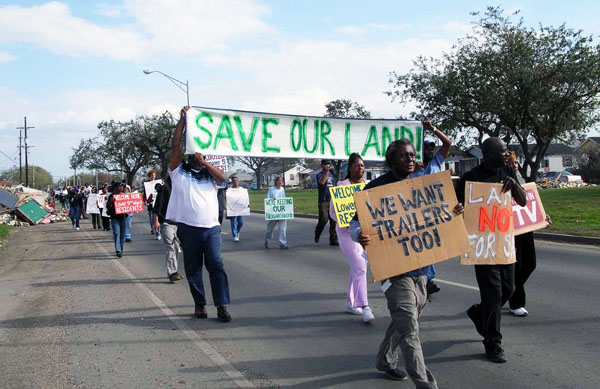
2/7/06 - Lower 9th Ward residents staged a press conference and march in response to a tour led by Governor Kathleen Blanco, designed to show lawmakers some of the hardest hit neighborhoods.
Seen by many as a political stunt designed to repair her image, the tour attracted less than half of the states 144 legislators.
After the press conference at which some lower ninth residents voiced their concerns about the re-building of levees and other issues, more than 60 residents and supporters marched through the devastated neighborhood .
Some carried signs that read "Electricity and Water Now, Rebuild Category Five Levees, and We Want Trailers Too!"
Although Blanco shirked the press conference staged by residents, she could not avoid the marchers who lined North Prieur chanting "We are here to stay," as buses carrying the governor and legislators rolled through en route to view the site where a loose barge crashed through the Industrial Canal flood wall.
Rep. Charmaine Marchand, a Democrat who represents the Lower 9th Ward, was present at the march, and helped negotiate with military police who attempted to block residents from the bus route.
Blanco stepped off the bus for a moment to address the demonstrators. Although she pledged her sympathy and support she did not to make any concrete statements regarding plans to re-build the area.
"We need to find out what the government gonna do about our situation here, we need to know if we gonna be able to build back, or if they gonna pay us for our land." said home owner Earl Odems.
Residents were protesting the fact that five months after the Lower 9th was ravaged by Katrina the area seems frozen in time. No clean up effort is underway. Many residents expressed concern about a proposal to turn the area into a green space, and fear that they will lose their land. "I don't want them to tear down my place where I grew up..." said Trinetta Woodberry Victorian. "I'm coming back, thats why I paid my property taxes."
Several residents speculated that the neighborhood had been deliberately used to drain other parts of the city. "Give us category five protection on the Industrial Canal. A levee that has broken three different times. For some reason they want to use this are a to be a spillway, we will not accept that," said Lower 9th home owner, Robert Spriggins.
http://www.commongroundrelief.org
Seen by many as a political stunt designed to repair her image, the tour attracted less than half of the states 144 legislators.
After the press conference at which some lower ninth residents voiced their concerns about the re-building of levees and other issues, more than 60 residents and supporters marched through the devastated neighborhood .
Some carried signs that read "Electricity and Water Now, Rebuild Category Five Levees, and We Want Trailers Too!"
Although Blanco shirked the press conference staged by residents, she could not avoid the marchers who lined North Prieur chanting "We are here to stay," as buses carrying the governor and legislators rolled through en route to view the site where a loose barge crashed through the Industrial Canal flood wall.
Rep. Charmaine Marchand, a Democrat who represents the Lower 9th Ward, was present at the march, and helped negotiate with military police who attempted to block residents from the bus route.
Blanco stepped off the bus for a moment to address the demonstrators. Although she pledged her sympathy and support she did not to make any concrete statements regarding plans to re-build the area.
"We need to find out what the government gonna do about our situation here, we need to know if we gonna be able to build back, or if they gonna pay us for our land." said home owner Earl Odems.
Residents were protesting the fact that five months after the Lower 9th was ravaged by Katrina the area seems frozen in time. No clean up effort is underway. Many residents expressed concern about a proposal to turn the area into a green space, and fear that they will lose their land. "I don't want them to tear down my place where I grew up..." said Trinetta Woodberry Victorian. "I'm coming back, thats why I paid my property taxes."
Several residents speculated that the neighborhood had been deliberately used to drain other parts of the city. "Give us category five protection on the Industrial Canal. A levee that has broken three different times. For some reason they want to use this are a to be a spillway, we will not accept that," said Lower 9th home owner, Robert Spriggins.
http://www.commongroundrelief.org
For more information:
http://neworleans.indymedia.org/news/2006/...
See the 9th ward for yourself on the condemned housing map
http://neworleans.indymedia.org/news/2005/12/6622.php
But if people want to support New Orleans organizing please do not forget...
http://www.communitylaborunited.net
or
http://katrina.mayfirst.org
or
http://neworleans.indymedia.org
or
for a more anarchist orientation
http://www.freewebs.com/ironrail
Lower 9th Ward Citizens Fight Demolition in New Orleans
http://www.indybay.org/news/2006/01/1793523.php
http://neworleans.indymedia.org/news/2005/12/6622.php
But if people want to support New Orleans organizing please do not forget...
http://www.communitylaborunited.net
or
http://katrina.mayfirst.org
or
http://neworleans.indymedia.org
or
for a more anarchist orientation
http://www.freewebs.com/ironrail
Lower 9th Ward Citizens Fight Demolition in New Orleans
http://www.indybay.org/news/2006/01/1793523.php
Newly reformed as a non-political, non-religious organization and adopting the name “Emergency Communities,” with non-profit status under the IHC (International Humanity Center), volunteers began setting up camp in the back parking lot of what had been an off-track betting parlor in the heart of St. Bernard. Struggling to find shelter and basic utilities as temperatures plummeted, they worked tirelessly to get up and running. On Dec. 12th the first meal was served at Emergency Communities’ Made with Love Café. For most residents and workers it was the first wholesome meal they had enjoyed since arriving in the area.
As residents return to take stock of their scattered belongings, Emergency Communities continues to grow in scope and ability. Volunteers live in tents pitched on raised platforms, traversing a muddy field and toxic ditch on a pallet walkway. They eat and subsist alongside returning residents in a cluster of domes and tents. Every day new amenities are added. First electricity and port-a-potties, then non-potable wash water from the hydrant system. As Emergency Communities continues to grow they are able to add other comforts, such as newly constructed solar showers and a laundry station.
As locals, volunteers and contractors begin to tackle the enormous task of rebuilding, the Made with Love Café has become a community center providing them with everything from basic supplies to much needed entertainment, with the aim of going beyond simple sustenance to holistically nourish the entire community. As volunteers give their energy and love to the community, the community responds in kind, sharing not only food but camaraderie and routine, recalling some semblance of their past lives otherwise lost in the flood. Creating beauty and harmony in such a bleak and contaminated environment is no small task. In doing so, the volunteers from Emergency Communities have made the seeming impossibility of rebuilding a city more plausible. The absolute necessity of such grass-roots organizations is apparent in the every day demand for flexibility and personal contact between residents and volunteers.
The residents here are still in need and more are moving back to the area everyday. Emergency Communities needs volunteers and donations to continue its service to the people of New Orleans. Please come volunteer and support our service based community or donate what you can in solidarity with our brothers and sisters on the gulf coast.
As residents return to take stock of their scattered belongings, Emergency Communities continues to grow in scope and ability. Volunteers live in tents pitched on raised platforms, traversing a muddy field and toxic ditch on a pallet walkway. They eat and subsist alongside returning residents in a cluster of domes and tents. Every day new amenities are added. First electricity and port-a-potties, then non-potable wash water from the hydrant system. As Emergency Communities continues to grow they are able to add other comforts, such as newly constructed solar showers and a laundry station.
As locals, volunteers and contractors begin to tackle the enormous task of rebuilding, the Made with Love Café has become a community center providing them with everything from basic supplies to much needed entertainment, with the aim of going beyond simple sustenance to holistically nourish the entire community. As volunteers give their energy and love to the community, the community responds in kind, sharing not only food but camaraderie and routine, recalling some semblance of their past lives otherwise lost in the flood. Creating beauty and harmony in such a bleak and contaminated environment is no small task. In doing so, the volunteers from Emergency Communities have made the seeming impossibility of rebuilding a city more plausible. The absolute necessity of such grass-roots organizations is apparent in the every day demand for flexibility and personal contact between residents and volunteers.
The residents here are still in need and more are moving back to the area everyday. Emergency Communities needs volunteers and donations to continue its service to the people of New Orleans. Please come volunteer and support our service based community or donate what you can in solidarity with our brothers and sisters on the gulf coast.
For more information:
http://www.emergencycommunities.org
Downing some stale ground-score coffee to write this, On the edge of the ninth ward, where neglected domesticity blends with hurricane Katrina wreckage, watermarked cars frozen in time mark the boundary between rich and poor.
The southern stereotype of rusted cars sitting awkwardly on front-lawns was not meant for this kind of devastation. In some places, five-plus months after something broke the levees, engulfing the city in a man-made lake of sludge and debris, it is hard to tell if the cars overturned or placed cleanly atop each other are sitting on somebody’s front lawn, or instead, in the middle of what used to be their living room, where they watched newscasts saying everything was going to be O.K. until just a Few days before the storm made landfall.
The evacuation order, for those without gas money or with only a bicycle to get to work in the French quarter, came about five days too late. And yes, people were shooting at helicopters, after five days invisible on black tar or asbestos roofs, five days watching them fly past faster than the bodies floating by in the water below.
What will become of New Orleans? For the living, we should speak in the future tense. In one of the oldest cities in the U.S, however, the past is evident like the walled-in graveyards where people were buried above-ground to keep them safe in shifting soil. Houses like empty mausoleums speak only of the past, of work to be done. The French quarter tee
-Jordan Freeman
The southern stereotype of rusted cars sitting awkwardly on front-lawns was not meant for this kind of devastation. In some places, five-plus months after something broke the levees, engulfing the city in a man-made lake of sludge and debris, it is hard to tell if the cars overturned or placed cleanly atop each other are sitting on somebody’s front lawn, or instead, in the middle of what used to be their living room, where they watched newscasts saying everything was going to be O.K. until just a Few days before the storm made landfall.
The evacuation order, for those without gas money or with only a bicycle to get to work in the French quarter, came about five days too late. And yes, people were shooting at helicopters, after five days invisible on black tar or asbestos roofs, five days watching them fly past faster than the bodies floating by in the water below.
What will become of New Orleans? For the living, we should speak in the future tense. In one of the oldest cities in the U.S, however, the past is evident like the walled-in graveyards where people were buried above-ground to keep them safe in shifting soil. Houses like empty mausoleums speak only of the past, of work to be done. The French quarter tee
-Jordan Freeman
For more information:
http://www.indybay.org/news/2006/02/180516...
We are 100% volunteer and depend on your participation to sustain our efforts!
Donate

$140.00 donated
in the past month
Get Involved
If you'd like to help with maintaining or developing the website, contact us.
Publish
Publish your stories and upcoming events on Indybay.
Topics
More
Search Indybay's Archives
Advanced Search
►
▼
IMC Network