







 Publish to Newswire
 Add an Event
MLK Jr. Message: "Act. Now."
"I am convinced that if we are to get on the right side of the world revolution, we as a nation must undergo a radical revolution of values. We must rapidly begin the shift from a thing-oriented society to a person-oriented society. When machines and computers, profit motives and property rights are considered more important than people, the giant triplets of racism, materialism, and militarism are incapable of being conquered."
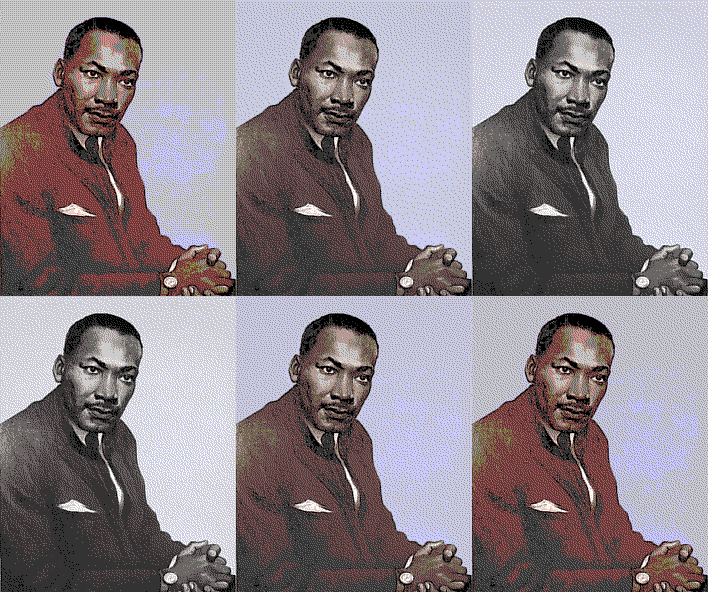
Dreams and Nightmares
In Martin Luther King
Jr's most famous speech, he had a dream.
But in another of King's important addresses, he faced the depth of our
nightmare.
We all know the famous words -- "I have a dream" -- delivered on the
steps of the Lincoln Memorial on August 28, 1963: "I have a dream that
one day this nation will rise up and live out the true meaning of its
creed: We hold these truths to be self-evident, that all men are
created equal."
On this day that we mark with his name, all over this country, that
speech will be played, as it should be. King articulated -- perhaps
more eloquently than anyone had to that point -- the demand that the
United States make good on the American dream, for all its citizens.
But on April 4, 1967, at the Riverside Church in New York City, in a
speech titled "Beyond Vietnam," King spoke just as eloquently of the
nightmare that lies underneath that dream. In that speech to Clergy and
Laymen Concerned about Vietnam, King not only made a compelling case
for ending the U.S. attack on Vietnam, but went beyond that to diagnose
a failed society.
On this day that we mark with his name, we owe it to King -- and to
ourselves -- to face that failure honestly.
This might sound crazy in a world in which the United States dominates
as no nation has ever dominated. After all, we won the Cold War. We are
the largest economy in the world. Our cultural products circulate
everywhere. The world fears our military. We are the most affluent
nation in the history of the world. And we have a black secretary of
state. A failed society? The United States? To borrow from a younger
generation, "We rule!"
Yes, we rule, sort of, for a time. But we also are a failed society, a
society heading toward collapse. We might remember that nothing looks
quite as invincible as a great army on the morning of its greatest
defeat.
The majority of King's Riverside speech was dedicated to an analysis of
the Vietnam War and an argument for a political settlement of that
conflict. Although many wanted him to avoid the controversial subject
of the war, King said he was moved "to break the betrayal of my own
silences and to speak from the burnings of my own heart," to go "beyond
the prophesying of smooth patriotism to the high grounds of a firm
dissent based upon the mandates of conscience and the reading of
history."
When he did that, King reached a difficult conclusion, that "the
greatest purveyor of violence in the world today" was "my own
government." He saw what imperial war does not only to the target, to
those on whom the bombs fall, but also to the aggressor society: "If
America's soul becomes totally poisoned," King said, "part of the
autopsy must read Vietnam. It can never be saved so long as it destroys
the deepest hopes of men the world over."
We might pause to consider what that means for us today, as the United
States fights another imperial war, this one in the Middle East. If we
were to go beyond a "smooth patriotism" and let conscience guide us to
a "firm dissent," what actions are required of us?
But I want to put aside for now the issue of wars, past and present,
and speak of King's deeper analysis in that speech. He knew that simply
condemning that war was "seductively tempting," but that his principles
demanded that he "go on now to say something even more disturbing."
King was blunt: "The war in Vietnam is but a symptom of a far deeper
malady within the American spirit," a condition that had left the
United States "on the wrong side of a world revolution." He continued:
"I am convinced that if we are to get on the right side of the world
revolution, we as a nation must undergo a radical revolution of values.
We must rapidly begin the shift from a thing-oriented society to a
person-oriented society. When machines and computers, profit motives
and property rights are considered more important than people, the
giant triplets of racism, materialism, and militarism are incapable of
being conquered."
"Our loyalties must become ecumenical rather than sectional. Every
nation must now develop an overriding loyalty to mankind as a whole in
order to preserve the best in their individual societies. This call for
a world-wide fellowship that lifts neighborly concern beyond one's
tribe, race, class and nation is in reality a call for an all-embracing
and unconditional love for all men."
In short, Martin Luther King Jr. saw that the task of the United States
was not simply to transcend racism. He saw racism as inextricably
connected to militarism and materialism. And he saw a hyperpatriotic
nationalism not as virtue but as a problem to be overcome.
So, we find ourselves today in an odd place: In a country in which we
routinely repeat the phrase "God bless America" with no sense of shame;
in which conventional politicians all clamor to be "tough" on national
security and support bloated military budgets; in which the shopping
mall is the real temple where people go to worship -- in that country,
King is a hero. That means the King who condemned not only racism but
nationalism, militarism, and materialism has to be pushed aside,
forgotten -- "whitewashed," if you'll allow the term. King's radical
political analysis and vision have to be rendered invisible if we are
to name a holiday after him. After years of calling him a traitor and a
troublemaker, white America is willing to allow King is to serve as the
icon for a national quest for racial justice, but only so long as we
don't actually listen to what he had to say or take it seriously.
None of this is surprising; it's the nature of power: When faced with
demands for justice by a movement of oppressed people, dominant groups
tend to concede only as much as necessary to relieve the pressure. When
enough time has passed and the threat to the system has been contained,
then the importance of the movement and some of its leaders can be
acknowledged, but only if their legacy can be constructed in a way that
doesn't undermine the existing distribution of power.
The nature of privilege is to ignore these realities when they make us
uncomfortable. We white people have that privilege. We have that
privilege because we live in a white-supremacist society. It is true
that the United States made enormous progress on race in the last half
of the 20th century, but we still live in a white-supremacist society.
What do I mean by that?
By "white supremacist," I mean a society whose founding is based in an
ideology of the inherent superiority of white Europeans over
non-whites, an ideology that was used to justify the inhuman crimes
against indigenous people and Africans that created the nation and its
wealth, an ideology that also has justified legal and extralegal
exploitation of every non-white immigrant group in our history.
By "white supremacist," I also mean a material reality. Forty years
after the victories of the civil-rights movement that ended legal
segregation, dramatic racialized disparities in wealth and well-being
endure. On some measures, such as family income and unemployment, the
gap between white and black America is wider today than it was in the
immediate aftermath of the civil-rights legislation of the 1960s. On
other measures where there has been some progress, such as home
ownership, closing the gap will take decades or centuries if current
trends continue.
This is a society in which white people occupy most of the top
positions in powerful institutions, with similar privileges available
in limited ways to non-white people if they fit themselves into white
society. It is a society in which many white people hold to that
supremacist ideology, believing the culture, politics, philosophy, and
art that comes out of white Europe to be superior to all others (even
if they won't admit in public that they believe this).
If white America were truly interested in racial justice, would we not
ask, simply, "why?" Why do so many still believe that? Why are the
racialized disparities still with us?
We don't ask because the answer is all too clear and painful: Most
white folks don't much care, and privilege allows us not to care.
What will it take for the United States to transcend white supremacy?
It seems obvious that it requires a revolution. But what kind? King
called for "a true revolution of values" based in a rejection of the
fundamental injustice of the systems in which we live. In King's words:
"A true revolution of values will soon look uneasily on the glaring
contrast of poverty and wealth. With righteous indignation, it will
look across the seas and see individual capitalists of the West
investing huge sums of money in Asia, Africa and South America, only to
take the profits out with no concern for the social betterment of the
countries, and say: This is not just."
"A true revolution of values will lay hands on the world order and say
of war: This way of settling differences is not just. This business of
burning human beings with napalm, of filling our nation's homes with
orphans and widows, of injecting poisonous drugs of hate into veins of
people normally humane, of sending men home from dark and bloody
battlefields physically handicapped and psychologically deranged,
cannot be reconciled with wisdom, justice and love."
In 1967, King laid it out clearly: "A nation that continues year after
year to spend more money on military defense than on programs of social
uplift is approaching spiritual death." In 2006, that spiritual death
is closer than ever, as it is clearer than ever that it is not
"military defense" on which we spend but "military offense."
At some level, I believe we all know this to be true. We all know the
grotesque and widening inequality -- within our own society and between
the First and the Third worlds -- cannot continue indefinitely. We know
that the belligerent militarism designed to secure resources cannot
continue indefinitely. At some level, somewhere within us all, we know
that the path this society is on is not the road up to a better future,
but a spiral down to something that will look like hell made real in
the world. We rule, for now. But how long can that continue?
We know the cost to the world of the quest for domination. About half
the world's population lives on less than $2 a day, and a quarter on
less than $1 a day. Iraqis count their dead in the tens -- perhaps
hundreds -- of thousands as a result of U.S. liberation. Those are the
bills being paid elsewhere.
What of the cost to us? What of our spiritual death?
The shopping malls are full. Does it fulfill our longing for community?
Does it make us feel loved?
We "support the troops." Does it fulfill our obligations to the world?
Does it make us safe?
What judgment would Martin Luther King Jr. render if he were with us
today? Lucky for us, we don't have to face that. The great thing about
dead heroes is that they can't speak. The theologian and historian
Vincent Harding quotes a poem by Carl Wendell Hines:
Now that he is safely dead
Let us praise him
build monuments to his glory
sing hosannas to his name.
Dead men make
such convenient heroes: They
cannot rise
to challenge the images
we would fashion from their lives.
And besides,
it is easier to build monuments
than to make a better world.
But,
of course, it doesn't matter what King would say. It matters what we
say, and -- as King always pointed out -- it matters what we do.
If you live in privilege, as I do, one thing is for sure: You haven't
done enough. I haven't done enough. We haven't done enough. If we had,
this world would look very different than it does.
We all carry that burden, one that is more than we should have to face.
In this world, it should be enough to just be a decent person -- to
work hard, treat folks around us fairly, care for those we love. That's
difficult enough in a world full of disappointment, disease, and death.
Just being an ordinary person is hard enough.
But at this moment in history, being decent in our private lives is not
enough. There is too much at stake, and too little time to correct the
course. We face crises on all fronts: Political, economic, cultural,
and most dramatically, ecological. We cannot know how much time is left
before destructive forces set in motion cannot be turned back. We
should be scared, and that fear should motivate us.
King was scared. In the new book, At Canaan's Edge: America in the
King Years 1965-68, Taylor Branch writes about how King was tired
and struggling with depression in the last months of his life. I
believe King understood how little time there was, not just for him but
for us all.
So, we have to face what one writer has called "the long emergency."
There can be no illusions about the nature of the struggle required to
create a different world, a world based not on domination but on a new
communion among peoples. The choice still remains the one King asked us
to face: "nonviolent coexistence or violent co-annihilation."
Privilege makes it easy to hide, but soon there will be no hiding from
the need to act. To turn from this knowledge of the world and its
demands on those of us with privilege is to turn from the values of
justice and equality that we claim to hold. Worse than that, it is to
turn away from our own humanity. And if the call to justice, the
yearning for our own humanity isn't motivation enough, realize this:
Soon, to hide will be to resign ourselves to that hell on earth that we
are creating.
To act is to have faith, in ourselves and in the possibility that there
is time. If King were alive today, we can be sure he would ask that of
us. And we can look to King's words on that April night in New York in
1967 for a reminder of what fate awaits us if we turn away:
"If we do not act we shall surely be dragged down the long, dark and
shameful corridors of time reserved for those who possess power without
compassion, might without morality, and strength without sight."
If we act, there is no guarantee that we can make right all that has
been torn asunder. We cannot wait for certainty, but must act out of
love, with hope. It is through our action that we learn to love and
feel hope. That action is the way we make love real in the world and
find hope in our hearts.
I don't pretend to know what King would say if he were alive today. I
don't know what analysis he would offer or what strategy he would
propose. But he would certainly challenge all of us to act -- every one
of us here today, everyone in this country, which has the opportunity
to turn its power away from wealth and war, toward justice and peace.
Whatever else King would say, he would say this:
Act. Now. Before the only path before us is that long, dark, shameful
corridor, which ends at a door we should all pray is never opened.
Donate

$110.00 donated
in the past month
Get Involved
If you'd like to help with maintaining or developing the website, contact us.
Publish
Publish your stories and upcoming events on Indybay.