







 Publish to Newswire
 Add an Event
San Jose: Carnage in America's 'safest big city' #2, Better living through legal lynching
"San Jose Named Safest City in the Country - But For Whom?" at http://
http://www.siliconvalleydebug.com/story/012405/newsafecity.html
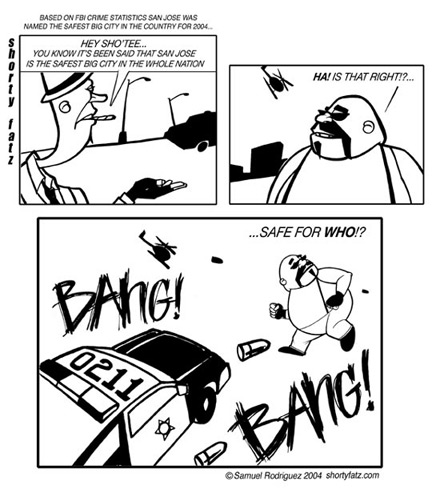
According to a Washington Post study on the 50 largest local law enforcement agencies during 1990-2000 [2], San Jose had the highest rate of fatal shootings by police, relative to the overall murder rate. In other cities with low murder rates, like Boston or Austin, Texas, police guns are not as quick to blast [3].
Under San Jose's white minority rule [4], with no true police oversight board and mainstream local media ignoring the disproportionate rate of police killings, perhaps San Jose police kill more often simply because they know they can get away with it.
The lack of critical debate in the media on issues of police conduct has not prevented the public from forming an adverse view of local police. During jury selection for the trial of the two Asian-American Palo Alto policemen who beat and tortured 59-year-old African-American Albert Hopkins, a surprising number of potential jurors made it clear that the unpunished killing of Bich Cau Thi Tran two years ago still grips the hearts of a wide spectrum of the public, fueling a persistent mistrust of police and the criminal justice system that excuses their crimes.
Just a few hours before Albert Hopkins was beat, Ms. Tran, a Vietnamese immigrant and 25-year-old mother of two toddlers, was shot dead in her kitchen by Euro-American San Jose policeman Chad Marshall when he responded to a 911 call that an unsupervised toddler was roaming the street. Seconds after Marshall knocked on the door, he put a bullet through the chest of the young mother, just a few feet away from her children.
Officials immediately reported that the "suspect" - Ms. Tran - was a violently crazed attacker with a lethal weapon and that the policeman correctly protected himself from the deadly threat. But after hundreds demonstrated and flooded local officials with letters, the authorities were forced to take a different public relations approach.
In a rare move, the DA called for grand jury hearings to be open to the public. The hearings revealed how the grand jury's decisions are determined by the DA: the jury's view of the case is restricted to what the DA feeds and suggests to them. Thus the DA determined that Marshall would not be indicted, despite the clear evidence that the shooting was unjustified.
The police then craftily exploited the public's frustration with police shootings. In April 2004, without any substantial action towards eradicating the root causes of the high rate of police killings, San Jose became the first major Bay Area city to arm all patrol officers with Taser stun guns, supposedly as a "nonlethal" alternative.
But, instead of declining, fatal shootings by police then spiked to near a 10-year high [5]. In one case, Johnny Nakao, accused of shoplifting, was first Tasered while fleeing and then shot to death. Zaim Bojcic, an unarmed Bosnian immigrant, for the capital offense of smoking outside the designated area of Starbucks, was first Tasered and then fatally shot by a policeman who happened to stop in on his break.
One year later, Tasers have resulted in an explosive escalation of force, used in San Jose on:
- a man urinating in public
- a 5-foot-3, 136-pound unarmed 14-year-old who'd been subdued by a neighbor. Shocked for walking away from police.
- an unarmed person (arrested for being drunk) bleeding badly after being hit in the head with a skateboard by another person. Shocked for refusing to cooperate with emergency personnel trying to tend his wound.
The list goes on and on. If police did not have Tasers, it is highly unlikely that they would have pumped lead into these persons (though certainly a possibility, given SJPD's track record). In the first three months of Taser deployment, police used Tasers over 90 times.
Compare that with San Jose's most deadly year for police shootings, when there were nine shootings. So in three months, police used Tasers 10 times more than they'd used guns in their most trigger-happy year. Clearly they are being used where lethal force was never an option. And as the Nakao and Bojcic cases show, police quickness to use Tasers, where perhaps no force would have been used previously, can lead to deadly conclusions.
On May 26 of this year, the pattern repeated when SJPD first Tasered and then fatally shot an unarmed Samuel Martinez, 34. Although police claim Martinez "charged" at the policeman, who then fired two Taser blasts with no apparent effect, that story raises puzzling questions. Taser darts only extend to 21 feet, and a Taser blast continues for five seconds [6]. So that implies Martinez "charged" within 21 feet, and yet the policeman had time to Taser, see it fail and then try again.
Even the slowest person can cover 21 feet in less than five seconds. If Martinez "charged" so slowly, where was the danger to the policeman that required a "split-second decision" to use deadly force?
Amnesty International lists over 100 deaths that followed Taser shocks, where the cause of death was attributed to the fall that followed the shock, asphyxia, cardiac arrest or other factors. When Tasers are added to the deadly mix of dangerous restraint methods, pepper spray, stress of police encounter and chase and any physical condition that increases susceptibility (age, alcohol, drugs, obesity), there's a good chance that an encounter will be pushed from high-risk to fatal.
By the same reasoning, if San Jose's recent increase in police shootings is a result of the expanded use of force and increased aggression that Tasers bring, thus pushing encounters farther into the danger zone, then every fatal shooting that follows a Taser shock can also be counted as a Taser death. So with three Taser deaths contributing to a jump in its police killings, San Jose has demonstrated the falseness of Taser's claim of "saving lives" and shown that Tasers mainly serve as a more efficient tool of oppression.
The struggle against the escalating slaughter in America's "safest big city" continues:
- The Martinez family has held vigils, and received support from groups including Barrio Defense Committee, Coalition for Justice and Accountability, Idriss Stelley Foundation, and October 22 Against Police Brutality. Visit http://groups.yahoo.com/group/Justice4Samuel.
- The Coalition for Justice and Accountability, formed immediately after the killing of Bich Cau Thi Tran, initially supported Tasers but is now leading a campaign to ban them in San Jose. Download their report from http://www.indybay.org/uploads/sj-taser-review.pdf.
- On June 29 a federal judge rejected the city of San Jose's motion to dismiss a civil suit brought by the family of Bich Cau Thi Tran and set trial for Nov. 1 to determine whether the killer, Chad Marshall, should have to pay monetary damages.
- The family of Eric Kleemeyer, 22, who was fatally shot by Santa Clara police just a few yards from his mother's driveway, is sponsoring "Justice Fest Picnic and Concert 2005." It will be held Saturday, Aug. 6, 2-9 p.m., in St. James Park, San Jose. Visit JusticeForErickleemeyer.com.
Notes:
[1] For example, see the Mayor's press release at http://www.sjmayor.org/event_library/new_website/Press/sjremainssafestcitynov2204.html
[2] http://www.washingtonpost.com/wp-srv/metro/specials/pgshoot/shootstats.htm
[3] Boston and Austin chosen for comparison because, like San Jose, they are also centers of high-tech
[4] According to Census 2000 (http://www.bayareacensus.ca.gov/cities/SanJose.htm), and using their terminology for "race" and ethnicity, non-Hispanic whites make up only 36% of San Jose's population. Hispanics comprise 30.2%, while 26.6% are non-Hispanic Asians, followed by non-Hispanic Black or African American at 3.3%. Thus, those usually referred to as "minorities" together constitute over 60% of the city, and those called "whites" are the actual minority.
[5] Taser info is taken from the CJA Taser report at http://www.indybay.org/uploads/sj-taser-review.pdf, which lists sources for the data cited.
[6] Taser X26 Operating Manual
This is the second part of a series about police killings and brutality on the Peninsula and in the South Bay. Read part 1 at http://www.sfbayview.com/072005/sanjosecarnage072005.shtml. Email Junya at junya@headcity.com.
Donate

$110.00 donated
in the past month
Get Involved
If you'd like to help with maintaining or developing the website, contact us.
Publish
Publish your stories and upcoming events on Indybay.