







 Publish to Newswire
 Add an Event
From the Open-Publishing Calendar
From the Open-Publishing Newswire
Indybay Feature
NO to CAFTA - Central American Free Trade Agreement
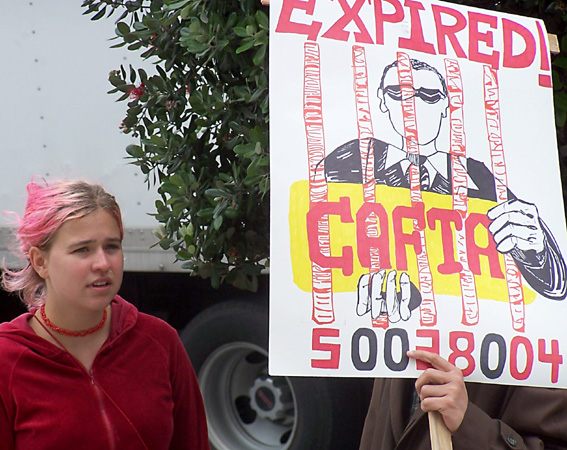
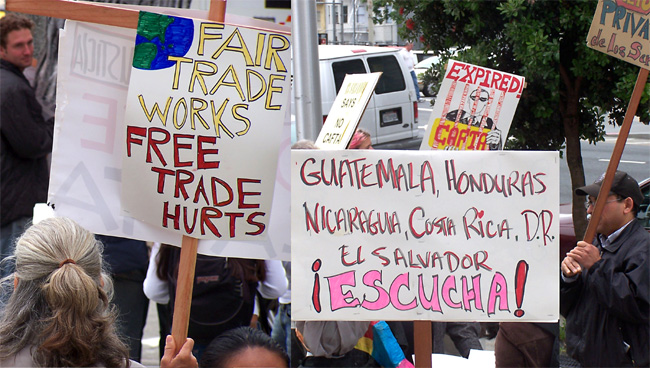
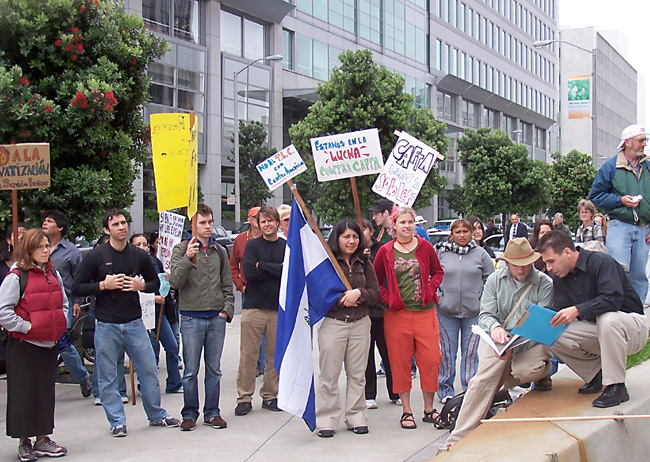
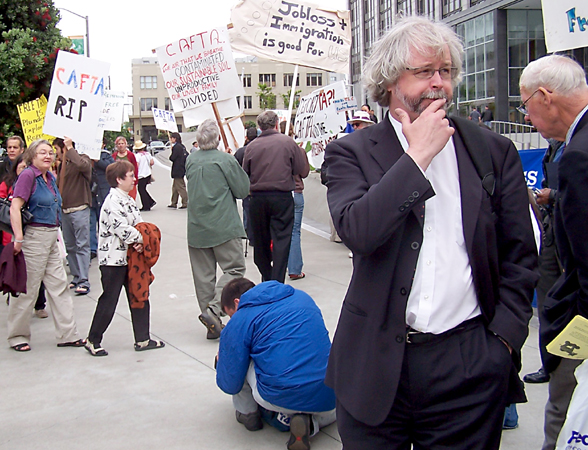
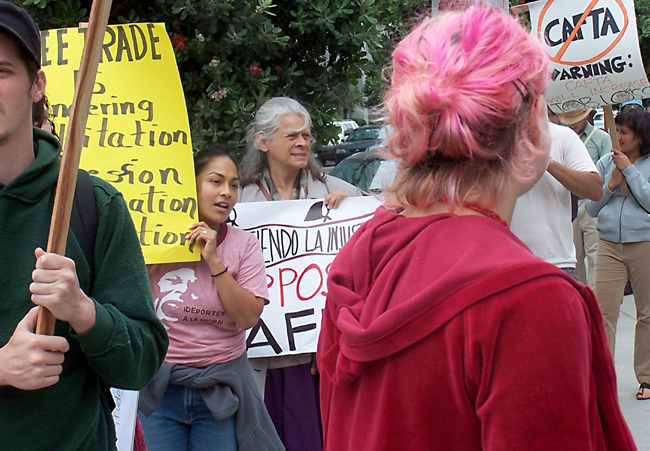
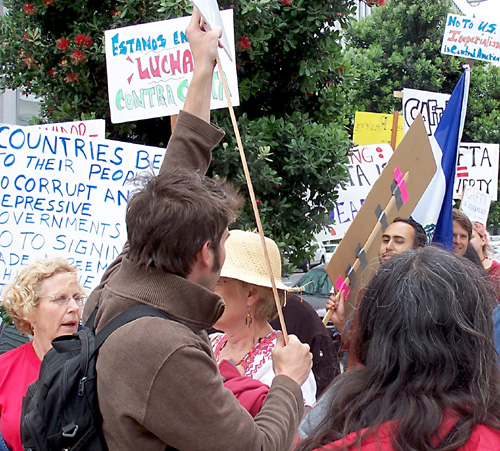
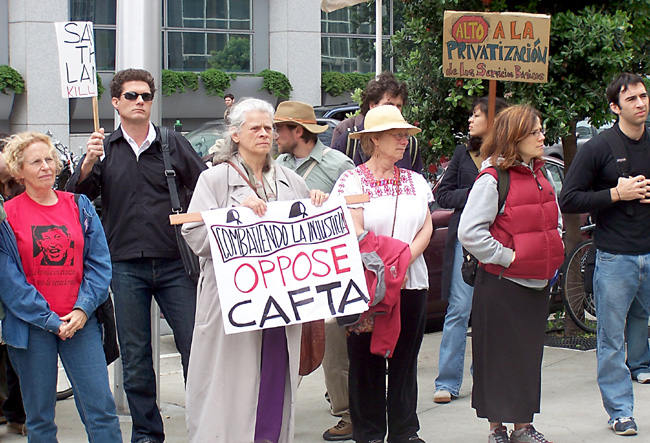
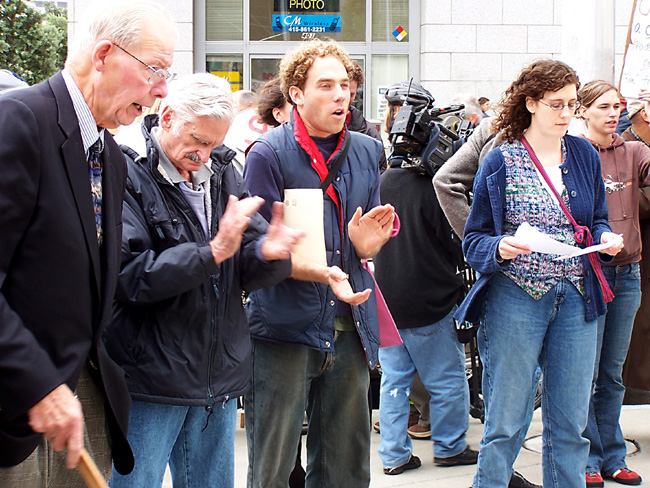
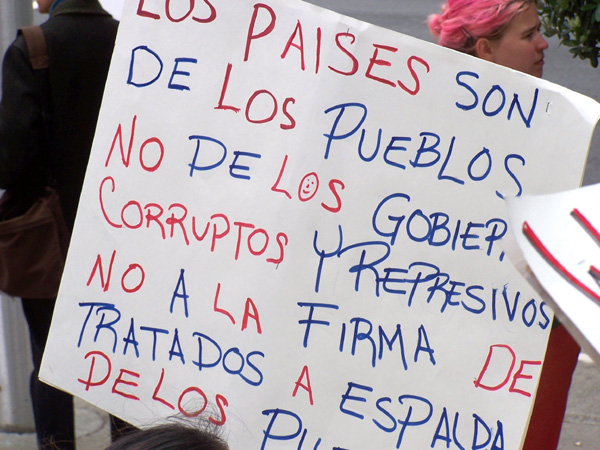
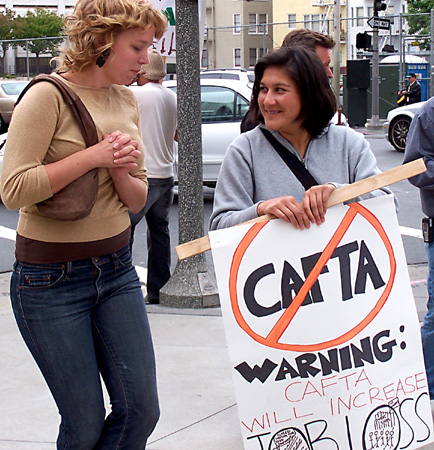
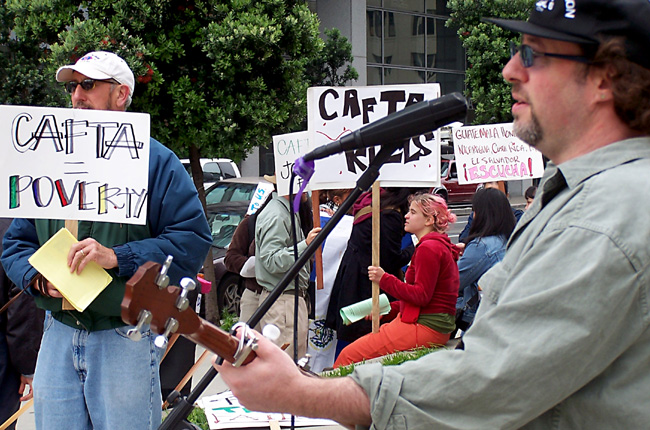
San Francisco Bay Area groups demonstrated at House Minority Leader Nancy Pelosi's office in the Federal Building in San Francisco May 26th urging Congress not to pass CAFTA.
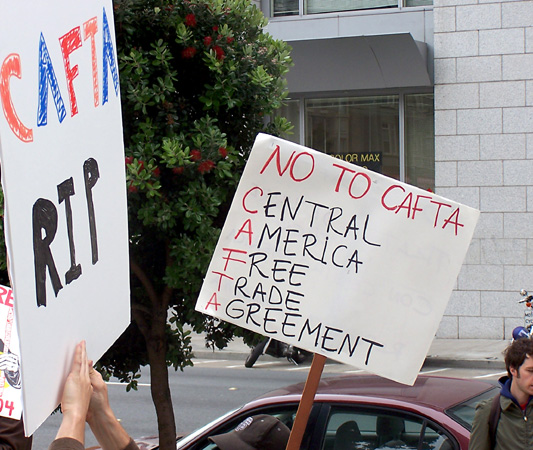
Two days later, May 28th, when President Bush signed the agreement, she stated her opposition:
"The countries of Central America have inadequate, poorly-enforced labor and environmental laws that do not follow international standards. As such, enforcement in these areas must be written into CAFTA rather than just asking the countries to police themselves."
CAFTA must be ratified by majority vote of both houses before it would go into effect.
For more information:
http://www.stopcafta.org/


Add Your Comments
Comments
(Hide Comments)
email this print this reprint or license this
Posted on Sat, May. 28, 2005
Click here to find out more!
Sen. Dole will vote `yes' on CAFTA
Trade pact has found friends and opponents in textile industry
TIM FUNK
Observer Washington Bureau
WASHINGTON - Sen. Elizabeth Dole, R-N.C., said Friday that she plans to vote for the Central America Free Trade Agreement, also known as CAFTA.
Her decision comes as a boost to the Bush administration, which has stepped up its lobbying of members of Congress. But it likely will prove controversial with large segments of the textile industry, which is predicting more job losses if the treaty is approved by the House and the Senate.
Dole disclosed her intention to vote "Yes" on CAFTA in a Friday letter to Larry Wooten, president of the N.C. Farm Bureau, which has endorsed the free trade agreement as a way for the state's farmers to reach new markets.
She wrote in the letter that CAFTA would also end up expanding markets and jobs in various other N.C. industries -- including heavy truck and bus manufacturers, electronics producers, software firms and drug makers.
"As their markets expand," Dole wrote, "so too should employment opportunities for people across North Carolina, and that is why I intend to support" CAFTA.
On textiles, Dole wrote that CAFTA "enjoys wide, if not universal, support in the textile industry. Many textile companies have informed me that creating a market for their products in Central America -- where American-made fabric would be transformed into apparel -- is fundamental to their strategies for keeping jobs from leaving North Carolina and going to China."
But that is a minority view in the textile industry, said Auggie Tantillo, president of the American Manufacturing Trade Action Coalition (AMTAC), which represents about 150 companies in the U.S. textile and apparel industry.
CAFTA, he said, "will pit workers in North Carolina who make $14 to $15 an hour and have a health-care package and pension program against (Central American) workers who make 80 cents an hour and are working in an environment where there are virtually no labor, health or environmental standards. ... It's illogical (to suggest) that U.S. jobs and factories are not going to migrate to these low-cost free-trade partners."
Another textile industry group -- the National Council of Textile Organizations -- endorsed CAFTA after Dole and Sen. Jim DeMint, R-S.C., got U.S. Trade Representative Rob Portman to agree to seek an amendment to CAFTA that would benefit producers of textile pocketing and linings.
But Tantillo said any changes to CAFTA require the unanimous approval of seven countries -- not just the United States -- and the other countries' presidents have been unwilling to commit to any amendments. "We should not confuse promises to fix problems with results," Tantillo said.
Posted on Sat, May. 28, 2005
Click here to find out more!
Sen. Dole will vote `yes' on CAFTA
Trade pact has found friends and opponents in textile industry
TIM FUNK
Observer Washington Bureau
WASHINGTON - Sen. Elizabeth Dole, R-N.C., said Friday that she plans to vote for the Central America Free Trade Agreement, also known as CAFTA.
Her decision comes as a boost to the Bush administration, which has stepped up its lobbying of members of Congress. But it likely will prove controversial with large segments of the textile industry, which is predicting more job losses if the treaty is approved by the House and the Senate.
Dole disclosed her intention to vote "Yes" on CAFTA in a Friday letter to Larry Wooten, president of the N.C. Farm Bureau, which has endorsed the free trade agreement as a way for the state's farmers to reach new markets.
She wrote in the letter that CAFTA would also end up expanding markets and jobs in various other N.C. industries -- including heavy truck and bus manufacturers, electronics producers, software firms and drug makers.
"As their markets expand," Dole wrote, "so too should employment opportunities for people across North Carolina, and that is why I intend to support" CAFTA.
On textiles, Dole wrote that CAFTA "enjoys wide, if not universal, support in the textile industry. Many textile companies have informed me that creating a market for their products in Central America -- where American-made fabric would be transformed into apparel -- is fundamental to their strategies for keeping jobs from leaving North Carolina and going to China."
But that is a minority view in the textile industry, said Auggie Tantillo, president of the American Manufacturing Trade Action Coalition (AMTAC), which represents about 150 companies in the U.S. textile and apparel industry.
CAFTA, he said, "will pit workers in North Carolina who make $14 to $15 an hour and have a health-care package and pension program against (Central American) workers who make 80 cents an hour and are working in an environment where there are virtually no labor, health or environmental standards. ... It's illogical (to suggest) that U.S. jobs and factories are not going to migrate to these low-cost free-trade partners."
Another textile industry group -- the National Council of Textile Organizations -- endorsed CAFTA after Dole and Sen. Jim DeMint, R-S.C., got U.S. Trade Representative Rob Portman to agree to seek an amendment to CAFTA that would benefit producers of textile pocketing and linings.
But Tantillo said any changes to CAFTA require the unanimous approval of seven countries -- not just the United States -- and the other countries' presidents have been unwilling to commit to any amendments. "We should not confuse promises to fix problems with results," Tantillo said.
For more information:
http://www.charlotte.com/mld/charlotte/bus...
We are 100% volunteer and depend on your participation to sustain our efforts!
Donate

$115.00 donated
in the past month
Get Involved
If you'd like to help with maintaining or developing the website, contact us.
Publish
Publish your stories and upcoming events on Indybay.
Topics
More
Search Indybay's Archives
Advanced Search
►
▼
IMC Network