







 Publish to Newswire
 Add an Event
From the Open-Publishing Calendar
From the Open-Publishing Newswire
Indybay Feature
Gigantic May Day March Rocks Caracas
Two May Day marches highlighted the growing role and power of workers in Venezuela. One was immense and jubilant - yet another sign of the enormous support enjoyed by Venezuelan President Hugo Chavez Frias. The other was far smaller and more somber, yet still showed that determined opposition to President Chavez is not exclusive to the rich.
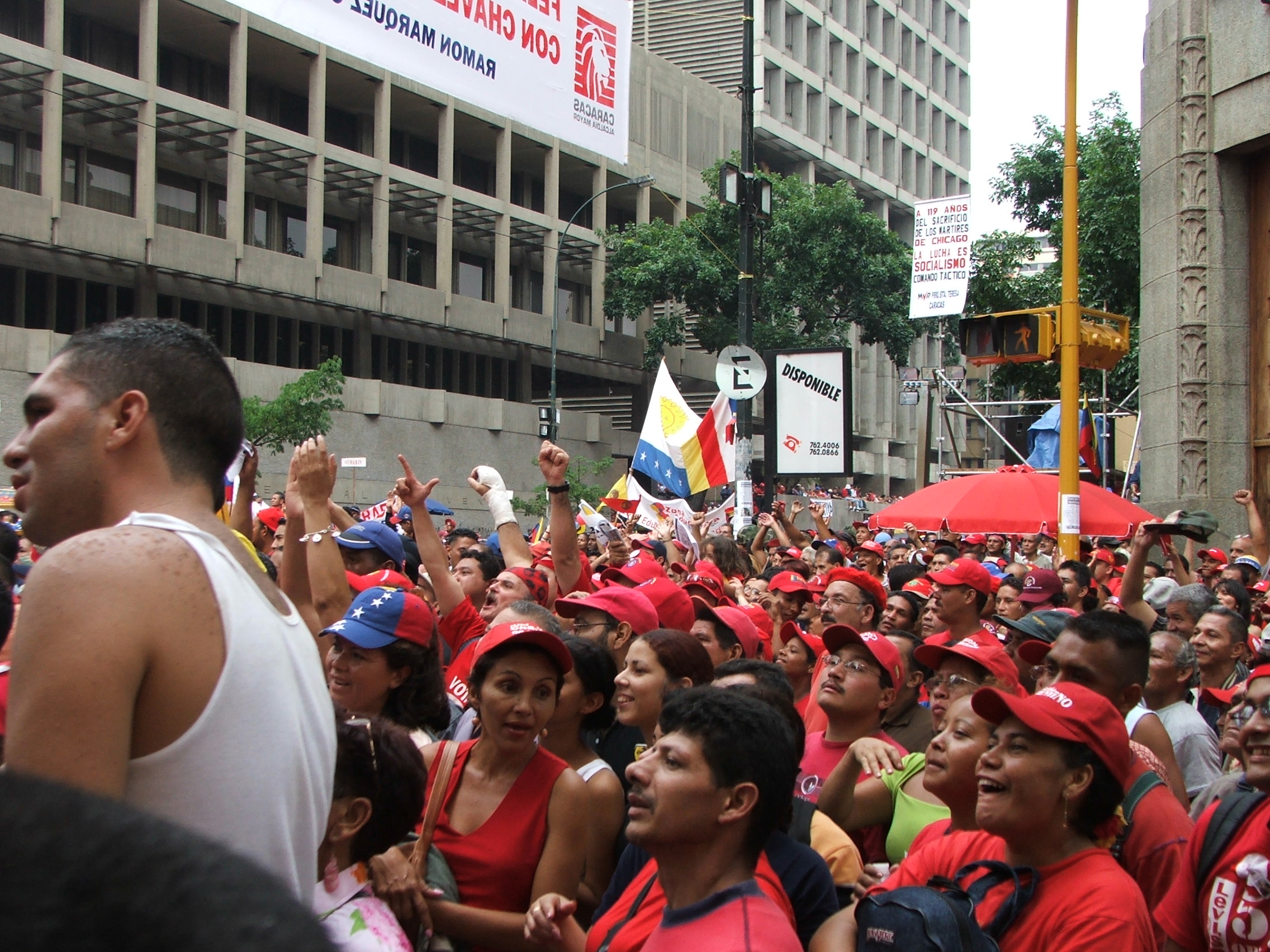
GIGANTIC MAY DAY MARCH ROCKS CARACAS
Jonathan Nack, Epicenter News Service
May 2, 2005
CARACAS, VENEZUELA - Two May Day marches highlighted the growing role and power of workers in Venezuela. One was immense and jubilant - yet another sign of the enormous support enjoyed by Venezuelan President Hugo Chavez Frias. The other was far smaller and more somber, yet still showed that determined opposition to President Chavez is not exclusive to the rich.
This May Day competition to demonstrate the support of Venezuelan workers was a no-contest. This came as no surprise to those knowledgeable about recent political developments here.
The left political parties which comprise President Chavez’s ruling coalition have won election after election since 1999, when Chavez was first elected. In August 2004, President Chavez easily survived a recall election. The opposition charged the vote was a massive fraud but has failed to produce substantial evidence. The election was certified as fair by former U.S. President Jimmy Carter and his Carter Foundation, as well as by the Organization of American States (OAS), which were on hand to observe.
The massive pro-government march was organized by the Uniòn National de Trabajadores (UNT), a relatively new union federation which has grown dramatically. It also enjoyed the support of independent unions and a great many grassroots community and youth organizations, as well as political parties which support the government, which are collectively known here as the “Chavistas“, the backbone of what proponents call the “Bolivarian Revolution“ (named after Simon Bolivar, the famed leader of the fight for independence from Spain in five South American nations).
Buses brought large numbers of Chavistas in from all over Venezuela. It was clear that considerable resources were dedicated to this effort. With most participants clad in red, the UNT march appeared as a river of red humanity punctuated by the yellow, blue, and red colors of the Venezuelan flag.
There were no estimates of the number of persons in the UNT march at deadline and it was so big that making any estimation is difficult. The Venezuelan press did uniformly describe it as massive. The newspaper, El Universal, reported May 2 that the march stretched for many miles.
This reporter could see neither the beginning nor the end of the UNT march and it was clear that it numbered in the many hundreds of thousands and might well have included over a million marchers.
President Chavez delivered a rousing speech at the rally which, as is his custom, was very long. Yet President Chavez appeared to never lose the crowd which cheered throughout, frequently interrupting Chavez with sustained revolutionary chants. He did not pull any punches and reiterated that he stood for “…profound social change… and the construction of socialism.” He emphasized his alliance with the Cuban government and exclaimed, “Long live the Cuban Revolution - long live Fidel!”
Criticism of the government of the United States was equally unrestrained. President Chavez characterized the U.S. as imperialistic, but was careful to say that while he opposed the policies of the government of President George W. Bush, he had fondness for the American people. He singled out for praise those in the U.S. who protest against the war in Iraq and corporate capitalist globalization and specifically included Anarchists.
While Chavez’s critics charge that many of the Chavistas were enticed to attend by material incentives, their enthusiasm appeared quite heartfelt. This reporter found that a random sampling of interviewees, including many who were clearly of low income, to be extremely articulate about the reasons they attended.
One dark skinned woman worker named Miralanda de Raisone, a member of a union of self-employed street vendors, said she came to march to give more power to President Chavez who is improving the lives of poor people. Ms. Deraisone described how before President Chavez, it was mostly illegal for her and other poor street vendors to do their work. “I no longer have to be afraid and run from the police. I am free to sell in the streets,” said Ms. De Raisone.
The smaller anti-government May Day mobilization was organized by the Confederaciòn de la Trabajadores de Venezuela (CTV), which until recently was the main labor federation in Venezuela. Opposition to President Chavez was emphasized, as was a call for a general amnesty for workers and the political opposition whom they charged the government is repressing.
Marisa Casas de las Marinas, another woman of dark complexion, who by her dress and manner appeared more affluent than Señora de Raisone, charged that the government had arrested her husband and has otherwise repressed her husband for his political beliefs. She said her husband has been a labor leader in Venezuela for 25 years and had been a leader of the strike by oil workers in 2002. Señora de las Marinas said her husband was now underground to the danger posed by the Government and that her husband was going to Geneva, Switzerland to file charges of human rights violations against the Chavez government. This reporter was unable to independently investigate Ms. de las Marinas’ allegations by deadline.
The oil strike in 2002 was largely political and united oil unions of the CTV with management of Venezuela’s state-owned oil corporation (known as PDV) against President Chavez’s government, which was putting in place a new leadership for PDV. The strike temporarily crippled Venezuela’s number one industry, but ended in failure. Almost the entire old management was fired, as were many workers, when they refused to obey an order from Venezuela’s Supreme Court to return to work.
The CTV march was much smaller in number and could clearly be counted in the thousands, with no more than 20,000 at the most. The number is nevertheless substantial compared to May Day mobilizations in many other countries. Participants emphasized that their mobilization was organized without any government support and with a climate of fear gripping much of the political opposition. This reporter witnessed no government repression on this day and cannot independently verify or refute opposition charges.
There was a large presence of heavily armed police and military to maintain order at both May Day mobilizations. The troops appeared ready but relaxed and no violent altercations were observed. There was no military parade as has frequently been held in Communist led countries.
If the dueling May Day events are a reflection of the relative strength of and support for the UNT and CTV, the older CTV is being badly out organized by the new UNT. The CTV appears to have paid dearly for their alliance with Venezuela’s wealthy and capitalists against President Chavez’s regime.
When asked if they had a message for the workers of the United States, participants at both marches sounded similar themes. Go out and join or organize a union to get better pay and benefits and more political power too, they advised.
Copyright Epicenter News Service - All rights reserved.
For more information:
http://www.EastBayNews.org
Add Your Comments
We are 100% volunteer and depend on your participation to sustain our efforts!
Donate

$110.00 donated
in the past month
Get Involved
If you'd like to help with maintaining or developing the website, contact us.
Publish
Publish your stories and upcoming events on Indybay.
Topics
More
Search Indybay's Archives
Advanced Search
►
▼
IMC Network