







 Publish to Newswire
 Add an Event
From the Open-Publishing Calendar
From the Open-Publishing Newswire
Indybay Feature
What future for Israel's Palestinian citizens?
Jonathan Cook, The Electronic Intifada, 19 March 2005
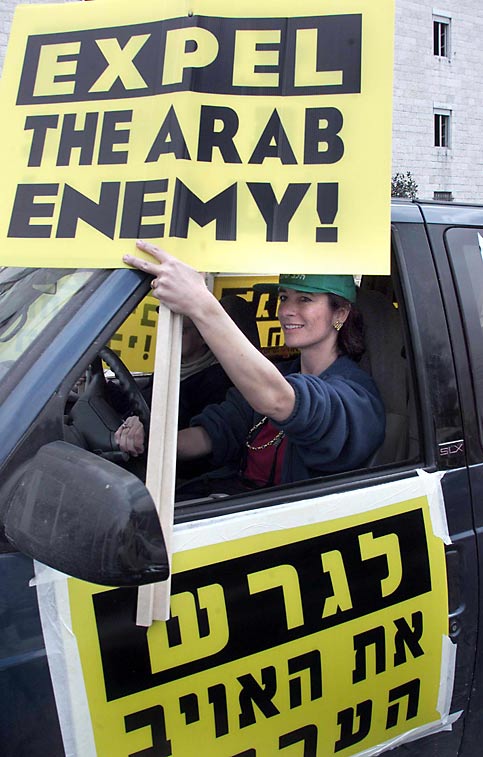
Nadia Matar, head of the extreme right-wing group "Women in Green", drives a car pasted with Hebrew and English slogans to "Expel the Arab Enemy" during a four-car convoy protest through Jerusalem, 17 March 2002. (AFP/Menahem Kahana)
---
Crowing over his success in breaking up the old Arab order, President George W. Bush has been strongly hinting that the first shoots of democracy pushing up through the sands of the Middle East will soon blossom into peace. Truly representative Arab leaders, we are assured, will put away the qassam and katuysha rockets and embrace their former enemies.
The model - at least in the thinking of the White House - is the peace process supposedly under way between the Israeli and Palestinian leaderships, sealed in a handshake last month at the Sinai beach resort of Sharm el-Sheikh. Mahmoud Abbas and Ariel Sharon are now doing business because both speak the same language of democracy - or so the Bush argument runs.
But neither Abbas nor Sharon paused at Sharm el-Sheikh, or have done so since, to consider how their agreements will affect the only community for which both are responsible by virtue of their office.
One and a quarter million Palestinians live as citizens of Israel, comprising a fifth of the country's population. Sharon is their representative as head of the Israeli government, while Abbas is charged with their welfare, as he is with that of the whole Palestinian people, in his role as chairman of the PLO.
Since the official talks that came to be known as the Oslo peace process began 12 years ago, the two leaderships have severely taxed this large Palestinian community's reservoir of goodwill. Speaking fluent Arabic and Hebrew and familiar with both cultures, these Palestinian citizens of Israel could have served as a bridgehead to peace long ago.
Instead, their potential contribution to a Middle Eastern peace process has been entirely ignored. The label most commonly adopted when referring to them, "Israeli Arabs", is a sign of how marginalised they are from both peoples, as though neither wishes to accept responsibility for them.
The Palestinian leadership has talked over their heads, obsessively pursuing a two-state solution based on a pre-1967 division of the land that would sever the Palestinian minority's ties to the rest of its people forever. And Israel has treated its Palestinian community as little more than temporary residents of a Jewish state, at best a demographic nuisance and at worst bargaining chips one day to be exchanged for a greater prize, such as a transfer of land from the West Bank to Israel.
The failure of both sides' vision is exemplified in the figure of Anton Shammas, an Israeli Arab novelist whose work makes an impassioned plea for understanding through a better integration of Arab and Jewish culture. His best known novel, Arabesques, a memoir of life in the Galilee, was written in Hebrew. Today, however, Shammas lives in exile in the United States, his Israeli citizenship renounced.
Israeli Arabs like Shammas have come to understand that their identity as Palestinians has been written out of the history books since 1948, even by the Palestinian leadership. In signing up to the Oslo process, Arafat, now followed by Abbas, made a tactical decision to accept both a minimalist headcount of his population (minus the Palestinian citizens of Israel and most of the refugees) and a minimalist accounting of his future state (minus the 78 per cent of historic Palestine which is now Israel).
That would not matter for Israel's Palestinian minority were they being embraced as fully fledged citizens of a democratic Israeli state - but they are not. Increasingly they have been tarred as traitors, as a fifth column, by Jewish compatriots raised from school age on a diet of racist stories about Arabs.
No surprise then that the Israeli police gunned down 13 unarmed Israeli Arabs and wounded hundreds more protesting in the days following the outbreak of the Intifada. Or that the Hebrew media dutifully lined up behind the police as its officers implausibly claimed that they were acting in self-defence.
After that outrage, a bout of soul-searching was required of Israeli society. The country's politician-generals chose instead to shore up Israel's battered reputation by arguing ever more vociferously that their state was both Jewish and democratic - and that any dissent was evidence of anti-Semitism. That mantra, quickly adopted by US mediators like Dennis Ross, has become a favourite in the White House.
The problem - at least for the White House and Israel - is that Israel's Palestinian citizens are potentially a very large fly in that ointment. On the one hand, their visible presence in the democratic process risks undermining the Israeli state's claims to its exclusive Jewishness; and, on the other, repression by Israel designed to silence them risks bursting its democratic pretensions.
The solution adopted by Israel has been to transform the Palestinian minority into non-citizens, justifying their exclusion on the grounds now being promoted by Washington: that Arabs need first to be educated in the ways of democracy before they can be allowed to participate in democratic processes.
In Israel, the deeds and opinions of Palestinian citizens automatically suffer from a "legitimacy deficit". This was neatly illustrated while Abbas and Sharon were cementing their relationship at Sharm el-Sheikh. Back in Israel, a parliamentary committee was pushing ahead with a bill to generously reward the few thousand settlers who may be forced to evacuate their homes in Gaza this summer under Sharon's unilateral withdrawal.
The measure passed by one vote: that of Mohammed Barakeh, the sole Arab member of the committee. It is a rare moment indeed when an Arab's voice has a decisive effect on the political processes of "the only democracy in the Middle East". The committee erupted into pandemonium.
Members of the committee opposed to the Gaza withdrawal called Barakeh's casting ballot "a disgrace". Their complaints were later taken up by several members of the cabinet, including the education minister Limor Livnat, who called the vote "illegitimate".
This episode echoed the uproar in 2000 that greeted the previous prime minister Ehud Barak's intention to stage a national referendum on a proposal to return the Golan Heights to Syria. Critics argued that a majority decision would be worthless, or dangerously divisive, if it relied on a strong Israeli Arab vote. Barak dropped the referendum.
Sharon's current refusal to countenance a referendum on his Gaza disengagement plan is based, at least partly, on the same racist calculation.
Read More
http://electronicintifada.net/v2/article3696.shtml
---
Crowing over his success in breaking up the old Arab order, President George W. Bush has been strongly hinting that the first shoots of democracy pushing up through the sands of the Middle East will soon blossom into peace. Truly representative Arab leaders, we are assured, will put away the qassam and katuysha rockets and embrace their former enemies.
The model - at least in the thinking of the White House - is the peace process supposedly under way between the Israeli and Palestinian leaderships, sealed in a handshake last month at the Sinai beach resort of Sharm el-Sheikh. Mahmoud Abbas and Ariel Sharon are now doing business because both speak the same language of democracy - or so the Bush argument runs.
But neither Abbas nor Sharon paused at Sharm el-Sheikh, or have done so since, to consider how their agreements will affect the only community for which both are responsible by virtue of their office.
One and a quarter million Palestinians live as citizens of Israel, comprising a fifth of the country's population. Sharon is their representative as head of the Israeli government, while Abbas is charged with their welfare, as he is with that of the whole Palestinian people, in his role as chairman of the PLO.
Since the official talks that came to be known as the Oslo peace process began 12 years ago, the two leaderships have severely taxed this large Palestinian community's reservoir of goodwill. Speaking fluent Arabic and Hebrew and familiar with both cultures, these Palestinian citizens of Israel could have served as a bridgehead to peace long ago.
Instead, their potential contribution to a Middle Eastern peace process has been entirely ignored. The label most commonly adopted when referring to them, "Israeli Arabs", is a sign of how marginalised they are from both peoples, as though neither wishes to accept responsibility for them.
The Palestinian leadership has talked over their heads, obsessively pursuing a two-state solution based on a pre-1967 division of the land that would sever the Palestinian minority's ties to the rest of its people forever. And Israel has treated its Palestinian community as little more than temporary residents of a Jewish state, at best a demographic nuisance and at worst bargaining chips one day to be exchanged for a greater prize, such as a transfer of land from the West Bank to Israel.
The failure of both sides' vision is exemplified in the figure of Anton Shammas, an Israeli Arab novelist whose work makes an impassioned plea for understanding through a better integration of Arab and Jewish culture. His best known novel, Arabesques, a memoir of life in the Galilee, was written in Hebrew. Today, however, Shammas lives in exile in the United States, his Israeli citizenship renounced.
Israeli Arabs like Shammas have come to understand that their identity as Palestinians has been written out of the history books since 1948, even by the Palestinian leadership. In signing up to the Oslo process, Arafat, now followed by Abbas, made a tactical decision to accept both a minimalist headcount of his population (minus the Palestinian citizens of Israel and most of the refugees) and a minimalist accounting of his future state (minus the 78 per cent of historic Palestine which is now Israel).
That would not matter for Israel's Palestinian minority were they being embraced as fully fledged citizens of a democratic Israeli state - but they are not. Increasingly they have been tarred as traitors, as a fifth column, by Jewish compatriots raised from school age on a diet of racist stories about Arabs.
No surprise then that the Israeli police gunned down 13 unarmed Israeli Arabs and wounded hundreds more protesting in the days following the outbreak of the Intifada. Or that the Hebrew media dutifully lined up behind the police as its officers implausibly claimed that they were acting in self-defence.
After that outrage, a bout of soul-searching was required of Israeli society. The country's politician-generals chose instead to shore up Israel's battered reputation by arguing ever more vociferously that their state was both Jewish and democratic - and that any dissent was evidence of anti-Semitism. That mantra, quickly adopted by US mediators like Dennis Ross, has become a favourite in the White House.
The problem - at least for the White House and Israel - is that Israel's Palestinian citizens are potentially a very large fly in that ointment. On the one hand, their visible presence in the democratic process risks undermining the Israeli state's claims to its exclusive Jewishness; and, on the other, repression by Israel designed to silence them risks bursting its democratic pretensions.
The solution adopted by Israel has been to transform the Palestinian minority into non-citizens, justifying their exclusion on the grounds now being promoted by Washington: that Arabs need first to be educated in the ways of democracy before they can be allowed to participate in democratic processes.
In Israel, the deeds and opinions of Palestinian citizens automatically suffer from a "legitimacy deficit". This was neatly illustrated while Abbas and Sharon were cementing their relationship at Sharm el-Sheikh. Back in Israel, a parliamentary committee was pushing ahead with a bill to generously reward the few thousand settlers who may be forced to evacuate their homes in Gaza this summer under Sharon's unilateral withdrawal.
The measure passed by one vote: that of Mohammed Barakeh, the sole Arab member of the committee. It is a rare moment indeed when an Arab's voice has a decisive effect on the political processes of "the only democracy in the Middle East". The committee erupted into pandemonium.
Members of the committee opposed to the Gaza withdrawal called Barakeh's casting ballot "a disgrace". Their complaints were later taken up by several members of the cabinet, including the education minister Limor Livnat, who called the vote "illegitimate".
This episode echoed the uproar in 2000 that greeted the previous prime minister Ehud Barak's intention to stage a national referendum on a proposal to return the Golan Heights to Syria. Critics argued that a majority decision would be worthless, or dangerously divisive, if it relied on a strong Israeli Arab vote. Barak dropped the referendum.
Sharon's current refusal to countenance a referendum on his Gaza disengagement plan is based, at least partly, on the same racist calculation.
Read More
http://electronicintifada.net/v2/article3696.shtml
Add Your Comments
Comments
(Hide Comments)
Last week, Palestinian laborers were attacked by settlers in what the Israel Defense Forces described as an "attempted lynching." At various locations throughout the West Bank, Jewish hooligans have used guns, iron bars and hammers in an attempt to ignite the territories.
In one case, students of the Yeshuat Mordechai Yeshiva attacked five laborers who had come to work in the settlement of Nahliel with sticks and stones. In a second case, Nawaf Hanani of Nablus was beaten all over his body by armed settlers who forced him to get out of his truck. In a third case, Hebron settlers invaded an Arab house, attacked the residents and destroyed part of the ceiling with hammers. In all of these places, soldiers and policemen were in the vicinity. Granted, some of the assailants were arrested the same day, but they were later allowed to go home.
The lenient attitudes shown by the army and police allow the settlers to conclude that the state either cannot or will not deal with them. If a handful of rioters from Nahliel and Hebron get off scot-free after what the army itself defined as an attempted lynching, the next pogrom is virtually inevitable. The extreme right will stop at nothing to put a spoke in the wheels of disengagement, and the current clashes are merely an omen of what is to come.
Yet faced with the determination of the right-wing battalions scattered throughout the West Bank, which are armed with weapons that the IDF gave them, the defense establishment is dithering over issues that should not be troubling it at all, such as whether it is proper to close Gush Katif to visitors now, or whether the residents should be allowed to celebrate Pesach first. The coming Pesach will be no innocent holiday. Many of those who will visit the Gaza Strip will remain in order to disrupt the evacuation. It is important to remember the seder that Rabbi Moshe Levinger celebrated at the Park Hotel in Hebron 35 years ago: The guests at that seder have not left the city to this day.
Talia Sasson's report on the illegal outposts, like Yehudit Karp's report in 1982, is infuriating in its descriptions of the failure to enforce the law against the settlers. Similar statements were made to the state commission of inquiry on the 1994 massacre at the Cave of the Patriarchs. Former police commissioner Rafi Peled told that commission that with regard to the settlers, there is only "the semblance of law." And nothing has changed since then.
Sasson expressed shock over the fact that settlers cut down thousands of Palestinian olive trees under the eyes of watching IDF soldiers and spoke of "the spirit of the commander" in the territories, from which the soldiers understood that they should not intervene, as everything the settlers do is for the sake of Zionism. The unhindered violence of the past few days indicates that this spirit is still active.
The Gaza Strip should be closed to visitors now. Similarly, all those who engage in violence, who push the envelope, who are working day and night to reignite the intifada in order to disrupt the evacuation of settlements by keeping the army busy with other tasks, must be arrested without hesitation. In places with a reputation for hooliganism, such as the settlements and outposts around Nablus, the army must keep an especially sharp eye out. The writing is already on the wall, and it sometimes seems as if the preparations being made by the police and army are less determined and less sophisticated than those being made by the settlers.
http://www.haaretz.com/hasen/spages/554565.html
In one case, students of the Yeshuat Mordechai Yeshiva attacked five laborers who had come to work in the settlement of Nahliel with sticks and stones. In a second case, Nawaf Hanani of Nablus was beaten all over his body by armed settlers who forced him to get out of his truck. In a third case, Hebron settlers invaded an Arab house, attacked the residents and destroyed part of the ceiling with hammers. In all of these places, soldiers and policemen were in the vicinity. Granted, some of the assailants were arrested the same day, but they were later allowed to go home.
The lenient attitudes shown by the army and police allow the settlers to conclude that the state either cannot or will not deal with them. If a handful of rioters from Nahliel and Hebron get off scot-free after what the army itself defined as an attempted lynching, the next pogrom is virtually inevitable. The extreme right will stop at nothing to put a spoke in the wheels of disengagement, and the current clashes are merely an omen of what is to come.
Yet faced with the determination of the right-wing battalions scattered throughout the West Bank, which are armed with weapons that the IDF gave them, the defense establishment is dithering over issues that should not be troubling it at all, such as whether it is proper to close Gush Katif to visitors now, or whether the residents should be allowed to celebrate Pesach first. The coming Pesach will be no innocent holiday. Many of those who will visit the Gaza Strip will remain in order to disrupt the evacuation. It is important to remember the seder that Rabbi Moshe Levinger celebrated at the Park Hotel in Hebron 35 years ago: The guests at that seder have not left the city to this day.
Talia Sasson's report on the illegal outposts, like Yehudit Karp's report in 1982, is infuriating in its descriptions of the failure to enforce the law against the settlers. Similar statements were made to the state commission of inquiry on the 1994 massacre at the Cave of the Patriarchs. Former police commissioner Rafi Peled told that commission that with regard to the settlers, there is only "the semblance of law." And nothing has changed since then.
Sasson expressed shock over the fact that settlers cut down thousands of Palestinian olive trees under the eyes of watching IDF soldiers and spoke of "the spirit of the commander" in the territories, from which the soldiers understood that they should not intervene, as everything the settlers do is for the sake of Zionism. The unhindered violence of the past few days indicates that this spirit is still active.
The Gaza Strip should be closed to visitors now. Similarly, all those who engage in violence, who push the envelope, who are working day and night to reignite the intifada in order to disrupt the evacuation of settlements by keeping the army busy with other tasks, must be arrested without hesitation. In places with a reputation for hooliganism, such as the settlements and outposts around Nablus, the army must keep an especially sharp eye out. The writing is already on the wall, and it sometimes seems as if the preparations being made by the police and army are less determined and less sophisticated than those being made by the settlers.
http://www.haaretz.com/hasen/spages/554565.html
Arabs just hate it when you shoot back...
Electronic Intifada Founder Advocating Bi-National Solution for Palestine
http://66.102.7.104/search?q=cache:DENBkNmgUKsJ:http://www.tehrantimes.com/archives/Description.asp%3FDa%3D5/17/2004%26Cat%3D15%26Num%3D1+abunimah+al-masakin&hl=en
http://66.102.7.104/search?q=cache:DENBkNmgUKsJ:http://www.tehrantimes.com/archives/Description.asp%3FDa%3D5/17/2004%26Cat%3D15%26Num%3D1+abunimah+al-masakin&hl=en
>>>One and a quarter million Palestinians live as citizens of Israel, comprising a fifth of the country's population. Sharon is their representative as head of the Israeli government, while Abbas is charged with their welfare, as he is with that of the whole Palestinian people, in his role as chairman of the PLO<<<FROM THE ABOVE ARTICLE>
Once you have the Palestinian State in the Whole of the West Bank and Gaza. You are on the Road to Peace and the Israeli Arabs have a better chance of equality as the Jewish Settlers will have a better chance at Peace. After all what is wrong with the State of Israel with a Jewish majority and an Arab minority?....And what is wrong With Palestine with a Palestinian majority and a Jewish minority?....Nothing if both nations were at Peace instead of One Group under the Brutal Occupation and Oppression of the Other.
Once you have a Palestinian State the Israeli Arabs who do not like living in Israel can move to Palestine, Just like the Jewish settlers who do not like living in the West Bank and Gaza under Palestinian Rule can move to Israel Proper.
Do the right thing and Peace Will Follow......
Hypocrisy and double standard does not lead to peace, and people are not blind and they can see the truth as it really is.
Thirty-six years of war should be enough for such a small number of people, when you consider the World Population.
Allowing the Palestinian People to have their small state in the Whole of the West Bank and Gaza can solve this conflict.
There are 1,200,000 or so Arabs living inside Israel Proper.
There are 400,000 or so Jews living inside the West Bank and Gaza.
Trying to remove all the settlement can be an almost undoable task.
So Set the Borders for Israel to it Pre 1967 Border (Green Line) and have the State of Palestine inside the West Bank and Gaza.
If the U.N. can decide the Borders of Israel in 1948,
The U.N. can decide the Borders of Palestine in 2005.
You would end up with Israel with a majority Jewish Population and Palestine with a majority Muslim Population.
This would allow for the Israeli Military to Guard and Control the Israeli pre 1967 borders instead of confiscating Palestinian Land and Demolishing Palestinian Homes in the West Bank and Gaza that only goes to fuel the need for the Palestinian People to fight for their Freedom.
The Jews who do not like living in the new Palestinian State can feel free to move to Israel if they so choose.
The Arabs living inside Israel can feel free to move to the new Palestinian State if they so choose.
Almost every nation on earth has more then one ethnic group or religious group, so why not Israel and Palestine?
It would sure be better then the never-ending conflict we have right now.
Who has died and how in this struggle for Palestinian Freedom?
CLICK HERE > http://www.ifamericansknew.org/stats/deaths.html
Once you have the Palestinian State in the Whole of the West Bank and Gaza. You are on the Road to Peace and the Israeli Arabs have a better chance of equality as the Jewish Settlers will have a better chance at Peace. After all what is wrong with the State of Israel with a Jewish majority and an Arab minority?....And what is wrong With Palestine with a Palestinian majority and a Jewish minority?....Nothing if both nations were at Peace instead of One Group under the Brutal Occupation and Oppression of the Other.
Once you have a Palestinian State the Israeli Arabs who do not like living in Israel can move to Palestine, Just like the Jewish settlers who do not like living in the West Bank and Gaza under Palestinian Rule can move to Israel Proper.
Do the right thing and Peace Will Follow......
Hypocrisy and double standard does not lead to peace, and people are not blind and they can see the truth as it really is.
Thirty-six years of war should be enough for such a small number of people, when you consider the World Population.
Allowing the Palestinian People to have their small state in the Whole of the West Bank and Gaza can solve this conflict.
There are 1,200,000 or so Arabs living inside Israel Proper.
There are 400,000 or so Jews living inside the West Bank and Gaza.
Trying to remove all the settlement can be an almost undoable task.
So Set the Borders for Israel to it Pre 1967 Border (Green Line) and have the State of Palestine inside the West Bank and Gaza.
If the U.N. can decide the Borders of Israel in 1948,
The U.N. can decide the Borders of Palestine in 2005.
You would end up with Israel with a majority Jewish Population and Palestine with a majority Muslim Population.
This would allow for the Israeli Military to Guard and Control the Israeli pre 1967 borders instead of confiscating Palestinian Land and Demolishing Palestinian Homes in the West Bank and Gaza that only goes to fuel the need for the Palestinian People to fight for their Freedom.
The Jews who do not like living in the new Palestinian State can feel free to move to Israel if they so choose.
The Arabs living inside Israel can feel free to move to the new Palestinian State if they so choose.
Almost every nation on earth has more then one ethnic group or religious group, so why not Israel and Palestine?
It would sure be better then the never-ending conflict we have right now.
Who has died and how in this struggle for Palestinian Freedom?
CLICK HERE > http://www.ifamericansknew.org/stats/deaths.html
>>>One and a quarter million Palestinians live as citizens of Israel, comprising a fifth of the country's population. Sharon is their representative as head of the Israeli government, while Abbas is charged with their welfare, as he is with that of the whole Palestinian people, in his role as chairman of the PLO<<<FROM THE ABOVE ARTICLE>
Once you have the Palestinian State in Part of the West Bank and Gaza, You are on the Road to Peace and the Israeli Arab settlers will have a better chance of equality as Jews will have a better chance at Peace. After all what is wrong with the State of Israel with a Jewish majority and an Arab minority? Some things...And what is wrong With Palestine with a Palestinian majority and a Jewish minority? Some things....Nothing if both nations are at Peace instead of One Group under the Brutal Terror and Mayhem of the Other.
Once you have a Palestinian State the Israeli Arab settlers who do not like living in Israel can move to Palestine, Just like the Jews who do not like living in Part of the West Bank and Gaza under Palestinian Rule can move to Israel.
Do the right thing and Peace Will Follow......
Hypocrisy and double standard about Palestinian Terror does not lead to peace, and people are not blind and they can see the truth as it really is.
Thirty-seven years of war should be enough for such a small number of people, when you consider the World Population.
Allowing the Palestinian People to have their small state in the Whole of the West Bank and Gaza can not in itself solve this conflict.
There are 1,200,000 or so Arab settlers living inside Israel Proper.
There are 400,000 or so Jews living inside the West Bank and Gaza.
Trying to remove all the settlements can be an almost undoable task.
So Set the Borders for Israel to somewhat beyond its Pre 1967 Border (Green Line) and have the State of Palestine inside Part of the West Bank and Gaza.
If the U.N. could decide the Borders of Israel in 1947 and fail to protect the Jews from the Arab Attack that ensued,
The U.N. can not decide the Borders of Palestine in 2005.
You would end up with Israel with a majority Jewish Population and Palestine with a majority Muslim Population.
This would allow for the Israeli Military to Guard and Control the new Israeli Borders instead of confiscating Palestinian Land and Demolishing Palestinian Homes in the West Bank and Gaza, provided the Palestinian Terrorists stop trying to rob the Israeli People of their Freedom, which only goes to fuel the Israeli reprisals.
The Jews who do not like living in the new Palestinian State can feel free to move to Israel if they so choose.
The Arab settlers living inside Israel should feel free to move to the new Palestinian State if they so choose.
Almost every nation on earth has more then one ethnic group or religious group, so why not Israel and Palestine?
It would sure be better then the never-ending Conflict we have right now.
Who has died and how in this struggle for Palestinian Murder and Destruction?
CLICK HERE > http://www.ifamericansknew.org/misleadingstats/deaths.html
Once you have the Palestinian State in Part of the West Bank and Gaza, You are on the Road to Peace and the Israeli Arab settlers will have a better chance of equality as Jews will have a better chance at Peace. After all what is wrong with the State of Israel with a Jewish majority and an Arab minority? Some things...And what is wrong With Palestine with a Palestinian majority and a Jewish minority? Some things....Nothing if both nations are at Peace instead of One Group under the Brutal Terror and Mayhem of the Other.
Once you have a Palestinian State the Israeli Arab settlers who do not like living in Israel can move to Palestine, Just like the Jews who do not like living in Part of the West Bank and Gaza under Palestinian Rule can move to Israel.
Do the right thing and Peace Will Follow......
Hypocrisy and double standard about Palestinian Terror does not lead to peace, and people are not blind and they can see the truth as it really is.
Thirty-seven years of war should be enough for such a small number of people, when you consider the World Population.
Allowing the Palestinian People to have their small state in the Whole of the West Bank and Gaza can not in itself solve this conflict.
There are 1,200,000 or so Arab settlers living inside Israel Proper.
There are 400,000 or so Jews living inside the West Bank and Gaza.
Trying to remove all the settlements can be an almost undoable task.
So Set the Borders for Israel to somewhat beyond its Pre 1967 Border (Green Line) and have the State of Palestine inside Part of the West Bank and Gaza.
If the U.N. could decide the Borders of Israel in 1947 and fail to protect the Jews from the Arab Attack that ensued,
The U.N. can not decide the Borders of Palestine in 2005.
You would end up with Israel with a majority Jewish Population and Palestine with a majority Muslim Population.
This would allow for the Israeli Military to Guard and Control the new Israeli Borders instead of confiscating Palestinian Land and Demolishing Palestinian Homes in the West Bank and Gaza, provided the Palestinian Terrorists stop trying to rob the Israeli People of their Freedom, which only goes to fuel the Israeli reprisals.
The Jews who do not like living in the new Palestinian State can feel free to move to Israel if they so choose.
The Arab settlers living inside Israel should feel free to move to the new Palestinian State if they so choose.
Almost every nation on earth has more then one ethnic group or religious group, so why not Israel and Palestine?
It would sure be better then the never-ending Conflict we have right now.
Who has died and how in this struggle for Palestinian Murder and Destruction?
CLICK HERE > http://www.ifamericansknew.org/misleadingstats/deaths.html
Well, ANGEL, imposter....Those are some views you have...
But why are they not good enough to post in your own name, or handle.
But why are they not good enough to post in your own name, or handle.
Idiots for Palestine
We are 100% volunteer and depend on your participation to sustain our efforts!
Donate

$110.00 donated
in the past month
Get Involved
If you'd like to help with maintaining or developing the website, contact us.
Publish
Publish your stories and upcoming events on Indybay.
Topics
More
Search Indybay's Archives
Advanced Search
►
▼
IMC Network