







 Publish to Newswire
 Add an Event
From the Open-Publishing Calendar
From the Open-Publishing Newswire
Indybay Feature
Old Growth Reserve Logging Begins at Biscuit: 11 Arrested at Fiddler Timber Sale Blockade
John West of Silver Creek Logging Co. anticipated a fight over Fiddler Mountain. With 85 loggers ready to go, he expressed his intent to begin logging once a court mandate allowed controversial old growth reserve timber sales in the Biscuit Fire area to proceed. The Ninth Circuit Court of Appeals issued that mandate this morning, opening the fight West promised.
As dawn broke on the Green Bridge over the Illinois River near Selma this morning, 75 people gathered to block old growth reserve logging at the Fiddler Timber Sale. Forest Service law enforcement officers and Josephine County Sheriffs escorted loggers to the site at 6:30 am where they encountered a large crowd effectively blocking all access to the sale units.
After issuing an order to disperse, 72-year-old Selma resident Joan Norman sat in the middle of the bridge, refusing to move. "We have no laws in our forest so we will be the law," said Norman, before law enforcement officers carried her off to be arrested, charging her with interfering with an agricultural operation. Two other individuals were arrested at the Green Bridge.
As dawn broke on the Green Bridge over the Illinois River near Selma this morning, 75 people gathered to block old growth reserve logging at the Fiddler Timber Sale. Forest Service law enforcement officers and Josephine County Sheriffs escorted loggers to the site at 6:30 am where they encountered a large crowd effectively blocking all access to the sale units.
After issuing an order to disperse, 72-year-old Selma resident Joan Norman sat in the middle of the bridge, refusing to move. "We have no laws in our forest so we will be the law," said Norman, before law enforcement officers carried her off to be arrested, charging her with interfering with an agricultural operation. Two other individuals were arrested at the Green Bridge.

As the caravan of law enforcement and loggers moved beyond the blockade at the Green Bridge, they encountered more trouble approximately four miles up the road. At a bend in the road, three forest defenders were locked down to a red pickup truck cemented into the road.
Using a tow truck, a power saw, and bolt cutters, law enforcement officers were able to remove the three people locked to the vehicle. Five other people passively resisted being removed from the blockade site and were arrested.
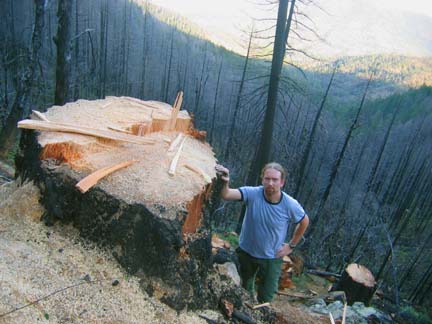
With the blockades removed, loggers were able to move to the lower units of the Fiddler sale and began falling trees. Ten to twelve loggers worked a shortened day, falling numerous large trees in the heavily burned unit.
Fiddler is one of five old growth reserve sales in the Biscuit Fire area opened to loggers by this morning's court mandate. On Wednesday, March 9, Federal District Judge Michael Hogan will hear a motion for a temporary restraining order to stop logging. Another court case is scheduled for late March.
In the meantime, Silver Creek Logging Co. plans to continue falling trees at Fiddler before a judge can weigh in on the merits of the case. Forest defenders vowed to continue demonstrating against these controversial sales.
Earlier reports and updates can be found at http://www.rogueimc.org.
Using a tow truck, a power saw, and bolt cutters, law enforcement officers were able to remove the three people locked to the vehicle. Five other people passively resisted being removed from the blockade site and were arrested.
With the blockades removed, loggers were able to move to the lower units of the Fiddler sale and began falling trees. Ten to twelve loggers worked a shortened day, falling numerous large trees in the heavily burned unit.
Fiddler is one of five old growth reserve sales in the Biscuit Fire area opened to loggers by this morning's court mandate. On Wednesday, March 9, Federal District Judge Michael Hogan will hear a motion for a temporary restraining order to stop logging. Another court case is scheduled for late March.
In the meantime, Silver Creek Logging Co. plans to continue falling trees at Fiddler before a judge can weigh in on the merits of the case. Forest defenders vowed to continue demonstrating against these controversial sales.
Earlier reports and updates can be found at http://www.rogueimc.org.
For more information:
http://www.o2collective.org



Add Your Comments
Comments
(Hide Comments)
Related subject info on L-P's history in Oroville, CA;
researched by luna moth
Timber corporation practices and their long term effects on communities can demonstrate corporate interest is short term profit. Far from the hills of Oregon a large scale timber operation leaves it's scar on Oroville..
Louisiana-Pacific corporation morphed out of Georgia-Pacific in 1973. The L-P wood treatment facility in southern Oroville used pentachlorophenols (PCPs) and other toxic chemicals in their log deck ponds. This site was shared with Kopper Co., for info on Kopper;
http://www.atsdr.cdc.gov/HAC/PHA/koppers2/kci_p1.html
Some other carcinogens used at the L-P log deck;
Arsenic, chromium (VI), formaldehyde, polycyclic aromated hydrocarbons (PAHs), polychlorinated dibenzo-dioxins/dibenzofurans (PCDDs/PCDFs), etc..
The L-P plant in Oroville is located 1.5 miles from the Feather River on top of a dredge tailing pile from previous mining. The dredge tailing is gravel and allows water to enter the shallow groundwater (7-45 ft below ground surface) and also regional aquifer (65- 317 ft below gs) over time. Between the shallow groundwater and regional aquifer is a shallow aquitard of clay and silt. PCPs were detected by residents between '73 and '83. The chemicals migrated in the regional aquifer for 1.5 miles south. L-P used fungicides containing PCPs between '70 and '84. Upon entering the Feather River, some PCP molecules are absorbed into fish by the process of bioaccumulation. Despite community concern about the health of fish and residents, the toxic groundwater was ignored by L-P execs..
Here's some very detailed info on PCPs from;
http://wlaphttp://www.gov.bc.ca/wat/wq/BCguidelines/chlorophenols/bcchlorophenol-10.htm
"Since they are immersed in the uptake medium, and have very efficient uptake sites in the gills, fish are most susceptible to bioaccumulation of PCP with factors up to 1000 for whole fish in sub-lethal PCP concentrations in the water (204, 279). Concentration factors in the gall bladder, where concentration and conjugation occur preparatory to elimination, may reach 5400 (204). Amphibian tadpole stages and neotenous forms are even more susceptible to chlorophenols since they too are fully immersed, have gills, are smaller, and do not have protective scales on most of their body."
A great deal of community pressure is needed for the EPA to declare a Superfund site on the National Priority List (NPL). There needs to be peer reviewed scientific evidence of a threat to get NPL status. When a site is removed from the NPL list, the corporation responsible for the hazardous materials is released from any financial obligation to help in site clean up. Time 2 pack up and leave, eh L-P?
In 1996 the EPA removed the contaminated site from the Superfund list;
http://www.epa.gov/superfund/sites/npl/d961121.htm
(Superfund info available at Oroville public library)
One year later;
from endgame website;
"A Corporation in Liquidation
In October 1997, L-P announced that over the next two years it would sell more than 25 percent ($1 billion worth) of its assets as part of its efforts to streamline its operations and focus on high-tech timber products. The assets, most of which are in Northern California, include 300,000 acres of redwood timber lands, accounting for about 23% of the firm's timberland properties; three sawmills; a pulp mill; and two distribution centers. L-P would still produce timber from 24 mills outside California. L-P also revealed plans to cut 3,500 jobs, or about 30% of its 12,000-member work force, including 1,108 workers in six Northern California facilities targeted for sale. It plans to produce a new generation of wood products using oriented strand board, which are laminated chips used as substitute for plywood and other traditional wood products"
above article from;
researched by luna moth
Timber corporation practices and their long term effects on communities can demonstrate corporate interest is short term profit. Far from the hills of Oregon a large scale timber operation leaves it's scar on Oroville..
Louisiana-Pacific corporation morphed out of Georgia-Pacific in 1973. The L-P wood treatment facility in southern Oroville used pentachlorophenols (PCPs) and other toxic chemicals in their log deck ponds. This site was shared with Kopper Co., for info on Kopper;
http://www.atsdr.cdc.gov/HAC/PHA/koppers2/kci_p1.html
Some other carcinogens used at the L-P log deck;
Arsenic, chromium (VI), formaldehyde, polycyclic aromated hydrocarbons (PAHs), polychlorinated dibenzo-dioxins/dibenzofurans (PCDDs/PCDFs), etc..
The L-P plant in Oroville is located 1.5 miles from the Feather River on top of a dredge tailing pile from previous mining. The dredge tailing is gravel and allows water to enter the shallow groundwater (7-45 ft below ground surface) and also regional aquifer (65- 317 ft below gs) over time. Between the shallow groundwater and regional aquifer is a shallow aquitard of clay and silt. PCPs were detected by residents between '73 and '83. The chemicals migrated in the regional aquifer for 1.5 miles south. L-P used fungicides containing PCPs between '70 and '84. Upon entering the Feather River, some PCP molecules are absorbed into fish by the process of bioaccumulation. Despite community concern about the health of fish and residents, the toxic groundwater was ignored by L-P execs..
Here's some very detailed info on PCPs from;
http://wlaphttp://www.gov.bc.ca/wat/wq/BCguidelines/chlorophenols/bcchlorophenol-10.htm
"Since they are immersed in the uptake medium, and have very efficient uptake sites in the gills, fish are most susceptible to bioaccumulation of PCP with factors up to 1000 for whole fish in sub-lethal PCP concentrations in the water (204, 279). Concentration factors in the gall bladder, where concentration and conjugation occur preparatory to elimination, may reach 5400 (204). Amphibian tadpole stages and neotenous forms are even more susceptible to chlorophenols since they too are fully immersed, have gills, are smaller, and do not have protective scales on most of their body."
A great deal of community pressure is needed for the EPA to declare a Superfund site on the National Priority List (NPL). There needs to be peer reviewed scientific evidence of a threat to get NPL status. When a site is removed from the NPL list, the corporation responsible for the hazardous materials is released from any financial obligation to help in site clean up. Time 2 pack up and leave, eh L-P?
In 1996 the EPA removed the contaminated site from the Superfund list;
http://www.epa.gov/superfund/sites/npl/d961121.htm
(Superfund info available at Oroville public library)
One year later;
from endgame website;
"A Corporation in Liquidation
In October 1997, L-P announced that over the next two years it would sell more than 25 percent ($1 billion worth) of its assets as part of its efforts to streamline its operations and focus on high-tech timber products. The assets, most of which are in Northern California, include 300,000 acres of redwood timber lands, accounting for about 23% of the firm's timberland properties; three sawmills; a pulp mill; and two distribution centers. L-P would still produce timber from 24 mills outside California. L-P also revealed plans to cut 3,500 jobs, or about 30% of its 12,000-member work force, including 1,108 workers in six Northern California facilities targeted for sale. It plans to produce a new generation of wood products using oriented strand board, which are laminated chips used as substitute for plywood and other traditional wood products"
above article from;
For more information:
http://www.endgame.org/lp.html
We are 100% volunteer and depend on your participation to sustain our efforts!
Donate

$85.00 donated
in the past month
Get Involved
If you'd like to help with maintaining or developing the website, contact us.
Publish
Publish your stories and upcoming events on Indybay.
Topics
More
Search Indybay's Archives
Advanced Search
►
▼
IMC Network