







 Publish to Newswire
 Add an Event
What Have Prisons Done to the Valley?
What Have Prisons Done to the Valley?
By Mike Rhodes
February 27, 2005
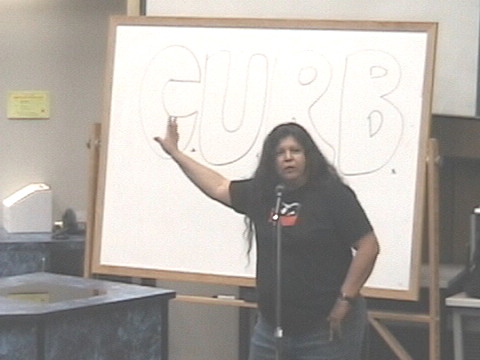
During the last two decades over half of California’s new prisons have been built in the Central Valley. The Californians United for A Responsible Budget (CURB), held a hearing in Fresno today to look at the prison industrial complex and how this growth has affected the people who live in this area.
Dr. Su Kapoor, a former member of the Fresno Human Relations Commission, asked "why have so many new prisons been built over the last 40 years and only one new college in the California State University system?" Kapoor went on to say that "it costs about $43,000 a year to incarcerate a person in prison but it costs less than $10,000 for them to go to school."
Debbie Reyes, who works for the Prison Moratorium Project, told the forum about the efforts to stop a new prison from being built in Mendota. Reyes said that a majority of the residents are opposed to the prison and they have attended numerous public forums to demand that it not be built. CURB board member Ruth Gilmore noted that when the government printed a 1,000 page environmental Impact Report (EIR) about the Mendota prison, it was only printed in English. Gilmore noted that "the vast majority of residents in Mendota only speak and read Spanish." When community groups asked why the EIR had not been printed in Spanish, so those who would be effected by the prison could understand the impact of the project, they were told that the report could not be translated because it had to many technical or scientific words.
Several speakers talked about the increasing number of immigrants that were being detained and sent to prison. Gloria Hernandez, from the group No Nos Vamos in Fresno, said that she was told by the FBI at a forum held right after 9-11 that anyone supporting groups like the Zapatistas could be arrested for supporting terrorism. Hernandez said that immigrants are being arrested and imprisoned on a variety of bogus charges and then being sent to out of state prisons, which further break their connection with families and friends.
Illyia Cespedes, a student from CSUF spoke out against the decreased funding in education and the increase in funding for the prison industrial complex. Cespedes said "68% of all prisoners are high school drop outs." She said that with the implementation of the No Child Left Behind high school "exit exam," more young people than ever will not receive a diploma. Cespedes added that youth organizers she is working with are being targeted by the police, making it increasingly difficult for them to do their jobs of keeping young people out of jail.
Speaker John Matacka told the forum about a young marine, Andres Raya, who was recently killed by Ceres police. Ceres is a small city just North of Modesto. Matacka said that as a result of this incident "over 900 Latino youth have been interrogated, over 100 arrested, over 60 vehicles have been towed, and 50 citations have been written." Matacka compared the racial profiling going on in Ceres and Modesto as being similar to the Sleepy Lagoon/Zoot Suit Riot incident in Los Angeles 63 years ago. For more information about the Andres Reya story and what is happening in Modesto/Ceres, see: http://www.indybay.org/news/2005/02/1723097.php .
The County of Fresno is planning a prison that will go on line in 2030, said Ruth Gilmore, one of the CURB members listening to testimony. She said "the prison they are planing is for the children of people whose parents haven’t even been born yet."
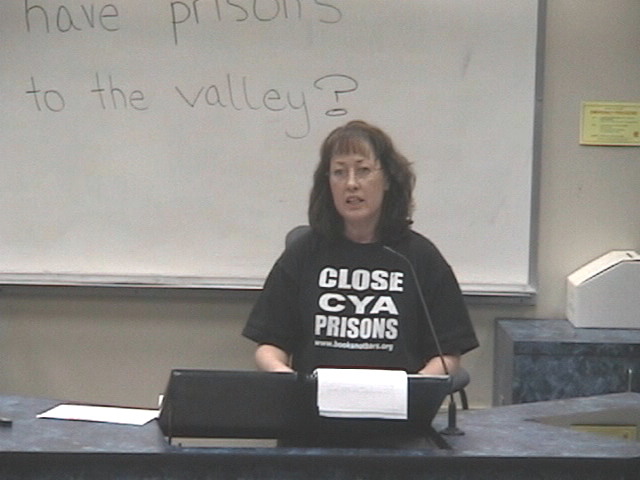
Laura Talkington, from the organization Books Not Bars, read a very moving story from a young man incarcerated in the California Youth Authority. It was published in a weekly newsletter called The Beat Within http://www.thebeatwithin.org/news/ . Talkington said the "poetic prisoner" who wrote the story concluded that the only solution for the CYA was to tear it down. Talkington said that "Books Not Bars is a grassroots campaign project that seeks to shift government resources away from punishment for young people and toward opportunities for them."
Tom Quinn, a private investigator in Fresno, focused on the California Correctional Peace Officers Association (CCPOA). Quinn said that the CCPOA was more of a para-military organization than a union. He said the CCPOA buys both Democrat and Republican politicians by providing them with about $7 million a year in campaign contributions. Quinn’s proposal, which he called modest, is to decertify them as a union. Quinn says they are "one of the most radical political groups active in the country today, and should not be allowed to operate as a union.
Mark Bautista, who works for the Service Employee International Union, which represents about 13,000 members who work in prisons, did not disagree with Quinn. Bautista said that as more money is poured into the prison industrial complex it "is starving other community services and that is wrong. When you have 20 prisons being built to one university, that is wrong." Bautista concluded by saying that the only way to stop prison growth is through rehabilitation.
Californians United for a Responsible Budget < http://www.curbprisonspending.org/ >, one of the sponsors for the forum, distributed a Prison Closure Proposal at the event. The proposal says:
* Given the California Department of Corrections’ (CDC) written commitment to reduce its prisoner population by 15,000 by June 2005;
* Given CDC’s statement that closures of prisons are assumed;
* Given the recognition in the Governor’s budget that "entire institution closures nearly double the potential savings (of a smaller prison population) by avoiding fixed costs,"
* and given the Governor’s creation of a commission to study and recommend prison closures;
We call upon the Governor, the CDC and the Legislature to take the following actions:
1. Do Not Open the Delano II Prison
2. Close Pelican Bay State Prison
3. Close Folsom State Prison
4. Close Valley State Prison for Women
5. Close California Correctional Center, Susanville
The Californians United for a Responsible Budget, Shadow Commission Hearing in Fresno brought together about 100 people to shine a light on the prison industrial complex and its effect on the Central Valley. The testimony came from people who would like to reform the system and some that would like to tear it down. There was testimony from activists that want to move in the direction of restorative justice - a move away from the state using prison as an institution to solely punish offenders.
To get more involved with The Prison Moratorium Project, call (559) 916-4370. They have meetings on the last Saturday of every month in Fresno. Call the number above for the time and location. For more information see:
http://www.criticalresistance.org/
http://www.prisonactivist.org/pmp/
###

Donate

$115.00 donated
in the past month
Get Involved
If you'd like to help with maintaining or developing the website, contact us.
Publish
Publish your stories and upcoming events on Indybay.