







 Publish to Newswire
 Add an Event
From the Open-Publishing Calendar
From the Open-Publishing Newswire
Indybay Feature
Nobody, really NOBODY, won 58% MANDATE
Nobody, really NOBODY, won 58% MANDATE
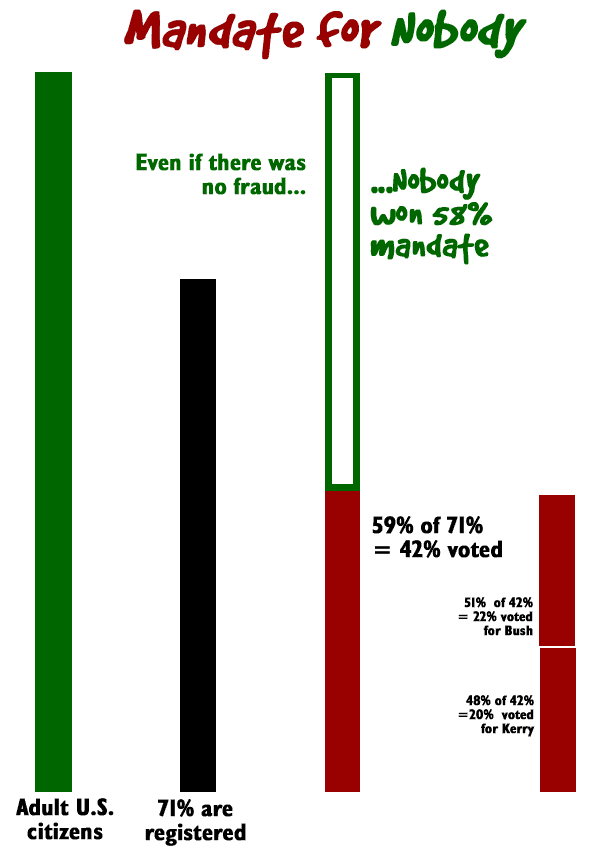
See source:
http://www.fairvote.org/turnout/
http://www.fairvote.org/turnout/
For more information:
http://www.sunmt.org/intro.html
Add Your Comments
Comments
(Hide Comments)
Unfortunately, "nobody" is not a "somebody".
Imagine for a moment, that these 58% had voted, had voted for 58 candidates each with 1% support. Would this have changed the results of the election one iota? No. And those 58 cnadidates could be spread over the entire possible political spectrum from left libertatians to monorchists or out and out fascists. In other words, you have no reason to believe that these "none of THESE votes" (as opposed to votes for "nobody") represented significant support FOR some particualr alternatives.
That's the whole theory behind "first past the post" elections (plurality to win). An assumption that it is NORMAL: that besides significant factions in favor of a couple candidates there are large numbers of alternative choices none with more than a smidgen of support -- lots of small factions as unable to agree among themselves as to what they want as they are to agree with any of the major factions. The idea is that in order to govern, whoever wins MUST be able to demonstrate a faction united behind that program.
Get it? All you know is that 58% didn't prefer A to win (say A had the largest faction). But suppose the faction behind B (the runner up) rose up to oppose A over some part of the A program? What you have no right to say is that in THIS conflcit how many of the 58% would support that issue and how many oppose.
Imagine for a moment, that these 58% had voted, had voted for 58 candidates each with 1% support. Would this have changed the results of the election one iota? No. And those 58 cnadidates could be spread over the entire possible political spectrum from left libertatians to monorchists or out and out fascists. In other words, you have no reason to believe that these "none of THESE votes" (as opposed to votes for "nobody") represented significant support FOR some particualr alternatives.
That's the whole theory behind "first past the post" elections (plurality to win). An assumption that it is NORMAL: that besides significant factions in favor of a couple candidates there are large numbers of alternative choices none with more than a smidgen of support -- lots of small factions as unable to agree among themselves as to what they want as they are to agree with any of the major factions. The idea is that in order to govern, whoever wins MUST be able to demonstrate a faction united behind that program.
Get it? All you know is that 58% didn't prefer A to win (say A had the largest faction). But suppose the faction behind B (the runner up) rose up to oppose A over some part of the A program? What you have no right to say is that in THIS conflcit how many of the 58% would support that issue and how many oppose.
Wow, this is kinda twisted thinking on several fronts.
First off, what's with the accusatory, macho language? Even if I did "get it" and felt that I had "no right," the way you phrased things would put me off.
Also, if I recall, the spread of non-voters tend to be democrats who are working class and more fed up than apathetic.
Lastly, the underlying assumption in your response seems to be "this is the way the system is, deal with it" combined with "if the two biggest bullies didn't duke it out, that would be anarchy!" Well...let's just say better minds than mine can fight over that one. Heh.
First off, what's with the accusatory, macho language? Even if I did "get it" and felt that I had "no right," the way you phrased things would put me off.
Also, if I recall, the spread of non-voters tend to be democrats who are working class and more fed up than apathetic.
Lastly, the underlying assumption in your response seems to be "this is the way the system is, deal with it" combined with "if the two biggest bullies didn't duke it out, that would be anarchy!" Well...let's just say better minds than mine can fight over that one. Heh.
Not at all!
I am saying that the massive numbers of disaffected mean nothing until quantities of them have been organized FOR some alternative. The existing system can afford to ignore them as long as they represent totally divided disaffected.
Trust me on this -- if even 10-20% of those disaffected could, be organized behind an alternative program that would force the "bullies" (as you put it) to either rearrange the coaliton whihc their faction represent or risk being replaced. If you study the history of the changing coalitions which make up the major power factions you will see that the real reason "third parties don't win" is that as soon as they reach ~10% the big boys DO choose to "readjust" to the new reality that these disaffected cannot be ignored << so one or the other ot the "bullies" allows the interests of these ORGANIZED disaffected to join the gang -- or possibly both do >>
I am saying that the massive numbers of disaffected mean nothing until quantities of them have been organized FOR some alternative. The existing system can afford to ignore them as long as they represent totally divided disaffected.
Trust me on this -- if even 10-20% of those disaffected could, be organized behind an alternative program that would force the "bullies" (as you put it) to either rearrange the coaliton whihc their faction represent or risk being replaced. If you study the history of the changing coalitions which make up the major power factions you will see that the real reason "third parties don't win" is that as soon as they reach ~10% the big boys DO choose to "readjust" to the new reality that these disaffected cannot be ignored << so one or the other ot the "bullies" allows the interests of these ORGANIZED disaffected to join the gang -- or possibly both do >>
Mike's objections are just so much static.
The system's legitimacy rests on the appearance of popular participation that elections bestow upon it.
It's stating the obvious to say that disaffection alone isn't sufficient. But pointing out the high degrees of it invariably triggers an avalanche of criticism from people who have some psuedo-wisdom to impart about the hidden wonders of america's shit-democracy.
The system's legitimacy rests on the appearance of popular participation that elections bestow upon it.
It's stating the obvious to say that disaffection alone isn't sufficient. But pointing out the high degrees of it invariably triggers an avalanche of criticism from people who have some psuedo-wisdom to impart about the hidden wonders of america's shit-democracy.
COLUMBUS, Ohio - The Ohio Supreme Court's chief justice on Thursday threw out a challenge to the state's presidential election results. The 40 voters who brought the case will likely be able to refile the challenge.
Chief Justice Thomas Moyer ruled that the request improperly challenged two separate election results. Ohio law only allows one race to be challenged in a single complaint, he said.
The challenge was backed by the Rev. Jesse Jackson and Cliff Arnebeck, a Columbus attorney for the Massachusetts-based Alliance for Democracy, who accused Bush's campaign of "high-tech vote stealing."
Claiming fraud, the voters cited reports of voting-machine errors, double-counting of ballots and a shortage of voting machines in predominantly minority precincts as reasons to throw out the results.
Ohio and its 20 electoral votes determined the outcome of the election, tipping the race to President Bush. The state declared Bush the winner by 119,000 votes, but counties are in the middle of a recount — requested by two minor party candidates and supported by John Kerry's campaign.
The complaint questioned how the actual results could show Bush winning when exit-poll interview findings on election night indicated that Kerry would win 52 percent of Ohio's presidential vote.
Without listing specific evidence, the complaint alleges that 130,656 votes for Kerry and John Edwards in 36 counties were somehow switched to count for the Bush-Cheney ticket.
The allegations are based on an analysis comparing the presidential race to Moyer's Supreme Court race against a Cleveland municipal judge.
But nothing in state law or any previous court decision allows challenges to be combined, Moyer said.
"Were this court to sanction consolidation here it would establish a precedent whereby twenty-five voters could challenge, in a single case, the election results of every statewide race and issue on the ballot in any given election," Moyer wrote.
Messages seeking comment on the court decision were left for Jackson and Arnebeck.
Chief Justice Thomas Moyer ruled that the request improperly challenged two separate election results. Ohio law only allows one race to be challenged in a single complaint, he said.
The challenge was backed by the Rev. Jesse Jackson and Cliff Arnebeck, a Columbus attorney for the Massachusetts-based Alliance for Democracy, who accused Bush's campaign of "high-tech vote stealing."
Claiming fraud, the voters cited reports of voting-machine errors, double-counting of ballots and a shortage of voting machines in predominantly minority precincts as reasons to throw out the results.
Ohio and its 20 electoral votes determined the outcome of the election, tipping the race to President Bush. The state declared Bush the winner by 119,000 votes, but counties are in the middle of a recount — requested by two minor party candidates and supported by John Kerry's campaign.
The complaint questioned how the actual results could show Bush winning when exit-poll interview findings on election night indicated that Kerry would win 52 percent of Ohio's presidential vote.
Without listing specific evidence, the complaint alleges that 130,656 votes for Kerry and John Edwards in 36 counties were somehow switched to count for the Bush-Cheney ticket.
The allegations are based on an analysis comparing the presidential race to Moyer's Supreme Court race against a Cleveland municipal judge.
But nothing in state law or any previous court decision allows challenges to be combined, Moyer said.
"Were this court to sanction consolidation here it would establish a precedent whereby twenty-five voters could challenge, in a single case, the election results of every statewide race and issue on the ballot in any given election," Moyer wrote.
Messages seeking comment on the court decision were left for Jackson and Arnebeck.
We are 100% volunteer and depend on your participation to sustain our efforts!
Donate

$125.00 donated
in the past month
Get Involved
If you'd like to help with maintaining or developing the website, contact us.
Publish
Publish your stories and upcoming events on Indybay.
Topics
More
Search Indybay's Archives
Advanced Search
►
▼
IMC Network