







 Publish to Newswire
 Add an Event
From the Open-Publishing Calendar
From the Open-Publishing Newswire
Indybay Feature
US strikes raze Falluja hospital
A hospital has been razed to the ground in one of the heaviest US air raids in the Iraqi city of Falluja.
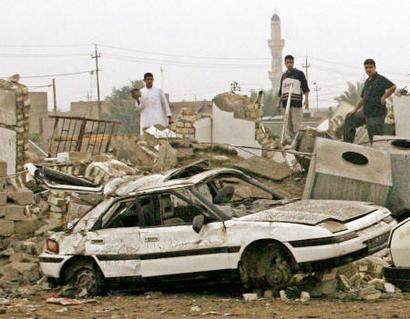
Iraqi civilians stand over the rubble of the Saudi funded emergency hospital in Falluja, Hai Nazal, after it was destroyed during an overnight U.S. air raid conducted over the western city, November 6, 2004
http://news.yahoo.com/news?tmpl=story2&u=/041106/ids_photos_india_wl/ra2464525635.jpg&e=2&ncid=708
---
Witnesses said only the facade remained of the small Nazzal Emergency Hospital in the centre of the city. There are no reports on casualties.
A nearby medical supplies storeroom and dozens of houses were damaged as US forces continued preparing the ground for an expected major assault.
UN chief Kofi Annan has warned against an attack on the restive Sunni city.
It is the third time since the end of the US-led war that US and Iraqi forces have tried to gain control of Falluja.
They say militants loyal to top al-Qaeda suspect Abu Musab al-Zarqawi are hiding there.
Zarqawi's supporters have been behind some of the worst attacks on coalition and Iraqi forces as well as dozens of kidnappings. Some of the hostages - foreigners and Iraqis - have been beheaded.
'Ruined'
US troops using 155mm howitzers pounded a number of pre-planned targets in Falluja on Saturday.
Along with air strikes - one of the heaviest in recent days - this is all part of what appears to be a steadily increasing pressure on the insurgents, says the BBC's Paul Wood, who is with US marines outside Falluja.
Overnight, a column of armoured vehicles and humvee jeeps carried out attacks in the outskirts of Falluja designed to draw out the rebels and provide fresh targets for the air power and artillery.
These are the kind of preliminary operations which would be carried out before a full-scale assault on Falluja, our correspondent says.
The air strikes reduced the Nazzal hospital, run by a Saudi Arabian Islamic charity, to rubble.
Hospital officials quoted by Reuters news agency say all the contents were ruined.
Read More
http://news.bbc.co.uk/2/hi/middle_east/3988433.stm
http://news.yahoo.com/news?tmpl=story2&u=/041106/ids_photos_india_wl/ra2464525635.jpg&e=2&ncid=708

---
Witnesses said only the facade remained of the small Nazzal Emergency Hospital in the centre of the city. There are no reports on casualties.
A nearby medical supplies storeroom and dozens of houses were damaged as US forces continued preparing the ground for an expected major assault.
UN chief Kofi Annan has warned against an attack on the restive Sunni city.
It is the third time since the end of the US-led war that US and Iraqi forces have tried to gain control of Falluja.
They say militants loyal to top al-Qaeda suspect Abu Musab al-Zarqawi are hiding there.
Zarqawi's supporters have been behind some of the worst attacks on coalition and Iraqi forces as well as dozens of kidnappings. Some of the hostages - foreigners and Iraqis - have been beheaded.
'Ruined'
US troops using 155mm howitzers pounded a number of pre-planned targets in Falluja on Saturday.
Along with air strikes - one of the heaviest in recent days - this is all part of what appears to be a steadily increasing pressure on the insurgents, says the BBC's Paul Wood, who is with US marines outside Falluja.
Overnight, a column of armoured vehicles and humvee jeeps carried out attacks in the outskirts of Falluja designed to draw out the rebels and provide fresh targets for the air power and artillery.
These are the kind of preliminary operations which would be carried out before a full-scale assault on Falluja, our correspondent says.
The air strikes reduced the Nazzal hospital, run by a Saudi Arabian Islamic charity, to rubble.
Hospital officials quoted by Reuters news agency say all the contents were ruined.
Read More
http://news.bbc.co.uk/2/hi/middle_east/3988433.stm
Add Your Comments
Comments
(Hide Comments)
FALLUJA, Iraq (Reuters) - The fiercest U.S. air and artillery bombardment of Falluja in months destroyed a hospital, a medical warehouse and dozens of homes overnight, residents said on Saturday.
Witnesses said U.S. air strikes and shelling lit up the night sky and shook the east and north of the rebel-held city.
A small hospital funded by a Saudi Arabian Islamic charity in the central Nazzal district was reduced to rubble. Only its facade, with a sign reading Nazzal Emergency Hospital, remained intact. Reuters pictures showed blue surgical cloths and empty medicine boxes amid earth and brick ruins.
A nearby compound used by the main Falluja Hospital to store medical supplies was also destroyed, witnesses said.
Hospital officials confirmed all its contents were ruined.
More than half of the city's 300,000 people are believed to have fled already. After Friday night's barrage, many of those who had stayed packed their cars with clothes and furniture and streamed out of the Sunni Muslim city's only remaining exit to the northwest.
All other roads have been sealed by U.S. forces poised for an offensive on Falluja and Ramadi, another Sunni city further west, to flush out Islamic militants and Saddam Hussein loyalists they say are entrenched there.
The U.S. military said an air strike after midnight smashed three "barricaded fighting positions" after a series of raids the previous day hit anti-aircraft weapons and an arms cache.
FLEEING FALLUJA
"I left the city two days ago, but my heart is still in Falluja," said Abu Mohammed, who had taken his family to stay with relatives just one km (a half mile) away.
"We are living in terror. How do they think people feel when the bombing starts every time we sit down for Iftar? Do they expect us to say 'welcome'?"
U.S. forces have bombarded Falluja almost daily since the mid-October start of the Muslim fasting month of Ramadan, when the faithful break the daily dawn-to-dusk fast with Iftar.
Iraq's interim government warns time is running out for locals to hand over foreign fighters led by al Qaeda ally Abu Musab al-Zarqawi and allow Iraqi forces and U.S. troops in.
Civilians said on Friday they had found leaflets from U.S. forces warning them to leave the city, 50 km (32 miles) west of Baghdad. Most women and children had long since gone.
Locals said U.S. forces had urged them through loudspeakers to leave for their own safety. A U.S. military spokesman denied this, saying the announcements told residents, among other things, to stay off the streets between 6 p.m. and 6 a.m.
The overnight bombardment was so intense that ambulances were unable to venture out, said Ahmad Khalil, a doctor at Falluja Hospital. Teams of volunteers had begun searching the rubble for dead and wounded.
Hospital officials said two corpses were brought in on Saturday. Seven people, among them women and children, also arrived with serious wounds.
http://wireservice.wired.com/wired/story.asp?section=Breaking&storyId=946359&tw=wn_wire_story
Witnesses said U.S. air strikes and shelling lit up the night sky and shook the east and north of the rebel-held city.
A small hospital funded by a Saudi Arabian Islamic charity in the central Nazzal district was reduced to rubble. Only its facade, with a sign reading Nazzal Emergency Hospital, remained intact. Reuters pictures showed blue surgical cloths and empty medicine boxes amid earth and brick ruins.
A nearby compound used by the main Falluja Hospital to store medical supplies was also destroyed, witnesses said.
Hospital officials confirmed all its contents were ruined.
More than half of the city's 300,000 people are believed to have fled already. After Friday night's barrage, many of those who had stayed packed their cars with clothes and furniture and streamed out of the Sunni Muslim city's only remaining exit to the northwest.
All other roads have been sealed by U.S. forces poised for an offensive on Falluja and Ramadi, another Sunni city further west, to flush out Islamic militants and Saddam Hussein loyalists they say are entrenched there.
The U.S. military said an air strike after midnight smashed three "barricaded fighting positions" after a series of raids the previous day hit anti-aircraft weapons and an arms cache.
FLEEING FALLUJA
"I left the city two days ago, but my heart is still in Falluja," said Abu Mohammed, who had taken his family to stay with relatives just one km (a half mile) away.
"We are living in terror. How do they think people feel when the bombing starts every time we sit down for Iftar? Do they expect us to say 'welcome'?"
U.S. forces have bombarded Falluja almost daily since the mid-October start of the Muslim fasting month of Ramadan, when the faithful break the daily dawn-to-dusk fast with Iftar.
Iraq's interim government warns time is running out for locals to hand over foreign fighters led by al Qaeda ally Abu Musab al-Zarqawi and allow Iraqi forces and U.S. troops in.
Civilians said on Friday they had found leaflets from U.S. forces warning them to leave the city, 50 km (32 miles) west of Baghdad. Most women and children had long since gone.
Locals said U.S. forces had urged them through loudspeakers to leave for their own safety. A U.S. military spokesman denied this, saying the announcements told residents, among other things, to stay off the streets between 6 p.m. and 6 a.m.
The overnight bombardment was so intense that ambulances were unable to venture out, said Ahmad Khalil, a doctor at Falluja Hospital. Teams of volunteers had begun searching the rubble for dead and wounded.
Hospital officials said two corpses were brought in on Saturday. Seven people, among them women and children, also arrived with serious wounds.
http://wireservice.wired.com/wired/story.asp?section=Breaking&storyId=946359&tw=wn_wire_story
We are 100% volunteer and depend on your participation to sustain our efforts!
Donate

$90.00 donated
in the past month
Get Involved
If you'd like to help with maintaining or developing the website, contact us.
Publish
Publish your stories and upcoming events on Indybay.
Topics
More
Search Indybay's Archives
Advanced Search
►
▼
IMC Network