







 Publish to Newswire
 Add an Event
From the Open-Publishing Calendar
From the Open-Publishing Newswire
Indybay Feature
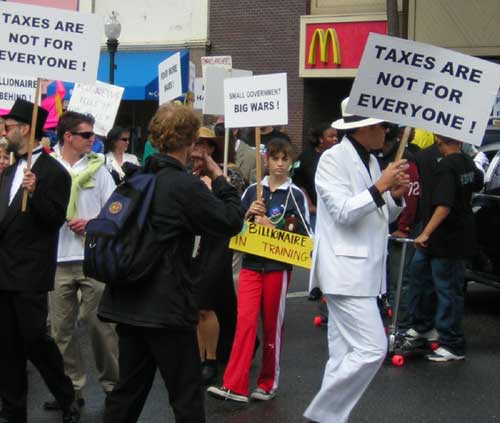
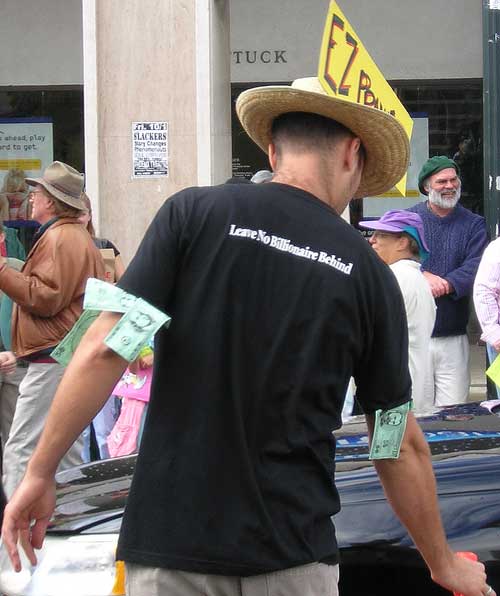
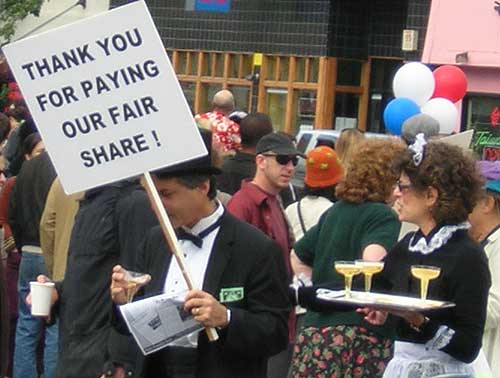
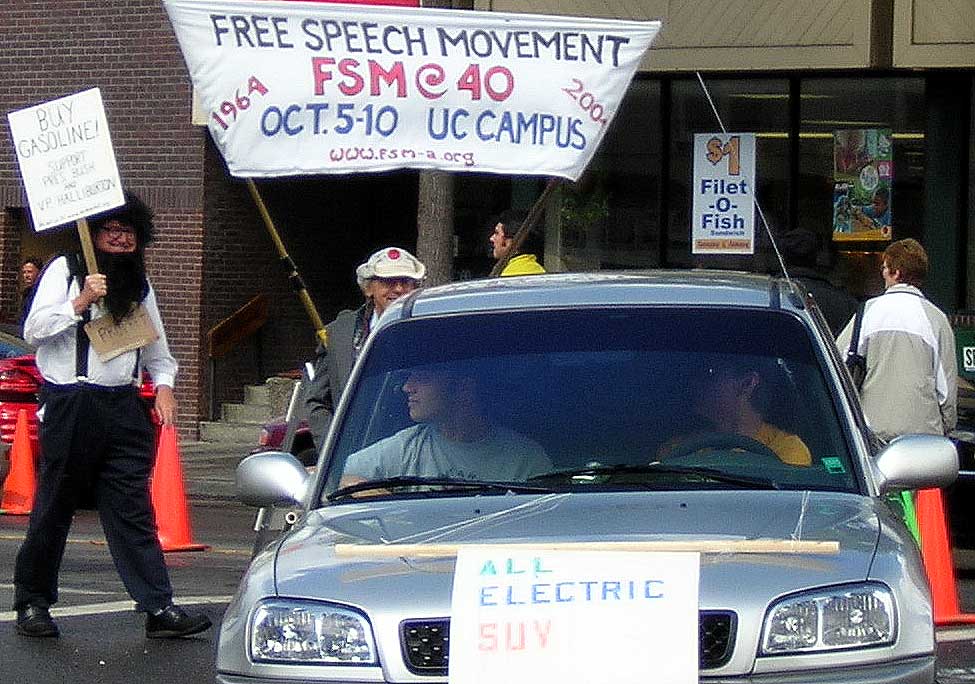
Billionaires for Bush Photos from How Berkeley Can You Be
Some photos of billionaires for Bush (http://billionairesforbush.com/index.php), also one sign about an upcoming event about the Free Speech Movement
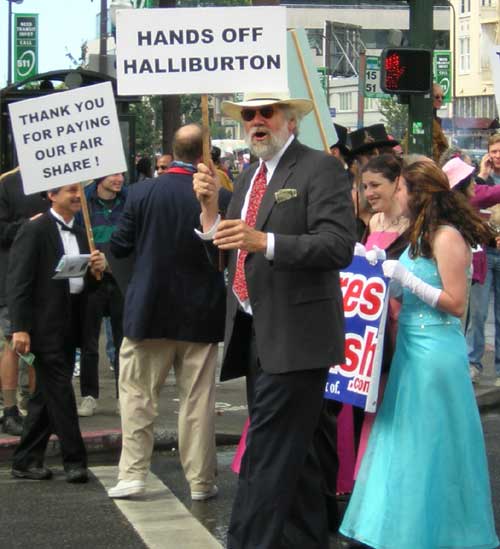
Some photos of billionaires for Bush (http://billionairesforbush.com/index.php), also one sign about an upcoming event about the Free Speech Movement
For more information:
http://www.indybay.org/arts
Add Your Comments
Comments
(Hide Comments)
=v= How sad that the venerable "How Berkeley Can You Be?" parade had to have a "how clueless can you be?" element. An "all-electric SUV" is no improvement on anything. There isn't enough electricity available to replace cars, nor can there be without resorting to many dirty sources, including fossil fuels.
Even modestly-sized EVs -- something I once had hope for and participated in -- aren't going to make enough of a difference, but all-electric SUVs are sheer idiocy!
Even modestly-sized EVs -- something I once had hope for and participated in -- aren't going to make enough of a difference, but all-electric SUVs are sheer idiocy!
For more information:
http://www.things.org/~jym/motion.html
I believe those particular SUVs had a sign explaining that the electricity was converted via solar panels from light energy.
I personally think wind energy is long overdue. There are lots of windy spots where it would be far more efficient than other types of power plants. Now someone has to design an invention to keep them from dooring cyclists and double parking.
I personally think wind energy is long overdue. There are lots of windy spots where it would be far more efficient than other types of power plants. Now someone has to design an invention to keep them from dooring cyclists and double parking.
I like this. In Kentucky here, they are so unhappy with the old disabled coal miners being able to leave their houses on these scooters because they get in the way of traffic. Kentucky town is overrun with gray-haired people in scooters
ROGER ALFORD, Associated Press Writer
Monday, September 20, 2004
(09-20) 11:26 PDT PAINTSVILLE, Ky. (AP) --
Stricken with arthritis, Connie Haller gave up strolling the streets of this mountain town. But when the 78-year-old woman learned that the government would buy her a motorized scooter, she gladly accepted. And so did her elderly friends. And their friends. And their friends.
Now, this town of 4,000 in Kentucky's coalfields is seemingly overrun with scooter riders.
Scores of scooters and motorized wheelchairs plod along busy streets to the Wal-Mart, restaurants and beauty salons. Motorists complain that they snarl traffic, and the gray-haired riders fret about the dangers of sharing the asphalt with cars and trucks.
Mayor Doug Pugh believes the government helped create the problem and should help pay for the sidewalks that would solve it.
"It would be a lot safer," Pugh said. "These aren't like little motorcycles -- they shouldn't have to be on the roads."
Paintsville officials are not sure exactly how many people in town have scooters. But Haller said she knows of at least 50 in her apartment building alone.
"It's been a lifesaver for me, and for many others," she said. "We ride our buggies everywhere."
This Appalachian region some 60 miles south of Huntington, W.Va., has long had high numbers of disabled residents, many of whom worked in the mining and logging industries.
Paintsville's plight also reflects a government-subsidized explosion in the use of scooters, which cost $5,000 or more, depending on accessories. Medicare, the federal health care program for 40 million older and disabled people, said claims for scooters and power wheelchairs have increased from 62,000 in 1999 to 168,000 in 2003. Medicare payments for the devices rose from $22.3 million in 1995 to $666.5 million in 2003.
"We get letters all the time from people who tell us that they've been to the mailbox for the first time in years, that they're able to go back to church," said Dan Gibbens, spokesman for the Texas-based Scooter Store, a major supplier of power scooters and wheelchairs. "They're able to turn the clock back several years."
Gibbens said the devices typically move at the same speed the average person walks, or 3 to 4 mph. He said that makes them appropriate for calm residential streets, but not for busy roads and highways.
In Paintsville, the problem is that the town's sidewalks were not built with motorized scooters in mind, and some of the roads most heavily traveled by scooters do not have sidewalks. That means the elderly and disabled have to ride either on the pavement or along the gravel shoulders.
"You look up and see big trucks passing," Haller said. "I feel like they get pretty close to us. You've got to keep your eyes on the road and on the people, especially at intersections. If they don't offer to wave you across, you'd better sit still and wait your turn."
So far, 47-year-old Vickie Whittaker has been the only scooter rider hurt in traffic. Already disabled by degenerative discs in her spine, Whittaker suffered minor injuries after being bumped by a car earlier this summer.
Elderly and disabled residents have been circulating a petition to get a quarter-mile walkway built from the town's residential area to the shopping district so that they do not have to ride on the shoulder of Kentucky Route 321, a busy road lined with stores and restaurants.
The mayor has promised to do his best to get the walkway built and said he believes it could be done for $250,000, perhaps with the use of an existing federal grant.
Whittaker said if elected officials do not move quickly to build the walkway, they could find themselves opposed by a dedicated bloc of voters who will gladly ride their scooters to the polls.
"Obviously, they don't care if we get where we're going or if we get killed going there," she said.
ROGER ALFORD, Associated Press Writer
Monday, September 20, 2004
(09-20) 11:26 PDT PAINTSVILLE, Ky. (AP) --
Stricken with arthritis, Connie Haller gave up strolling the streets of this mountain town. But when the 78-year-old woman learned that the government would buy her a motorized scooter, she gladly accepted. And so did her elderly friends. And their friends. And their friends.
Now, this town of 4,000 in Kentucky's coalfields is seemingly overrun with scooter riders.
Scores of scooters and motorized wheelchairs plod along busy streets to the Wal-Mart, restaurants and beauty salons. Motorists complain that they snarl traffic, and the gray-haired riders fret about the dangers of sharing the asphalt with cars and trucks.
Mayor Doug Pugh believes the government helped create the problem and should help pay for the sidewalks that would solve it.
"It would be a lot safer," Pugh said. "These aren't like little motorcycles -- they shouldn't have to be on the roads."
Paintsville officials are not sure exactly how many people in town have scooters. But Haller said she knows of at least 50 in her apartment building alone.
"It's been a lifesaver for me, and for many others," she said. "We ride our buggies everywhere."
This Appalachian region some 60 miles south of Huntington, W.Va., has long had high numbers of disabled residents, many of whom worked in the mining and logging industries.
Paintsville's plight also reflects a government-subsidized explosion in the use of scooters, which cost $5,000 or more, depending on accessories. Medicare, the federal health care program for 40 million older and disabled people, said claims for scooters and power wheelchairs have increased from 62,000 in 1999 to 168,000 in 2003. Medicare payments for the devices rose from $22.3 million in 1995 to $666.5 million in 2003.
"We get letters all the time from people who tell us that they've been to the mailbox for the first time in years, that they're able to go back to church," said Dan Gibbens, spokesman for the Texas-based Scooter Store, a major supplier of power scooters and wheelchairs. "They're able to turn the clock back several years."
Gibbens said the devices typically move at the same speed the average person walks, or 3 to 4 mph. He said that makes them appropriate for calm residential streets, but not for busy roads and highways.
In Paintsville, the problem is that the town's sidewalks were not built with motorized scooters in mind, and some of the roads most heavily traveled by scooters do not have sidewalks. That means the elderly and disabled have to ride either on the pavement or along the gravel shoulders.
"You look up and see big trucks passing," Haller said. "I feel like they get pretty close to us. You've got to keep your eyes on the road and on the people, especially at intersections. If they don't offer to wave you across, you'd better sit still and wait your turn."
So far, 47-year-old Vickie Whittaker has been the only scooter rider hurt in traffic. Already disabled by degenerative discs in her spine, Whittaker suffered minor injuries after being bumped by a car earlier this summer.
Elderly and disabled residents have been circulating a petition to get a quarter-mile walkway built from the town's residential area to the shopping district so that they do not have to ride on the shoulder of Kentucky Route 321, a busy road lined with stores and restaurants.
The mayor has promised to do his best to get the walkway built and said he believes it could be done for $250,000, perhaps with the use of an existing federal grant.
Whittaker said if elected officials do not move quickly to build the walkway, they could find themselves opposed by a dedicated bloc of voters who will gladly ride their scooters to the polls.
"Obviously, they don't care if we get where we're going or if we get killed going there," she said.
We are 100% volunteer and depend on your participation to sustain our efforts!
Donate

$110.00 donated
in the past month
Get Involved
If you'd like to help with maintaining or developing the website, contact us.
Publish
Publish your stories and upcoming events on Indybay.
Topics
More
Search Indybay's Archives
Advanced Search
►
▼
IMC Network