







 Publish to Newswire
 Add an Event
From the Open-Publishing Calendar
From the Open-Publishing Newswire
Indybay Feature
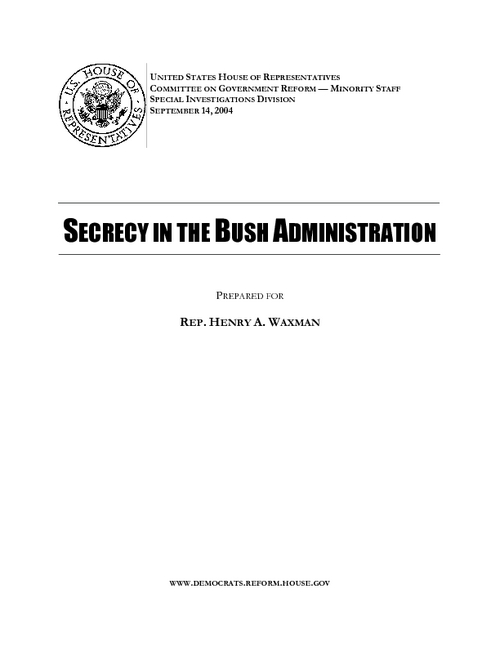
Report on Secrecy in the Bush Administration
Open and accountable government is one of the bedrock principles of our
democracy. Yet virtually since inauguration day, questions have been raised about
the Bush Administration’s commitment to this principle.
democracy. Yet virtually since inauguration day, questions have been raised about
the Bush Administration’s commitment to this principle.
Open and accountable government is one of the bedrock principles of our
democracy. Yet virtually since inauguration day, questions have been raised about
the Bush Administration’s commitment to this principle. News articles and reports
by independent groups over the last four years have identified a growing series of
instances where the Administration has sought to operate without public or
congressional scrutiny.
At the request of Rep. Henry A. Waxman, this report is a comprehensive
examination of secrecy in the Bush Administration. It analyzes how the
Administration has implemented each of our nation’s major open government laws.
The report finds that there has been a consistent pattern in the Administration’s
actions: laws that are designed to promote public access to information have been
undermined, while laws that authorize the government to withhold information or to
operate in secret have repeatedly been expanded. The cumulative result is an
unprecedented assault on the principle of open government.
The Administration has supported amendments to open government laws to create
new categories of protected information that can be withheld from the public.
President Bush has issued an executive order sharply restricting the public release of
the papers of past presidents. The Administration has expanded the authority to
classify documents and dramatically increased the number of documents classified. It
has used the USA Patriot Act and novel legal theories to justify secret investigations,
detentions, and trials. And the Administration has engaged in litigation to contest
Congress’ right to information.
The records at issue have covered a vast array of topics, ranging from simple census
data and routine agency correspondence to presidential and vice presidential records.
Among the documents that the Administration has refused to release to the public
and members of Congress are (1) the contacts between energy companies and the
Vice President’s energy task force, (2) the communications between the Defense
Department and the Vice President’s office regarding contracts awarded to
Halliburton, (3) documents describing the prison abuses at Abu Ghraib, (4)
memoranda revealing what the White House knew about Iraq’s weapons of mass
destruction, and (5) the cost estimates of the Medicare prescription drug legislation
withheld from Congress.
There are three main categories of federal open government laws: (1) laws that
provide public access to federal records; (2) laws that allow the government to
restrict public access to federal information; and (3) laws that provide for
congressional access to federal records. In each area, the Bush Administration has
acted to restrict the amount of government information that is available.
democracy. Yet virtually since inauguration day, questions have been raised about
the Bush Administration’s commitment to this principle. News articles and reports
by independent groups over the last four years have identified a growing series of
instances where the Administration has sought to operate without public or
congressional scrutiny.
At the request of Rep. Henry A. Waxman, this report is a comprehensive
examination of secrecy in the Bush Administration. It analyzes how the
Administration has implemented each of our nation’s major open government laws.
The report finds that there has been a consistent pattern in the Administration’s
actions: laws that are designed to promote public access to information have been
undermined, while laws that authorize the government to withhold information or to
operate in secret have repeatedly been expanded. The cumulative result is an
unprecedented assault on the principle of open government.
The Administration has supported amendments to open government laws to create
new categories of protected information that can be withheld from the public.
President Bush has issued an executive order sharply restricting the public release of
the papers of past presidents. The Administration has expanded the authority to
classify documents and dramatically increased the number of documents classified. It
has used the USA Patriot Act and novel legal theories to justify secret investigations,
detentions, and trials. And the Administration has engaged in litigation to contest
Congress’ right to information.
The records at issue have covered a vast array of topics, ranging from simple census
data and routine agency correspondence to presidential and vice presidential records.
Among the documents that the Administration has refused to release to the public
and members of Congress are (1) the contacts between energy companies and the
Vice President’s energy task force, (2) the communications between the Defense
Department and the Vice President’s office regarding contracts awarded to
Halliburton, (3) documents describing the prison abuses at Abu Ghraib, (4)
memoranda revealing what the White House knew about Iraq’s weapons of mass
destruction, and (5) the cost estimates of the Medicare prescription drug legislation
withheld from Congress.
There are three main categories of federal open government laws: (1) laws that
provide public access to federal records; (2) laws that allow the government to
restrict public access to federal information; and (3) laws that provide for
congressional access to federal records. In each area, the Bush Administration has
acted to restrict the amount of government information that is available.
Add Your Comments
We are 100% volunteer and depend on your participation to sustain our efforts!
Donate

$110.00 donated
in the past month
Get Involved
If you'd like to help with maintaining or developing the website, contact us.
Publish
Publish your stories and upcoming events on Indybay.
Topics
More
Search Indybay's Archives
Advanced Search
►
▼
IMC Network