







 Publish to Newswire
 Add an Event
"Gitmo on the Hudson" RNC NYC - A Indybay Reporter's Account
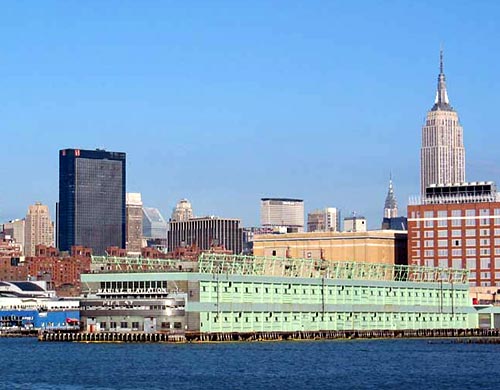
“Guantanamo on the Hudson”
Over 1,800 suspected protesters were swept from NYC streets during the Republican National Convention. Many were “disappeared” for up to 24 hours at Pier 57, a bus maintenance facility converted into an urban detention camp.
Ambushed by NYPD pre-crime enforcement. Part II - A first hand account.
Jeff Paterson
Independent Media Center
September 13, 2004
On Tuesday, August 31, two days
after the massive march of more than a half million people against the Bush
Agenda, I was one of the 1,800 swept off the
streets of New York City and held at Pier 57. It would come to be known as “Guantanamo
on the Hudson” by many. For the details of my illegal arrest, including
photos of the event itself, see “Ambushed
by NYPD pre-crime enforcement. Part 1”
http://www.indybay.org/news/2004/09/1694424.php
Day 1 – Pier 57 Welcome
After my illegal arrest for “blocking the sidewalk” in a “disorderly” fashion an hour and half earlier, the police bus rolled into the newly minted Pier 57 temporary detention processing facility with plastic flex cuffs biting into my wrists at 6 pm.
Hundreds of other suspected protesters (interchangeably referred to as “perps” or “bodies” by our jailers) were already lining the facility’s walls awaiting personal property inventory collection. Posted “RNC Intake” instruction signs guided police in our processing. Another sign warned police not to write their arrest reports without first consulting with their supervisor.
Every five “perps” had our own arresting officer. Officer Western (badge 083) was mine. Since he arrested me while I was displaying my “Independent Media Center Working Press” badge, he wanted to know if I was going to write about this. Unlike many of the more than 100 cops working the Pier 57 beat that night, Officer Western was a bit bemused and slightly perplexed about what this was all for. He was just doing his job, and I was just doing mine, so “no hard feelings” was his attitude. Of course he had actually stopped me from doing my job by arbitrarily suspending my civil rights and liberty without cause. But what the hell, no hard feelings.
The same could not be said for cop who searched me prior to my official admittance to the pier. This guy was a cross between an airline security screener from hell and my Marine Corps boot camp drill sergeant. “Look straight ahead! No, the other straight! Hands behind you back, to your side, to your back! Spread your legs!” Without a lawyer present, I was grilled repeatedly, “Are those your underwear, or are you wearing an extra pair of shorts.” Apparently, “extra” clothing was not authorized. He also seemed to squeeze my testicles harder than what was required. However, he did cut off my cuffs, and for that I gave thanks.
Despite my assurances that I was not carrying contraband, Office Unfriendly caught me red handed. With a quick and forceful rip, he literally tore the cargo pocket off of my shorts. A forgotten pack of M&Ms candy was confiscated as it flopped to the ground.
Each of the ten smaller cages measured approx 30 feet by 20 feet, and each cage was divided in half for additional “body” management. When half of each caged reached its physical capacity of about 50, the second half would be opened and another 40 would be jammed in. Each cage initially had a pair of fresh portable toilets, and three benches to seat five people each.
Throughout the night the buses kept coming. Each new wave of arriving suspected protesters was cheered.
Pier 57 – Environmental danger?
For the previous three decades Pier
57 had served as a municipal bus maintenance facility. The floor was caked
in layers of thick black oily grime, presumably
motor oil and transmission fluid. Signs still hung from the walls above us. “Raw
Chemical Storage Area”, “Antifreeze”, and other areas had
been designated for the storage and use of exotic sounding chemicals: "ZEP
Drying Agent", "Transynd", “XHP 222 Special” and
others.
It was apparent that some time ago the sides of the facility were sandbagged
to protect the Hudson River from the runoff of this facility. This meant
that this buildup of pollution would serve as bedding for 1,800 people. Later
I would witness fellow prisoners develop chemical burns and white pussy infections
that I could only attribute to these conditions.
Meals consisted of sandwiches of stale white bread with either: two slices of orange cheese, a dab of a jelly/peanut butter mixture, or a slice of “mystery” baloney. The guards joked that these were vegetarian, vegan, and kosher.
Without a trash container of any kind, some folks discarded much of their first meal onto the ground. The blotchy pink and brown baloney slices instantly camouflaged black as it hit the ground. Before anyone ever imagined actually sleeping, people spat on the floor.
As the night dragged on, our cage slowly filled to capacity. Every fifteen minutes or so, a name would be called out, and some lucky person would leave us and move further on into the system. There was no apparent order to who was called out of the cage when, and for every one to leave us behind, three more would join our growing community.
Without anyone saying anything, the fifteen coveted bench spots were reserved for the older people—including a minister, a School of the Americans Watch veteran, and a older black man who said that this reminded him of being imprisoned in the South during the Civil Rights Movement.
Not yet old enough to get a bench spot myself, and having held out to long from lying on the ground—which was now completely spoken for—I found my own sanctuary. It was a beautiful nook between the cyclone fence and the side of the portable toilet. The cool, smooth, clean plastic of the toilet exterior was a welcome refuge from the harsh surroundings.
Later I would read that Police Commissioner Raymond W. Kelly referred to claims of unhealthy conditions at the Pier 57 as "exaggerated" and "outright falsehoods." In a press release, he declared, "The longest anyone has been detained [at Pier 57] waiting further processing is eight hours." I had now been held there for eight hours. It would be another fourteen hours before I would be moved downtown.
Day 2 – Morning and waiting
In the morning, all of the approximately 800 men were transferred to the Pier’s single large cage that measured approximately 100 feet by 70 feet. The women had been shuffled and divided up into the smaller cages.
With trash pilling up in the middle of this huge cage, and folks waking from an evening of catnaps among industrial pollution, the chant “Attica, Attica, Attica” rang through the pier as we stood up and wandered about—refusing to remain silently seated in neat lines on the ground as “The Chief” demanded.
As the day wore on, the now full portable toilets simmered in the afternoon heat. Our numbers on the pier were decreasing, so artists among us created an elaborate 30-foot wide peace symbol made of our trash. Others played pickup games of soccer and catch with discarded intertwined plastic cuffs.
By 4pm I was among the last group of twelve to leave our large cage. We joked that we were the real “dirty dozen” as we stood looking at each ours grimy darkened clothing and faces.
On the way out to the last waiting bus, we noticed workers actually mopping the floors and laying artificial grass rugs in the smaller cages. There must be a press tour and photo op coming in soon we said to each other.
Next thing we know, we are in a police squad car-escorted “corrections” bus careening through the city streets. “What the hell is the hurry?” we ask, as our faces bounce off the metal mesh of these tiny mobile cages. We figure that the cops are trying to show that they are doing “everything possible to expedite the process,” just in case anyone on the street is watching.
Maybe this new sense of urgency would mean that I could soon tell the judge how I was framed. We heard that under New York law, arrestees are to be brought before a judge within 24 hours. Maybe I’ll be able to sleep in a bed tonight I catch myself thinking. Yet it would be another 25 hours before I would see a courtroom.
Central Booking, 100 Center Street
About 15-minutes after leaving Pier 57, our bus lurches to a halt in the Central Booking enclosed receiving driveway at about 4:45 pm. As the garage doors close behind us, so does any effort to “expedite the process” on behalf of the cops.
Eventually we are taken off the bus and jammed into a holding cell. For an hour we remained cuffed for no real reason. Many people were having circulation problems, as their hands were turning visibly blue. After threats of having people committed to the psych ward for any “unexpected behavior,” the cuffs were eventually cut off.
At 6 pm we are granted our first access to a telephone, nearly 26 hours after being detained and arrested.
“Looks like we’re milking this well,” clusters of cops joke outside our cell. They seem to be referring to both the unofficial work slow down, and their own overtime pay. At every turn, a dozen cops would be sitting around reading the daily paper and talking on their personal cell-phones. “There is no hurry, not for them.” RNC-related police overtime pay alone cost $59 million according to NYC Police Commissioner Kelly.
Later in the evening we are shuffled down corridors, chained together in groups of six. Along the way all of our fingers are printed, and our mugs are thoroughly shot. Will NYPD, Homeland Security, and Total Information Awareness destroy this information if I am eventually cleared of my alleged “disorderly conduct”? Or could this data collection be just another state benefit of mass pre-crime roundups and detentions?
As yet another cell door slams shut behind us, we are told this is the “last stop” before seeing the judge. At 10 pm, a cop approaches the cell to perform a medical evaluation. Actually just a series of questions about our illegal drug use, alcohol abuse, and possible other illnesses. EMT’s are allowed to distribute a few ice packs for bruised wrists, and “baby wipes” are distributed to wipe some of the grime away.
At 11 pm, court workers have another questionnaire. Where do you work, for whom, and how much to you make? Despite their promises to the contrary, why do I get the feeling that the cops will end up with this information as well?
Another night under bright florescent lights passes. At least this night everyone has a bench to sit and sleep on, not to mention unlimited use of our very own a one-piece stainless steel toilet/sink. We are even served an apple with our cheese sandwiches. “The Chief” made sure that we knew that he was taking care of us.
Day Three
At what point does the state make the price for even lawful, “constitutionally protected” dissent to high for the average dissident?
These were the things on my mind as I drifted in and out of sleep at 4 am when a seemingly deranged cop began stomping down the cellblock hollering, “You know that you’re helping the terrorists! Because you wanted to get arrested, I have to be here and baby sit instead of protecting the convention.” The cellblock returned a mixture of “We didn’t chose to be arrested” and “shut up you freak.” Needing the last word, the cop replied, “I had to listen to your chanting and whining all day, now it’s your turn to listen to me!”
Another morning came and went. We heard that the New York State Court has issued an “appeal-proof” ruling that half of us need to be released by 3 pm, and the rest by 5 pm. But by 4:30 pm, our numbers seem to have remained steady. Friends continue to move on into the system, but others join our cell to keep it at capacity.
A National Lawyers Guild attorney is allowed to walk down the cellblock and very briefly respond to questions about court dates, desk appearance tickets, and deferments. We can no longer claim to have not “seen” a lawyer I think to myself.
Finally, somewhat anti-climactically, my name is called. A short chain-gang shuffle down a hallway and into a courtroom with a dozen more cops, but no judge. An ultimatum is issued to sign the desk appearance ticket that promises I’ll return to NYC for court on October 6th. If I sign, I can walk out into the street and be greeted by hundreds of supporters—or I can return to the holding cell and await the unknown. Like most, I walk.
On the line, guarding the courthouse—from the recently release I presume, I find Officer Western, my arresting officer from 49-hours ago. I motion Western over for a chat. After briefly hesitating he breaks formation. “You know Western, for your disorderly conduct charge to stick, you’re going to have to tell some pretty tall tales in that courtroom the next time I see you,” I open with. “I won’t do that Jeff. You were a perfect gentleman,” says Western.
We’ll see.
Donate

$65.00 donated
in the past month
Get Involved
If you'd like to help with maintaining or developing the website, contact us.
Publish
Publish your stories and upcoming events on Indybay.