







 Publish to Newswire
 Add an Event
From the Open-Publishing Calendar
From the Open-Publishing Newswire
Indybay Feature
Muni, CCSF Conduit Fiasco Taxpayer and Ratepayer get ready to Pay
It is well-known that Muni’s Third Street Rail project has had a devastating impact on communities in southeast San Francisco. But it now involves up all as ratepayers and taxpayers.
Muni, CCSF Conduit Fiasco
It is well-known that Muni’s Third Street Rail project has had a devastating impact on communities in southeast San Francisco. All up and down Third Street black businesses have closed because of the endless construction mess — three years and counting — that blocks sidewalks and leaves no room for parking. Muni has not met its minority and women (MBE and WBE) hiring and contracting goals. The only blacks working on the project are flaggers and street sweepers— hardly a career path.
Less well-known is the environmental and financial disaster related to the City’s incompetent construction of the electrical conduit for the rail line across Islais Creek. On Thanksgiving, 2001, local artists were enjoying their hard-won little Muwkema Ohlone Park next to the Illinois Street Bridge across Islais Creek when they noticed sinkholes and sand sprouts appearing all over the park. David Erickson grabbed his camera and photographed the sinkholes gradually getting bigger. Then the asphalt of a parking lot next door started to crack and a bulldozer sitting in it sank through.
What had happened is the crew building muni’s electrical conduit had tunneled under the huge 10 ft. force main carrying 80 million gallons/day of secondary sewage effluent from the Southeast sewage treatment plant. The force main runs along the North bank of Islais Creek and empties into the Bay some distance offshore.
Faulty construction of the electrical conduit line had undermined and cracked the sewage pipe, pouring sewage into the creek and damaging the park.
Why is this still an issue, three years later? It turns out the repairs (which further demolished the park) were as shoddy as the original construction, and the sewer pipe is leaking again. Now it is even more serious, as Muni’s and CCSF electrical wires have been loaded into the conduit, which has been compressed to an egg-shape and flooded.
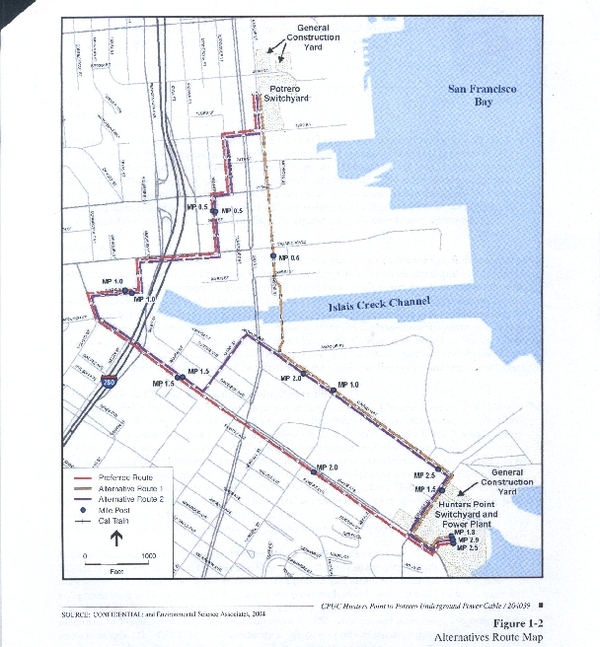
Meanwhile, the City is desperately trying to get PG&E to share the cost of rebuilding the conduit once again. PG&E and the City had been discussing a joint project whereby PG&E would run a new “AP-1” transmission line between its Potrero and Hunters Point substations in tandem with Muni’s electrical lines.
PG&E’s May 24, 2004 filing at the California Public Utilities Commission describes why PG&E is refusing to have anything to do with the City’s project. It plans to route its line around the West end of the creek instead because its engineering analysis shows multiple reasons why the Illinois Street route should never have been attempted at all. It shows that the soils in the area are unstable and subject to “liquefaction” in an earthquake:
“Now, with its reckless demand for time-consuming reconsideration of a routing alternative that months of expert engineering investigation has already shown to be infeasible, albeit financially advantageous for the city, CCSF places both of these important goals at risk…
“Further, the underwater conduit is currently flooded that was constructed by CCSF without following basic engineering practices such as backfilling the casing with grout to prevent intrusion of water and was installed atop soils subject to liquefaction and other seismic problems.”
Local residents and the Community First Coalition of Bayview Hunters Point are also asking why the City ever allowed this project to go forward. They have a number of questions for the City:
• A Nov. 17, 2000 US Geological Survey map shows liquefaction zones in San Francisco, including in this area. Why wasn’t this taken into consideration?
• Whose decision was it to build the conduit in this area? Was it Muni? Was it SFPUC?
What other City agencies are involved?
• Where does the SF Dept. of Environment stand on protecting the environment? We’ve had millions and millions of gallons of secondary effluent going into Islais creek while the main sewage outflow was being repaired. This violates State and Federal laws.
• With force main flowing secondary effluent into the west end of Islais Creek, what is it doing to plant and fish life, the natural species of the creek?
• Did the EIR take these impacts into consideration or were they omitted?
• Where is the State’s Dept. of Toxic Substance Control (DTSC) and the federal EPA? Have they been notified of these violations?
• How is this disaster impacting San Francisco’s budget deficit?
• This multimillion dollar job is trash. How much is it costing the City? What is the cost of the project to date? From the faulty engineering design, to digging the trench, to placing the conduits in, to repairing the main outfall line, the backfilling of the parking lot and the areas that were damaged, including the park. What is the total accumulated cost? What is the estimated cost of repairing this line again? What is the estimated cost of using PG&E’s alternate line?
• If the force main has to be repaired how long is it going to take? How many gallons more effluent will be put in Islais Creek and what will be the environmental effect on the community?
• Whose budget is this coming out of? Muni’s tubes for the light rail are funded by the County Transportation Authority (CTA), which has federal transportation money. Muni is taking money out of the operations budget and putting it into construction, making the unions unhappy. Does that have something to do with finding money for this project?
• Will CCSF taxpayers have to pick up the cost of Muni’s fiasco?
• If PG&E puts in this alternate line which they and their experts say is necessary – it means that the ratepayer will end up paying for that separately. Since Black & Veatch has done an independent study for PG&E what is the cost of that? The people of SF being double-billed. Will CCSF’s Muni conduit be abandoned?
• Was PG&E involved in the city’s project in any way? The City and PG&E have held many meetings to plan this joint project? When did those meetings begin and what was discussed?
• Was there insurance or bond money on this project to protect the taxpayer? Will they relieve the taxpayers burden and go after the contractors and all the people at fault?
• As taxpayers and ratepayers and as members of the impacted community, what recourse or mitigation is there for the community?
• This is a power project, which would involve the SF PUC. PG&E’s document mentions that the City planned to use the conduit for other projects but is now abandoning those plans. What are those projects? Were the City’s proposed peakers going to use these lines? (The peakers are the power plants the City wants to site at Potrero, which is very near this area.)
• SFPUC happens to have a large amount of bond money (for rebuilding Hetch Hetchy). Is Muni attempting to raid these funds? Why is Susan Leal being moved to SFPUC? Would she try to cover this up?
• Could this have been prevented if Muni had hired local people who would have been proud of those jobs, and might have been more careful? Instead you have people who get their paycheck and leave town, who don’t care.
• Are the buildings in that area in danger of collapse?
• The community meeting to discuss PG&E’s project is being held the same night as the monthly meeting of the “Restoration Advisory Board” for the Shipyard (RAB). Many environmental activists in Bayview Hunters Point are tied up at those meetings. Why does the City schedule so many environmental meetings in this community on the same night as the RAB?
Barbara George
David Erickson
Maurice Campbell
It is well-known that Muni’s Third Street Rail project has had a devastating impact on communities in southeast San Francisco. All up and down Third Street black businesses have closed because of the endless construction mess — three years and counting — that blocks sidewalks and leaves no room for parking. Muni has not met its minority and women (MBE and WBE) hiring and contracting goals. The only blacks working on the project are flaggers and street sweepers— hardly a career path.
Less well-known is the environmental and financial disaster related to the City’s incompetent construction of the electrical conduit for the rail line across Islais Creek. On Thanksgiving, 2001, local artists were enjoying their hard-won little Muwkema Ohlone Park next to the Illinois Street Bridge across Islais Creek when they noticed sinkholes and sand sprouts appearing all over the park. David Erickson grabbed his camera and photographed the sinkholes gradually getting bigger. Then the asphalt of a parking lot next door started to crack and a bulldozer sitting in it sank through.
What had happened is the crew building muni’s electrical conduit had tunneled under the huge 10 ft. force main carrying 80 million gallons/day of secondary sewage effluent from the Southeast sewage treatment plant. The force main runs along the North bank of Islais Creek and empties into the Bay some distance offshore.
Faulty construction of the electrical conduit line had undermined and cracked the sewage pipe, pouring sewage into the creek and damaging the park.
Why is this still an issue, three years later? It turns out the repairs (which further demolished the park) were as shoddy as the original construction, and the sewer pipe is leaking again. Now it is even more serious, as Muni’s and CCSF electrical wires have been loaded into the conduit, which has been compressed to an egg-shape and flooded.
Meanwhile, the City is desperately trying to get PG&E to share the cost of rebuilding the conduit once again. PG&E and the City had been discussing a joint project whereby PG&E would run a new “AP-1” transmission line between its Potrero and Hunters Point substations in tandem with Muni’s electrical lines.
PG&E’s May 24, 2004 filing at the California Public Utilities Commission describes why PG&E is refusing to have anything to do with the City’s project. It plans to route its line around the West end of the creek instead because its engineering analysis shows multiple reasons why the Illinois Street route should never have been attempted at all. It shows that the soils in the area are unstable and subject to “liquefaction” in an earthquake:
“Now, with its reckless demand for time-consuming reconsideration of a routing alternative that months of expert engineering investigation has already shown to be infeasible, albeit financially advantageous for the city, CCSF places both of these important goals at risk…
“Further, the underwater conduit is currently flooded that was constructed by CCSF without following basic engineering practices such as backfilling the casing with grout to prevent intrusion of water and was installed atop soils subject to liquefaction and other seismic problems.”
Local residents and the Community First Coalition of Bayview Hunters Point are also asking why the City ever allowed this project to go forward. They have a number of questions for the City:
• A Nov. 17, 2000 US Geological Survey map shows liquefaction zones in San Francisco, including in this area. Why wasn’t this taken into consideration?
• Whose decision was it to build the conduit in this area? Was it Muni? Was it SFPUC?
What other City agencies are involved?
• Where does the SF Dept. of Environment stand on protecting the environment? We’ve had millions and millions of gallons of secondary effluent going into Islais creek while the main sewage outflow was being repaired. This violates State and Federal laws.
• With force main flowing secondary effluent into the west end of Islais Creek, what is it doing to plant and fish life, the natural species of the creek?
• Did the EIR take these impacts into consideration or were they omitted?
• Where is the State’s Dept. of Toxic Substance Control (DTSC) and the federal EPA? Have they been notified of these violations?
• How is this disaster impacting San Francisco’s budget deficit?
• This multimillion dollar job is trash. How much is it costing the City? What is the cost of the project to date? From the faulty engineering design, to digging the trench, to placing the conduits in, to repairing the main outfall line, the backfilling of the parking lot and the areas that were damaged, including the park. What is the total accumulated cost? What is the estimated cost of repairing this line again? What is the estimated cost of using PG&E’s alternate line?
• If the force main has to be repaired how long is it going to take? How many gallons more effluent will be put in Islais Creek and what will be the environmental effect on the community?
• Whose budget is this coming out of? Muni’s tubes for the light rail are funded by the County Transportation Authority (CTA), which has federal transportation money. Muni is taking money out of the operations budget and putting it into construction, making the unions unhappy. Does that have something to do with finding money for this project?
• Will CCSF taxpayers have to pick up the cost of Muni’s fiasco?
• If PG&E puts in this alternate line which they and their experts say is necessary – it means that the ratepayer will end up paying for that separately. Since Black & Veatch has done an independent study for PG&E what is the cost of that? The people of SF being double-billed. Will CCSF’s Muni conduit be abandoned?
• Was PG&E involved in the city’s project in any way? The City and PG&E have held many meetings to plan this joint project? When did those meetings begin and what was discussed?
• Was there insurance or bond money on this project to protect the taxpayer? Will they relieve the taxpayers burden and go after the contractors and all the people at fault?
• As taxpayers and ratepayers and as members of the impacted community, what recourse or mitigation is there for the community?
• This is a power project, which would involve the SF PUC. PG&E’s document mentions that the City planned to use the conduit for other projects but is now abandoning those plans. What are those projects? Were the City’s proposed peakers going to use these lines? (The peakers are the power plants the City wants to site at Potrero, which is very near this area.)
• SFPUC happens to have a large amount of bond money (for rebuilding Hetch Hetchy). Is Muni attempting to raid these funds? Why is Susan Leal being moved to SFPUC? Would she try to cover this up?
• Could this have been prevented if Muni had hired local people who would have been proud of those jobs, and might have been more careful? Instead you have people who get their paycheck and leave town, who don’t care.
• Are the buildings in that area in danger of collapse?
• The community meeting to discuss PG&E’s project is being held the same night as the monthly meeting of the “Restoration Advisory Board” for the Shipyard (RAB). Many environmental activists in Bayview Hunters Point are tied up at those meetings. Why does the City schedule so many environmental meetings in this community on the same night as the RAB?
Barbara George
David Erickson
Maurice Campbell
For more information:
http://islaiscreek.org/sewerpipecollapseat...
Add Your Comments
Latest Comments
Listed below are the latest comments about this post.
These comments are submitted anonymously by website visitors.
TITLE
AUTHOR
DATE
Answer to racial hiring quotas
Sat, Aug 7, 2004 6:15AM
racial hiring quotas
Sun, Aug 1, 2004 10:40AM
Protest and Objection of the Hunters Point Shipyard
Fri, Jul 30, 2004 9:12PM
Sorry about Environmental Racism
Fri, Jul 30, 2004 1:01PM
Prop 209
Fri, Jul 30, 2004 8:58AM
We are 100% volunteer and depend on your participation to sustain our efforts!
Donate

$110.00 donated
in the past month
Get Involved
If you'd like to help with maintaining or developing the website, contact us.
Publish
Publish your stories and upcoming events on Indybay.
Topics
More
Search Indybay's Archives
Advanced Search
►
▼
IMC Network