







 Publish to Newswire
 Add an Event
Creature of Resistance: A communique from & to the resistant multitudes
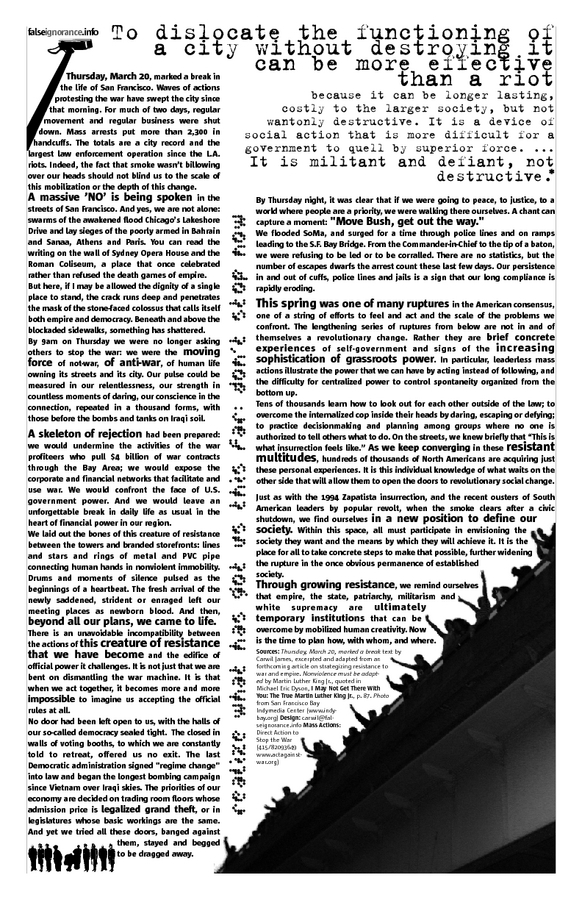
"To dislocate the functioning of
a city without destroying it
can be more effective
than a riot
because it can be longer lasting,
costly to the larger society,
but not wantonly destructive.
It is a device of social action that is more difficult
for a government to quell by superior force. ...
It is militant and defiant, not destructive."
Thursday, March 20, marked a break in the life of San Francisco. Waves of actions protesting the war have swept the city since that morning. For much of two days, regular movement and regular business were shut down. Mass arrests put more than 2,300 in handcuffs. The totals are a city record and the largest law enforcement operation since the L.A. riots. Indeed, the fact that smoke wasn’t billowing over our heads should not blind us to the scale of this mobilization or the depth of this change.
A massive ’NO’ is being spoken in the streets of San Francisco. And yes, we are not alone: swarms of the awakened flood Chicago’s Lakeshore Drive and lay sieges of the poorly armed in Bahrain and Sanaa, Athens and Paris. You can read the writing on the wall of Sydney Opera House and the Roman Coliseum, a place that once celebrated rather than refused the death games of empire.
But here, if I may be allowed the dignity of a single place to stand, the crack runs deep and penetrates the mask of the stone-faced colossus that calls itself both empire and democracy. Beneath and above the blockaded sidewalks, something has shattered.
By 9am on Thursday, we were no longer asking others to stop the war: we were the moving force of not-war, of anti-war, of human life owning its streets and its city. Our pulse could be measured in our relentlessness, our strength in countless moments of daring, our conscience in the connection, repeated in a thousand forms, with those before the bombs and tanks on Iraqi soil.
A skeleton of rejection had been prepared: we would undermine the activities of the war profiteers who pull $4 billion of war contracts through the Bay Area; we would expose the corporate and financial networks that facilitate and use war. We would confront the face of U.S. government power. And we would leave an unforgettable break in daily life as usual in the heart of financial power in our region.
We laid out the bones of this creature of resistance between the towers and branded storefronts: lines and stars and rings of metal and PVC pipe connecting human hands in nonviolent immobility. Drums and moments of silence pulsed as the beginnings of a heartbeat. The fresh arrival of the newly saddened, strident or enraged left our meeting places as newborn blood. And then, beyond all our plans, we came to life.
There is an unavoidable incompatibility between the actions of this creature of resistance that we have become and the edifice of official power it challenges. It is not just that we are bent on dismantling the war machine. It is that when we act together, it becomes more and more impossible to imagine us accepting the official rules at all.
No door had been left open to us, with the halls of our so-called democracy sealed tight. The closed in walls of voting booths, to which we are constantly told to retreat, offered us no exit. The last Democratic administration signed "regime change" into law and began the longest bombing campaign since Vietnam over Iraqi skies. The priorities of our economy are decided on trading room floors whose admission price is legalized grand theft, or in legislatures whose basic workings are the same. And yet we tried all these doors, banged against them, stayed and begged to be dragged away.
By Thursday night, it was clear that if we were going to peace, to justice, to a world where people are a priority, we were walking there ourselves. A chant can capture a moment: "Move Bush, get out the way."
We flooded SoMa, and surged for a time through police lines and on ramps leading to the S.F. Bay Bridge. From the Commander-in-Chief to the tip of a baton, we were refusing to be led or to be corralled. There are no statistics, but the number of escapes dwarfs the arrest count these last few days. Our persistence in and out of cuffs, police lines and jails is a sign that our long compliance is rapidly eroding.
Last spring was one of many ruptures in the American consensus, one of a string of efforts to feel and act and the scale of the problems we confront. The lengthening series of ruptures from below are not in and of themselves a revolutionary change. Rather they are brief concrete experiences of self-government and signs of the increasing sophistication of grassroots power. In particular, leaderless mass actions illustrate the power that we can have by acting instead of following, and the difficulty for centralized power to control spontaneity organized from the bottom up.
Tens of thousands learn how to look out for each other outside of the law; to overcome the internalized cop inside their heads by daring, escaping or defying; to practice decisionmaking and planning among groups where no one is authorized to tell others what to do. On the streets, we knew briefly that “This is what insurrection feels like.” As we keep converging in these resistant multitudes, hundreds of thousands of North Americans are acquiring just these personal experiences. It is this individual knowledge of what waits on the other side that will allow them to open the doors to revolutionary social change.
Just as with the 1994 Zapatista insurrection, and the recent ousters of South American leaders by popular revolt, when the smoke clears after a civic shutdown, we find ourselves in a new position to define our society. Within this space, all must participate in envisioning the society they want and the means by which they will achieve it. It is the place for all to take concrete steps to make that possible, further widening the rupture in the once obvious permanence of established society.
Through growing resistance, we remind ourselves that empire, the state, patriarchy, militarism and white supremacy are ultimately temporary institutions that can be overcome by mobilized human creativity. Now is the time to plan how, with whom, and where.
Sources: Thursday, March 20, marked a break text by Carwil James, excerpted and adapted from an forthcoming article on strategizing resistance to war and empire. To dislocate the functioning of a city by Martin Luther King Jr., quoted in Michael Eric Dyson, I May Not Get There With You: The True Martin Luther King Jr., p. 87.
Donate

$110.00 donated
in the past month
Get Involved
If you'd like to help with maintaining or developing the website, contact us.
Publish
Publish your stories and upcoming events on Indybay.