







 Publish to Newswire
 Add an Event
From the Open-Publishing Calendar
From the Open-Publishing Newswire
Indybay Feature
Countries Start To Ban US Beef Due To Mad Cow Disease: Aren't You Glad You Don't Eat Meat?
A growing number of countries are banning imports of American beef after the US announced its first suspected case of "mad cow" disease.
The bans came within hours of the detection of BSE in a single cow in the north-western state of Washington.
The move was led by Japan, which bought $800m of US beef last year - one-third of US exports of the meat.
Russia, Ukraine, Mexico and a number of Asian counties from Singapore to South Korea have also barred imports.
Mainland China is monitoring the situation.
Shares in hamburger giant McDonald's Corp fell by about 5% on the New York stock exchange, although the company said its supply chain was not linked to the suspected "mad cow" disease case.
Details of the case were revealed by US Agriculture Secretary Ann Veneman, who said a Holstein cow had tested positive on 9 December - but she insisted the country's beef was safe.
Tissue samples from the suspected cow are being studied in the UK, which suffered a devastating outbreak of mad cow disease in the mid-1990s.
The results will be known in a few days' time.
The list of countries imposing bans or temporary suspensions of beef imports has steadily grown.
Quarantine
BBC business correspondent Mark Gregory says the loss of Asian markets in particular is a huge blow to the US beef industry, which is worth $38bn a year.
Of the five top importers of US beef, only Canada has held off imposing some kind of restriction.
Our reporter says that a collapse of US domestic demand for beef would be the industry's ultimate nightmare, since 90% of US beef is consumed at home.
He adds that if American consumers panicked and stopped eating beef, 200,000 jobs could be at risk.
BSE has been linked to new variant Creutzfeldt-Jakob Disease (vCJD), a human brain-wasting disease.
The farm near Yakima, Washington, where the cow was found, has been quarantined.
"We remain confident in the safety of our food supply," Ms Veneman told reporters - adding that she planned to serve beef on Christmas Day.
The dairy cow had been sick or injured and was never destined for the public food supply, Ms Veneman said.
Canadian caution
Canada, the third biggest foreign market for US beef, said it would wait for confirmation on the test results before taking any action.
In August, the US eased a ban on Canadian beef imports imposed in May after a single case of the disease was found at a farm in Alberta. The two cases do not appear to be connected.
A private study released in November estimated that Canada's beef industry lost $2.5bn (C$3.3bn) in the six months after its mad cow case was discovered.
First diagnosed in Britain in 1986, BSE (Bovine Spongiform Encephalopathy) affected 178,000 British cattle and resulted in the eventual destruction of 3.7 million animals.
It cost British farming billions of dollars as countries around the world banned British beef.
Shares of restaurant stocks are expected to be hit by the mad cow announcement.
Correspondents say the US beef business has been booming - partly due to the popularity of the protein-rich Atkins diet.
The European Union said it was keeping a close eye on the situation, but it has anyway banned most US beef for many years because of growth hormones in the meat.
http://news.bbc.co.uk/2/hi/americas/3345929.stm
The move was led by Japan, which bought $800m of US beef last year - one-third of US exports of the meat.
Russia, Ukraine, Mexico and a number of Asian counties from Singapore to South Korea have also barred imports.
Mainland China is monitoring the situation.
Shares in hamburger giant McDonald's Corp fell by about 5% on the New York stock exchange, although the company said its supply chain was not linked to the suspected "mad cow" disease case.
Details of the case were revealed by US Agriculture Secretary Ann Veneman, who said a Holstein cow had tested positive on 9 December - but she insisted the country's beef was safe.
Tissue samples from the suspected cow are being studied in the UK, which suffered a devastating outbreak of mad cow disease in the mid-1990s.
The results will be known in a few days' time.
The list of countries imposing bans or temporary suspensions of beef imports has steadily grown.
Quarantine
BBC business correspondent Mark Gregory says the loss of Asian markets in particular is a huge blow to the US beef industry, which is worth $38bn a year.
Of the five top importers of US beef, only Canada has held off imposing some kind of restriction.
Our reporter says that a collapse of US domestic demand for beef would be the industry's ultimate nightmare, since 90% of US beef is consumed at home.
He adds that if American consumers panicked and stopped eating beef, 200,000 jobs could be at risk.
BSE has been linked to new variant Creutzfeldt-Jakob Disease (vCJD), a human brain-wasting disease.
The farm near Yakima, Washington, where the cow was found, has been quarantined.
"We remain confident in the safety of our food supply," Ms Veneman told reporters - adding that she planned to serve beef on Christmas Day.
The dairy cow had been sick or injured and was never destined for the public food supply, Ms Veneman said.
Canadian caution
Canada, the third biggest foreign market for US beef, said it would wait for confirmation on the test results before taking any action.
In August, the US eased a ban on Canadian beef imports imposed in May after a single case of the disease was found at a farm in Alberta. The two cases do not appear to be connected.
A private study released in November estimated that Canada's beef industry lost $2.5bn (C$3.3bn) in the six months after its mad cow case was discovered.
First diagnosed in Britain in 1986, BSE (Bovine Spongiform Encephalopathy) affected 178,000 British cattle and resulted in the eventual destruction of 3.7 million animals.
It cost British farming billions of dollars as countries around the world banned British beef.
Shares of restaurant stocks are expected to be hit by the mad cow announcement.
Correspondents say the US beef business has been booming - partly due to the popularity of the protein-rich Atkins diet.
The European Union said it was keeping a close eye on the situation, but it has anyway banned most US beef for many years because of growth hormones in the meat.
http://news.bbc.co.uk/2/hi/americas/3345929.stm
Add Your Comments
Comments
(Hide Comments)
Check out this issue of E Magazine from a couple of years ago. I think they make some good arguments for eating less meat- it's better for the environment, better for your body, etc.
http://www.emagazine.com/january-february_2002/_0102contents.html
http://www.emagazine.com/january-february_2002/_0102contents.html
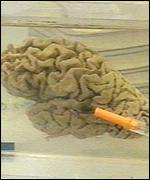
vCJD produces gaps inside the brain
---
Creutzfeldt-Jacob disease is an untreatable and invariably fatal disease in humans which is similar to BSE in cattle and scrapie in sheep.
The diseases are together called "spongiform encephalopathies", because they all reduce the brain to the same spongy appearance, with gaps appearing within the tissue.
The type of CJD associated with BSE in cattle is termed "variant CJD", and is distinctively different from standard CJD - which emerges in between 25 and 60 UK adults each year, normally in people aged over 55.
Variant CJD began to emerge and be diagnosed in the mid-1990s - there have been 73 confirmed cases so far, with just under a dozen probable cases which have yet to be confirmed, either because the patient is still alive, or because the post mortem has yet to take place.
It seems to be capable of developing in much younger people than standard CJD.
While death from standard CJD happens approximately six months after diagnosis, it generally takes much longer - up to 18 months - for a patient with vCJD to die.
Diseases like vCJD and BSE are believed to be caused by an infectious agent called a prion, which can be carried in blood and tissue.
This causes the death of brain cells, in humans causing symptoms such as unsteadiness, insomnia, memory loss and dementia.
Post mortem
Eventually, enough brain cells die for the tell-tale gaps to appear in the tissues, although the only way of definitively confirming a CJD case in humans is following death during post mortem.
The prion is a protein, thought to linger in human tissue, potentially for many years, before any symptoms begin to emerge.
Unlike a virus or bacteria, it contains no genetic information of its own, and does not spread by reproducing or making copies of itself.
Instead, scientists believe that it "recruits" another natural protein, PrP, which sits on the surface of brain cells, to become like it.
Eventually, huge numbers of these mutated proteins build up, form insoluble masses within cells, which kill them.
While no definitive link between prion diseases in animals and CJD in humans has been established, the mechanism and progression of the diseases are so similar that most scientists are convinced that infection with BSE prion may under certain circumstances lead to the development of vCJD in humans.
In addition, scientists have been able to produce spongiform symptoms in mice injected with diseased brain matter from cows.
Recent studies also showed that certain cells contained in blood were capable of harbouring the infectious agent and causing spongiform disease when transfused into another animal.
When a cow has BSE, certain parts of its carcass harbour far larger concentrations of prions than others.
Cuts of meat
The brain and spinal cord are thought to be the main reservoirs for prions.
It is the belief of scientists that, just as BSE is likely to have been passed from infected cow through feed contaminated with brains and spinal cord, humans can acquire the BSE prion through cuts of meat which contain this material.
Again, this has yet to be satisfactorily proven by experts.
And the obvious question is that while millions of UK children and adults have potentially consumed infected flesh from cattle, only a handful so far have succumbed to the disease.
Doctors do not yet know the likely incubation period for CJD.
There have been recent strides in diagnosing the condition, through better imaging with brain scans, and through tests on tonsils, which may also harbour the prions.
http://news.bbc.co.uk/2/hi/health/967133.stm
---
Creutzfeldt-Jacob disease is an untreatable and invariably fatal disease in humans which is similar to BSE in cattle and scrapie in sheep.
The diseases are together called "spongiform encephalopathies", because they all reduce the brain to the same spongy appearance, with gaps appearing within the tissue.
The type of CJD associated with BSE in cattle is termed "variant CJD", and is distinctively different from standard CJD - which emerges in between 25 and 60 UK adults each year, normally in people aged over 55.
Variant CJD began to emerge and be diagnosed in the mid-1990s - there have been 73 confirmed cases so far, with just under a dozen probable cases which have yet to be confirmed, either because the patient is still alive, or because the post mortem has yet to take place.
It seems to be capable of developing in much younger people than standard CJD.
While death from standard CJD happens approximately six months after diagnosis, it generally takes much longer - up to 18 months - for a patient with vCJD to die.
Diseases like vCJD and BSE are believed to be caused by an infectious agent called a prion, which can be carried in blood and tissue.
This causes the death of brain cells, in humans causing symptoms such as unsteadiness, insomnia, memory loss and dementia.
Post mortem
Eventually, enough brain cells die for the tell-tale gaps to appear in the tissues, although the only way of definitively confirming a CJD case in humans is following death during post mortem.
The prion is a protein, thought to linger in human tissue, potentially for many years, before any symptoms begin to emerge.
Unlike a virus or bacteria, it contains no genetic information of its own, and does not spread by reproducing or making copies of itself.
Instead, scientists believe that it "recruits" another natural protein, PrP, which sits on the surface of brain cells, to become like it.
Eventually, huge numbers of these mutated proteins build up, form insoluble masses within cells, which kill them.
While no definitive link between prion diseases in animals and CJD in humans has been established, the mechanism and progression of the diseases are so similar that most scientists are convinced that infection with BSE prion may under certain circumstances lead to the development of vCJD in humans.
In addition, scientists have been able to produce spongiform symptoms in mice injected with diseased brain matter from cows.
Recent studies also showed that certain cells contained in blood were capable of harbouring the infectious agent and causing spongiform disease when transfused into another animal.
When a cow has BSE, certain parts of its carcass harbour far larger concentrations of prions than others.
Cuts of meat
The brain and spinal cord are thought to be the main reservoirs for prions.
It is the belief of scientists that, just as BSE is likely to have been passed from infected cow through feed contaminated with brains and spinal cord, humans can acquire the BSE prion through cuts of meat which contain this material.
Again, this has yet to be satisfactorily proven by experts.
And the obvious question is that while millions of UK children and adults have potentially consumed infected flesh from cattle, only a handful so far have succumbed to the disease.
Doctors do not yet know the likely incubation period for CJD.
There have been recent strides in diagnosing the condition, through better imaging with brain scans, and through tests on tonsils, which may also harbour the prions.
http://news.bbc.co.uk/2/hi/health/967133.stm
How Mad Now, Cow?
author: Joseph Eisenschmidt
Dec 23, 2003 20:11
Today, December 23rd, 2003, the first instance of Mad Cow disease was reported to have been found in Washington State. Americas first ever case of Bovine Spongiform Encephalopathy (BSE), a single case, occurred in a national herd of 103 million cattle. Our reaction will test the politicians ability to think beyond the next election and make the decisions that Americas farmers, merchants, and public require to remain safe and informed-and well fed.
Today, December 23rd, 2003, the first instance of Mad Cow disease was reported to have been found in Washington State. Americas first ever case of Bovine Spongiform Encephalopathy (BSE), a single case, occurred in a national herd of 103 million cattle. Our reaction will test the politicians ability to think beyond the next election and make the decisions that Americas farmers, merchants, and public require to remain safe and informed-and well fed.
As a beefeater, I must by say that I consider eating meat an important part of my dietary health regimen. My entire family has always eaten a lot of animal products, and we are by and large in excellent health. We have never had a premature death due to illness.
That said, there are so many more points of entry for pathogens to get into the food supply with regards to meat consumption as opposed to vegetable consumption, we carnivores must pay heed to all warnings of contamination or concern.
During the recent outbreak of mad Cow Disease in Canada (One cow!), the Canadian beef industry was certainly pummeled beyond all reason. The Canadian Beef herd is massive, and the banning of beef imports from our northern neighbor made me fume. Canada has 15.7 million head of cattle, 4.9 million being beef cattle, and to ban imports based on one incidence of a deadly disease was irrational. When decision makers get irrational during crises, watch out.
Now Americas herd, 103 million strong with 33.6 million being beef cattle, faces the same situation Canada faced. As of now, Canadian cattle imports are banned from the U.S., and beef imports are still weak. Out of the 103 million cattle in America, 9.8 million are on feed. So over 90% of the U.S. herd is immune to the effects of BSE, the same as in Canada.
One diseased Canadian cow was used as the excuse to ban all cattle from our neighbor, 4.4 million of which were not susceptible to the disease in any case. Canada’s industry exported half of its beef production, and one quarter of its calf crop, so the effects on Canada are potentially more pronounced than that on America. Still, a look at the price of Canadian beef compared to U.S, Beef is telling. Prices of cattle in Canada are about one half to on forth the U.S. rate depending on location, grade and size. Suffice it to say, prices are devastatingly low compared to those in the U.S.A.
What can we expect from the situation here in Washington State? We can expect a shake out at the local super market as the consuming public adjusts its habits according to the information provided. We can expect to see a short-term overreaction by the consumers of U.S. beef products. We can expect to see more testing than the 20,526 out of 103 million head of cattle that has been the past practice.
And we can expect better from politicians than to make judgments and take actions based on tiny instances of contamination, actions that can have a lasting effect on billions of peoples lives. We can expect at least that much.
Joseph Eisenschmidt
http://www.ext.nodak.edu/extnews/newsrelease/2003/101603/06livstk.htm
http://seattletimes.nwsource.com/html/localnews/2001821869_webmadcow23.html
author: Joseph Eisenschmidt
Dec 23, 2003 20:11
Today, December 23rd, 2003, the first instance of Mad Cow disease was reported to have been found in Washington State. Americas first ever case of Bovine Spongiform Encephalopathy (BSE), a single case, occurred in a national herd of 103 million cattle. Our reaction will test the politicians ability to think beyond the next election and make the decisions that Americas farmers, merchants, and public require to remain safe and informed-and well fed.
Today, December 23rd, 2003, the first instance of Mad Cow disease was reported to have been found in Washington State. Americas first ever case of Bovine Spongiform Encephalopathy (BSE), a single case, occurred in a national herd of 103 million cattle. Our reaction will test the politicians ability to think beyond the next election and make the decisions that Americas farmers, merchants, and public require to remain safe and informed-and well fed.
As a beefeater, I must by say that I consider eating meat an important part of my dietary health regimen. My entire family has always eaten a lot of animal products, and we are by and large in excellent health. We have never had a premature death due to illness.
That said, there are so many more points of entry for pathogens to get into the food supply with regards to meat consumption as opposed to vegetable consumption, we carnivores must pay heed to all warnings of contamination or concern.
During the recent outbreak of mad Cow Disease in Canada (One cow!), the Canadian beef industry was certainly pummeled beyond all reason. The Canadian Beef herd is massive, and the banning of beef imports from our northern neighbor made me fume. Canada has 15.7 million head of cattle, 4.9 million being beef cattle, and to ban imports based on one incidence of a deadly disease was irrational. When decision makers get irrational during crises, watch out.
Now Americas herd, 103 million strong with 33.6 million being beef cattle, faces the same situation Canada faced. As of now, Canadian cattle imports are banned from the U.S., and beef imports are still weak. Out of the 103 million cattle in America, 9.8 million are on feed. So over 90% of the U.S. herd is immune to the effects of BSE, the same as in Canada.
One diseased Canadian cow was used as the excuse to ban all cattle from our neighbor, 4.4 million of which were not susceptible to the disease in any case. Canada’s industry exported half of its beef production, and one quarter of its calf crop, so the effects on Canada are potentially more pronounced than that on America. Still, a look at the price of Canadian beef compared to U.S, Beef is telling. Prices of cattle in Canada are about one half to on forth the U.S. rate depending on location, grade and size. Suffice it to say, prices are devastatingly low compared to those in the U.S.A.
What can we expect from the situation here in Washington State? We can expect a shake out at the local super market as the consuming public adjusts its habits according to the information provided. We can expect to see a short-term overreaction by the consumers of U.S. beef products. We can expect to see more testing than the 20,526 out of 103 million head of cattle that has been the past practice.
And we can expect better from politicians than to make judgments and take actions based on tiny instances of contamination, actions that can have a lasting effect on billions of peoples lives. We can expect at least that much.
Joseph Eisenschmidt
http://www.ext.nodak.edu/extnews/newsrelease/2003/101603/06livstk.htm
http://seattletimes.nwsource.com/html/localnews/2001821869_webmadcow23.html
TSE (Transmissible Spongiform Encephalopathy) in Rocky Mountain elk known as chronic wasting disease is also a prion caused disease similar to BSE "Mad Cow" in cattle..
The Rocky Mountain cattle ranchers may have exposed the elk to prions via the outdoors feed troughs frequented by elk. The large open areas of Rocky Mountain rangeland make it easy for both elk and cattle to share the same feeding troughs..
If any downer cows were added to the feed mix as protein supplement, it is likely that the TSE chronic wasting in elk is a result of exposure to downer cows containing the prion..
Since this happened years ago, the symptoms may have taken a while to be visible..
Mad cow, chronic wasting in elk and Creutzfeld-Jacob in humans do not show drastic symptoms overnight. Instead a gradual disintigration of mental functioning is accompanied by minor changes in walking gait/balance. Often times not noticed by medical professionals and misdiagnosed as dementia, alzheimers, mental illness, etc..
The Rocky Mountain cattle ranchers may have exposed the elk to prions via the outdoors feed troughs frequented by elk. The large open areas of Rocky Mountain rangeland make it easy for both elk and cattle to share the same feeding troughs..
If any downer cows were added to the feed mix as protein supplement, it is likely that the TSE chronic wasting in elk is a result of exposure to downer cows containing the prion..
Since this happened years ago, the symptoms may have taken a while to be visible..
Mad cow, chronic wasting in elk and Creutzfeld-Jacob in humans do not show drastic symptoms overnight. Instead a gradual disintigration of mental functioning is accompanied by minor changes in walking gait/balance. Often times not noticed by medical professionals and misdiagnosed as dementia, alzheimers, mental illness, etc..
We are 100% volunteer and depend on your participation to sustain our efforts!
Donate

$110.00 donated
in the past month
Get Involved
If you'd like to help with maintaining or developing the website, contact us.
Publish
Publish your stories and upcoming events on Indybay.
Topics
More
Search Indybay's Archives
Advanced Search
►
▼
IMC Network