







 Publish to Newswire
 Add an Event
From the Open-Publishing Calendar
From the Open-Publishing Newswire
Indybay Feature
Black Bloc report/critique
This report from the SF demo was posted to the DC Indymedia site, as a response to a report on black bloc actions there on Oct 25th.
Re: Black Bloc HAMMERS City Living DC, then joins antiwar march
by Susie-!
(No verified email address) Current rating: 0
26 Oct 2003
That sounds a lot better than the only black bloc-ish thing I saw in San Francisco.
They did no outreach, had no message or fliers, got caught by the police...
I saw them leave the post-march rally and followed at a slow pace. My friend had heard someone practicing poor security say that they were going to Union Square, where all the Macy's-type stores are. I headed in that direction so slowly that I even stopped for a leisurely lunch.
I knew I was getting close when I saw the vehicle that the police always use to follow us around town. When I found them they were marching towards the Gap. There were about 20 or so people, some masked up. Mostly young and around half women or so. They stopped near a side entrance of the Gap and turned around. Then they went quickly to a side entrance of Macy's (I think it was Macy's, it was hard to think what with the cloud of toxic perfume, which, by the way, is an oil-war product), where some people were sitting on the ground, apparently detained by the cops. People argued with the cops and while someone was showing me his detention slip from a little bit earlier (kind of like a ticket, I guess) the four people joined the crowd.
The crowd next went to a nearby Starbucks. People went straight in and demanded free water and use of the bathroom. Apparently now they only let you use the bathroom if you buy something. People tried to talk politics with some of the cashiers and they got angry and walked away from their posts. We talked a lot of shit about Starbucks (as you know, they are part of the corporate consumer boringization of cafes all over the country, imposing their "culture" where once there had been bazillions of mom and pop cafes) and slowly walked out when the cops started to notice where we were.
Then we stood around on the sidewalk for a bit. Some people showed off the things they had stolen- right outside the door! Another example of poor security.
Overall this "action" was an example of why we don't necessarily need to even try to do things as the black bloc or anarchists/anti-authoritarians at some of these big demos. Since we don't know each other, we can't even get together at the announced gathering points, cuz we don't recognize each other. Then we can't announce discussions of actions, so people feel alienated. Then when we alternately joke loudly about inviting our 20+ "friends" to go "shopping" in a store and, as we march down the sidewalk because we don't have sufficient numbers to take the street, and chant slogans against the police for no apparent reason, our "actions" show that they have no purpose- they are not creating an effective spectacle, and they are not sending out a political message that people can understand. At this particular action, there were no flyers given out, nor were people writing political stuff on police cars, walls, windows, or anything, as far as I could see.
I know it's important to do things that feel fun to the people who are doing them, but I think that things like today should be done at the affinity group level. When there are demos where we'll have the necessary numbers (how will we know this in advance?) we should then call for larger bb gatherings so we can do things that require more people.
One more thing- how long can this framework of listening to the same speakers over and over and marching the same routes go on? These demos are about preaching to the choir and trying to outdo each other with our signs and banners. We might as well call them anti-war pride parades instead of "end the occupation" marches...
by Susie-!
(No verified email address) Current rating: 0
26 Oct 2003
That sounds a lot better than the only black bloc-ish thing I saw in San Francisco.
They did no outreach, had no message or fliers, got caught by the police...
I saw them leave the post-march rally and followed at a slow pace. My friend had heard someone practicing poor security say that they were going to Union Square, where all the Macy's-type stores are. I headed in that direction so slowly that I even stopped for a leisurely lunch.
I knew I was getting close when I saw the vehicle that the police always use to follow us around town. When I found them they were marching towards the Gap. There were about 20 or so people, some masked up. Mostly young and around half women or so. They stopped near a side entrance of the Gap and turned around. Then they went quickly to a side entrance of Macy's (I think it was Macy's, it was hard to think what with the cloud of toxic perfume, which, by the way, is an oil-war product), where some people were sitting on the ground, apparently detained by the cops. People argued with the cops and while someone was showing me his detention slip from a little bit earlier (kind of like a ticket, I guess) the four people joined the crowd.
The crowd next went to a nearby Starbucks. People went straight in and demanded free water and use of the bathroom. Apparently now they only let you use the bathroom if you buy something. People tried to talk politics with some of the cashiers and they got angry and walked away from their posts. We talked a lot of shit about Starbucks (as you know, they are part of the corporate consumer boringization of cafes all over the country, imposing their "culture" where once there had been bazillions of mom and pop cafes) and slowly walked out when the cops started to notice where we were.
Then we stood around on the sidewalk for a bit. Some people showed off the things they had stolen- right outside the door! Another example of poor security.
Overall this "action" was an example of why we don't necessarily need to even try to do things as the black bloc or anarchists/anti-authoritarians at some of these big demos. Since we don't know each other, we can't even get together at the announced gathering points, cuz we don't recognize each other. Then we can't announce discussions of actions, so people feel alienated. Then when we alternately joke loudly about inviting our 20+ "friends" to go "shopping" in a store and, as we march down the sidewalk because we don't have sufficient numbers to take the street, and chant slogans against the police for no apparent reason, our "actions" show that they have no purpose- they are not creating an effective spectacle, and they are not sending out a political message that people can understand. At this particular action, there were no flyers given out, nor were people writing political stuff on police cars, walls, windows, or anything, as far as I could see.
I know it's important to do things that feel fun to the people who are doing them, but I think that things like today should be done at the affinity group level. When there are demos where we'll have the necessary numbers (how will we know this in advance?) we should then call for larger bb gatherings so we can do things that require more people.
One more thing- how long can this framework of listening to the same speakers over and over and marching the same routes go on? These demos are about preaching to the choir and trying to outdo each other with our signs and banners. We might as well call them anti-war pride parades instead of "end the occupation" marches...
Add Your Comments
Comments
(Hide Comments)
The over all"black bloc" action was a joke. Children running from Police officers is more like it. At one point when asked why they broke off into a residential area it was replied with :"because we could". No tactics and a bunch of punkish youth is what is was.
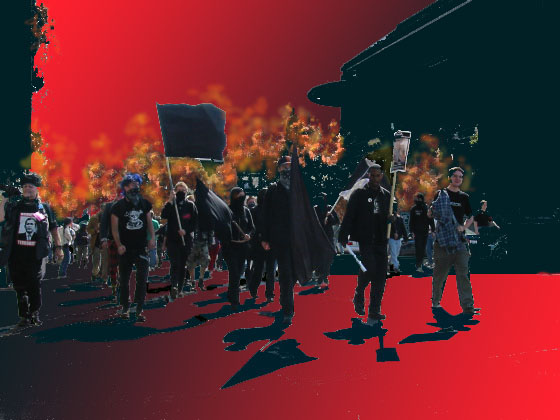
this action was in no way intended to be a true black bloc. Though no flyers were distributed, info sheets are in the making. This flashmob tactic is used to 1. get public attention without the scorn associated with breaking stuff 2. get 60 % of the SFPD to follow them around so that you can go burn the banks. Jump on the opportunity 3. build comraderie, teamwork skills, and on your feet experience to young ppl who wish to do bloc work but are at the time shy of it and needing practice in mobilizations
If you do not see the benefits of having this divergant bloc, you are nopt thinking very subversively. maybe if some ppl interested in a bloc got together and actually planned out some sortt of loose attack scheme, as outlined in the black bloc papers, things would work out a little better.
email:
nixvilence [at] yahoo.com
If you do not see the benefits of having this divergant bloc, you are nopt thinking very subversively. maybe if some ppl interested in a bloc got together and actually planned out some sortt of loose attack scheme, as outlined in the black bloc papers, things would work out a little better.
email:
nixvilence [at] yahoo.com
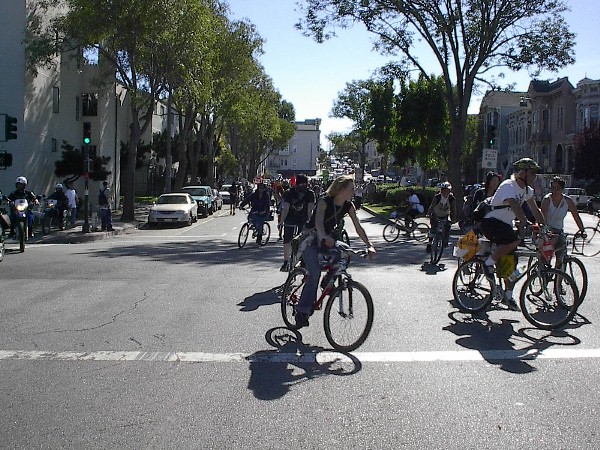
identities safely concealed, here is a picture of the black bloc in the distance behind the bicycle bloc after they led some people on a different route
to call something a black bloc critique if
in the text of the article you call it "the only
black blockISH THING" you saw, isn't it?
there's so many people out there in the "anarchist" scene that complain about stuff that happens spontaneously, as this did, and stuff that is planned (as in other actions). what i wonder is if you think theres nothing good going on in the anarchist "black blocish" scene in the bay area, then why do you hang around it, and follow it around as a spectator just to critique it?
and about anarchist shopping, if you want to reach people, the malls are a great place to do it. theres tons of disillusioned kids who wander around feeling disempowered and disengaged in these giant spaces, going in and having some fun is a good message in and of itself.
and as for affinity groups, noone knows what those are anymore, except for an excuse for people to complain about small actions that "should be done in affinity groups".
in the text of the article you call it "the only
black blockISH THING" you saw, isn't it?
there's so many people out there in the "anarchist" scene that complain about stuff that happens spontaneously, as this did, and stuff that is planned (as in other actions). what i wonder is if you think theres nothing good going on in the anarchist "black blocish" scene in the bay area, then why do you hang around it, and follow it around as a spectator just to critique it?
and about anarchist shopping, if you want to reach people, the malls are a great place to do it. theres tons of disillusioned kids who wander around feeling disempowered and disengaged in these giant spaces, going in and having some fun is a good message in and of itself.
and as for affinity groups, noone knows what those are anymore, except for an excuse for people to complain about small actions that "should be done in affinity groups".
if the bloc would have collaborated with the organizers of this march (gay shame) they would not have looked so foolish to the public. but this kind of disorganization is to be expected in the first march, next time we will do a better job of organizing and supervising the bloc members, perhaps give them some advice on fliers
I think you're getting actions confused -- the flash mob took off on the same day as the ANSWER march on the 25th, the Gay Shame action was the day before. I do think its pretty humorous that you're expecting Gay Shame to lead others in classic "management" style, which has nothing to do with the purpose of Gay Shame. I think you're missing the point on several fronts, my friend.
bb
bb
If you do a google search you will see that the aftermarch from Saturday was not a flash mob.
http://www.wordspy.com/words/flashmob.asp
Flash mobs are sudden gatherings of people at a predetermined location at a predetermined time. People in flash mobs usually perform according to a written script, then disperse quickly. Flash mobs can be for many purposes but most groups stick to having fun.
It was not sudden or predetermined, as far as I could tell: people left Jefferson Park largely all at once, which was obvious, there didn't seem to be a written script, and they did not disperse quickly.
I would also argue that that march was not spontaneous. This was shown by the chants and the choices of locations people went to, as it seemed to have 2 purposes: 1. against police, and 2. against consumerism.
http://www.wordspy.com/words/flashmob.asp
Flash mobs are sudden gatherings of people at a predetermined location at a predetermined time. People in flash mobs usually perform according to a written script, then disperse quickly. Flash mobs can be for many purposes but most groups stick to having fun.
It was not sudden or predetermined, as far as I could tell: people left Jefferson Park largely all at once, which was obvious, there didn't seem to be a written script, and they did not disperse quickly.
I would also argue that that march was not spontaneous. This was shown by the chants and the choices of locations people went to, as it seemed to have 2 purposes: 1. against police, and 2. against consumerism.
For instance...why complain when you're the one not doing anything?
B.B.'s work in certain cases, like this one at the EU.
http://news.bbc.co.uk/2/hi/in_depth/photo_gallery/2953695.stm
In other cases they're used to distract the police so AUTONOMOUS action can take place.
B.B.'s are effective most of the time, except when there's like, 6 people in masks.
A bloc is a tactic for mass action, I don't think masking up when you only have 20 people and slowly walking is a good idea, but eh, diversity of tactics I guess?
I say, if you're gonna don the mask, be quick, fuck shit up, and blend in with the crowd afterwards.
Or you could just sit in the middle of a liberal march and scream mean things at the police! Oh yeah, direct action...*cough*
I'm going to shit myself and die if I see this shit in Miami. Come on, stop reading Green Anarchy and all the rest of those zines and start ACTING, we won't get anything done with simply writing about revolution. Why do it if you don't have the intentions to start something big?
B.B.'s work in certain cases, like this one at the EU.
http://news.bbc.co.uk/2/hi/in_depth/photo_gallery/2953695.stm
In other cases they're used to distract the police so AUTONOMOUS action can take place.
B.B.'s are effective most of the time, except when there's like, 6 people in masks.
A bloc is a tactic for mass action, I don't think masking up when you only have 20 people and slowly walking is a good idea, but eh, diversity of tactics I guess?
I say, if you're gonna don the mask, be quick, fuck shit up, and blend in with the crowd afterwards.
Or you could just sit in the middle of a liberal march and scream mean things at the police! Oh yeah, direct action...*cough*
I'm going to shit myself and die if I see this shit in Miami. Come on, stop reading Green Anarchy and all the rest of those zines and start ACTING, we won't get anything done with simply writing about revolution. Why do it if you don't have the intentions to start something big?
If it was not for the leadership of GAY SHAME,
THIS WEEKEND WOULD HAVE BEEN A COMPLIETE FAILURE!
the bloc follows tin the efforts of other groups (like ours) and as of yet has done nothing of it's own.
if you want to be part of our events then you will have to
follow directions like everyone else.
or- you can go it on your own, (ha,ha,ha! like this would have any effect!)
THIS WEEKEND WOULD HAVE BEEN A COMPLIETE FAILURE!
the bloc follows tin the efforts of other groups (like ours) and as of yet has done nothing of it's own.
if you want to be part of our events then you will have to
follow directions like everyone else.
or- you can go it on your own, (ha,ha,ha! like this would have any effect!)
it is not even about that. we weresimply going "shopping" to inform people about what they are buying/supporting, and teaching them. education isthe best way for change. if you didn't realize bashing us the "black boc" "flashmob" whatever you want to call us is not doing anything when if knew we were detained for a reason that the police could not explain to us. and they also exclaimed to us that they were better, i say inform the people of what is going on. fucking shit up is easier and more effective when there are more people. remember there were only about 20 of us and we were doing the best we could.
it is not even about that. we weresimply going "shopping" to inform people about what they are buying/supporting, and teaching them. education isthe best way for change. if you didn't realize bashing us the "black boc" "flashmob" whatever you want to call us is not doing anything when if knew we were detained for a reason that the police could not explain to us. and they also exclaimed to us that they were better, i say inform the people of what is going on. fucking shit up is easier and more effective when there are more people. remember there were only about 20 of us and we were doing the best we could.
The block has done nothing? What about the spectacular events on the first day of the escalation where everyone blocked downtown San Francisco's financial district, the most dense district of capital on the west coast. That sort of got some news coverage, and was known to be the most successful protest in the U.S. on that day.
on the first day of the escalation where everyone blocked downtown San Francisco's financial district- bb
as you where part of the protest group your little clique cannot take credit for the protest that you did nothing to plan,promote, or organize.
It was OUR efforts and leadership that makes the statement on "O-25", you are just riding on our coat tails. if you had not shown up I doubt BB would have been missed.
as you where part of the protest group your little clique cannot take credit for the protest that you did nothing to plan,promote, or organize.
It was OUR efforts and leadership that makes the statement on "O-25", you are just riding on our coat tails. if you had not shown up I doubt BB would have been missed.
Looking at the posts I have a curious feeling JT is someone working for Newsom trying to create divisions between Gay Shame and other activist groups. Newsom has just over one moth left until the real election (assuming he doesnt get over 50% next week) and he is starting to be afraid that Gay Shame could unite with the antiwar protests and prevent a Newsom victory.
If Newsom's Republican voting record were to get out to SF progressives and people realized that the city is facing someone far to the right of even Arnold he wouldnt have a chancce. His best chance to get elected is to sow infighting on the radical left and court the liberal antiwar vote with promises that change depending on his audience.
If Newsom's Republican voting record were to get out to SF progressives and people realized that the city is facing someone far to the right of even Arnold he wouldnt have a chancce. His best chance to get elected is to sow infighting on the radical left and court the liberal antiwar vote with promises that change depending on his audience.
That sounds a lot better than the only black bloc-ish thing I saw in San Francisco.
so now you are trying to shift the focus from your own laziness and lack of participation.
you can theorize all you want, when it comes down to it, you are not doing your share. excuses don't cut it
so now you are trying to shift the focus from your own laziness and lack of participation.
you can theorize all you want, when it comes down to it, you are not doing your share. excuses don't cut it
bloc didn't do anything, they rarely ever do. what else is new. thats just the way it is
Yeah, even the Chronicle had to point out that Newsom has a gang of 'hecklers' that follow him around month after month. They tried to make him look good by saying he didn't skip a beat when they were taken away, but it's so formula (as in Bushmoron response to protests) that it only makes it clear that the news is trying to gloss over the fact that only one candidate is constantly attacked for his policies.
FOG = Friend of Gavin
I would respond, but this is obviously a troll. It ain't gonna work.
bb
I would respond, but this is obviously a troll. It ain't gonna work.
bb
it is not even about that. we weresimply going "shopping" to inform people about what they are buying/supporting, and teaching them. education isthe best way for change. if you didn't realize, bashing us the "black boc" "flashmob" whatever you want to call us is not doing anything morally wrong and then we were detained for a reason that the police could not explain to us. and they also exclaimed to us that they were better, i say inform the people of what is going on. comlaining about us is not going to do anything when we are strong and have powerful minds, why dont you spend your time being productive and maybe research police brutality and unjust happenings everyday, we are not the enemy.
fucking shit up is easier and more effective when there are more people. remember there were only about 20 of us and we were doing the best we could.
fucking shit up is easier and more effective when there are more people. remember there were only about 20 of us and we were doing the best we could.
fucking shit up is easier and more effective when there are more people. remember there were only about 20 of us and we were doing the best we could.
........and then we were detained for a reason that the police could not explain to us.
I had no idea that these so called hard core political action groups would be such crybabies when some one writes a report that shows the short commings in their actions,
the article aske for input and when you don't like what you hear you start this paranoid ranting about spies, police, and a city councle guy you hassel when he runs for mayor?
(((((give me a break)))))
you have been given bad reviews across the board,
may-be you deserve them? (duh) get a clue!
this is not the cia setting you up, it your peers saying that that you are lazy and do not pull your weight!
deal with it! don't be such wussies!
may-be that is part of your problem? YES?
........and then we were detained for a reason that the police could not explain to us.
I had no idea that these so called hard core political action groups would be such crybabies when some one writes a report that shows the short commings in their actions,
the article aske for input and when you don't like what you hear you start this paranoid ranting about spies, police, and a city councle guy you hassel when he runs for mayor?
(((((give me a break)))))
you have been given bad reviews across the board,
may-be you deserve them? (duh) get a clue!
this is not the cia setting you up, it your peers saying that that you are lazy and do not pull your weight!
deal with it! don't be such wussies!
may-be that is part of your problem? YES?
You expected the cops to be able to explain, let alone to actually do it? You don’t know to much about cops, do you?
Clue one: know who you are dealing with. Read a police training manuals. “Police Officer” by O’Neill, Hammer and Steinberg, ISBN 0-02-8615182, will do. It’s from ARCO, “The 1st Name in Civil Service.”
Short version: Most of these guys are not rocket scientists. But if you honestly don’t know why you were detained, neither are you. You were detained because you were wearing colors. You stood out like sore thumbs. Had you instead been wearing effective drag, and been travelling in twos and threes, and especially had you not been in the same vicinity of the street action, they never would have noticed you.
Drag is the answer, drag, dispersion and syncronized watches.
If, for example, a team of three or four of you had been dressed like yuppies and acting like you were on your way somewhere important, you could have bluffed your way in to most buildings downtown. A team dressed in coveralls and hard hats, especially if accompanied buy an imperious acting guy in a white shirt with the sleeves rolled up, also wearing a hard hat and carrying a clipboard, can get into almost anywhere. In some places, wearing a lab coat and carrying a clipboard will not only get you through most of the doors, it will get you treated like a living god. Even just a clipboard and a clean set of clothes will get you past many perimeters. Briefcases work, too. In most circumstances, old beat up ones work best.
Always be polite. Pretend you’re in a movie. Act bored. Tell them what they want to hear. And smile, smile, smile.
Or, you can wear conspicuous headgear, clothing and jewelry, present a clear profile, and repeatedly hurl yourself at your enemies, trying to count coup. The choice is yours. Make it wisely. But first, I recommend that you read up on the history of Native America. “Bury My Heart At Wounded Knee” by Dee Alexander Brown, ISBN 0805066691, will do.
Clue one: know who you are dealing with. Read a police training manuals. “Police Officer” by O’Neill, Hammer and Steinberg, ISBN 0-02-8615182, will do. It’s from ARCO, “The 1st Name in Civil Service.”
Short version: Most of these guys are not rocket scientists. But if you honestly don’t know why you were detained, neither are you. You were detained because you were wearing colors. You stood out like sore thumbs. Had you instead been wearing effective drag, and been travelling in twos and threes, and especially had you not been in the same vicinity of the street action, they never would have noticed you.
Drag is the answer, drag, dispersion and syncronized watches.
If, for example, a team of three or four of you had been dressed like yuppies and acting like you were on your way somewhere important, you could have bluffed your way in to most buildings downtown. A team dressed in coveralls and hard hats, especially if accompanied buy an imperious acting guy in a white shirt with the sleeves rolled up, also wearing a hard hat and carrying a clipboard, can get into almost anywhere. In some places, wearing a lab coat and carrying a clipboard will not only get you through most of the doors, it will get you treated like a living god. Even just a clipboard and a clean set of clothes will get you past many perimeters. Briefcases work, too. In most circumstances, old beat up ones work best.
Always be polite. Pretend you’re in a movie. Act bored. Tell them what they want to hear. And smile, smile, smile.
Or, you can wear conspicuous headgear, clothing and jewelry, present a clear profile, and repeatedly hurl yourself at your enemies, trying to count coup. The choice is yours. Make it wisely. But first, I recommend that you read up on the history of Native America. “Bury My Heart At Wounded Knee” by Dee Alexander Brown, ISBN 0805066691, will do.
ha. that happened on the 3rd breakaway march of the pre-escalation season in 15 February. The huge bloc went towards union square, and the police numbered in the hundreds but were practicing a revolutionary war era strategy of clumping their police troops in lines at union square, with one commander who received bad information directing all of them. So at the SE corner of Union square, there were cavalry and foot troops lined up (one picture I took is the one at the bottom of the front page of sf.indymedia where you can click to donate, and it shows a horse officer batting John Blanco on the head while the rest of the bloc leans forwards. John Blanco is an innocent art student who was holding a big paper airplane he made up above his head). Here are some other pictures. The police were allowing all shopper dressed people right through their line, but keeping out people wearing black. intrepid sf.imc photographer Z had a brown jacket on as a disguise and so they let him walk right through and he stood right behind the police taking pictures, and no police bothered him: http://www.indybay.org/news/2003/02/1575808.php?theme=2
man, you guys gotta just stop bickering. so what if you didn't like the action and so what if you did? At least it was SOMETHING. we all want the revolution to happen and you cant argue over tactics constantly if you're gonna get anything done. stop complaining, man. it's just ONE small action. hell i think it was worthwile to do something than not do anything at all.
but you all will now bitch and moan and say that im wrong and how you think i'm not contributing to the greater good, blah blah blah all that crap cause you want to argue more about how you're right cause that's what everyone does thanks to the system and society and such. natural born lawyers...*sigh*
anyway, just keep the peace and put your differences aside and just be glad something did go on whether it was black bloc or flash mob or just crazy anti capitalist kids messing around, at least SOMETHING went down and the effort is really what counts.
but you all will now bitch and moan and say that im wrong and how you think i'm not contributing to the greater good, blah blah blah all that crap cause you want to argue more about how you're right cause that's what everyone does thanks to the system and society and such. natural born lawyers...*sigh*
anyway, just keep the peace and put your differences aside and just be glad something did go on whether it was black bloc or flash mob or just crazy anti capitalist kids messing around, at least SOMETHING went down and the effort is really what counts.
okay im sorry you didn't appreciate what we did, but we are trying tochange the revolution. it was something spontaneous, i mean what were you doing that was any better than us. atleast we were getting knowledge into people's heads. and I'm happy to say that we did educate people. Myabe instead of saying you should have done this and should of done that, give us advice for next time. and yeah i actually did discuss with people that different things would have been more effective but we hadn't prepared and did it in the moment.
and maybe dressing like yuppies would be effective, but honestly i don't like to hide who i am.
I'm not so selfish, self centered, egotistical and vain, to put my personal likes and dislikes, especially *fashion*, ahead of what's good for the Cause.
http://www.adtdl.army.mil/cgi-bin/atdl.dll/fm/19-15/CH2.htm#s1
RDL
Homepage
Table of
Contents
Document
Information
Download
Instructions
CHAPTER 2
The Participants
A civil disturbance occurs only in a particular environment.
That environment is a fusing of cause, place, and willingly confrontive participants. Civil disturbance participants come from all walks of life. Participants cover the political spectrum from the far right to the far left. They range from members of special interest groups to the ranks of the unemployed. They may be environmentalists, anti-nuclear activists, or foreign and domestic opponents of US policy. They come from all age groups and from all classes.
They may be curious onlookers who have become swept away by the excitement of an event. They may be demonstrators or counterdemonstrators who have become emotional about their cause. Whoever they are, they have become subject to the social and psychological factors that can turn a large gathering of people into a disruptive, disorderly mass. Understanding these factors can help reduce confrontation and permit order to be restored with a minimum of force.
The basic human element sparking a disturbance is the presence of a crowd.
There are almost as many types of crowds as there are reasons for people to assemble. There are casual crowds like the crowd that assembles for a football game or gathers at an accident. Persons in such a crowd probably have no common bonds other than enjoyment of the game or curiosity about the accident. And there are "planned" crowds like the crowd that assembles at the call of a leader to accomplish a goal. Members of a planned crowd have common bonds of interest and purpose.
Simply being a part of a crowd affects a person. Each person in a crowd is, to some degree, open to actions different from his usual behavior. Crowds provide a sense of anonymity because they are large and often temporary congregations. Crowd members often feel that their moral responsibility has shifted from themselves to the crowd as a whole. Large numbers of people discourage individual behavior; the urge to imitate is strong in humans. People look to others for cues and disregard their own background and training. Only well-disciplined persons or persons with strong convictions can resist conforming to a crowd's behavior. Crowd behavior influences the actions of both the disorderly participants and the authorities tasked to control them.
Under normal circumstances, a crowd is orderly. It does not violate any laws. It does not threaten life or property. It does not present a problem to authorities. But when a crowd's collective behavior becomes unacceptable to the common good, cause for concern arises. When a crowd's lawabiding collective behavior breaks down and takes a dramatic form, a civil disturbance ensues.
Civil disturbances arise when a crowd--
• Gathers to air grievances on issues and transfers its anger from the issues to the people dealing with the issues.
• Swells uncontrollably as curious bystanders and sympathetic onlookers join forces with the activists or protectors.
• Is incited to irrational action by skillful agitators.
• Adopts irrational behavior and becomes a mob.
• Consists of two or more groups with opposing views, and they become engaged in a violent confrontation.
CROWD BEHAVIOR
Crowd behavior is influenced by the presence or absence of social factors like leadership, moral attitudes, and social uniformity. Crowd behavior is also influenced by the psychological factors of suggestion, imitation, anonymity, impersonality, emotional release, emotional contagion, and panic.
Crowd behavior expresses the emotional needs, resentments, and prejudices of the crowd members. However, a crowd only does those things that most of its members want to do. The crowd is influenced by the concerns of its members as to what is right, based on local custom, convention, and morality. But the emotional stimulus and protection of being in a crowd encourages its members to unleash impulses, aggressions, and rages that they usually restrain. When blocked from expressing its emotions in one direction, a crowd's hostility often is or can be redirected elsewhere. In a civil disturbance environment, any crowd can be a threat to law and order because it is open to manipulation.
Leadership has a profound effect on the intensity and direction of crowd behavior. In many crowd situations, the members become frustrated by confusion and uncertainty. They want to be directed. The first person to give clear orders in an authoritative manner is likely to be followed. When crowd members become frustrated, radicals can take charge. They can exploit a crowd's mood and turn them against a convenient target. A skillful agitator can increase a crowd's capacity for violence. He or she can convert a group of frustrated, resentful people into a vengeful mob. An agitator can direct a crowd's aggression toward any target included in their resentment. In fact, skillful agitators using television, radio, and other communications media can reach large portions of the population and incite them to unlawful acts without having direct personal contact. On the other hand, one person can sometimes calm or divert a crowd by a strategic suggestion or command. An experienced leader may be able to calm a crowd, appeal to the reasoning powers of its members, and avoid a serious situation.
Crowd behavior is influenced by emotional contagion. Excitement, transmitted from one person to another, creates a high state of collective emotion. Ideas conceived by crowd leaders and dominant crowd members pass rapidly from person to person. These ideas and the general mood of the crowd sweep to bystanders and curiosity seekers, who can become caught in the wave of excitement and crowd action. Emotional contagion exceeds the bounds of personal contact. It can be passed by mass media.
Emotional contagion is especially significant in a civil disturbance environment. It provides the crowd psychological "unity." The unity is usually temporary. But this unity may be the only momentum a crowd needs to turn it to mob action. When emotional contagion prevails, self-discipline is low. Normal controls give way to raw emotions. Personal prejudices and unsatisfied desires, which usually are restrained, are readily released. This is a strong incentive for individuals to follow the crowd, to do things they have wanted to do but dared not try alone. This contagion can cause a crowd to lose its concern for law and authority. A crowd that follows its leaders into unlawful and disruptive acts becomes a mob. Mob behavior is highly emotional. It is often unreasonable. It is always potentially violent.
Panic also affects crowds. It prompts unreasoning and frantic efforts to seek safety. Panic is extremely contagious and spreads rapidly. In a state of panic, people become so irrational they endanger themselves and others. Panic can occur during a civil disturbance when crowds--
• Think or feel danger is so close at hand that the only course of action is to flee.
• Think escape routes are limited or that only one escape route exists.
• Think the limited routes are blocked or congested and passage is slowed or stopped.
• Believe an escape route is open after it is blocked and in trying to force a way to the exit, cause those in front to be crushed, smothered, or trampled.
• Are not able to disperse quickly after being exposed to riot control agents and begin to believe their lives are at risk.
Like participants, control force members are also susceptible to crowd behavior.
They, too, are likely to become emotionally stimulated during a tense confrontation. The highly emotional atmosphere of a disturbance can infect control force members despite their disciplined training. When emotional tension is high, members may lose their feeling of restraint. Then they may commit acts they normally would suppress. Emotional contagion can also make a control force easily affected by rumor and fear. Commanders must watch for this and counteract it quickly.
In a large control force dealing with masses of demonstrators, control force members can lose their sense of individuality. Control force members must not be allowed to develop a feeling of anonymity. Leaders must know their subordinates' names and address them by name at every opportunity. Commanders must ensure that soldiers of questionable emotional stability or with strong prejudices against the group being controlled do not participate directly in civil disturbance control operations.
Control force members, like crowd members, tend to imitate the actions of others. One improper act copied by others can result in a chain of wrong behavior. But rigorous training, effective supervision, and immediate correction of improper acts can prevent this. During confrontations a control force also must guard against coming to see the participants impersonally rather than as people. The control force should have a racial and ethnic balance to reduce the chance of seeing the disturbance as a confrontation between "them" and "us." Some control force members may harbor ill feelings toward people who look, think, or behave unlike themselves. If they take advantage of the confrontation and show their ill will, their behavior will inflame rather than reduce a confrontation. A control force must be thoroughly briefed on fair and impartial performance of their duties. All members of the control force must be aware that they are accountable for all their actions.
CROWD TACTICS
In civil disturbances, crowds employ any number of tactics to resist control or to achieve their goals. Tactics may be unplanned or planned, nonviolent or violent. The more purposeful the disturbance, the more likely is the possibility of well-planned tactics.
Nonviolent tactics may range from name-calling to building barricades. Demonstrators may converse with control force members to distract them or to gain their sympathy. Demonstrators may try to convince control force members to leave their posts and join the demonstrators. They may use verbal abuse. Obscene remarks, taunts, ridicule, and jeers can be expected. Crowd members want to anger and demoralize the opposition. They want authorities to take actions that later may be exploited as acts of brutality.
Sometimes women, children, and elderly people are placed in the front ranks. This plays on a control force's sympathy to try to discourage countermeasures. When countermeasures are taken, agitators take photographs to stir public displeasure and to embarrass the control force. Demonstrators may form human blockades to impede traffic by sitting down in roads or at the entrances to buildings. This can disrupt normal activity, forcing control personnel to physically remove the demonstrators. Demonstrators may lock arms, making it hard for the control force to separate and remove them. It also makes the control force seem to be using excessive force.
Groups of demonstrators may trespass on private or government property. They want to force mass arrests, overwhelm detainment facilities, and clog the legal system. Or demonstrators may resist by going limp, forcing control force members to carry them. They may chain or handcuff themselves to objects or to each other. This prolongs the demonstration. Agitators may spread rumors to incite the crowd and to try to force the control force to use stronger measures to control or disperse the crowd. The agitators want to make the control force appear to be using excessive force. Terrorist groups may try to agitate crowds as a diversion for terrorist acts. They also try to provoke an overreaction by the control force.
Mass demonstrations tend to consist of people on foot. But sometimes groups organize mobile demonstrations using cars, vans, and trucks. Mobile groups often coordinate their actions by CB radios and walkie-talkies. Demonstrators also may monitor police frequencies by using scanners. They may even try to use transmitters to jam police communications or to confuse control forces through misinformation.
Violent crowd tactics, which may be extremely destructive, can include physical attacks on people and property, setting fires, and bombings. Crowd use of violent tactics is limited only by the attitudes and ingenuity of crowd members, the training of their leaders, and the materials available to them. Crowd or mob members may commit violence with crude, homemade weapons. Or they may employ sophisticated small arms and explosives. If unplanned violence occurs, a crowd will use rocks, bricks, bottles, or whatever else is at hand. If violence is planned, a crowd can easily conceal makeshift weapons or tools for vandalism. They may carry--
• Balloons filled with paint to use as "bombs."
• Bolt cutters to cut through fences.
• Picket signs to be used as clubs.
• Pipes wrapped in newspapers to throw as deadly missiles.
• Firecrackers dipped in glue and covered with BBs or small nails to use as deadly grenades.
• Plywood shields and motorcycle helmets to protect against riot batons.
• Safety goggles to protect against tear gas.
A crowd may erect barricades to impede troop movement or to prevent a control force from entering certain areas or buildings. They may use vehicles, trees, furniture, fences, or any other material that may be handy. In an effort to breach barriers, rioters may throw grapples into wire barricades and drag them. They may use grapples, chains, wire, or rope to pull down gates or fences. They may use long poles or spears to keep control forces back while removing barricades or to prevent the use of bayonets. They also may crash vehicles into gates or fences to breach them.
Rioters can be expected to vent their emotions on individuals, troop formations, and control force equipment. Rioters may throw rotten fruits and vegetables, rocks, bricks, bottles, improvised bombs, or any other objects at hand from overpasses, windows, and roofs. In the past, troops, firefighters, and utility workers on duty during a civil disorder have been beaten, injured, or killed. Vehicles have been overturned, set on fire, or otherwise damaged.
Rioters may direct dangerous objects like vehicles, carts, barrels, and liquids at troops located on or at the bottom of a slope. On level ground, they may drive wheeled vehicles at the troops, jumping out before the vehicles reach the target. This tactic is also used to breach roadblocks and barricades.
Rioters may set fire to buildings and vehicles to block the advance of troops. Fires are also set to create confusion or diversion, to destroy property, and to mask looting and sniping. Rioters may flood an area with gasoline or oil and ignite it. Or they may pour gasoline or oil down a slope or drop it from buildings and ignite it.
Weapons fire against troops may take the form of selective sniping or massed fire. The fire may come from within the ranks of the rioters or from buildings or other adjacent cover. The weapons used can vary from homemade one-shot weapons to high-powered rifles. Snipers may try to panic control force members into firing a volley into the crowd. Innocent casualties make a control force appear both undisciplined and oppressive.
Explosives may be used to breach a dike, levee, or dam. Bombs can be exploded ahead of troops or vehicles so rubble blocks a street. They can be used to block an underpass by demolishing the overhead bridge. In extremely violent confrontations, bombs placed in buildings may be timed to explode when troops or vehicles are near. Demolition charges can be buried in streets and exploded as troops or vehicles pass over them. Explosive-laden vehicles can be rolled or driven at troops. Animals with explosives attached to their bodies can be forced toward troops to be set off by remote control. Even harmless looking objects like cigarette lighters and toys have been loaded with explosives and used.
RDL
Homepage
Table of
Contents
Document
Information
Download
Instructions
CHAPTER 2
The Participants
A civil disturbance occurs only in a particular environment.
That environment is a fusing of cause, place, and willingly confrontive participants. Civil disturbance participants come from all walks of life. Participants cover the political spectrum from the far right to the far left. They range from members of special interest groups to the ranks of the unemployed. They may be environmentalists, anti-nuclear activists, or foreign and domestic opponents of US policy. They come from all age groups and from all classes.
They may be curious onlookers who have become swept away by the excitement of an event. They may be demonstrators or counterdemonstrators who have become emotional about their cause. Whoever they are, they have become subject to the social and psychological factors that can turn a large gathering of people into a disruptive, disorderly mass. Understanding these factors can help reduce confrontation and permit order to be restored with a minimum of force.
The basic human element sparking a disturbance is the presence of a crowd.
There are almost as many types of crowds as there are reasons for people to assemble. There are casual crowds like the crowd that assembles for a football game or gathers at an accident. Persons in such a crowd probably have no common bonds other than enjoyment of the game or curiosity about the accident. And there are "planned" crowds like the crowd that assembles at the call of a leader to accomplish a goal. Members of a planned crowd have common bonds of interest and purpose.
Simply being a part of a crowd affects a person. Each person in a crowd is, to some degree, open to actions different from his usual behavior. Crowds provide a sense of anonymity because they are large and often temporary congregations. Crowd members often feel that their moral responsibility has shifted from themselves to the crowd as a whole. Large numbers of people discourage individual behavior; the urge to imitate is strong in humans. People look to others for cues and disregard their own background and training. Only well-disciplined persons or persons with strong convictions can resist conforming to a crowd's behavior. Crowd behavior influences the actions of both the disorderly participants and the authorities tasked to control them.
Under normal circumstances, a crowd is orderly. It does not violate any laws. It does not threaten life or property. It does not present a problem to authorities. But when a crowd's collective behavior becomes unacceptable to the common good, cause for concern arises. When a crowd's lawabiding collective behavior breaks down and takes a dramatic form, a civil disturbance ensues.
Civil disturbances arise when a crowd--
• Gathers to air grievances on issues and transfers its anger from the issues to the people dealing with the issues.
• Swells uncontrollably as curious bystanders and sympathetic onlookers join forces with the activists or protectors.
• Is incited to irrational action by skillful agitators.
• Adopts irrational behavior and becomes a mob.
• Consists of two or more groups with opposing views, and they become engaged in a violent confrontation.
CROWD BEHAVIOR
Crowd behavior is influenced by the presence or absence of social factors like leadership, moral attitudes, and social uniformity. Crowd behavior is also influenced by the psychological factors of suggestion, imitation, anonymity, impersonality, emotional release, emotional contagion, and panic.
Crowd behavior expresses the emotional needs, resentments, and prejudices of the crowd members. However, a crowd only does those things that most of its members want to do. The crowd is influenced by the concerns of its members as to what is right, based on local custom, convention, and morality. But the emotional stimulus and protection of being in a crowd encourages its members to unleash impulses, aggressions, and rages that they usually restrain. When blocked from expressing its emotions in one direction, a crowd's hostility often is or can be redirected elsewhere. In a civil disturbance environment, any crowd can be a threat to law and order because it is open to manipulation.
Leadership has a profound effect on the intensity and direction of crowd behavior. In many crowd situations, the members become frustrated by confusion and uncertainty. They want to be directed. The first person to give clear orders in an authoritative manner is likely to be followed. When crowd members become frustrated, radicals can take charge. They can exploit a crowd's mood and turn them against a convenient target. A skillful agitator can increase a crowd's capacity for violence. He or she can convert a group of frustrated, resentful people into a vengeful mob. An agitator can direct a crowd's aggression toward any target included in their resentment. In fact, skillful agitators using television, radio, and other communications media can reach large portions of the population and incite them to unlawful acts without having direct personal contact. On the other hand, one person can sometimes calm or divert a crowd by a strategic suggestion or command. An experienced leader may be able to calm a crowd, appeal to the reasoning powers of its members, and avoid a serious situation.
Crowd behavior is influenced by emotional contagion. Excitement, transmitted from one person to another, creates a high state of collective emotion. Ideas conceived by crowd leaders and dominant crowd members pass rapidly from person to person. These ideas and the general mood of the crowd sweep to bystanders and curiosity seekers, who can become caught in the wave of excitement and crowd action. Emotional contagion exceeds the bounds of personal contact. It can be passed by mass media.
Emotional contagion is especially significant in a civil disturbance environment. It provides the crowd psychological "unity." The unity is usually temporary. But this unity may be the only momentum a crowd needs to turn it to mob action. When emotional contagion prevails, self-discipline is low. Normal controls give way to raw emotions. Personal prejudices and unsatisfied desires, which usually are restrained, are readily released. This is a strong incentive for individuals to follow the crowd, to do things they have wanted to do but dared not try alone. This contagion can cause a crowd to lose its concern for law and authority. A crowd that follows its leaders into unlawful and disruptive acts becomes a mob. Mob behavior is highly emotional. It is often unreasonable. It is always potentially violent.
Panic also affects crowds. It prompts unreasoning and frantic efforts to seek safety. Panic is extremely contagious and spreads rapidly. In a state of panic, people become so irrational they endanger themselves and others. Panic can occur during a civil disturbance when crowds--
• Think or feel danger is so close at hand that the only course of action is to flee.
• Think escape routes are limited or that only one escape route exists.
• Think the limited routes are blocked or congested and passage is slowed or stopped.
• Believe an escape route is open after it is blocked and in trying to force a way to the exit, cause those in front to be crushed, smothered, or trampled.
• Are not able to disperse quickly after being exposed to riot control agents and begin to believe their lives are at risk.
Like participants, control force members are also susceptible to crowd behavior.
They, too, are likely to become emotionally stimulated during a tense confrontation. The highly emotional atmosphere of a disturbance can infect control force members despite their disciplined training. When emotional tension is high, members may lose their feeling of restraint. Then they may commit acts they normally would suppress. Emotional contagion can also make a control force easily affected by rumor and fear. Commanders must watch for this and counteract it quickly.
In a large control force dealing with masses of demonstrators, control force members can lose their sense of individuality. Control force members must not be allowed to develop a feeling of anonymity. Leaders must know their subordinates' names and address them by name at every opportunity. Commanders must ensure that soldiers of questionable emotional stability or with strong prejudices against the group being controlled do not participate directly in civil disturbance control operations.
Control force members, like crowd members, tend to imitate the actions of others. One improper act copied by others can result in a chain of wrong behavior. But rigorous training, effective supervision, and immediate correction of improper acts can prevent this. During confrontations a control force also must guard against coming to see the participants impersonally rather than as people. The control force should have a racial and ethnic balance to reduce the chance of seeing the disturbance as a confrontation between "them" and "us." Some control force members may harbor ill feelings toward people who look, think, or behave unlike themselves. If they take advantage of the confrontation and show their ill will, their behavior will inflame rather than reduce a confrontation. A control force must be thoroughly briefed on fair and impartial performance of their duties. All members of the control force must be aware that they are accountable for all their actions.
CROWD TACTICS
In civil disturbances, crowds employ any number of tactics to resist control or to achieve their goals. Tactics may be unplanned or planned, nonviolent or violent. The more purposeful the disturbance, the more likely is the possibility of well-planned tactics.
Nonviolent tactics may range from name-calling to building barricades. Demonstrators may converse with control force members to distract them or to gain their sympathy. Demonstrators may try to convince control force members to leave their posts and join the demonstrators. They may use verbal abuse. Obscene remarks, taunts, ridicule, and jeers can be expected. Crowd members want to anger and demoralize the opposition. They want authorities to take actions that later may be exploited as acts of brutality.
Sometimes women, children, and elderly people are placed in the front ranks. This plays on a control force's sympathy to try to discourage countermeasures. When countermeasures are taken, agitators take photographs to stir public displeasure and to embarrass the control force. Demonstrators may form human blockades to impede traffic by sitting down in roads or at the entrances to buildings. This can disrupt normal activity, forcing control personnel to physically remove the demonstrators. Demonstrators may lock arms, making it hard for the control force to separate and remove them. It also makes the control force seem to be using excessive force.
Groups of demonstrators may trespass on private or government property. They want to force mass arrests, overwhelm detainment facilities, and clog the legal system. Or demonstrators may resist by going limp, forcing control force members to carry them. They may chain or handcuff themselves to objects or to each other. This prolongs the demonstration. Agitators may spread rumors to incite the crowd and to try to force the control force to use stronger measures to control or disperse the crowd. The agitators want to make the control force appear to be using excessive force. Terrorist groups may try to agitate crowds as a diversion for terrorist acts. They also try to provoke an overreaction by the control force.
Mass demonstrations tend to consist of people on foot. But sometimes groups organize mobile demonstrations using cars, vans, and trucks. Mobile groups often coordinate their actions by CB radios and walkie-talkies. Demonstrators also may monitor police frequencies by using scanners. They may even try to use transmitters to jam police communications or to confuse control forces through misinformation.
Violent crowd tactics, which may be extremely destructive, can include physical attacks on people and property, setting fires, and bombings. Crowd use of violent tactics is limited only by the attitudes and ingenuity of crowd members, the training of their leaders, and the materials available to them. Crowd or mob members may commit violence with crude, homemade weapons. Or they may employ sophisticated small arms and explosives. If unplanned violence occurs, a crowd will use rocks, bricks, bottles, or whatever else is at hand. If violence is planned, a crowd can easily conceal makeshift weapons or tools for vandalism. They may carry--
• Balloons filled with paint to use as "bombs."
• Bolt cutters to cut through fences.
• Picket signs to be used as clubs.
• Pipes wrapped in newspapers to throw as deadly missiles.
• Firecrackers dipped in glue and covered with BBs or small nails to use as deadly grenades.
• Plywood shields and motorcycle helmets to protect against riot batons.
• Safety goggles to protect against tear gas.
A crowd may erect barricades to impede troop movement or to prevent a control force from entering certain areas or buildings. They may use vehicles, trees, furniture, fences, or any other material that may be handy. In an effort to breach barriers, rioters may throw grapples into wire barricades and drag them. They may use grapples, chains, wire, or rope to pull down gates or fences. They may use long poles or spears to keep control forces back while removing barricades or to prevent the use of bayonets. They also may crash vehicles into gates or fences to breach them.
Rioters can be expected to vent their emotions on individuals, troop formations, and control force equipment. Rioters may throw rotten fruits and vegetables, rocks, bricks, bottles, improvised bombs, or any other objects at hand from overpasses, windows, and roofs. In the past, troops, firefighters, and utility workers on duty during a civil disorder have been beaten, injured, or killed. Vehicles have been overturned, set on fire, or otherwise damaged.
Rioters may direct dangerous objects like vehicles, carts, barrels, and liquids at troops located on or at the bottom of a slope. On level ground, they may drive wheeled vehicles at the troops, jumping out before the vehicles reach the target. This tactic is also used to breach roadblocks and barricades.
Rioters may set fire to buildings and vehicles to block the advance of troops. Fires are also set to create confusion or diversion, to destroy property, and to mask looting and sniping. Rioters may flood an area with gasoline or oil and ignite it. Or they may pour gasoline or oil down a slope or drop it from buildings and ignite it.
Weapons fire against troops may take the form of selective sniping or massed fire. The fire may come from within the ranks of the rioters or from buildings or other adjacent cover. The weapons used can vary from homemade one-shot weapons to high-powered rifles. Snipers may try to panic control force members into firing a volley into the crowd. Innocent casualties make a control force appear both undisciplined and oppressive.
Explosives may be used to breach a dike, levee, or dam. Bombs can be exploded ahead of troops or vehicles so rubble blocks a street. They can be used to block an underpass by demolishing the overhead bridge. In extremely violent confrontations, bombs placed in buildings may be timed to explode when troops or vehicles are near. Demolition charges can be buried in streets and exploded as troops or vehicles pass over them. Explosive-laden vehicles can be rolled or driven at troops. Animals with explosives attached to their bodies can be forced toward troops to be set off by remote control. Even harmless looking objects like cigarette lighters and toys have been loaded with explosives and used.
What can we learn from this?
Found this around the 'net. Thought it was great, but don't know who wrote it (found it in the public domain and am sorry for posting it and not attributing it--I just thought it's too good not to get circulated). It's an excellent critique of the whole "peace" movement.
FT
Peace Movement Follies: A Proletarian Polemic
' THE MOST SPECTACULAR DISPLAY OF PUBLIC MORALITY EVER'
-Arundati Roy
"Peace" is an abstraction that appeals to everybody from pacifists to generals. Everybody professes horror at the brutalities of war and the suffering of "innocent victims." The White House is not to be outdone by ANSWER in its use of images of sad-eyed Iraqi children. Raising "peace" as a goal is the first mistake of anybody opposed to war. For the causes of war lie precisely in those times that are retrospectively ennobled by the term "peace." This is particularly forgetful in the case of Iraq, as the recent "war" was preceded by over a decade of strategic bombings, starvation sanctions, destabilization efforts, coup attempts, etc. Conflicts of interest and hostilities are the content of "peace."
Some in the peace movement pronounce war to be a "failure" of politics. Or, more radically, that war should not be a means of politics. But war is the final product of the violent business of politics that the state actually practices. By dissociating politics and politicians from war, peace protestors preserve their faith in politics, as if the politicians (and nobody else) who make wars could not foresee the regrettable consequences of their decisions, perhaps out of naivete or stupidity. They see it as their civic responsibility to remind those in power of the human consequences of war. Yet war is a means of politics. The everyday politics between nation-states are characterized by all the viciousness and extortion which leads to the equally political decision to attack another state with force of arms.
What the peace movement objects to is war as a method; its ends - which are political, being the destruction of a foreign state power with weapons prepared in peace time - are given their blessing. Bush could not have been clearer about the purpose of the war ("regime change"). The peace movement never passes up the opportunity to express their relief that the evil tyrant of Baghdad is gone.
The anti-war crowd makes a case that the Iraq war will lead to more terrorism against Americans. They show their loyalty to the war on terrorism, disputing only whether the use of military power is really suitable to the stabilizing the dangerous Middle East. Unasked is what "stability" consists of. They join the consensus that it is up to the US to control the region. The role of the US as guarantor of the region's stability is the reason for their injunction to "get involved".
The antiwar movement is as concerned with the search for weapons and terrorists as the Bush administration. They only think that these noble ends should be accomplished without war ("win without war"). They refuse to believe the US administration's assurances that its political aims can only be realized through war. Thus they condemn America's warlords before a ridiculous ideal of a charitable world rule.
The opponents of the Iraq war are in agreement with the war's organizers that the existence of an Iraqi arsenal of weapons would be an emergency for which something must be done right away, but they just don't believe themselves to be threatened by Iraq. The peace movement has critically examined the administration's case for war and found it wanting. This war is not just, they say, and make their lawsuit: No evidence of weapons of mass destruction. This implies that if Iraq had weapons - which are what state power requires - the war would be legitimate. Only the US has the authority to construct an arsenal of destruction and decide which state - like its fascist bloodhound in the region, Israel - has permission to wield them. Some wits point out that North Korea needs to be disarmed much more than Iraq does, and find the US claims implausible due to inconsistency. Buying into the US's entire construction of the entire matter of rog! ue states, they express their preference that Bush carry out his mission in reverse order.
Iraq is not be implicated in the 9/11 attack by Al Qaida. Endlessly and banally repeated by everybody, this is the war opposition's favorite explanation for why so many good citizens favor the war. Yet facts are irrelevant: Saddam and Osama may hate each other, but in the eyes of the US they are united in common hatred for America, so they might as well be on the same team. This argument implies approval of the war on Afghanistan - in which case nobody disputes a connection between the terrorists and the state.
Not believing the official reasons for war, the antiwar movement posits lowly motives: no blood for oil! They refuse to accept the objectively necessary connection between economic interests, political control and military strikes because they would then have to question the entire democratic and free market constitution of the world of states. If they could no longer reject war as an unsuitable exception to the rule of an otherwise peacefully and not-so-horribly organized world they would never get around to their brave "No!" In a world full of reasons for war, control over sources of wealth being not the least significant, they seek to not allow oil to be a reason for war because of its baseness. They really mean: no blood merely for oil! And when the war can't be stopped by these expressions of moral outrage, they inform the democratic authorities that the war is not in our name. It is a matter of personal honor!
The antiwar protest acts at the level of the justifications that politicians owe their nation when they claim its money and put its sons and daughters in harm's way. Politicians adopt a moral sales strategy anyway: the more they use their citizens in the service of their state, the more insistently do they treat them as moral personalities who are all the more supposed to agree to those things about which they have no say. The peace lovers don't come down from this level of publicly paraded political morality. In their true element, they place enormous value on the ideal decision-making competence offered to them as compensation for their practical powerlessness. They see through the hypocritical justifications and disapprove of the base motives, and withdraw their moral allegiance to the leadership. Some even engage in symbolic actions!
All the peace types personalize their case against the war ("Impeach Bush"). Some radicals even portray Bush as the main terrorist threat. Yet all this burning indignation suffers from one problem: it feeds off nothing other than the ideal of a political leadership that is dedicated to the highest moral values and a charitable political world order - that is, off the same ideal picture that the apologists of the current war paint of the US administration. The peace movement wouldn't have any means to disgrace the president without this ideal at hand; and by disgracing them under this standard, the standard itself becomes only stronger. No judgment against the purposes of state ever comes out of the condemnation of the political figures that execute these purposes and represent these purposes in their personality.
It is no wonder that so many who attended the huge antiwar protests that preceded the occupation of Iraq were demoralized by their failure to impact their leaders. They do this because they believe that the state exists to serve them, rather than the reverse: they are manipulable objects who serve the state. The state asks them to be content with moral appeals which may not be to the liking of the intended audience, so they respond with moral objections. But they meet the state on its own grounds and strengthen the unity between themselves and the power which disposes over them. It is a conflict which they avoid and can only lose.
It is disgusting to oppose spending on war with spending on health care, education and jobs. People are forced to work. To make a demand out of a necessity is the most craven submission to the interests of capital over those of our class. The alternative to prisons are not schools: one is the extension of the other. War and wage labor are both conditions of life that are part of the normal, happy functioning of our free market democracy. Any effort to offer constructive solutions to the problems that capitalism generates in an exercise in the management of misery. As communists we don't seek to solve the "problems" of capitalism, we seek to abolish the conditions that create these problems in the first place.
Peace is the unity of the ruler and the ruled!
-- some materialists
FT
Peace Movement Follies: A Proletarian Polemic
' THE MOST SPECTACULAR DISPLAY OF PUBLIC MORALITY EVER'
-Arundati Roy
"Peace" is an abstraction that appeals to everybody from pacifists to generals. Everybody professes horror at the brutalities of war and the suffering of "innocent victims." The White House is not to be outdone by ANSWER in its use of images of sad-eyed Iraqi children. Raising "peace" as a goal is the first mistake of anybody opposed to war. For the causes of war lie precisely in those times that are retrospectively ennobled by the term "peace." This is particularly forgetful in the case of Iraq, as the recent "war" was preceded by over a decade of strategic bombings, starvation sanctions, destabilization efforts, coup attempts, etc. Conflicts of interest and hostilities are the content of "peace."
Some in the peace movement pronounce war to be a "failure" of politics. Or, more radically, that war should not be a means of politics. But war is the final product of the violent business of politics that the state actually practices. By dissociating politics and politicians from war, peace protestors preserve their faith in politics, as if the politicians (and nobody else) who make wars could not foresee the regrettable consequences of their decisions, perhaps out of naivete or stupidity. They see it as their civic responsibility to remind those in power of the human consequences of war. Yet war is a means of politics. The everyday politics between nation-states are characterized by all the viciousness and extortion which leads to the equally political decision to attack another state with force of arms.
What the peace movement objects to is war as a method; its ends - which are political, being the destruction of a foreign state power with weapons prepared in peace time - are given their blessing. Bush could not have been clearer about the purpose of the war ("regime change"). The peace movement never passes up the opportunity to express their relief that the evil tyrant of Baghdad is gone.
The anti-war crowd makes a case that the Iraq war will lead to more terrorism against Americans. They show their loyalty to the war on terrorism, disputing only whether the use of military power is really suitable to the stabilizing the dangerous Middle East. Unasked is what "stability" consists of. They join the consensus that it is up to the US to control the region. The role of the US as guarantor of the region's stability is the reason for their injunction to "get involved".
The antiwar movement is as concerned with the search for weapons and terrorists as the Bush administration. They only think that these noble ends should be accomplished without war ("win without war"). They refuse to believe the US administration's assurances that its political aims can only be realized through war. Thus they condemn America's warlords before a ridiculous ideal of a charitable world rule.
The opponents of the Iraq war are in agreement with the war's organizers that the existence of an Iraqi arsenal of weapons would be an emergency for which something must be done right away, but they just don't believe themselves to be threatened by Iraq. The peace movement has critically examined the administration's case for war and found it wanting. This war is not just, they say, and make their lawsuit: No evidence of weapons of mass destruction. This implies that if Iraq had weapons - which are what state power requires - the war would be legitimate. Only the US has the authority to construct an arsenal of destruction and decide which state - like its fascist bloodhound in the region, Israel - has permission to wield them. Some wits point out that North Korea needs to be disarmed much more than Iraq does, and find the US claims implausible due to inconsistency. Buying into the US's entire construction of the entire matter of rog! ue states, they express their preference that Bush carry out his mission in reverse order.
Iraq is not be implicated in the 9/11 attack by Al Qaida. Endlessly and banally repeated by everybody, this is the war opposition's favorite explanation for why so many good citizens favor the war. Yet facts are irrelevant: Saddam and Osama may hate each other, but in the eyes of the US they are united in common hatred for America, so they might as well be on the same team. This argument implies approval of the war on Afghanistan - in which case nobody disputes a connection between the terrorists and the state.
Not believing the official reasons for war, the antiwar movement posits lowly motives: no blood for oil! They refuse to accept the objectively necessary connection between economic interests, political control and military strikes because they would then have to question the entire democratic and free market constitution of the world of states. If they could no longer reject war as an unsuitable exception to the rule of an otherwise peacefully and not-so-horribly organized world they would never get around to their brave "No!" In a world full of reasons for war, control over sources of wealth being not the least significant, they seek to not allow oil to be a reason for war because of its baseness. They really mean: no blood merely for oil! And when the war can't be stopped by these expressions of moral outrage, they inform the democratic authorities that the war is not in our name. It is a matter of personal honor!
The antiwar protest acts at the level of the justifications that politicians owe their nation when they claim its money and put its sons and daughters in harm's way. Politicians adopt a moral sales strategy anyway: the more they use their citizens in the service of their state, the more insistently do they treat them as moral personalities who are all the more supposed to agree to those things about which they have no say. The peace lovers don't come down from this level of publicly paraded political morality. In their true element, they place enormous value on the ideal decision-making competence offered to them as compensation for their practical powerlessness. They see through the hypocritical justifications and disapprove of the base motives, and withdraw their moral allegiance to the leadership. Some even engage in symbolic actions!
All the peace types personalize their case against the war ("Impeach Bush"). Some radicals even portray Bush as the main terrorist threat. Yet all this burning indignation suffers from one problem: it feeds off nothing other than the ideal of a political leadership that is dedicated to the highest moral values and a charitable political world order - that is, off the same ideal picture that the apologists of the current war paint of the US administration. The peace movement wouldn't have any means to disgrace the president without this ideal at hand; and by disgracing them under this standard, the standard itself becomes only stronger. No judgment against the purposes of state ever comes out of the condemnation of the political figures that execute these purposes and represent these purposes in their personality.
It is no wonder that so many who attended the huge antiwar protests that preceded the occupation of Iraq were demoralized by their failure to impact their leaders. They do this because they believe that the state exists to serve them, rather than the reverse: they are manipulable objects who serve the state. The state asks them to be content with moral appeals which may not be to the liking of the intended audience, so they respond with moral objections. But they meet the state on its own grounds and strengthen the unity between themselves and the power which disposes over them. It is a conflict which they avoid and can only lose.
It is disgusting to oppose spending on war with spending on health care, education and jobs. People are forced to work. To make a demand out of a necessity is the most craven submission to the interests of capital over those of our class. The alternative to prisons are not schools: one is the extension of the other. War and wage labor are both conditions of life that are part of the normal, happy functioning of our free market democracy. Any effort to offer constructive solutions to the problems that capitalism generates in an exercise in the management of misery. As communists we don't seek to solve the "problems" of capitalism, we seek to abolish the conditions that create these problems in the first place.
Peace is the unity of the ruler and the ruled!
-- some materialists
the actions of bloc are a sad commentary on the civility of the residents of san francisco. I would have hoped that our citizens could conduct them selves is a educated and thoughtful manner. it seems we do have our share of Neanderthals roaming the streets
We are 100% volunteer and depend on your participation to sustain our efforts!
Donate

$110.00 donated
in the past month
Get Involved
If you'd like to help with maintaining or developing the website, contact us.
Publish
Publish your stories and upcoming events on Indybay.
Topics
More
Search Indybay's Archives
Advanced Search
►
▼
IMC Network