







 Publish to Newswire
 Add an Event
From the Open-Publishing Calendar
From the Open-Publishing Newswire
Indybay Feature
Were the Nazis radical environmentalists?
Any evidence of capitalist engagement with a democratic demand such as affirmative action, clean air and water, or animal rights can tend to make us suspicious of the demand itself. This is not Anarchism. It is sectarianism and must be fought.
Were the Nazis radical environmentalists?
1) "What we today call "environmentalism" is ... based on a fear of
change," says Frank Furedi. "It's based upon a fear of the outcome of human
action. And therefore it's not surprising that when you look at the more
xenophobic right-wing movements in Europe in the 19th century, including
German fascism, it quite often had a very strong environmentalist dynamic
to it." Fascism, animal rights and human rights The most notorious
environmentalists in history were the German Nazis. The Nazis ordered
soldiers to plant more trees. They were the first Europeans to establish
nature reserves and order the protection of hedgerows and other wildlife
habitats. And they were horrified at the idea of hydroelectric dams on the
Rhine. Adolf Hitler and other leading Nazis were vegetarian and they passed
numerous laws on animal rights.
(The above paragraph is from the transcript of the British channel 4
documentary "Against Nature," whose political direction came from Furedi's
Living Marxism magazine. I extracted this passage from Ron Arnold's
Committee in Defense of Free Enterprise web-page, where the transcript is
featured as a "guest editorial." Arnold is best known as the leader of the
"Wise Use" movement, a right-wing anti-environmentalist group. Arnold
recently contributed an article on the Unabomber to Living Marxism
magazine. The article claimed that the Unabomber was some kind of deep
ecologist rather than a crazed terrorist.)
2) If the forest is a symbol of German nation, then forest die-back is a
threat to national identity. This association played a key role in sparking
the contemporary German green movement but it also posed considerable
difficulty for that movement because it reveals how contemporary ecological
sensibilities have their roots in traditions that also prompted the Nazis
to be the "first radical environmentalists in charge of a state".
(David Harvey, "Justice, Nature & the Geography of Difference," p. 171)
The fundamental mistake that the "brown" Marxists Frank Furedi and David
Harvey make is in assuming that the Nazi party introduced nature worship
into German society. Harvey explicitly cites Alice Bramwell's "Ecology in
the 20th century: a history," but there is little doubt that she influenced
Furedi as well. Bramwell devotes considerable effort into making the case
that Hitler was a prototypical green because he cared about the forests.
The political implication is that Adolph Hitler is a forerunner to the late
Judy Bari of Earth First.
This is bonkers. Nature worship in Germany goes back to the origins of
modern romanticism. It was felt almost everywhere, from the writings of
Goethe to the symphonies of Mahler. Students at the University of
Heidelberg had hiking clubs through the entire 19th century. The Social
Democracy had such clubs as well and they were viewed as an integral part
of the character development of young Marxists. A recent biography of
Walter Benjamin points out how important such nature hikes were to him. It
was part of the general German culture, which influenced the both socialist
and ultraright parties, including Hitler's.
It is important to understand that the feeling of loss that the industrial
revolution brought on was very widespread throughout Europe and was not
peculiar to Germany. Thomas Carlyle articulated this feeling of loss and
the pre-Raphaelite school was a movement based on such a desire to return
to pre-industrial roots. Carlye influenced John Ruskin and William Morris,
two important anti-capitalist thinkers. He also strongly influenced
Frederic Engels' "Condition of the Working Class in England" and is cited
frequently.
David Harvey alludes to the apparent ecological concerns of Nazi party
member Martin Heidegger, who did not want to see nature turned into a
"gigantic gasoline station." Harvey claims that the slogans of Earth First
parallel those of Heidegger. Heidegger says nature must be seen as "the
serving bearer, blossoming and fruiting, spreading out in rock and water,
rising up into plant and animal." Earth First says, "Set the Rivers Free!"
Ergo, the Nazi functionary and the people who were hounded by the FBI and
right-wing terrorists had common ideological roots.
The problem with taking a history of ideas approach to these fundamentally
political questions is that you end up in a pure Platonic world of
contending Ideas. This is not a sound approach for Marxists, especially
those with sterling reputations like David Harvey. The simple truth is that
nearly every philosophical tendency has something to say about the
environment and how to save it. John Bellamy Foster has pointed this out
and it is worth repeating. Disciples of Adam Smith are using his doctrines
as a way of solving the ecological crisis through free market pricing
mechanisms. They argue that if you adequately price water or soil, then it
will be conserved properly. The Old Testament becomes contested territory
as well. Green-minded Jews have defended their holy scripture from the
charge of being anthropocentric by citing passages which call for
stewardship of the earth, rather than naked exploitation. These
philosophical debates, as is their nature, are incapable of being resolved.
They do serve as grist for academic conferences and journals.
It is much more profitable for those of us in the Marxist tradition to
concentrate on historical and social phenomena. In that context, there are
some interesting developments that took place in the first year or so of
Nazi rule that might be interpreted as having a greenish tinge. I speak now
of their call for social transformation through a synthesis of urban and
rural life, which was called "rurban" values by Arthur Schweitzer in his
"Big Business and the Third Reich." The Nazis promoted the view that the
class-struggle in the city could be overcome by returning to the villages
and developing artisan and agricultural economies based on cooperation.
Ayrans needed to get back to the soil and simple life
The core of Nazi rural socialism was the idea that land-use must be
planned. Gottfried Feder was a leading Nazi charged with the duty of
formulating such policy. He made a speech in Berlin in 1934 in which he
stated that the right to build homes or factories or to use land according
to the personal interests of owners was to be abolished. The government
instead would dictate how land was to be used and what would be constructed
on it. Feder next began to build up elaborate administrative machinery to
carry out his plans.
Not surprisingly, Feder earned the wrath of the construction industry. This
segment of heavy industry had no tolerance for any kind of socialism, even
if it was of the fake, nutty Nazi variety. Hitler had promised the captains
of heavy industry that the "rabble-rousers" in his party would be curbed
and Feder certainly fell into that category.
Hjalmar Schacht was a more reliable Nazi functionary who agreed with the
need to curb Feder's excesses. After Hitler named Schacht Minister of
Economics on November 26, 1934, he gave Feder the boot assured the
construction magnates that business would be run as usual.
>From 1934 to 1936, every expression of Nazi radicalism was suppressed.
After the working-class was tamed in 1933, the petty-bourgeois supporters
of a "People's Revolution" were purged from the government one by one. The
real economic program of the big bourgeoisie was rearmament. Any pretense
at "rural socialism" was dispensed with and the Third Reich's real goal
became clear: preparation for a new European war. It needed coal, oil and
other resources from Eastern Europe. It also needed to channel all
investment into the armaments industry, which could act as a steam-engine
for general capitalist recovery. In brief, the economic policy of the Nazi
government started to look not that different from Franklin Roosevelt's. It
was World War Two, after all, that brought the United States out of the
Great Depression, not ineffectual public works programs.
So except for the fitful "rurban" experiments of the first 2 years of Nazi
rule, there was very few actual policies that could be called ecological.
Does this mean that it is legitimate to describe, as Harvey citing Bramwell
does, Nazis as being the "first radical environmentalists in charge of a
state"? This claim turns out to be completely false.
The first radical environmentalists in charge of a state were actually the
Soviet Communists. Douglas R. Weiner's "Models of Nature: Ecology,
Conservation, and Cultural Revolution in Soviet Union" (Indiana Univ.,
1988) is, as far as I know, the most detailed account of the efforts of the
Russian government to implement a "green" policy.
The Communist Party issued a decree "On Land" in 1918. It declared all
forests, waters, and minerals to be the property of the state, a
prerequisite to rational use. When the journal "Forests of the Republic"
complained that trees were being chopped down wantonly, the Soviet
government issued a stern decree "On Forests" at a meeting chaired by Lenin
in May of 1918. From then on, forests would be divided into an exploitable
sector and a protected one. The purpose of the protected zones would
specifically be to control erosion, protect water basins and the
"preservation of monuments of nature." This last stipulation is very
interesting when you compare it to the damage that is about to take place
in China as a result of the Yangtze dam. The beautiful landscapes which
inspired Chinese artists and poets for millennia is about to disappear, all
in the name of heightened "productiveness."
What's surprising is that the Soviet government was just as protective of
game animals as the forests, this despite the revenue-earning possibilities
of fur. The decree "On Hunting Seasons and the Right to Possess Hunting
Weapons" was approved by Lenin in May 1919. It banned the hunting of moose
and wild goats and brought the open seasons in spring and summer to an end.
These were some of the main demands of the conservationists prior to the
revolution and the Communists satisfied them completely. The rules over
hunting were considered so important to Lenin that he took time out from
deliberations over how to stop the White Armies in order to meet with the
agronomist Podiapolski.
Podialpolski urged the creation of "zapovedniki", roughly translatable as
"nature preserves." Russian conservationists had pressed this long before
the revolution. In such places, there would be no shooting, clearing,
harvesting, mowing, sowing or even the gathering of fruit. The argument was
that nature must be left alone. These were not even intended to be tourist
meccas. They were intended as ecological havens where all species, flora
and fauna would maintain the "natural equilibrium [that] is a crucial
factor in the life of nature."
Podiapolski recalls the outcome of the meeting with Lenin:
"Having asked me some questions about the military and political situation
in the Astrakhan' region, Vladimir Ilich expressed his approval for all of
our initiatives and in particular the one concerning the project for the
zapovednik. He stated that the cause of conservation was important not only
for the Astrakhan krai [does anybody know what this means?], but for the
whole republic as well."
Podiapolski sat down and drafted a resolution that eventually was approved
by the Soviet government in September 1921 with the title "On the
Protection of Nature, Gardens, and Parks." A commission was established to
oversee implementation of the new laws. It included a
geographer-anthropologist, a mineralogist, two zoologists, an ecologist.
Heading it was Vagran Ter-Oganesov, a Bolshevik astronomer who enjoyed
great prestige.
The commission first established a forest zapovednik in Astrakhan,
according to Podiapolski's desires Next it created the Ilmenski zapovednik,
a region which included precious minerals. Despite this, the Soviet
government thought that Miass deposits located there were much more
valuable for what they could teach scientists about geological processes.
Scientific understanding took priority over the accumulation of capital.
The proposal was endorsed by Lenin himself who thought that pure scientific
research had to be encouraged. And this was at a time when the Soviet Union
was desperate for foreign currency.
Under Lenin, the USSR stood for the most audacious approach to nature
conservancy in the 20th century. Soviet agencies set aside vast portions of
the country where commercial development, including tourism, would be
banned. These "zapovedniki", or natural preserves, were intended for
nothing but ecological study. Scientists sought to understand natural
biological processes better through these living laboratories. This would
serve pure science and it would also have some ultimate value for Soviet
society's ability to interact with nature in a rational manner. For
example, natural pest elimination processes could be adapted to agriculture.
After Lenin's death, there were all sorts of pressures on the Soviet Union
to adapt to the norms of the capitalist system that surrounded and hounded
it and produce for profit rather than human need. This would have included
measures to remove the protected status of the zapovedniki. Surprisingly,
the Soviet agencies responsible for them withstood such pressures and even
extended their acreage through the 1920s.
One of the crown jewels was the Askania-Nova zapovednik in the Ukranian
steppes. The scientists in charge successfully resisted repeated bids by
local commissars to extend agriculture into the area through the end of the
1920s. Scientists still enjoyed a lot of prestige in the Soviet republic,
despite a growing move to make science cost-justify itself. Although pure
science would eventually be considered "bourgeois", the way it was in the
Chinese Cultural Revolution, it could stand on its own for the time being.
The head administrator of Askania-Nova was Vladimir Stanchinksi, a
biologist who sought to make the study of ecology an exact science through
the use of quantitative methods, including mathematics and statistics. He
identified with scientists in the West who had been studying predator-prey
and parasite-host relationships with laws drawn from physics and chemistry.
(In this he was actually displaying an affinity with Karl Marx, who also
devoted a number of years to the study of agriculture using the latest
theoretical breakthroughs in the physical sciences and agronomy. Marx's
study led him to believe that capitalist agriculture is detrimental to
sound agricultural practices.)
Stanchinski adopted a novel approach to ecology. He thought that "the
quantity of living matter in the biosphere is directly dependent on the
amount of solar energy that is transformed by autotrophic plants." Such
plants were the "economic base of the living world." He invoked the Second
Law of Thermodynamics to explain the variations in mass between flora and
fauna at the top, middle and bottom of the biosphere. Energy was lost as
each rung in the ladder was scaled, since more and more work was necessary
to procure food.
This interesting slice of Soviet history is completely ignored in David
Harvey's book, as is history in general. This is unfortunate. The only way
to make sense of the environmental movements of the 20th century is within
the context of the class struggle and not within the history of ideas. I am
not sure why Harvey elected to take this approach, but it tends to
decontextualize everything.
There is a strong case for the intrinsic ties between Marxian socialism and
the ecology movement, but that is a subject for other articles and books.
Harvey's attempt to drive a wedge between the greens and Marxism is tied to
a workerish impulse that has marked the extreme left over the past 25
years. Whether it comes from Living Marxism or the Spartacist League, it is
grounded in a dogmatic understanding of Marxism. It is disconcerting to see
one of our premier Marxist thinkers echoing these sorts of "brownish"
sentiments, but we can understand their origin. We are living in a deeply
disorienting period as global capital seems unconquerable. Therefore, any
evidence of capitalist engagement with a democratic demand such as
affirmative action or clean air and water can tend to make us suspicious of
the demand itself. This is not Marxism. It is sectarianism and must be fought.
Louis Proyect
(http://www.panix.com/~lnp3/marxism.html)
http://csf.colorado.edu/ecol-econ/may98/0034.html
1) "What we today call "environmentalism" is ... based on a fear of
change," says Frank Furedi. "It's based upon a fear of the outcome of human
action. And therefore it's not surprising that when you look at the more
xenophobic right-wing movements in Europe in the 19th century, including
German fascism, it quite often had a very strong environmentalist dynamic
to it." Fascism, animal rights and human rights The most notorious
environmentalists in history were the German Nazis. The Nazis ordered
soldiers to plant more trees. They were the first Europeans to establish
nature reserves and order the protection of hedgerows and other wildlife
habitats. And they were horrified at the idea of hydroelectric dams on the
Rhine. Adolf Hitler and other leading Nazis were vegetarian and they passed
numerous laws on animal rights.
(The above paragraph is from the transcript of the British channel 4
documentary "Against Nature," whose political direction came from Furedi's
Living Marxism magazine. I extracted this passage from Ron Arnold's
Committee in Defense of Free Enterprise web-page, where the transcript is
featured as a "guest editorial." Arnold is best known as the leader of the
"Wise Use" movement, a right-wing anti-environmentalist group. Arnold
recently contributed an article on the Unabomber to Living Marxism
magazine. The article claimed that the Unabomber was some kind of deep
ecologist rather than a crazed terrorist.)
2) If the forest is a symbol of German nation, then forest die-back is a
threat to national identity. This association played a key role in sparking
the contemporary German green movement but it also posed considerable
difficulty for that movement because it reveals how contemporary ecological
sensibilities have their roots in traditions that also prompted the Nazis
to be the "first radical environmentalists in charge of a state".
(David Harvey, "Justice, Nature & the Geography of Difference," p. 171)
The fundamental mistake that the "brown" Marxists Frank Furedi and David
Harvey make is in assuming that the Nazi party introduced nature worship
into German society. Harvey explicitly cites Alice Bramwell's "Ecology in
the 20th century: a history," but there is little doubt that she influenced
Furedi as well. Bramwell devotes considerable effort into making the case
that Hitler was a prototypical green because he cared about the forests.
The political implication is that Adolph Hitler is a forerunner to the late
Judy Bari of Earth First.
This is bonkers. Nature worship in Germany goes back to the origins of
modern romanticism. It was felt almost everywhere, from the writings of
Goethe to the symphonies of Mahler. Students at the University of
Heidelberg had hiking clubs through the entire 19th century. The Social
Democracy had such clubs as well and they were viewed as an integral part
of the character development of young Marxists. A recent biography of
Walter Benjamin points out how important such nature hikes were to him. It
was part of the general German culture, which influenced the both socialist
and ultraright parties, including Hitler's.
It is important to understand that the feeling of loss that the industrial
revolution brought on was very widespread throughout Europe and was not
peculiar to Germany. Thomas Carlyle articulated this feeling of loss and
the pre-Raphaelite school was a movement based on such a desire to return
to pre-industrial roots. Carlye influenced John Ruskin and William Morris,
two important anti-capitalist thinkers. He also strongly influenced
Frederic Engels' "Condition of the Working Class in England" and is cited
frequently.
David Harvey alludes to the apparent ecological concerns of Nazi party
member Martin Heidegger, who did not want to see nature turned into a
"gigantic gasoline station." Harvey claims that the slogans of Earth First
parallel those of Heidegger. Heidegger says nature must be seen as "the
serving bearer, blossoming and fruiting, spreading out in rock and water,
rising up into plant and animal." Earth First says, "Set the Rivers Free!"
Ergo, the Nazi functionary and the people who were hounded by the FBI and
right-wing terrorists had common ideological roots.
The problem with taking a history of ideas approach to these fundamentally
political questions is that you end up in a pure Platonic world of
contending Ideas. This is not a sound approach for Marxists, especially
those with sterling reputations like David Harvey. The simple truth is that
nearly every philosophical tendency has something to say about the
environment and how to save it. John Bellamy Foster has pointed this out
and it is worth repeating. Disciples of Adam Smith are using his doctrines
as a way of solving the ecological crisis through free market pricing
mechanisms. They argue that if you adequately price water or soil, then it
will be conserved properly. The Old Testament becomes contested territory
as well. Green-minded Jews have defended their holy scripture from the
charge of being anthropocentric by citing passages which call for
stewardship of the earth, rather than naked exploitation. These
philosophical debates, as is their nature, are incapable of being resolved.
They do serve as grist for academic conferences and journals.
It is much more profitable for those of us in the Marxist tradition to
concentrate on historical and social phenomena. In that context, there are
some interesting developments that took place in the first year or so of
Nazi rule that might be interpreted as having a greenish tinge. I speak now
of their call for social transformation through a synthesis of urban and
rural life, which was called "rurban" values by Arthur Schweitzer in his
"Big Business and the Third Reich." The Nazis promoted the view that the
class-struggle in the city could be overcome by returning to the villages
and developing artisan and agricultural economies based on cooperation.
Ayrans needed to get back to the soil and simple life
The core of Nazi rural socialism was the idea that land-use must be
planned. Gottfried Feder was a leading Nazi charged with the duty of
formulating such policy. He made a speech in Berlin in 1934 in which he
stated that the right to build homes or factories or to use land according
to the personal interests of owners was to be abolished. The government
instead would dictate how land was to be used and what would be constructed
on it. Feder next began to build up elaborate administrative machinery to
carry out his plans.
Not surprisingly, Feder earned the wrath of the construction industry. This
segment of heavy industry had no tolerance for any kind of socialism, even
if it was of the fake, nutty Nazi variety. Hitler had promised the captains
of heavy industry that the "rabble-rousers" in his party would be curbed
and Feder certainly fell into that category.
Hjalmar Schacht was a more reliable Nazi functionary who agreed with the
need to curb Feder's excesses. After Hitler named Schacht Minister of
Economics on November 26, 1934, he gave Feder the boot assured the
construction magnates that business would be run as usual.
>From 1934 to 1936, every expression of Nazi radicalism was suppressed.
After the working-class was tamed in 1933, the petty-bourgeois supporters
of a "People's Revolution" were purged from the government one by one. The
real economic program of the big bourgeoisie was rearmament. Any pretense
at "rural socialism" was dispensed with and the Third Reich's real goal
became clear: preparation for a new European war. It needed coal, oil and
other resources from Eastern Europe. It also needed to channel all
investment into the armaments industry, which could act as a steam-engine
for general capitalist recovery. In brief, the economic policy of the Nazi
government started to look not that different from Franklin Roosevelt's. It
was World War Two, after all, that brought the United States out of the
Great Depression, not ineffectual public works programs.
So except for the fitful "rurban" experiments of the first 2 years of Nazi
rule, there was very few actual policies that could be called ecological.
Does this mean that it is legitimate to describe, as Harvey citing Bramwell
does, Nazis as being the "first radical environmentalists in charge of a
state"? This claim turns out to be completely false.
The first radical environmentalists in charge of a state were actually the
Soviet Communists. Douglas R. Weiner's "Models of Nature: Ecology,
Conservation, and Cultural Revolution in Soviet Union" (Indiana Univ.,
1988) is, as far as I know, the most detailed account of the efforts of the
Russian government to implement a "green" policy.
The Communist Party issued a decree "On Land" in 1918. It declared all
forests, waters, and minerals to be the property of the state, a
prerequisite to rational use. When the journal "Forests of the Republic"
complained that trees were being chopped down wantonly, the Soviet
government issued a stern decree "On Forests" at a meeting chaired by Lenin
in May of 1918. From then on, forests would be divided into an exploitable
sector and a protected one. The purpose of the protected zones would
specifically be to control erosion, protect water basins and the
"preservation of monuments of nature." This last stipulation is very
interesting when you compare it to the damage that is about to take place
in China as a result of the Yangtze dam. The beautiful landscapes which
inspired Chinese artists and poets for millennia is about to disappear, all
in the name of heightened "productiveness."
What's surprising is that the Soviet government was just as protective of
game animals as the forests, this despite the revenue-earning possibilities
of fur. The decree "On Hunting Seasons and the Right to Possess Hunting
Weapons" was approved by Lenin in May 1919. It banned the hunting of moose
and wild goats and brought the open seasons in spring and summer to an end.
These were some of the main demands of the conservationists prior to the
revolution and the Communists satisfied them completely. The rules over
hunting were considered so important to Lenin that he took time out from
deliberations over how to stop the White Armies in order to meet with the
agronomist Podiapolski.
Podialpolski urged the creation of "zapovedniki", roughly translatable as
"nature preserves." Russian conservationists had pressed this long before
the revolution. In such places, there would be no shooting, clearing,
harvesting, mowing, sowing or even the gathering of fruit. The argument was
that nature must be left alone. These were not even intended to be tourist
meccas. They were intended as ecological havens where all species, flora
and fauna would maintain the "natural equilibrium [that] is a crucial
factor in the life of nature."
Podiapolski recalls the outcome of the meeting with Lenin:
"Having asked me some questions about the military and political situation
in the Astrakhan' region, Vladimir Ilich expressed his approval for all of
our initiatives and in particular the one concerning the project for the
zapovednik. He stated that the cause of conservation was important not only
for the Astrakhan krai [does anybody know what this means?], but for the
whole republic as well."
Podiapolski sat down and drafted a resolution that eventually was approved
by the Soviet government in September 1921 with the title "On the
Protection of Nature, Gardens, and Parks." A commission was established to
oversee implementation of the new laws. It included a
geographer-anthropologist, a mineralogist, two zoologists, an ecologist.
Heading it was Vagran Ter-Oganesov, a Bolshevik astronomer who enjoyed
great prestige.
The commission first established a forest zapovednik in Astrakhan,
according to Podiapolski's desires Next it created the Ilmenski zapovednik,
a region which included precious minerals. Despite this, the Soviet
government thought that Miass deposits located there were much more
valuable for what they could teach scientists about geological processes.
Scientific understanding took priority over the accumulation of capital.
The proposal was endorsed by Lenin himself who thought that pure scientific
research had to be encouraged. And this was at a time when the Soviet Union
was desperate for foreign currency.
Under Lenin, the USSR stood for the most audacious approach to nature
conservancy in the 20th century. Soviet agencies set aside vast portions of
the country where commercial development, including tourism, would be
banned. These "zapovedniki", or natural preserves, were intended for
nothing but ecological study. Scientists sought to understand natural
biological processes better through these living laboratories. This would
serve pure science and it would also have some ultimate value for Soviet
society's ability to interact with nature in a rational manner. For
example, natural pest elimination processes could be adapted to agriculture.
After Lenin's death, there were all sorts of pressures on the Soviet Union
to adapt to the norms of the capitalist system that surrounded and hounded
it and produce for profit rather than human need. This would have included
measures to remove the protected status of the zapovedniki. Surprisingly,
the Soviet agencies responsible for them withstood such pressures and even
extended their acreage through the 1920s.
One of the crown jewels was the Askania-Nova zapovednik in the Ukranian
steppes. The scientists in charge successfully resisted repeated bids by
local commissars to extend agriculture into the area through the end of the
1920s. Scientists still enjoyed a lot of prestige in the Soviet republic,
despite a growing move to make science cost-justify itself. Although pure
science would eventually be considered "bourgeois", the way it was in the
Chinese Cultural Revolution, it could stand on its own for the time being.
The head administrator of Askania-Nova was Vladimir Stanchinksi, a
biologist who sought to make the study of ecology an exact science through
the use of quantitative methods, including mathematics and statistics. He
identified with scientists in the West who had been studying predator-prey
and parasite-host relationships with laws drawn from physics and chemistry.
(In this he was actually displaying an affinity with Karl Marx, who also
devoted a number of years to the study of agriculture using the latest
theoretical breakthroughs in the physical sciences and agronomy. Marx's
study led him to believe that capitalist agriculture is detrimental to
sound agricultural practices.)
Stanchinski adopted a novel approach to ecology. He thought that "the
quantity of living matter in the biosphere is directly dependent on the
amount of solar energy that is transformed by autotrophic plants." Such
plants were the "economic base of the living world." He invoked the Second
Law of Thermodynamics to explain the variations in mass between flora and
fauna at the top, middle and bottom of the biosphere. Energy was lost as
each rung in the ladder was scaled, since more and more work was necessary
to procure food.
This interesting slice of Soviet history is completely ignored in David
Harvey's book, as is history in general. This is unfortunate. The only way
to make sense of the environmental movements of the 20th century is within
the context of the class struggle and not within the history of ideas. I am
not sure why Harvey elected to take this approach, but it tends to
decontextualize everything.
There is a strong case for the intrinsic ties between Marxian socialism and
the ecology movement, but that is a subject for other articles and books.
Harvey's attempt to drive a wedge between the greens and Marxism is tied to
a workerish impulse that has marked the extreme left over the past 25
years. Whether it comes from Living Marxism or the Spartacist League, it is
grounded in a dogmatic understanding of Marxism. It is disconcerting to see
one of our premier Marxist thinkers echoing these sorts of "brownish"
sentiments, but we can understand their origin. We are living in a deeply
disorienting period as global capital seems unconquerable. Therefore, any
evidence of capitalist engagement with a democratic demand such as
affirmative action or clean air and water can tend to make us suspicious of
the demand itself. This is not Marxism. It is sectarianism and must be fought.
Louis Proyect
(http://www.panix.com/~lnp3/marxism.html)
http://csf.colorado.edu/ecol-econ/may98/0034.html
Add Your Comments
Comments
(Hide Comments)
Animal Rights Commentary
Thursday, February 29, 1996: Nazis and Animal Rights
An ad hominem argument is one in which we attack someone in a personal or abusive way as a means of discrediting her substantive position. For example, former Beatle John Lennon was often criticized for endorsing utopian socialism at the same time that he had amassed great wealth. This is an ad hominem argument, and it is a logical fallacy. The amount of money that John Lennon had was absolutely irrelevant to the truth or falsity of what he had to say about world peace or socialism. The fact that Lennon had money is used to show that his position on socialism was wrong. But whether Lennon had a lot of money is absolutely irrelevant to the desirability of socialism as a social, political, and economic system. The worst that one could say about Lennon in this regard is that he may have been hypocritical in that he preached a doctrine that he may not have followed in his personal life. So what? Lennon's personal behavior is absolutely irrelevant to the merits or lack of merits of socialism.
There is another ad hominem argument that is often used in connection with those who subscribe to the view that nonhumans ought to be accorded certain fundamental rights. The argument goes as follows: during the 1930s, the Nazis passed a number of laws that restricted the use of live animals in biomedical experiments, or "vivisection" as the practice is known. It is also said that some Nazis, including Hitler, were vegetarians, but the historical evidence for this assertion, especially as it relates to Hitler, is questionable. But let us assume that it is not. Let us assume for a moment that Hitler was a vegetarian. The Nazi laws against vivisection, and Hitler's supposed vegetarianism, are offered to show that the animal rights position is wrong. This is a perfect example of the ad hominem fallacy. And it does not work. Let us consider the various contexts in which this argument has been raised.
The most common context involves the argument that since Hitler was supposedly a vegetarian, and since the Nazis restricted vivisection, this somehow shows that people who believe in animal rights are somehow like Nazis. The argument goes like this: the Nazis believed that animals had certain rights but maintained a policy of genocide against certain people. Therefore, those who subscribe to animal rights are similarly morally tainted. They are like Nazis.
This argument is obviously absurd. Consider the following argument. Stalin ate meat. Stalin killed over 6 million peasants in his effort to collective Russia in the 1930s. Therefore, those who eat meat are similarly morally tainted. But that argument simply does not work. Just because someone eats meat does not mean that they would endorse the killing of people. They might do so; they might not. But their eating meat is irrelevant to whether they would endorse the killing of people. Similarly, the fact that Nazis may have liked animals but hated humans does not mean that those who subscribe to animal rights also believe that the killing of Jews or gypsies, or non-Aryans generally, is OK.
The second context in which this argument is made involves a matter of historical interest. During the 1930s, the Nazis certainly did show some interest in protecting animals. It is, of course, rather difficult to argue that a military force that was destroying half of Europe, including its animal population, really cared about animals, but I do not dispute that Nazis did pass fairly progressive measures against vivisection. At the same time that they were legislating to help animals, however, the Nazis were engineering the killing of millions of humans. The argument goes: there is something pathological about a society that cares about animals but not about humans, and even seeks to impose enormous suffering on at least some humans. Therefore, concern about animals must be judged against the prevailing treatment of humans, and if the latter is lesser by comparison, any concern for animal suffering is pathological.
Again, this argument does not work. The fact that some people may favor nonhumans greater than they do some group of human beings is not peculiar to Nazi Germany. During the 18th century, many American states passed all sorts of anticruelty laws involving animals while at the same time human slavery was legal. It is simply too easy to regard the pathology of Nazi Germany as unique in this respect. Moreover, in 1996, some people think that even more tax breaks for the rich should get greater priority than providing the minimal requirements for a decent and dignified life to disempowered and dispossessed humans. The sad fact is that humans often favor some other group of humans or animals more than they do some other human beings. But that says absolutely nothing about whether animals should have rights; it does say a lot about some people, however.
The third form of this argument is that by regarding animals as having rights, we "blur" the line between human and non-human, and thus facilitate the exploitation of humans who become "devalued" in this process. The argument goes: the Nazis blurred the line between human and nonhuman, and then started exploiting humans as though they were animals. Again, this argument does not make sense. When we "blur" the line between human and nonhuman for the purpose of arguing that animals, like humans, should be regarded as rightholders, we are seeking to elevate the status of animals so that the mindless violence and death that we inflict on them will no longer be regarded as morally justified. We are not using this argument to justify the devaluation of humans, but rather to increase the moral status of animals. The Nazis may have "blurred" the human/non-human line for the purpose of promoting violence; Gandhi and others who advocate vegetarianism as a means of reducing overall violence "blurred" the human/non-human line as a means of promoting peace. The use that one makes out of "blurring" the human/non-human line depends on the political motivation and morality of the person doing the "blurring," but there is nothing inherent in this enterprise that would necessarily support a violent use over a peaceful use.
Ad hominem arguments abound in modern discourse. Whether Pat Buchanan owns a foreign car has nothing to do with the truth or falsity or other virtues of Buchanan's trade policies. If Buchanan's trade policies are sound, then his ownership of a foreign car might allow us to call him a hypocrite, but this personal observation about Buchanan is completely unrelated to the merits or lack of merits of his position on trade. Similarly, if Clarence Thomas opposes affirmative action, we might well call him a hypocrite as he is a beneficiary of that doctrine. But Thomas's views on affirmative action must stand or fall on their own merits, and are not determined by whether Clarence Thomas is consistent in his views. Whether animals have rights is a matter that must stand or fall on its own merits. The most that we can conclude from any observations about the Nazis is that people who seem to like animals somewhat can be really terrible to human beings. So what? Many of those who eat meat and do not like animals may also act horribly to human beings. But the merits of the arguments in favor of animal rights are unrelated to the personal habits of those who espouse--or dispute--that animals have rights.
http://www.animal-law.org/commentaries/fe29.htm
Thursday, February 29, 1996: Nazis and Animal Rights
An ad hominem argument is one in which we attack someone in a personal or abusive way as a means of discrediting her substantive position. For example, former Beatle John Lennon was often criticized for endorsing utopian socialism at the same time that he had amassed great wealth. This is an ad hominem argument, and it is a logical fallacy. The amount of money that John Lennon had was absolutely irrelevant to the truth or falsity of what he had to say about world peace or socialism. The fact that Lennon had money is used to show that his position on socialism was wrong. But whether Lennon had a lot of money is absolutely irrelevant to the desirability of socialism as a social, political, and economic system. The worst that one could say about Lennon in this regard is that he may have been hypocritical in that he preached a doctrine that he may not have followed in his personal life. So what? Lennon's personal behavior is absolutely irrelevant to the merits or lack of merits of socialism.
There is another ad hominem argument that is often used in connection with those who subscribe to the view that nonhumans ought to be accorded certain fundamental rights. The argument goes as follows: during the 1930s, the Nazis passed a number of laws that restricted the use of live animals in biomedical experiments, or "vivisection" as the practice is known. It is also said that some Nazis, including Hitler, were vegetarians, but the historical evidence for this assertion, especially as it relates to Hitler, is questionable. But let us assume that it is not. Let us assume for a moment that Hitler was a vegetarian. The Nazi laws against vivisection, and Hitler's supposed vegetarianism, are offered to show that the animal rights position is wrong. This is a perfect example of the ad hominem fallacy. And it does not work. Let us consider the various contexts in which this argument has been raised.
The most common context involves the argument that since Hitler was supposedly a vegetarian, and since the Nazis restricted vivisection, this somehow shows that people who believe in animal rights are somehow like Nazis. The argument goes like this: the Nazis believed that animals had certain rights but maintained a policy of genocide against certain people. Therefore, those who subscribe to animal rights are similarly morally tainted. They are like Nazis.
This argument is obviously absurd. Consider the following argument. Stalin ate meat. Stalin killed over 6 million peasants in his effort to collective Russia in the 1930s. Therefore, those who eat meat are similarly morally tainted. But that argument simply does not work. Just because someone eats meat does not mean that they would endorse the killing of people. They might do so; they might not. But their eating meat is irrelevant to whether they would endorse the killing of people. Similarly, the fact that Nazis may have liked animals but hated humans does not mean that those who subscribe to animal rights also believe that the killing of Jews or gypsies, or non-Aryans generally, is OK.
The second context in which this argument is made involves a matter of historical interest. During the 1930s, the Nazis certainly did show some interest in protecting animals. It is, of course, rather difficult to argue that a military force that was destroying half of Europe, including its animal population, really cared about animals, but I do not dispute that Nazis did pass fairly progressive measures against vivisection. At the same time that they were legislating to help animals, however, the Nazis were engineering the killing of millions of humans. The argument goes: there is something pathological about a society that cares about animals but not about humans, and even seeks to impose enormous suffering on at least some humans. Therefore, concern about animals must be judged against the prevailing treatment of humans, and if the latter is lesser by comparison, any concern for animal suffering is pathological.
Again, this argument does not work. The fact that some people may favor nonhumans greater than they do some group of human beings is not peculiar to Nazi Germany. During the 18th century, many American states passed all sorts of anticruelty laws involving animals while at the same time human slavery was legal. It is simply too easy to regard the pathology of Nazi Germany as unique in this respect. Moreover, in 1996, some people think that even more tax breaks for the rich should get greater priority than providing the minimal requirements for a decent and dignified life to disempowered and dispossessed humans. The sad fact is that humans often favor some other group of humans or animals more than they do some other human beings. But that says absolutely nothing about whether animals should have rights; it does say a lot about some people, however.
The third form of this argument is that by regarding animals as having rights, we "blur" the line between human and non-human, and thus facilitate the exploitation of humans who become "devalued" in this process. The argument goes: the Nazis blurred the line between human and nonhuman, and then started exploiting humans as though they were animals. Again, this argument does not make sense. When we "blur" the line between human and nonhuman for the purpose of arguing that animals, like humans, should be regarded as rightholders, we are seeking to elevate the status of animals so that the mindless violence and death that we inflict on them will no longer be regarded as morally justified. We are not using this argument to justify the devaluation of humans, but rather to increase the moral status of animals. The Nazis may have "blurred" the human/non-human line for the purpose of promoting violence; Gandhi and others who advocate vegetarianism as a means of reducing overall violence "blurred" the human/non-human line as a means of promoting peace. The use that one makes out of "blurring" the human/non-human line depends on the political motivation and morality of the person doing the "blurring," but there is nothing inherent in this enterprise that would necessarily support a violent use over a peaceful use.
Ad hominem arguments abound in modern discourse. Whether Pat Buchanan owns a foreign car has nothing to do with the truth or falsity or other virtues of Buchanan's trade policies. If Buchanan's trade policies are sound, then his ownership of a foreign car might allow us to call him a hypocrite, but this personal observation about Buchanan is completely unrelated to the merits or lack of merits of his position on trade. Similarly, if Clarence Thomas opposes affirmative action, we might well call him a hypocrite as he is a beneficiary of that doctrine. But Thomas's views on affirmative action must stand or fall on their own merits, and are not determined by whether Clarence Thomas is consistent in his views. Whether animals have rights is a matter that must stand or fall on its own merits. The most that we can conclude from any observations about the Nazis is that people who seem to like animals somewhat can be really terrible to human beings. So what? Many of those who eat meat and do not like animals may also act horribly to human beings. But the merits of the arguments in favor of animal rights are unrelated to the personal habits of those who espouse--or dispute--that animals have rights.
http://www.animal-law.org/commentaries/fe29.htm
The idea of fair play and justice was probably invented by monkeys 40 million years ago, says a study today.
And that's why monkeys and union activists share a common trait - both are prepared to go on strike for equal pay.
In the first experimental demonstration of its kind, scientists have shown how capuchin monkeys get annoyed when they fail to get a fair deal, and will down tools if they see another capuchin get paid more for the same job.
Researchers have long recognised the sense of fairness within the human species, and a propensity to go on strike.
But this is the first study to confirm this trait in non-human primates - brown capuchin monkeys - and the first to show animals are capable of recognising unfairness.
These findings also back a recent suggestion that economic decision-making is based as much on an emotional sense of fairness as on rational considerations.
The research is published in Nature by a team led by Ms Sarah Brosnan and Dr Frans de Waal at the Yerkes National Primate Research Centre of Emory University, and the Living Links Centre, Atlanta.
The team taught brown capuchin monkeys (Cebus apella) to swap tokens for food. Normally, capuchins were happy to exchange their tokens for cucumber. But if they saw their partner getting a grape - which is more coveted by capuchins - they took offence.
Some refused to pay, others took the cucumber but refused to eat it. The animal's umbrage was even greater if the other monkey was rewarded for doing nothing. They did more than sulk, sometimes throwing the food out of their cage.
These emotional reactions are akin to those which underpin economics. "The sense of fairness underpins co-operation and other economic decisions in humans," she said.
Previous experiments with humans have shown that they become less co-operative if treated unfairly, and punish the unco-operative - even if their own pay-off declines as a result. "People often forgo an available reward because it is not what they expect or think is fair," said Ms Brosnan.
This has baffled scientists and economists, who traditionally have argued all economic decisions are rational - in other words, it is better to eat cucumber than nothing at all.
However, the capuchin study reveals an emotional sense of fairness plays a key role in such decision-making, said Ms Brosnan. This sense of equality may be common among social primates.
"We don't know when this behaviour evolved," she said, though it is likely to be before the New World primates, such as capuchins, split from Old World primates around 40 million years ago.
http://www.telegraph.co.uk/news/main.jhtml?xml=/news/2003/09/18/wmonky18.xml&sSheet=/portal/2003/09/18/ixportal.html
And that's why monkeys and union activists share a common trait - both are prepared to go on strike for equal pay.
In the first experimental demonstration of its kind, scientists have shown how capuchin monkeys get annoyed when they fail to get a fair deal, and will down tools if they see another capuchin get paid more for the same job.
Researchers have long recognised the sense of fairness within the human species, and a propensity to go on strike.
But this is the first study to confirm this trait in non-human primates - brown capuchin monkeys - and the first to show animals are capable of recognising unfairness.
These findings also back a recent suggestion that economic decision-making is based as much on an emotional sense of fairness as on rational considerations.
The research is published in Nature by a team led by Ms Sarah Brosnan and Dr Frans de Waal at the Yerkes National Primate Research Centre of Emory University, and the Living Links Centre, Atlanta.
The team taught brown capuchin monkeys (Cebus apella) to swap tokens for food. Normally, capuchins were happy to exchange their tokens for cucumber. But if they saw their partner getting a grape - which is more coveted by capuchins - they took offence.
Some refused to pay, others took the cucumber but refused to eat it. The animal's umbrage was even greater if the other monkey was rewarded for doing nothing. They did more than sulk, sometimes throwing the food out of their cage.
These emotional reactions are akin to those which underpin economics. "The sense of fairness underpins co-operation and other economic decisions in humans," she said.
Previous experiments with humans have shown that they become less co-operative if treated unfairly, and punish the unco-operative - even if their own pay-off declines as a result. "People often forgo an available reward because it is not what they expect or think is fair," said Ms Brosnan.
This has baffled scientists and economists, who traditionally have argued all economic decisions are rational - in other words, it is better to eat cucumber than nothing at all.
However, the capuchin study reveals an emotional sense of fairness plays a key role in such decision-making, said Ms Brosnan. This sense of equality may be common among social primates.
"We don't know when this behaviour evolved," she said, though it is likely to be before the New World primates, such as capuchins, split from Old World primates around 40 million years ago.
http://www.telegraph.co.uk/news/main.jhtml?xml=/news/2003/09/18/wmonky18.xml&sSheet=/portal/2003/09/18/ixportal.html
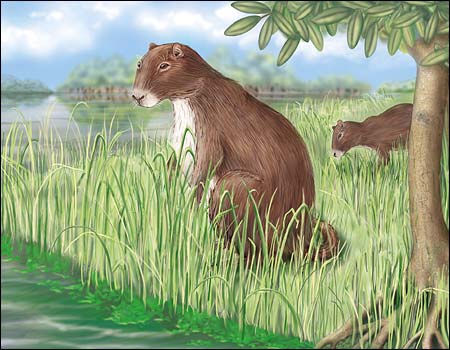
The fossil remains of a gigantic rodent that looked something like a monster guinea pig have been identified by scientists in Venezuela.
The 700-kilogram beast - about the size of a buffalo - lived among the reeds and grasses of an ancient river system that threaded its way into the Caribbean Sea eight million years ago.
Researchers think the creature, which was 10 times as big as today's largest rodents, could have run in huge packs.
Evidence suggests it also had to dodge the constant attentions of super-sized crocodiles and carnivorous birds, which stood three metres tall.
The biggest
The discovery of "Guinea-zilla", as some have already dubbed it, is reported in the journal Science.
...
"Urumaco was a place of giants eight million years ago," he said. "The world's largest turtle - three metres long - was found there. It had some of the largest crocs ever seen and there are undescribed fish that were also three metres long."
http://news.bbc.co.uk/2/hi/science/nature/3120950.stm
The 700-kilogram beast - about the size of a buffalo - lived among the reeds and grasses of an ancient river system that threaded its way into the Caribbean Sea eight million years ago.
Researchers think the creature, which was 10 times as big as today's largest rodents, could have run in huge packs.
Evidence suggests it also had to dodge the constant attentions of super-sized crocodiles and carnivorous birds, which stood three metres tall.
The biggest
The discovery of "Guinea-zilla", as some have already dubbed it, is reported in the journal Science.
...
"Urumaco was a place of giants eight million years ago," he said. "The world's largest turtle - three metres long - was found there. It had some of the largest crocs ever seen and there are undescribed fish that were also three metres long."
http://news.bbc.co.uk/2/hi/science/nature/3120950.stm
Ahimsa, animal rights and spirituality
by Claudette Vaughan
Ahimsa, or ‘Dynamic Compassion’ is a principle of non-harming and non-violence. Human behaviour that violates this ethical principle is seen, not only as morally wrong, but also as its original perspective as negative karma that reverts back onto the person responsible for the harm or violence done.
Possibly the most famous exponent this century was Mahatma Gandhi who was profoundly influenced by and propagated the Jain doctrine of Ahimsa. The first Jain spiritual father lived between 599 and 527 BC. He exhorted his followers to “regard every living being as thyself and hurt no one.” It was this statement that Gandhi acknowledged as pivotal to human ethics and it led him to adopt the principle of the harmless life. Ahimsa says that we have no right to inflict suffering and death onto another living creature and, that if harmlessness were the keynote of our lives, then this would do more to produce harmonious conditions than any other discipline.
Throughout the industrial revolution, the Western world is increasingly institutionalized violence towards both human and non-human species. Intensive agricultural practice (factory farming), in terms of the large number of sentient beings involved, is probably the most glaring example. For decades there has been an ongoing campaign for the abolition of battery egg production because of the cruelty to the caged hens. These animals have been deprived o their most fundamental needs such as soil and grass and are exposed to artificial light to deceive them into laying more eggs that they would do under natural conditions. Kept in these conditions the birds become aggressive because of their increased requirements for food and water and the interruption of their natural pecking order. Heat build-up in egg factories further aggravates this situation. The hens are de-beaked without the use of painkillers and unwanted male chicks are simply disposed of by gassing or suff9cation.
Anyone concerned about the welfare of animals must often feel overwhelmed by the sheer volume of negativity that assaults their sensibility on a daily basis. It is precisely at these times of disillusionment where corruption, inhumanity and chaos is ever evident that Gandhi’s influence should ring true. He did not treat every setback as an occasion to give up. He repeatedly emphasized that a person is only defeated when he/she ceases to struggle. He himself returned time and time again with new vigour into the fray.
The ultimate goal is to make the principle of Ahimsa permeate the whole of our society. This involves not only following a healthy vegetarian diet but also treating all beings with empathy and kindness in recognition of the fact that their sentience in the final analysis is no different to our own. One of the most basic laws of ecology is that every living thing exists for a reason forming part of a greater whole. For the student of Ahimsa, the concept of the environment and the earth as one body closely resonates with every aspect of reverence for life.
Our lack of understanding and the pain we directly or indirectly cause animals reflects a deep spiritual disorder in the collective psyche of our species. In the West we have been conditioned to think that big is better than small, that strong is better than weak, that fast is better than slow and that physical strength is greater than moral or spiritual strength. Gandhi wrote that, “Ahimsa is the highest duty. Even if we cannot practice it in full, we must try to understand its spirit and refrain as far as humanly possible from violence.” Perhaps inner strength requires that we endure being branded as ‘emotional’ or ‘irrational’ when we are motivated by our sense of compassion.
A major hurdle to overcome is not so much our lack of care but rather our ignorance of the plight of the animals. Fifty years ago things were very different. The farm’s trade was ‘animal husbandry’, their duty being to provide care. With factory farming animal husbandry has given way to animal science to the detriment of animal welfare. Today’s farm animals are kept in extremely over-crowded conditions and deliberately keep as immobile as possible. Applied science has found an artificial way to hasten a broiler chicken’s growth to such an extent that the vast majority of them have trouble walking or are crippled by not being able to bear their own body weight. Newborn calves are separated from their mothers and many dairy cows rest no more than three months between pregnancies. After their calf-bearing years are over, they are slaughtered to provide cheap hamburger meat. In intensive piggeries, sows sleep on bare concrete and it is not uncommon for them to be kept in small crates for their entire lives.
The challenge of Ahimsa is enormous. It encourages an active inner state of being rather than merely a passive state of refraining from violence. The intention to hurt another living being is apprehensible to the principles of Ahimsa for it is in this absence of conscious integration of compassion that we currently find ourselves. We acknowledge this situation intellectually yet we are sufficiently culturally desensitized to ignore it, allowing it to continue by default. Early peoples recognized the individual specialness of animals. They transformed our lives with their kinship, antics and even their sense of humour. These humans were at peace with the animals and spoke their language. Animals formed their totems, became their familiars and their teachers. It is that lost instinctive tie to the rhythms and patters of nature that Ahimsa exhorts us to regain.
One philosopher that has not ignored the subject of the treatment of animals is E.F. Schumacher. He observed that “there have been no sages or holy men/women in our or anybody’s history who were cruel to animals or who looked upon them as nothing but utilities and innumerable are the legends and stories which link sanctity as well as happiness with a loving kindness towards these creatures.” Modern visionaries can trace the beginning of the beef industry to the loss of the sense of the sacredness of ourselves, of others, of animals and of the earth. This loss mirrors itself as the callous and cruel exercise of power over other creatures more helpless than ourselves. There is no compassion in a science, philosophy or doctrine that ignores our interdependence with other species.
Compassion suffers miserably at the hands of big business. Per Singer’s excellent book, Animal Liberation, established that we already hold the high moral ground as our cause is just. Ahimsa training requires that we confront our indifference and lack of moral courage and acknowledge that animals have a silent dignity all of their own that we have violated.
Cornering the linchpin of our own ignorance is not an easy task. When the mystic Gurdjieff arrived in the West at the turn of the century with his message that “Man is asleep. Man is a machine”, he was misunderstood. Fortunately, as we approach the new millennium, we are more willing to reassess our values. Vegetarianism and Ahimsa are rapidly becoming a rational and ethical requirement for modern day living.
Perhaps, however, the last work should go to the animals, but since they do not speak our language they must rely on us to speak for them.
We need another and a wiser and perhaps a more mystical concept of animals. Remote from universal nature, and living by complicated artifice, man in civilization surveys the creatures through the glass of his knowledge and sees thereby a feather magnified and the whole image in distortion. We patronize them for their incompleteness, for their tragic fate of having taken form so far below ourselves. And therein we err, we greatly err. For the animals shall not be measure by man. In a world older and more complete, gifted with extension of the senses we have lost or never attained, living by voices we shall never hear. They are not brethren, they are not underlings. They are other nations, caught with ourselves in the net of life and time, fellow prisoners of the splendour and travail of the earth. – Henry Beston
http://www.veg.ca/lifelines/mayjun/ahimsa.htm
by Claudette Vaughan
Ahimsa, or ‘Dynamic Compassion’ is a principle of non-harming and non-violence. Human behaviour that violates this ethical principle is seen, not only as morally wrong, but also as its original perspective as negative karma that reverts back onto the person responsible for the harm or violence done.
Possibly the most famous exponent this century was Mahatma Gandhi who was profoundly influenced by and propagated the Jain doctrine of Ahimsa. The first Jain spiritual father lived between 599 and 527 BC. He exhorted his followers to “regard every living being as thyself and hurt no one.” It was this statement that Gandhi acknowledged as pivotal to human ethics and it led him to adopt the principle of the harmless life. Ahimsa says that we have no right to inflict suffering and death onto another living creature and, that if harmlessness were the keynote of our lives, then this would do more to produce harmonious conditions than any other discipline.
Throughout the industrial revolution, the Western world is increasingly institutionalized violence towards both human and non-human species. Intensive agricultural practice (factory farming), in terms of the large number of sentient beings involved, is probably the most glaring example. For decades there has been an ongoing campaign for the abolition of battery egg production because of the cruelty to the caged hens. These animals have been deprived o their most fundamental needs such as soil and grass and are exposed to artificial light to deceive them into laying more eggs that they would do under natural conditions. Kept in these conditions the birds become aggressive because of their increased requirements for food and water and the interruption of their natural pecking order. Heat build-up in egg factories further aggravates this situation. The hens are de-beaked without the use of painkillers and unwanted male chicks are simply disposed of by gassing or suff9cation.
Anyone concerned about the welfare of animals must often feel overwhelmed by the sheer volume of negativity that assaults their sensibility on a daily basis. It is precisely at these times of disillusionment where corruption, inhumanity and chaos is ever evident that Gandhi’s influence should ring true. He did not treat every setback as an occasion to give up. He repeatedly emphasized that a person is only defeated when he/she ceases to struggle. He himself returned time and time again with new vigour into the fray.
The ultimate goal is to make the principle of Ahimsa permeate the whole of our society. This involves not only following a healthy vegetarian diet but also treating all beings with empathy and kindness in recognition of the fact that their sentience in the final analysis is no different to our own. One of the most basic laws of ecology is that every living thing exists for a reason forming part of a greater whole. For the student of Ahimsa, the concept of the environment and the earth as one body closely resonates with every aspect of reverence for life.
Our lack of understanding and the pain we directly or indirectly cause animals reflects a deep spiritual disorder in the collective psyche of our species. In the West we have been conditioned to think that big is better than small, that strong is better than weak, that fast is better than slow and that physical strength is greater than moral or spiritual strength. Gandhi wrote that, “Ahimsa is the highest duty. Even if we cannot practice it in full, we must try to understand its spirit and refrain as far as humanly possible from violence.” Perhaps inner strength requires that we endure being branded as ‘emotional’ or ‘irrational’ when we are motivated by our sense of compassion.
A major hurdle to overcome is not so much our lack of care but rather our ignorance of the plight of the animals. Fifty years ago things were very different. The farm’s trade was ‘animal husbandry’, their duty being to provide care. With factory farming animal husbandry has given way to animal science to the detriment of animal welfare. Today’s farm animals are kept in extremely over-crowded conditions and deliberately keep as immobile as possible. Applied science has found an artificial way to hasten a broiler chicken’s growth to such an extent that the vast majority of them have trouble walking or are crippled by not being able to bear their own body weight. Newborn calves are separated from their mothers and many dairy cows rest no more than three months between pregnancies. After their calf-bearing years are over, they are slaughtered to provide cheap hamburger meat. In intensive piggeries, sows sleep on bare concrete and it is not uncommon for them to be kept in small crates for their entire lives.
The challenge of Ahimsa is enormous. It encourages an active inner state of being rather than merely a passive state of refraining from violence. The intention to hurt another living being is apprehensible to the principles of Ahimsa for it is in this absence of conscious integration of compassion that we currently find ourselves. We acknowledge this situation intellectually yet we are sufficiently culturally desensitized to ignore it, allowing it to continue by default. Early peoples recognized the individual specialness of animals. They transformed our lives with their kinship, antics and even their sense of humour. These humans were at peace with the animals and spoke their language. Animals formed their totems, became their familiars and their teachers. It is that lost instinctive tie to the rhythms and patters of nature that Ahimsa exhorts us to regain.
One philosopher that has not ignored the subject of the treatment of animals is E.F. Schumacher. He observed that “there have been no sages or holy men/women in our or anybody’s history who were cruel to animals or who looked upon them as nothing but utilities and innumerable are the legends and stories which link sanctity as well as happiness with a loving kindness towards these creatures.” Modern visionaries can trace the beginning of the beef industry to the loss of the sense of the sacredness of ourselves, of others, of animals and of the earth. This loss mirrors itself as the callous and cruel exercise of power over other creatures more helpless than ourselves. There is no compassion in a science, philosophy or doctrine that ignores our interdependence with other species.
Compassion suffers miserably at the hands of big business. Per Singer’s excellent book, Animal Liberation, established that we already hold the high moral ground as our cause is just. Ahimsa training requires that we confront our indifference and lack of moral courage and acknowledge that animals have a silent dignity all of their own that we have violated.
Cornering the linchpin of our own ignorance is not an easy task. When the mystic Gurdjieff arrived in the West at the turn of the century with his message that “Man is asleep. Man is a machine”, he was misunderstood. Fortunately, as we approach the new millennium, we are more willing to reassess our values. Vegetarianism and Ahimsa are rapidly becoming a rational and ethical requirement for modern day living.
Perhaps, however, the last work should go to the animals, but since they do not speak our language they must rely on us to speak for them.
We need another and a wiser and perhaps a more mystical concept of animals. Remote from universal nature, and living by complicated artifice, man in civilization surveys the creatures through the glass of his knowledge and sees thereby a feather magnified and the whole image in distortion. We patronize them for their incompleteness, for their tragic fate of having taken form so far below ourselves. And therein we err, we greatly err. For the animals shall not be measure by man. In a world older and more complete, gifted with extension of the senses we have lost or never attained, living by voices we shall never hear. They are not brethren, they are not underlings. They are other nations, caught with ourselves in the net of life and time, fellow prisoners of the splendour and travail of the earth. – Henry Beston
http://www.veg.ca/lifelines/mayjun/ahimsa.htm
Eighty-one percent of 1,000 Americans interviewed for the poll by the Pew Initiative on Food and Biotechnology said designing biotech crops to make affordable drugs is a good idea, but just 49 percent of them believe genetically engineering animals for drugs is a good idea.
"As you go up the evolutionary ladder, people are less comfortable with genetic modification of any animals," said Michael Rodemeyer, executive director for the Pew Initiative, a research group.
...
The survey, released Thursday, said 89 percent of consumers believe that companies should be required to submit safety information to the FDA for review, and the FDA shouldn't allow it on the market until it's proven safe.
The biotechnology industry and consumer groups have been calling for a mandatory process to replace the letters of certification to increase consumer trust in biotech foods.
But Jim Maryanski, the FDA biotechnology coordinator for foods, said the current process is working fine, noting that all companies come to the agency seeking the letter for their products — an assurance for food companies.
It isn't the first time that FDA has come under scrutiny by the Pew Initiative. In January, the group questioned the adequacy of FDA regulations for reviewing the risks of transgenic fish.
The agency is assessing an application by Aqua Bounty Farms Inc., a biotech company in Waltham, Mass., to market genetically modified Atlantic salmon. The company is preparing tests to see if the fish — designed to produce less waste but grow larger and faster than their wild counterparts — would cause allergic reactions in people. That's a final stage in the approval process.
The survey was conducted by The Mellman Group and Public Opinion Strategies. Pew said it commissioned the survey to check on consumer opinion of genetic engineering
http://www.grandforks.com/mld/grandforks/news/6798578.htm
"As you go up the evolutionary ladder, people are less comfortable with genetic modification of any animals," said Michael Rodemeyer, executive director for the Pew Initiative, a research group.
...
The survey, released Thursday, said 89 percent of consumers believe that companies should be required to submit safety information to the FDA for review, and the FDA shouldn't allow it on the market until it's proven safe.
The biotechnology industry and consumer groups have been calling for a mandatory process to replace the letters of certification to increase consumer trust in biotech foods.
But Jim Maryanski, the FDA biotechnology coordinator for foods, said the current process is working fine, noting that all companies come to the agency seeking the letter for their products — an assurance for food companies.
It isn't the first time that FDA has come under scrutiny by the Pew Initiative. In January, the group questioned the adequacy of FDA regulations for reviewing the risks of transgenic fish.
The agency is assessing an application by Aqua Bounty Farms Inc., a biotech company in Waltham, Mass., to market genetically modified Atlantic salmon. The company is preparing tests to see if the fish — designed to produce less waste but grow larger and faster than their wild counterparts — would cause allergic reactions in people. That's a final stage in the approval process.
The survey was conducted by The Mellman Group and Public Opinion Strategies. Pew said it commissioned the survey to check on consumer opinion of genetic engineering
http://www.grandforks.com/mld/grandforks/news/6798578.htm

What would it take for you to agree that a mouse or monkey should suffer pain, or even die? To develop a drug to cure leukaemia? To understand why some people are hard of hearing? Or are there no scientific gains that can justify the animal's suffering?
These questions ought to be pivotal in any debate over the ethics of animal experimentation. The trouble is, the public's views aren't usually taken into account. To committed supporters of animal rights, such experiments can never be justified--even if a majority thinks otherwise. Meanwhile, the scientists involved defend the status quo because they assume that people want to see progress in medicine. "Much basic research on physiological, pathological and therapeutic processes still requires animal experimentation. Such research has provided and continues to provide the essential foundation for improvements in medical and veterinary knowledge, education and practice," said the British Association for the Advancement of Science in a 1992 statement.
In a democracy, people's views do count, of course. And we suspected that a desire for better drugs and vaccines might not necessarily translate into blanket approval for all the experiments that are sanctioned at the moment. So to work out exactly where the British public draw the line, we commissioned MORI to poll people aged 15 and over.
First, we asked half of the sample whether, on balance, they agreed or disagreed that scientists should be allowed to experiment on animals. The rest were asked the same question, but were first told: "Some scientists are developing and testing new drugs to reduce pain, or developing new treatments for life-threatening diseases such as leukaemia and AIDS. By conducting experiments on live animals, scientists believe they can make more rapid progress than would otherwise have been possible."
The "cold start" question revealed that basic attitudes to animal experimentation are distinctly hostile. Just 24 per cent of people were in favour, with 64 per cent against (see Figure).
We drew up a list of activities, and asked people to say which ones they had taken part in within the past two years or so. From their answers we could tell which "lifestyle factors" correlate most strongly with disapproval of research involving animals. Not surprisingly, the strongest views were held by people who had signed petitions on animal welfare (86 per cent disapproval), vegetarians (85 per cent) and members of animal welfare organisations (83 per cent). People who had bought "cruelty free" cosmetics, not tested on animals, also stood out: 77 per cent of them disapproved of animal experiments. More women were opposed than men: 71 per cent disapproval versus 57 per cent.
Identifying groups who support animal experimentation on the cold start question was difficult. People who said they or a close family member had taken a drug for a serious illness--and who knew this drug had been tested on animals--were more tolerant of animal experiments than most, but 52 per cent of them still disapproved. The only group who clearly backed animal research, with 62 per cent in favour, were those who had worn a fur coat or taken part in a blood sport. These people, who made up just 2 per cent of our sample, are presumably used to swimming against the tide of public opinion on animal welfare issues.
Including the preamble justifying the use of animals in medical research completely altered the picture, however. On this "warm start" question, people backed animal experimentation by a slim majority, with 45 per cent for versus 41 per cent against. This represents a swing of 22 per cent from disapproval to approval--a huge swing for a poll of this type. "The implication is that the public's mind is not made up on these issues," says Robert Worcester, chairman of MORI. "Most people are willing to be persuaded, although initially sceptical of the value of animal experimentation." The swing for women was 23 per cent; for men it was 21 per cent.
Most of our lifestyle groups were swayed by a similar amount. The largest and smallest swings were for two of the groups who were most strongly opposed to animal experiments on the cold start question. Members of animal welfare organisations held firm, with the justifying preamble producing a swing of just 14 per cent. But people who had bought cruelty-free cosmetics showed a swing of 30 per cent, and on the warm start question were almost equally divided in their responses.
The narrow majority in favour of animal research for our warm start question is slightly different from the results of other polls that have investigated public attitudes to the use of animals in medical experiments, which have tended to find a small majority against. In 1990, a Harris poll for The Observer asked: "Are you in favour of animal tests for medical drugs?" Forty-six per cent answered yes; 48 per cent said no. A similar question in a 1995 Gallup poll for The Daily Telegraph found 40 per cent in favour and 50 per cent against.
But previous polls have not tried to delve beneath these superficial attitudes to find out whether people approve of specific experiments. We selected a range of goals for animal experiments, and asked people whether they approved or disapproved: a) if animals do not suffer b) if animals are subjected to pain, illness or surgery c) if animals may die. Again, the sample was split. One half was told the experiments would be on mice, the other was told monkeys would be involved.
The Tables ("People carefully weigh the costs and benefits of individual experiments..." and "The species involved makes a difference...") show the results, which reveal that people seem to carry out a sophisticated cost-benefit analysis before deciding whether an animal experiment can be justified. The experiment's goal and whether animals will suffer in any way are the most important factors. However, people don't find experiments in which animals might die any more objectionable than those involving pain, illness or surgery.
Mice are by far the most commonly used animals in British laboratories. They were used in 1·52 million of the 2·64 million licensed procedures conducted in 1997. The results show that a majority of people are prepared to accept that mice may suffer, if this helps to fight life-threatening diseases. There were clear majorities in favour of experiments to develop an AIDS vaccine or a drug for treating childhood leukaemia. People were just as happy to support the final stages of testing to check whether drugs and vaccines are safe and effective as they were to back experiments involved earlier in their development.
But these positive views did not extend to all forms of medical research. Opinion was evenly divided over experiments to develop and test a painkilling drug if the experiment involved mice suffering pain - which is unavoidable in tests of a painkiller.
The results for the experiments investigating the sense of hearing are striking. These are exactly the sort of basic biomedical experiments that the British Association's statement on animal research was designed to defend. A large majority supported the use of mice in such experiments if they would come to no harm, but the hearing experiments showed the biggest swing towards disapproval as soon as pain, surgery or illness became involved (see Figure). If animal suffering can't be ruled out, it may be hard to convince the public of the worth of continuing the fundamental biological research on which many scientists believe medical advances depend. In 1997, this category accounted for more than 800 000 licensed procedures with animals in Britain. But it is possible that many were relatively benign, and so might win public support if they were described in detail.
Most people opposed testing cosmetics ingredients on mice, even if the mice came to no harm. These tests are already banned in Britain, but other forms of toxicity testing continue. And responses to our garden insecticide example suggest these tests do not command public support if any animal suffering is involved (see "Toxic shocker").
Experiments on monkeys were viewed much more negatively than those involving mice. Indeed, only experiments to test or develop drugs to treat childhood leukaemia were seen as justifying monkeys suffering. In Britain, experiments involving primates are very tightly controlled. Researchers must convince government officials that the knowledge to be gained justifies any suffering to the animals, and that adequate data cannot be obtained by using other species.
In practice, this means that monkeys are unlikely to be used in leukaemia research, as the disease can be studied in other animals. But attempts to develop AIDS vaccines depend heavily on experiments with related viruses in monkeys, in which some of the animals are likely to become ill. Our poll indicates that a majority of British people would oppose these experiments.
In the US, where regulations are less stringent, the goal of developing an AIDS vaccine is seen as sufficient justification for injecting chimpanzees, our nearest relatives, with potentially lethal strains of HIV ("Dying so we might live", 20 February). And while most people are probably not aware of such facts, 64 per cent of those we polled judged correctly that regulations governing animal experiments in Britain are as strict, or stricter, than those in other developed countries. Just 11 per cent thought that British rules are less strict, while 24 per cent said they didn't know.
In one respect, however, our poll reveals a disturbing gap in people's knowledge, which the British government might want to address. No prescription drug is marketed without first being tested in animals, yet people are either unaware that this is the case, or don't want to acknowledge the fact. While 35 per cent of the people we polled said they or a close family member had been prescribed a drug for a serious illness in the past two years or so, only 18 per cent of these people - 6 per cent of the total sample - knew it had been tested on animals. Significantly, this small group was more favourably disposed to animal experimentation than the larger number who said they weren't aware their drugs had been tested on animals. Indeed, with 66 per cent of them backing animal research in our "warm start" question, they were more positive about animal experiments than everyone we polled except the hunters and fur coat wearers.
While people may not be in full possession of the facts about animal research, many experiments that are licensed in Britain--including hundreds of thousands of toxicity tests and fundamental biological studies--could be banned if regulators were to follow the majority views expressed in our poll.
As the answers to the two versions of our first question have revealed, however, public opinion on animal research is not set in stone. Argument for or against particular types of experiment might swing public opinion. Our results highlight those types of experiment on which antivivisectionists might expect an abolitionist argument to receive a sympathetic hearing. Those who believe that such research should continue will need to detail the steps taken to minimise suffering, and produce compelling arguments to explain why the knowledge they expect to gain justifies using animals.
People can clearly weigh the pros and cons of animal experimentation. It's time for those who want to pursue a peaceful debate to seize the initiative.
http://www.newscientist.com/hottopics/animalexperiments/
These questions ought to be pivotal in any debate over the ethics of animal experimentation. The trouble is, the public's views aren't usually taken into account. To committed supporters of animal rights, such experiments can never be justified--even if a majority thinks otherwise. Meanwhile, the scientists involved defend the status quo because they assume that people want to see progress in medicine. "Much basic research on physiological, pathological and therapeutic processes still requires animal experimentation. Such research has provided and continues to provide the essential foundation for improvements in medical and veterinary knowledge, education and practice," said the British Association for the Advancement of Science in a 1992 statement.
In a democracy, people's views do count, of course. And we suspected that a desire for better drugs and vaccines might not necessarily translate into blanket approval for all the experiments that are sanctioned at the moment. So to work out exactly where the British public draw the line, we commissioned MORI to poll people aged 15 and over.
First, we asked half of the sample whether, on balance, they agreed or disagreed that scientists should be allowed to experiment on animals. The rest were asked the same question, but were first told: "Some scientists are developing and testing new drugs to reduce pain, or developing new treatments for life-threatening diseases such as leukaemia and AIDS. By conducting experiments on live animals, scientists believe they can make more rapid progress than would otherwise have been possible."
The "cold start" question revealed that basic attitudes to animal experimentation are distinctly hostile. Just 24 per cent of people were in favour, with 64 per cent against (see Figure).
We drew up a list of activities, and asked people to say which ones they had taken part in within the past two years or so. From their answers we could tell which "lifestyle factors" correlate most strongly with disapproval of research involving animals. Not surprisingly, the strongest views were held by people who had signed petitions on animal welfare (86 per cent disapproval), vegetarians (85 per cent) and members of animal welfare organisations (83 per cent). People who had bought "cruelty free" cosmetics, not tested on animals, also stood out: 77 per cent of them disapproved of animal experiments. More women were opposed than men: 71 per cent disapproval versus 57 per cent.
Identifying groups who support animal experimentation on the cold start question was difficult. People who said they or a close family member had taken a drug for a serious illness--and who knew this drug had been tested on animals--were more tolerant of animal experiments than most, but 52 per cent of them still disapproved. The only group who clearly backed animal research, with 62 per cent in favour, were those who had worn a fur coat or taken part in a blood sport. These people, who made up just 2 per cent of our sample, are presumably used to swimming against the tide of public opinion on animal welfare issues.
Including the preamble justifying the use of animals in medical research completely altered the picture, however. On this "warm start" question, people backed animal experimentation by a slim majority, with 45 per cent for versus 41 per cent against. This represents a swing of 22 per cent from disapproval to approval--a huge swing for a poll of this type. "The implication is that the public's mind is not made up on these issues," says Robert Worcester, chairman of MORI. "Most people are willing to be persuaded, although initially sceptical of the value of animal experimentation." The swing for women was 23 per cent; for men it was 21 per cent.
Most of our lifestyle groups were swayed by a similar amount. The largest and smallest swings were for two of the groups who were most strongly opposed to animal experiments on the cold start question. Members of animal welfare organisations held firm, with the justifying preamble producing a swing of just 14 per cent. But people who had bought cruelty-free cosmetics showed a swing of 30 per cent, and on the warm start question were almost equally divided in their responses.
The narrow majority in favour of animal research for our warm start question is slightly different from the results of other polls that have investigated public attitudes to the use of animals in medical experiments, which have tended to find a small majority against. In 1990, a Harris poll for The Observer asked: "Are you in favour of animal tests for medical drugs?" Forty-six per cent answered yes; 48 per cent said no. A similar question in a 1995 Gallup poll for The Daily Telegraph found 40 per cent in favour and 50 per cent against.
But previous polls have not tried to delve beneath these superficial attitudes to find out whether people approve of specific experiments. We selected a range of goals for animal experiments, and asked people whether they approved or disapproved: a) if animals do not suffer b) if animals are subjected to pain, illness or surgery c) if animals may die. Again, the sample was split. One half was told the experiments would be on mice, the other was told monkeys would be involved.
The Tables ("People carefully weigh the costs and benefits of individual experiments..." and "The species involved makes a difference...") show the results, which reveal that people seem to carry out a sophisticated cost-benefit analysis before deciding whether an animal experiment can be justified. The experiment's goal and whether animals will suffer in any way are the most important factors. However, people don't find experiments in which animals might die any more objectionable than those involving pain, illness or surgery.
Mice are by far the most commonly used animals in British laboratories. They were used in 1·52 million of the 2·64 million licensed procedures conducted in 1997. The results show that a majority of people are prepared to accept that mice may suffer, if this helps to fight life-threatening diseases. There were clear majorities in favour of experiments to develop an AIDS vaccine or a drug for treating childhood leukaemia. People were just as happy to support the final stages of testing to check whether drugs and vaccines are safe and effective as they were to back experiments involved earlier in their development.
But these positive views did not extend to all forms of medical research. Opinion was evenly divided over experiments to develop and test a painkilling drug if the experiment involved mice suffering pain - which is unavoidable in tests of a painkiller.
The results for the experiments investigating the sense of hearing are striking. These are exactly the sort of basic biomedical experiments that the British Association's statement on animal research was designed to defend. A large majority supported the use of mice in such experiments if they would come to no harm, but the hearing experiments showed the biggest swing towards disapproval as soon as pain, surgery or illness became involved (see Figure). If animal suffering can't be ruled out, it may be hard to convince the public of the worth of continuing the fundamental biological research on which many scientists believe medical advances depend. In 1997, this category accounted for more than 800 000 licensed procedures with animals in Britain. But it is possible that many were relatively benign, and so might win public support if they were described in detail.
Most people opposed testing cosmetics ingredients on mice, even if the mice came to no harm. These tests are already banned in Britain, but other forms of toxicity testing continue. And responses to our garden insecticide example suggest these tests do not command public support if any animal suffering is involved (see "Toxic shocker").
Experiments on monkeys were viewed much more negatively than those involving mice. Indeed, only experiments to test or develop drugs to treat childhood leukaemia were seen as justifying monkeys suffering. In Britain, experiments involving primates are very tightly controlled. Researchers must convince government officials that the knowledge to be gained justifies any suffering to the animals, and that adequate data cannot be obtained by using other species.
In practice, this means that monkeys are unlikely to be used in leukaemia research, as the disease can be studied in other animals. But attempts to develop AIDS vaccines depend heavily on experiments with related viruses in monkeys, in which some of the animals are likely to become ill. Our poll indicates that a majority of British people would oppose these experiments.
In the US, where regulations are less stringent, the goal of developing an AIDS vaccine is seen as sufficient justification for injecting chimpanzees, our nearest relatives, with potentially lethal strains of HIV ("Dying so we might live", 20 February). And while most people are probably not aware of such facts, 64 per cent of those we polled judged correctly that regulations governing animal experiments in Britain are as strict, or stricter, than those in other developed countries. Just 11 per cent thought that British rules are less strict, while 24 per cent said they didn't know.
In one respect, however, our poll reveals a disturbing gap in people's knowledge, which the British government might want to address. No prescription drug is marketed without first being tested in animals, yet people are either unaware that this is the case, or don't want to acknowledge the fact. While 35 per cent of the people we polled said they or a close family member had been prescribed a drug for a serious illness in the past two years or so, only 18 per cent of these people - 6 per cent of the total sample - knew it had been tested on animals. Significantly, this small group was more favourably disposed to animal experimentation than the larger number who said they weren't aware their drugs had been tested on animals. Indeed, with 66 per cent of them backing animal research in our "warm start" question, they were more positive about animal experiments than everyone we polled except the hunters and fur coat wearers.
While people may not be in full possession of the facts about animal research, many experiments that are licensed in Britain--including hundreds of thousands of toxicity tests and fundamental biological studies--could be banned if regulators were to follow the majority views expressed in our poll.
As the answers to the two versions of our first question have revealed, however, public opinion on animal research is not set in stone. Argument for or against particular types of experiment might swing public opinion. Our results highlight those types of experiment on which antivivisectionists might expect an abolitionist argument to receive a sympathetic hearing. Those who believe that such research should continue will need to detail the steps taken to minimise suffering, and produce compelling arguments to explain why the knowledge they expect to gain justifies using animals.
People can clearly weigh the pros and cons of animal experimentation. It's time for those who want to pursue a peaceful debate to seize the initiative.
http://www.newscientist.com/hottopics/animalexperiments/
“there have been no sages or holy men/women in our or anybody’s history who were cruel to animals or who looked upon them as nothing but utilities and innumerable are the legends and stories which link sanctity as well as happiness with a loving kindness towards these creatures."
Does that include the sages or holy men/women who historically and presently engage in animal sacrifice the world over? Is it cruel to sacrifice an animal if the animal is considered to be part of a sacred chain of being? Is it cruel to eat an animal if the animal is raised or hunted and then slaughtered and prepared by one's own hand? Is there a moral difference between small scale slaughter like the former and the mechanized mass breeding and slaughter of today?
Does that include the sages or holy men/women who historically and presently engage in animal sacrifice the world over? Is it cruel to sacrifice an animal if the animal is considered to be part of a sacred chain of being? Is it cruel to eat an animal if the animal is raised or hunted and then slaughtered and prepared by one's own hand? Is there a moral difference between small scale slaughter like the former and the mechanized mass breeding and slaughter of today?
Is there any evidence of a connection between animal cruelty and human violence?
Absolutely. Many studies in psychology, sociology, and criminology during the last 25 years have demonstrated that violent offenders frequently have childhood and adolescent histories of serious and repeated animal cruelty. The FBI has recognized the connection since the 1970s, when its analysis of the lives of serial killers suggested that most had killed or tortured animals as children. Other research has shown consistent patterns of animal cruelty among perpetrators of more common forms of violence, including child abuse, spouse abuse, and elder abuse. In fact, the American Psychiatric Association considers animal cruelty one of the diagnostic criteria of conduct disorder.
Why would anyone be cruel to animals?
There can be many reasons. Animal cruelty, like any other form of violence, is often committed by a person who feels powerless, unnoticed, and under the control of others. The motive may be to shock, threaten, intimidate, or offend others or to demonstrate rejection of society's rules. Some who are cruel to animals copy things they have seen or that have been done to them. Others see harming an animal as a safe way to get revenge on someone who cares about that animal.
http://www.hsus.org/ace/15866
Absolutely. Many studies in psychology, sociology, and criminology during the last 25 years have demonstrated that violent offenders frequently have childhood and adolescent histories of serious and repeated animal cruelty. The FBI has recognized the connection since the 1970s, when its analysis of the lives of serial killers suggested that most had killed or tortured animals as children. Other research has shown consistent patterns of animal cruelty among perpetrators of more common forms of violence, including child abuse, spouse abuse, and elder abuse. In fact, the American Psychiatric Association considers animal cruelty one of the diagnostic criteria of conduct disorder.
Why would anyone be cruel to animals?
There can be many reasons. Animal cruelty, like any other form of violence, is often committed by a person who feels powerless, unnoticed, and under the control of others. The motive may be to shock, threaten, intimidate, or offend others or to demonstrate rejection of society's rules. Some who are cruel to animals copy things they have seen or that have been done to them. Others see harming an animal as a safe way to get revenge on someone who cares about that animal.
http://www.hsus.org/ace/15866
Hey nessie, if you are against what happened in Auschwitz then stop trying to force the Jews of Israel to let millions of Palestinians exercise a "right of return" and come into Israel where the extremist portions of their population can then devote their lives to killing off or chasing away the Jews. Go right ahead and urge the Jews of Israel to end the occupation, provided RESPONSIBLE PALESTINIAN LEADERSHIP (and not arafat or hamas) gets the new power to run the state. But if Auschwitz is as disgusting to you as it should be, you should not be trying to replicate, nor should you expect the jews of israel to ever put themselves in a position where a substantial portion of their own population would dedicate their lives to killing the jews (which is exactly what hamas, islamic jihad and countless other groups, as well as the palestinian teenagers whose religious leaders have taught them to hate jews not just for israel but because they're jews) would attempt to do.
"There’s a reason people hate Israelis enough to sacrifice their own lives to kill them. Why on earth would anybody hate them that much?
Hint: it’s not because Israelis make good neighbors.
"
The reason is that Israeli's are the only non-muslim state in the region and I think we all know the lengths these koranimals will go to kill the infidels.
9-11 anyone?
Israel could be a nation of non-muslim puppies and these barbaric creatures would be literally killing themselves trying to annihilate them.
All your PC bullshit is a plague. Islam and those who follow it strictly as it's intended is THE enemy of the civilized world.
Israel is merely on the front lines of this war.
Thank God WE finally have the balls to stand up to them.
Thank God for Bush.
Hint: it’s not because Israelis make good neighbors.
"
The reason is that Israeli's are the only non-muslim state in the region and I think we all know the lengths these koranimals will go to kill the infidels.
9-11 anyone?
Israel could be a nation of non-muslim puppies and these barbaric creatures would be literally killing themselves trying to annihilate them.
All your PC bullshit is a plague. Islam and those who follow it strictly as it's intended is THE enemy of the civilized world.
Israel is merely on the front lines of this war.
Thank God WE finally have the balls to stand up to them.
Thank God for Bush.
From an athiestic/secular perspective it is arbitrary to say that humans are things that must be protected and given rights and that animals (for example chimpanzees) should be denied such rights. (on what grounds would you judge who deserves rights and who doesnt?)
However it is also clear that one cannot give the same rights to the animals as one gives to the humans.
The argument that animal testing of treatments for diseases is needed is relevant in that a human might be valued above an animal but brings up the problem that human testing of the same treatments would be infinitly superior.
However it is also clear that one cannot give the same rights to the animals as one gives to the humans.
The argument that animal testing of treatments for diseases is needed is relevant in that a human might be valued above an animal but brings up the problem that human testing of the same treatments would be infinitly superior.
"However it is also clear that one cannot give the same rights to the animals as one gives to the humans. "
Some animal rights activists probably think that animals and humans should have the same rights. Its not an irrational belief so you cant argue with it. Its usually more talk than anything else since few people would not kill a tape worm or let bugs run rampant in their home (even if they dont kill them they are not giving them the "right" to have equal access to the fridge).
The morality of treatment of animals at mass factory farms, rights of corporations to use mammals to test cosmetics etc... are moral arguments that cant be won through argumentation. That said, the moral views of animal rights activists are not that extreme. If most Americans saw the conditions in many factory farms or the lack of concern for pain in cosmetic testing many people would change their political views. But its hardly a black and white issue; as the New Scientist study mentioned above show, most people hold views that depend on the actual case of the animal study.
There is of course the secondary issue of corporate and personal rights. When does society have the right to regulate personal and corporate behavior? When should the public have the right to decide on what should and shouldnt be allowed? Few people have consistent views on this. Many Republicans feel that society has a right to regulate abortion. Many liberals feel society has a right to regulate mistreatment of workers. Many liberals, radicals and conservatives may oppose something morally (like sexism and violence in movies) but feel that society has no right to regulate the content if it doesnt cross some sortof line. Note that I say society rather than government since I want to include anarchists in this discussion (and really there is little difference something being banned by law or banned by threat or harassment). While anarchists may oppose government most would still feel that society (maybe just friends) has a right to step in if a woman is stuck in an abusive relationship or there is a clear case of sexual abuse of a child. When it comes to animal rights the current state of things is that many companies are allowed to treat animals in ways that most of the public would find immoral, but most of the public doesnt seem to support more regulation. At the same time the public does support regulation of private treatment of animals and its a top news story when a pet is severely abused. Is it ok that the public has fewer rights than corporations (who in many cases have publically aproved charters)? Shouldnt it be the other way around? Does it matter that the public seems to care little about either the lack of regulations or the violence by groups like ALF?
Animal rights isnt purely a moral issue or a choice issue but both aspects should be taken into account. Arguments that revolve around the morality and nonspecific cases can lead nowhere since morality is something that sits on its own foundations.
Some animal rights activists probably think that animals and humans should have the same rights. Its not an irrational belief so you cant argue with it. Its usually more talk than anything else since few people would not kill a tape worm or let bugs run rampant in their home (even if they dont kill them they are not giving them the "right" to have equal access to the fridge).
The morality of treatment of animals at mass factory farms, rights of corporations to use mammals to test cosmetics etc... are moral arguments that cant be won through argumentation. That said, the moral views of animal rights activists are not that extreme. If most Americans saw the conditions in many factory farms or the lack of concern for pain in cosmetic testing many people would change their political views. But its hardly a black and white issue; as the New Scientist study mentioned above show, most people hold views that depend on the actual case of the animal study.
There is of course the secondary issue of corporate and personal rights. When does society have the right to regulate personal and corporate behavior? When should the public have the right to decide on what should and shouldnt be allowed? Few people have consistent views on this. Many Republicans feel that society has a right to regulate abortion. Many liberals feel society has a right to regulate mistreatment of workers. Many liberals, radicals and conservatives may oppose something morally (like sexism and violence in movies) but feel that society has no right to regulate the content if it doesnt cross some sortof line. Note that I say society rather than government since I want to include anarchists in this discussion (and really there is little difference something being banned by law or banned by threat or harassment). While anarchists may oppose government most would still feel that society (maybe just friends) has a right to step in if a woman is stuck in an abusive relationship or there is a clear case of sexual abuse of a child. When it comes to animal rights the current state of things is that many companies are allowed to treat animals in ways that most of the public would find immoral, but most of the public doesnt seem to support more regulation. At the same time the public does support regulation of private treatment of animals and its a top news story when a pet is severely abused. Is it ok that the public has fewer rights than corporations (who in many cases have publically aproved charters)? Shouldnt it be the other way around? Does it matter that the public seems to care little about either the lack of regulations or the violence by groups like ALF?
Animal rights isnt purely a moral issue or a choice issue but both aspects should be taken into account. Arguments that revolve around the morality and nonspecific cases can lead nowhere since morality is something that sits on its own foundations.
Some animal rights activists probably think that animals and humans should have the same rights. Its not an irrational belief so you cant argue with it. Its usually more talk than anything else since few people would not kill a tape worm or let bugs run rampant in their home (even if they dont kill them they are not giving them the "right" to have equal access to the fridge).
you should be writing for Leno!
you should be writing for Leno!
Unfortunatly morals are not like physics. They are contextual and almost all (if not all) of them can be proven to be absurd when taken to their extreme.
Someone above mentioned starvation in Africa and animal rights activists promoting veganism against the corporate beef/chicken industry..
There is a direct correlation between increased meat consumption in first world nations and increased starvation in third world nations. Corporations like McDonalds are notorious for using beef that was raised in South America and other former rainforests..
The cattle ranches of third world nations are former rainforests. This beef is exported into first world nations like America, were many people are encouraged to eat beef by corporate McMedia propaganda. This cheap beef causes working class Americans higher rates of heart disease, diabetes and high blood pressure. The starvation of people in third world countries is a result of the land consumption of cattle grazing and the lack of forest where indigenous people used to live and survive..
There's something in biology called the trophic pyramid. Basically 90 percent of energy is lost when converting from plant to cattle to human. Much of the alfalfa grown for cattle is lost as heat (methane) and this ties up valuable land that could be used to grow crops for direct human consumption without the transition phase of beef..
With 8 billion people on the planet, we cannot all eat meat. We need to recognize the effect of beef consumption on starvation in third world nations..
Vegans are abstaining from meat for moral reasons..
..to prevent animal cruelty and also to prevent starvation of third world people as a result of corporate cattle eating up their forests for export to first world fast food..
..people are starving because of corporate McTheft
There is a direct correlation between increased meat consumption in first world nations and increased starvation in third world nations. Corporations like McDonalds are notorious for using beef that was raised in South America and other former rainforests..
The cattle ranches of third world nations are former rainforests. This beef is exported into first world nations like America, were many people are encouraged to eat beef by corporate McMedia propaganda. This cheap beef causes working class Americans higher rates of heart disease, diabetes and high blood pressure. The starvation of people in third world countries is a result of the land consumption of cattle grazing and the lack of forest where indigenous people used to live and survive..
There's something in biology called the trophic pyramid. Basically 90 percent of energy is lost when converting from plant to cattle to human. Much of the alfalfa grown for cattle is lost as heat (methane) and this ties up valuable land that could be used to grow crops for direct human consumption without the transition phase of beef..
With 8 billion people on the planet, we cannot all eat meat. We need to recognize the effect of beef consumption on starvation in third world nations..
Vegans are abstaining from meat for moral reasons..
..to prevent animal cruelty and also to prevent starvation of third world people as a result of corporate cattle eating up their forests for export to first world fast food..
..people are starving because of corporate McTheft
Soy, guilty as beef:
http://makeashorterlink.com/?B39B217F5
Relentless Foe of the Amazon Jungle: Soybeans
By LARRY ROHTER
UIABÁ, Brazil — It takes only a trip on the busy but rutted highway that leads north from here to understand how an area of the Amazon jungle larger than New Jersey could have been razed over the course of just a year.
Where the jungle once offered shelter to parrots and deer, the land is now increasingly being cleared for soybeans, Brazil's hottest cash crop.
Soy cultivation is booming, driven by a coincidence of global demand from as far off as China and the local politics of state where the new governor was known as the Soybean King even before his election last October.
Today soybeans are eating up larger and larger chunks of the Amazon, leading to a 40 percent jump in deforestation last year, to nearly 10,000 square miles. Even the pastures where cows grazed until recently are being converted, pushing a cattle herd that has become the world's largest even deeper into the agricultural frontier.
"The new factor in the equation of Amazon deforestation is clearly soybeans and the appeal they hold for agribusiness," Stephan Schwartzmann, director of the Washington-based group Environmental Defense, said after a visit to the region in July.
A dry season that was unusually parched also appears to have figured in the surge in deforestation from August 2001 to July 2002, according to the country's National Institute for Space Research. So did a certain laxness in law enforcement, traditional during an election year, and a weak currency that made farming for export especially attractive, analysts have suggested.
But experts are unanimous in warning that as soybean farming continues to spread through the adjacent southern Amazon states of Mato Grosso and Pará, the threat to the Amazon ecological system is likely to worsen in the next few years.
Environmental groups had hoped that Brazil's left-wing president, Luiz Inácio Lula da Silva, would take steps to combat deforestation. But Mr. da Silva has instead emphasized increasing agricultural production to swell exports and feed the urban poor, a position that has earned him criticism even from allies.
"The Amazon is not untouchable," Mr. da Silva said during a visit to the region in July. That view is strongly supported by Blairo Maggi, the new governor here in the state of Mato Grosso, who has repeatedly dismissed any concerns about deforestation.
Mr. Maggi, elected last year as the candidate of the Popular Socialist Party, and his family own one of Brazil's largest soy producers, transporters and exporters. The Soybean King, as the Brazilian press is fond of calling him, advocates soybeans as an engine of growth and development in the Amazon.
In fact, Mr. Maggi has called for nearly tripling the area planted with soybeans during the next decade in Mato Grosso, whose name means dense jungle. His own company, Grupo Maggi, announced early this year that it intended to double the area it has in production.
"To me, a 40 percent increase in deforestation doesn't mean anything at all, and I don't feel the slightest guilt over what we are doing here," Mr. Maggi said in an interview at his office here in Cuiabá, the capital of Mato Grosso. "We're talking about an area larger than Europe that has barely been touched, so there is nothing at all to get worried about."
Economists say that the main spur to the soybean boom is the emergence of a middle class in China, much of whose newly disposable income has been spent on a richer, more varied diet. During the past decade, China has been transformed from a net exporter of soybeans to the world's largest importer in some years of whole soybeans as well as oil and meal byproducts.
At the same time, the recent outbreak of mad cow disease in Europe has led to a sharp shift away from using ground-up animal body parts in feed, further increasing demand for soy protein for cattle and pigs.
Initially, the planting was focused in savanna in the area that the Brazilian government defines as Legal Amazonia, but which is not truly forest. But as soy prices rise, producers are pushing northward into the heart of the Amazon, especially along the 1,100-mile highway called BR163, which links this city to the Amazon port of Santarém.
With Mr. da Silva's support, state governments in the Amazon are pushing to complete the paving of highway BR163, which scientists and economists say would accelerate both deforestation and soy cultivation. Mr. Maggi said an agreement had been reached to split the paving costs among private interests and the state and federal governments.
Mr. Maggi rejected the argument advanced by his critics that there is an inherent conflict of interest between his roles as governor and businessman. "It's no secret that I want to build roads and expand agricultural production," he said. "The people voted for that, so I don't see the problem."
The soybean producers who backed Mr. Maggi have been calling for some jungle areas to be reclassified as transitional land or savanna. Brazilian law permits landowners to raze trees and brush and plant crops on 20 percent of their jungle holdings, but that figure rises to 50 percent in transitional areas and 65 percent in savannas.
During the interview, Mr. Maggi argued that the goal of more than doubling soybean production in his state over the next decade could be achieved "if we take full advantage of the deforestation ceiling of 20 percent without going beyond it." But most Brazilian and foreign experts disagree.
"It would be impossible for them to do that within the law" as currently written, said Dan Nepstad, an American scientist with the Amazon Institute for Environmental Research in Belém. "I suspect that is why they now want to play with the land classification scheme."
Much of last year's deforestation produced clouds of smoke so thick that some airplane flights had to be canceled. But beyond fouling the air with jungle burning, the rapid expansion of soybean production has also contributed to pollution of watersheds that feed into the Amazon, threatening isolated tribes.
Mr. Maggi says any pollution and deforestation problems are largely caused by thousands of poor families from other regions of Brazil that the federal government has settled on homesteads in remote areas of this frontier state.
Recent government research, however, indicates that only 17 percent of deforestation can be attributed to small peasant farmers trying to feed themselves.
http://makeashorterlink.com/?B39B217F5
Relentless Foe of the Amazon Jungle: Soybeans
By LARRY ROHTER
UIABÁ, Brazil — It takes only a trip on the busy but rutted highway that leads north from here to understand how an area of the Amazon jungle larger than New Jersey could have been razed over the course of just a year.
Where the jungle once offered shelter to parrots and deer, the land is now increasingly being cleared for soybeans, Brazil's hottest cash crop.
Soy cultivation is booming, driven by a coincidence of global demand from as far off as China and the local politics of state where the new governor was known as the Soybean King even before his election last October.
Today soybeans are eating up larger and larger chunks of the Amazon, leading to a 40 percent jump in deforestation last year, to nearly 10,000 square miles. Even the pastures where cows grazed until recently are being converted, pushing a cattle herd that has become the world's largest even deeper into the agricultural frontier.
"The new factor in the equation of Amazon deforestation is clearly soybeans and the appeal they hold for agribusiness," Stephan Schwartzmann, director of the Washington-based group Environmental Defense, said after a visit to the region in July.
A dry season that was unusually parched also appears to have figured in the surge in deforestation from August 2001 to July 2002, according to the country's National Institute for Space Research. So did a certain laxness in law enforcement, traditional during an election year, and a weak currency that made farming for export especially attractive, analysts have suggested.
But experts are unanimous in warning that as soybean farming continues to spread through the adjacent southern Amazon states of Mato Grosso and Pará, the threat to the Amazon ecological system is likely to worsen in the next few years.
Environmental groups had hoped that Brazil's left-wing president, Luiz Inácio Lula da Silva, would take steps to combat deforestation. But Mr. da Silva has instead emphasized increasing agricultural production to swell exports and feed the urban poor, a position that has earned him criticism even from allies.
"The Amazon is not untouchable," Mr. da Silva said during a visit to the region in July. That view is strongly supported by Blairo Maggi, the new governor here in the state of Mato Grosso, who has repeatedly dismissed any concerns about deforestation.
Mr. Maggi, elected last year as the candidate of the Popular Socialist Party, and his family own one of Brazil's largest soy producers, transporters and exporters. The Soybean King, as the Brazilian press is fond of calling him, advocates soybeans as an engine of growth and development in the Amazon.
In fact, Mr. Maggi has called for nearly tripling the area planted with soybeans during the next decade in Mato Grosso, whose name means dense jungle. His own company, Grupo Maggi, announced early this year that it intended to double the area it has in production.
"To me, a 40 percent increase in deforestation doesn't mean anything at all, and I don't feel the slightest guilt over what we are doing here," Mr. Maggi said in an interview at his office here in Cuiabá, the capital of Mato Grosso. "We're talking about an area larger than Europe that has barely been touched, so there is nothing at all to get worried about."
Economists say that the main spur to the soybean boom is the emergence of a middle class in China, much of whose newly disposable income has been spent on a richer, more varied diet. During the past decade, China has been transformed from a net exporter of soybeans to the world's largest importer in some years of whole soybeans as well as oil and meal byproducts.
At the same time, the recent outbreak of mad cow disease in Europe has led to a sharp shift away from using ground-up animal body parts in feed, further increasing demand for soy protein for cattle and pigs.
Initially, the planting was focused in savanna in the area that the Brazilian government defines as Legal Amazonia, but which is not truly forest. But as soy prices rise, producers are pushing northward into the heart of the Amazon, especially along the 1,100-mile highway called BR163, which links this city to the Amazon port of Santarém.
With Mr. da Silva's support, state governments in the Amazon are pushing to complete the paving of highway BR163, which scientists and economists say would accelerate both deforestation and soy cultivation. Mr. Maggi said an agreement had been reached to split the paving costs among private interests and the state and federal governments.
Mr. Maggi rejected the argument advanced by his critics that there is an inherent conflict of interest between his roles as governor and businessman. "It's no secret that I want to build roads and expand agricultural production," he said. "The people voted for that, so I don't see the problem."
The soybean producers who backed Mr. Maggi have been calling for some jungle areas to be reclassified as transitional land or savanna. Brazilian law permits landowners to raze trees and brush and plant crops on 20 percent of their jungle holdings, but that figure rises to 50 percent in transitional areas and 65 percent in savannas.
During the interview, Mr. Maggi argued that the goal of more than doubling soybean production in his state over the next decade could be achieved "if we take full advantage of the deforestation ceiling of 20 percent without going beyond it." But most Brazilian and foreign experts disagree.
"It would be impossible for them to do that within the law" as currently written, said Dan Nepstad, an American scientist with the Amazon Institute for Environmental Research in Belém. "I suspect that is why they now want to play with the land classification scheme."
Much of last year's deforestation produced clouds of smoke so thick that some airplane flights had to be canceled. But beyond fouling the air with jungle burning, the rapid expansion of soybean production has also contributed to pollution of watersheds that feed into the Amazon, threatening isolated tribes.
Mr. Maggi says any pollution and deforestation problems are largely caused by thousands of poor families from other regions of Brazil that the federal government has settled on homesteads in remote areas of this frontier state.
Recent government research, however, indicates that only 17 percent of deforestation can be attributed to small peasant farmers trying to feed themselves.
"Soy, guilty as beef: "
Are those soybeans being grown to feed people as a high protein food source?
Nope.
Most soybeans are grown for oil and animal feed.
http://www.ncsoy.org/How_are_Soybeans_Used_/how_are_soybeans_used_.htm
The reason meat eaters are worse on the environment than vegetarians is mainly due to the amount of food grown for animal feed.
" If we take into account the large amounts of feed that highly productive animals need to eat, it has been calculated that 1 kg of animal protein typically takes 100 times as much water to produce as 1 kg of plant protein. To take the example of beef, the production of 1 kg of beef would need 100 kg of forage and 4 kg of grain. This means that the production of 1 kg of beef takes between 100,000 and 200,000 litres of water, depending on the growing conditions. 87% of the fresh water consumed worldwide is used for agriculture. Clearly meat production is a very inefficient use of water"
http://www.ivu.org/congress/2002/texts/david2.html
""Animal farming is the most environmentally costly way of feeding the world. The production of animal protein is a highly inefficient use of land and water resources. Farm animals convert plant protein to animal protein with a low efficiency - typically around 30 - 40 % and only 8% in the case of beef production. Four kg of grain fed to a pig produces one kg of pork. An estimate from Cornell University is that the water requirement for beef production is over 50 times as much as for rice production and 100 times as much as for wheat production. The United States Union of Concerned Scientists has concluded that halving the average US household’s meat consumption would reduce food-related land use by 30% and water pollution by 24%. Compassion in World Farming Trust’s recent book, The Meat Business, argues that global factory farming could lead to environmental and social devastation. In the next two decades the problem of how to feed at least 8 billion people while protecting our natural resources of land, water, air and wild species will become increasingly urgent. The spread of intensive animal farming throughout the world cannot be seen as a sustainable solution.""
http://www.ivu.org/congress/2002/texts/david2.html
Are those soybeans being grown to feed people as a high protein food source?
Nope.
Most soybeans are grown for oil and animal feed.
http://www.ncsoy.org/How_are_Soybeans_Used_/how_are_soybeans_used_.htm
The reason meat eaters are worse on the environment than vegetarians is mainly due to the amount of food grown for animal feed.
" If we take into account the large amounts of feed that highly productive animals need to eat, it has been calculated that 1 kg of animal protein typically takes 100 times as much water to produce as 1 kg of plant protein. To take the example of beef, the production of 1 kg of beef would need 100 kg of forage and 4 kg of grain. This means that the production of 1 kg of beef takes between 100,000 and 200,000 litres of water, depending on the growing conditions. 87% of the fresh water consumed worldwide is used for agriculture. Clearly meat production is a very inefficient use of water"
http://www.ivu.org/congress/2002/texts/david2.html
""Animal farming is the most environmentally costly way of feeding the world. The production of animal protein is a highly inefficient use of land and water resources. Farm animals convert plant protein to animal protein with a low efficiency - typically around 30 - 40 % and only 8% in the case of beef production. Four kg of grain fed to a pig produces one kg of pork. An estimate from Cornell University is that the water requirement for beef production is over 50 times as much as for rice production and 100 times as much as for wheat production. The United States Union of Concerned Scientists has concluded that halving the average US household’s meat consumption would reduce food-related land use by 30% and water pollution by 24%. Compassion in World Farming Trust’s recent book, The Meat Business, argues that global factory farming could lead to environmental and social devastation. In the next two decades the problem of how to feed at least 8 billion people while protecting our natural resources of land, water, air and wild species will become increasingly urgent. The spread of intensive animal farming throughout the world cannot be seen as a sustainable solution.""
http://www.ivu.org/congress/2002/texts/david2.html
IS the 8 billion people. We need to reduce our numbers, not expand them. The carrying capacity of this planet is being strained beyond limits. With a rasonable population level, anybody who wanted to eat meat could eat as much as they want with no harm to the environment and without taking food out of anybody's mouth. Anybody who didn't want to eat meat, could abstain without having to feel justified in trying to impose their tastes on the rest of us.
Meat eating is not the problem. We are the problem. There are simply too many of us. We need to put limits on our breeding, and soon, very soon. If we don't, meat or no meat, we're in deep, deep trouble.
Meat eating is not the problem. We are the problem. There are simply too many of us. We need to put limits on our breeding, and soon, very soon. If we don't, meat or no meat, we're in deep, deep trouble.
For more information:
http://www.dieoff.org/
We are 100% volunteer and depend on your participation to sustain our efforts!
Donate

$110.00 donated
in the past month
Get Involved
If you'd like to help with maintaining or developing the website, contact us.
Publish
Publish your stories and upcoming events on Indybay.
Topics
More
Search Indybay's Archives
Advanced Search
►
▼
IMC Network