







 Publish to Newswire
 Add an Event
From the Open-Publishing Calendar
From the Open-Publishing Newswire
Indybay Feature
Kucinich: The Real Soul of The Democratic Party
"We're ALREADY PAYING for universal healthcare. We're just NOT GETTING IT ... More deductibles, higher co-pays, less access. This is the trend. The ONLY way to freeze costs is for a single-payer system that cares for everyone. Take the profits out so these companies don't have their hands on your wallet!"
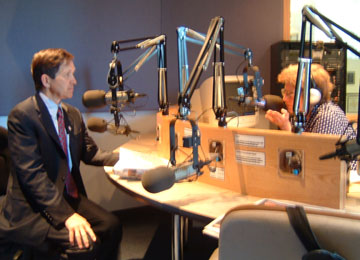
Dennis Kucinich: the real soul of the Democratic Party?
Wednesday 20 August @ 12:33:52
an interview and profile by Lydia Howell
photos by Jonathan Miller
The best-kept secret on the Democratic presidential campaign trail ignited St. Paul's Central High School auditorium August 16, bringing the almost 1000-strong crowd repeatedly to its feet, cheering.
Supporters of Rep. Dennis Kucinich (D-Ohio) defy definition, spanning independents, Greens, veterans, students, peace activists, consumers and environmentalists. Doubts about his "electability" are greatly exaggerated—Kucinich won by 70 percent in 2001 in a traditionally Republican district. Willie Nelson is recording campaign ads for him
and doing concert fundraisers with Ani DiFranco in Des Moines, Iowa, in early September. Grassroots campaign organizations are spreading like smoldering prairie fire across the country.
Lydia Howell interviews presidential candidate Dennis Kucinich on her show "Catalyst" which airs on KFAI Aug 26 @ 11 a.m.
"When the Founders of our country spoke of `forming a more perfect union,' it wasn't just about politics. It was also about being able to be more than we are—about consciously evolving," Kucinich evoked the recurring anthem of his St. Paul speech—"It's not too late to
seek a new world!"
Kucinich knows about transformation firsthand. Growing up poor, he had 21 addresses before age 17—including a car. His ex-Marine father was a truck driver who Kucinich said "died with his first retirement
check uncashed in his pocket." The oldest of seven, Kucinich was the first in his family to go to college. Degrees in communications took him from newsroom copy boy to radio, TV cameraman and lecturer, in
between elected offices.
"First, you have to understand what Bush's presidency is about: accelerating wealth upward. Its about putting the nation's wealth into fewer and fewer hands," Kucinich said in a KFAI interview in July, pointing to post-9/11 bailouts that gave airlines billions while their employees got massive layoffs. "The Bush economy is driven by the interests of a few at the expense of the many. That's what the war and the tax cuts are about."
Kucinich joined the anti-World Trade Organization (WTO) battle in Seattle. He'll use Executive Orders to withdraw from the WTO and repeal the North American Free Trade Agreement (NAFTA) that's exported millions of American jobs to Mexican sweatshops.
"Labels like liberal, conservative, Democrat, Republican don't mean much when you look at these trade agreements. The real issue is: WHOSE side are you on? Are you on the side of multinational
corporations driving down wages, knocking out benefits, breaking unions and crushing communities when they move jobs out?" Kucinich gains momentum, not allowed in CSPAN 60-second sound-bites. "Or are you on the side of people struggling for workers' rights, human rights and environmental principles?"
Kucinich's legislation aimed to restore fairness between employees and management: enforcement of labor laws, anti-discrimination and collective bargaining. He salvaged Ohio's steel industry and kept public hospitals open. Democratic competitor, Rep. Richard Gephardt assumes entitlement to union endorsements, yet (like all the other candidates) refuses to take a stand against the obviously destructive NAFTA.
Challenging corporate power has been Kucinich's quest since he became the youngest (31) mayor of a major city (Cleveland) in the late 1970s. Inheriting financial crisis of misspent bonds, he faced a
corporate power-play: pressure to privatize the public Muny Electric utility, backed up by banks threatening to call in city loans if Kucinich didn't capitulate. "It was extortion," he says. Kucinich refused, loans were pulled, resulting in Cleveland's bankruptcy and
Kucinich's loss of his re-election bid. Now, even his detractors concede he was right, as California's power outages and rate hikes proved privatization failed [for more on this see "After the Blackout are We Still in the Dark?]. Kucinich noted in St. Paul the recent Northeast/Canada power shutdown (being traced to Ohio) was another example of "profits at the expense of public interest."
Is Kucinich the democratic Don Quixote?
It took almost 15 years for Kucinich's resolute integrity to create a political come back outshining Clinton's. From state senator to three terms in Congress, Kucinich put a light bulb on his campaign signs:
perhaps, partly a poke at the powerful, but also easily interpreted as symbolizing his commitment to illuminating corporate misdeeds while raising fresh hopeful ideas.
"We're ALREADY PAYING for universal healthcare. We're just NOT GETTING IT," Kucinich goes to the heart of the 2004 campaign's "banner issue": healthcare. Current U.S. spending is 14 percent of GNP on healthcare, Kucinich explained, projected to rise to 18 percent within 10 years—even without expanding access. "Insurance keeps going up. What do insurance companies do? They make money by EXCLUDING coverage. Everyone knows this. More
deductibles, higher co-pays, less access. This is the trend. The ONLY way to freeze costs is for a single-payer system that cares for everyone. Take the profits out so these companies don't have their hands on your wallet!"
A new study by the Journal of the American Medical Association (JAMA) backs up Kucinich by concluding that our healthcare is a "diseased system" which sacrifices public health.
Kucinich quietly relates the devil's bargains made by families with a health crisis: homes mortgaged, retirement funds liquidated, children's college savings spent. Anger and sorrow mingle in Kucinich's voice, "Even if you're insured now, there's no guarantee you'll be able to continue to afford it. There's no guarantee you won't get the call—`We don't cover that anymore. SORRY. You're EXCLUDED!' We're in a moment in our country's economic evolution, where a market-based approach to healthcare is immoral. That people are excluded from survival is fundamentally wrong in a democracy."
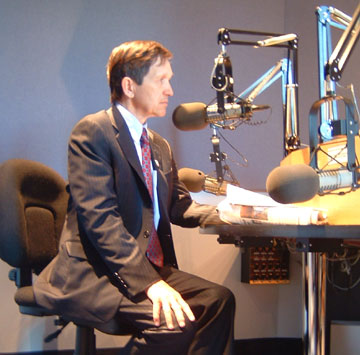
The KFAI studio is somber and I'm struck by Kucinich's unmistakable empathy. Was his working-class father's early death (like 44 million uninsured Americans) another casualty of corporate profiteering?
While other Democrats tinker with cosmetic changes, Kucinich is the only candidate proposing universal, single-payer healthcare, including dental, vision-care, mental health and long-term care. JAMA's study announced last week that 8,000 doctors agree that
Kucinich's plan is the only solution for both containing costs and alarming health disparities. One doctor disagrees: Howard Dean says "it can't pass," and his plan leaves healthcare under corporate control.
"Those saying `it won't pass' are conceding that this system is so corrupt that we're all captive to it!" Kucinich retorts. "I'll challenge the insurance and drug companies to do what's right for the American people. WE don't exist for them. THEY exist for us." The more one hears Kucinich speak and researches his record, a pattern emerges: a practical visionary, taking on the "big issues" and linking them to impacts on ordinary citizens' lives. While other Democrats waffle or evade about Bush's tax cuts and war, Kucinich
remains a David boldly challenging Goliath, declaring. "When they say tax cuts what they really mean is giveaways to the wealthy who don't
need it and service cuts." Kucinich observes that under Bush, 2.5 million jobs have disappeared. "In Minnesota, that's meant 125,000—96,000 after the FIRST tax cut! It's wealth concentrated into fewer
and fewer hands and we have less democracy."
He leaps to the Patriot Act: "As the Administration has propelled fear, they've become more powerful and the American people have become less powerful. With less power politically and economically, you have a population easier to manipulate and control." He told the St. Paul rally he would repeal the Patriot Act by Executive Order.
Besides opposing the Iraq war resolution "supporting the troops" that Congress passed, Kucinich is fighting the simultaneous and hypocritical cuts to veterans' services that are traveling through Congress right now. He initiated restoring retired veterans healthcare and co-sponsored a bill allocating 20 percent of public
housing for the nation's 200,000 homeless veterans. At the same time, he is leading the charge demanding an investigation of Bush's use of intelligence that misled Congress and the public to support invading
Iraq.
Says Kucinich about the war in Iraq, "Think about why this country went to war. Iraq was not responsible for 9/11, had no connection to Al-Qaeda. Iraq had no connection to the anthrax attack. Iraq had no weapons of mass destruction to immediately deploy against the United States." Kucinich's reasoning is as methodical as a bricklayer. "Was it about the defense of this nation? Or was it about a power grab ... and oil? I think we still need to have this debate."
"We're ALREADY PAYING for universal healthcare. We're just NOT GETTING IT ... More deductibles, higher co-pays, less access. This is the trend. The ONLY way to freeze costs is for a single-payer system
that cares for everyone. Take the profits out so these companies don't have their hands on your wallet!"
Kucinich exposes budgets bloated by defense contractors' cost over-runs and waste while working on a subcommittee for oversight of military budgets. The Pentagon reported $1.3 trillion unaccounted
for. Kucinich wants a 15 percent ($65 billion) cut in military spending.
"This Administration, cycling fear, created pretexts for war. They became more powerful as they did that. With lies and manipulations, now, they seek to totally destroy the social agenda of our nation with a military build up: $400 billion budget, 13 percent increase.
We're rapidly coming to the point where we spend more on the Pentagon than all other countries COMBINED spend on their defense! What implication does this have for our democracy?"
As he pauses, I realize no other candidates mention military budgets.
"This continued military build up will be the DEATH-knell for our democracy. They're SUCKING OUT THE OXYGEN that's needed for the economy!" he concluded. Kucinich is ranking Democrat on the National Security Committee. Vowing to cut military spending, "I'll correct this direction. We'll have a strong defense, but we ALREADY had that before 9/11. My concern is that we understand that education is part
of national defense, Healthcare is national defense. Having good jobs and full employment is national defense. Making sure veterans have the full benefits we promised them when they said they'd serve is
national defense. This is a moment for fundamental and deep change and my candidacy represents that."
In quoting Martin Luther King Jr.'s phrase "interconnected garment of destiny," Kucinich confirmed he's not just a critic. Driven by profound purpose unmatched by his Democratic rivals, Kucinich hopes for a Cabinet-level Department of Peace (already co-sponsored by 50 fellow Congress-members) exhilarated the crowd. It links both domestic problems and international relations with the goal of "making non-violence the organizing principle of our nation." He began by recognizing the national epidemic of violence against women, child abuse and youth violence and went on to advocate to expand mediation, and on the international front, to strengthen the United Nations, cooperate with other countries and to join the International Criminal Court.
Kucinich's stump-style is a half-hour speech followed by throwing himself open to audience questions. An electrifying orator, he also enjoys engaging people. Diverse issues flung from the audience revealed more of his positions.
He stated that the prison system's tripled population, largely due to a failed "drug war," should receive more treatment and rehabilitation, less incarceration. "Only violent people should be locked up." He opposes the federal death penalty.
He expressed support for sustainable energy as sound for the environment and invigorating for the economy.
Some insist Kucinich has an Achilles heel: abortion. His first two terms in Congress, he voted anti-choice. Skeptics contend he `flip-flopped' in order to seek the Democratic nomination. This reporter pressed him hard about how and why he's become pro-choice, committed to Roe as the "litmus test" for judges.
"I became increasingly disturbed about politicization by the Republican Party and moves toward the criminalization [of abortion]." Kucinich cited extremist legislation proposed to ban contraceptives. "Mostly, I listened to a lot of women. What became clear to me is this isn't only about choice. If women can't make
these decisions for themselves, they can't take their equal place in society. That's what's at stake."
Kucinich's depth on issues was further revealed in his pro-choice position, which included preventing unplanned pregnancies with access to contraceptives and sex education—both of which are under right-
wing Christian attack. Unlike anti-choice politicians
pushing "welfare reform," Kucinich sees supports for mothers and children as critical to women having real reproductive rights. Many feminists don't act beyond upholding Roe, so, I was utterly convinced of Kucinich's sincerity. His record is consistently ourageous on controversy.
Mainstream media primarily asks about Kucinich's fundraising and "electability." Unlike Sen. John Kerry's $16 million or Dean's $7 million in corporate contributions, Kucinich adheres to the campaign
finance reform he's worked to pass. In the last quarter, he raised $2 million, half on the Internet, with contributions averaging $77, indicating that it is private citizens who make up the base of his monetary support. Half of those contributors are giving money to a campaign for the first time.
"When you connect with people's hearts, money always follows," he told the rally's press conference.
Regarding "electability," U. S. Senate candidate, Minneapolis performance artist and self-proclaimed "electoral politics junkie," David Daniels has crunched the numbers. "All Kucinich needs is to win the states Al Gore won plus one more—that extra would be his home state Ohio. He doesn't even need Florida and he'd have the Electoral College votes."
Historical perspective also challenges pundits' premature judgments: At this point in the campaign process, Bill Clinton had 6 percent and Jimmy Carter didn't make the polls at all, yet, both won the White
House. Kucinich is polling 7 percent in Iowa, even without media coverage. Some call Kucinich the "Seabiscuit of 2004."
As Howard Dean expropriates Paul Wellstone's memory, a reality-check is in order: Kucinich worked closely with Wellstone in Congress' Progressive Caucus, sharing concerns and positions on issues. Some see Dean as a more genteel version of Jesse Ventura: a social libertarian, conservative on everyting else.
Beth, a Kucinich supporter, described a recent Iowa candidates' forum. "As soon as Dennis came on stage, he got a standing ovation—
before he said a single word! None of the others got close to that kind of reaction."
Deeply ethical, hard-working, informed by facts and empathy, impishly humorous: These are some impressions of the livewire Congressman from
Ohio who's kept the courage with which he began his political career. Burned through war-induced despair and Bush-generated fear, Dennis Kucinich inspired hundreds of people to imagine victory.
http://www.pulsetc.com/article.php?sid=583
Wednesday 20 August @ 12:33:52
an interview and profile by Lydia Howell
photos by Jonathan Miller
The best-kept secret on the Democratic presidential campaign trail ignited St. Paul's Central High School auditorium August 16, bringing the almost 1000-strong crowd repeatedly to its feet, cheering.
Supporters of Rep. Dennis Kucinich (D-Ohio) defy definition, spanning independents, Greens, veterans, students, peace activists, consumers and environmentalists. Doubts about his "electability" are greatly exaggerated—Kucinich won by 70 percent in 2001 in a traditionally Republican district. Willie Nelson is recording campaign ads for him
and doing concert fundraisers with Ani DiFranco in Des Moines, Iowa, in early September. Grassroots campaign organizations are spreading like smoldering prairie fire across the country.
Lydia Howell interviews presidential candidate Dennis Kucinich on her show "Catalyst" which airs on KFAI Aug 26 @ 11 a.m.
"When the Founders of our country spoke of `forming a more perfect union,' it wasn't just about politics. It was also about being able to be more than we are—about consciously evolving," Kucinich evoked the recurring anthem of his St. Paul speech—"It's not too late to
seek a new world!"
Kucinich knows about transformation firsthand. Growing up poor, he had 21 addresses before age 17—including a car. His ex-Marine father was a truck driver who Kucinich said "died with his first retirement
check uncashed in his pocket." The oldest of seven, Kucinich was the first in his family to go to college. Degrees in communications took him from newsroom copy boy to radio, TV cameraman and lecturer, in
between elected offices.
"First, you have to understand what Bush's presidency is about: accelerating wealth upward. Its about putting the nation's wealth into fewer and fewer hands," Kucinich said in a KFAI interview in July, pointing to post-9/11 bailouts that gave airlines billions while their employees got massive layoffs. "The Bush economy is driven by the interests of a few at the expense of the many. That's what the war and the tax cuts are about."
Kucinich joined the anti-World Trade Organization (WTO) battle in Seattle. He'll use Executive Orders to withdraw from the WTO and repeal the North American Free Trade Agreement (NAFTA) that's exported millions of American jobs to Mexican sweatshops.
"Labels like liberal, conservative, Democrat, Republican don't mean much when you look at these trade agreements. The real issue is: WHOSE side are you on? Are you on the side of multinational
corporations driving down wages, knocking out benefits, breaking unions and crushing communities when they move jobs out?" Kucinich gains momentum, not allowed in CSPAN 60-second sound-bites. "Or are you on the side of people struggling for workers' rights, human rights and environmental principles?"
Kucinich's legislation aimed to restore fairness between employees and management: enforcement of labor laws, anti-discrimination and collective bargaining. He salvaged Ohio's steel industry and kept public hospitals open. Democratic competitor, Rep. Richard Gephardt assumes entitlement to union endorsements, yet (like all the other candidates) refuses to take a stand against the obviously destructive NAFTA.
Challenging corporate power has been Kucinich's quest since he became the youngest (31) mayor of a major city (Cleveland) in the late 1970s. Inheriting financial crisis of misspent bonds, he faced a
corporate power-play: pressure to privatize the public Muny Electric utility, backed up by banks threatening to call in city loans if Kucinich didn't capitulate. "It was extortion," he says. Kucinich refused, loans were pulled, resulting in Cleveland's bankruptcy and
Kucinich's loss of his re-election bid. Now, even his detractors concede he was right, as California's power outages and rate hikes proved privatization failed [for more on this see "After the Blackout are We Still in the Dark?]. Kucinich noted in St. Paul the recent Northeast/Canada power shutdown (being traced to Ohio) was another example of "profits at the expense of public interest."
Is Kucinich the democratic Don Quixote?
It took almost 15 years for Kucinich's resolute integrity to create a political come back outshining Clinton's. From state senator to three terms in Congress, Kucinich put a light bulb on his campaign signs:
perhaps, partly a poke at the powerful, but also easily interpreted as symbolizing his commitment to illuminating corporate misdeeds while raising fresh hopeful ideas.
"We're ALREADY PAYING for universal healthcare. We're just NOT GETTING IT," Kucinich goes to the heart of the 2004 campaign's "banner issue": healthcare. Current U.S. spending is 14 percent of GNP on healthcare, Kucinich explained, projected to rise to 18 percent within 10 years—even without expanding access. "Insurance keeps going up. What do insurance companies do? They make money by EXCLUDING coverage. Everyone knows this. More
deductibles, higher co-pays, less access. This is the trend. The ONLY way to freeze costs is for a single-payer system that cares for everyone. Take the profits out so these companies don't have their hands on your wallet!"
A new study by the Journal of the American Medical Association (JAMA) backs up Kucinich by concluding that our healthcare is a "diseased system" which sacrifices public health.
Kucinich quietly relates the devil's bargains made by families with a health crisis: homes mortgaged, retirement funds liquidated, children's college savings spent. Anger and sorrow mingle in Kucinich's voice, "Even if you're insured now, there's no guarantee you'll be able to continue to afford it. There's no guarantee you won't get the call—`We don't cover that anymore. SORRY. You're EXCLUDED!' We're in a moment in our country's economic evolution, where a market-based approach to healthcare is immoral. That people are excluded from survival is fundamentally wrong in a democracy."
The KFAI studio is somber and I'm struck by Kucinich's unmistakable empathy. Was his working-class father's early death (like 44 million uninsured Americans) another casualty of corporate profiteering?
While other Democrats tinker with cosmetic changes, Kucinich is the only candidate proposing universal, single-payer healthcare, including dental, vision-care, mental health and long-term care. JAMA's study announced last week that 8,000 doctors agree that
Kucinich's plan is the only solution for both containing costs and alarming health disparities. One doctor disagrees: Howard Dean says "it can't pass," and his plan leaves healthcare under corporate control.
"Those saying `it won't pass' are conceding that this system is so corrupt that we're all captive to it!" Kucinich retorts. "I'll challenge the insurance and drug companies to do what's right for the American people. WE don't exist for them. THEY exist for us." The more one hears Kucinich speak and researches his record, a pattern emerges: a practical visionary, taking on the "big issues" and linking them to impacts on ordinary citizens' lives. While other Democrats waffle or evade about Bush's tax cuts and war, Kucinich
remains a David boldly challenging Goliath, declaring. "When they say tax cuts what they really mean is giveaways to the wealthy who don't
need it and service cuts." Kucinich observes that under Bush, 2.5 million jobs have disappeared. "In Minnesota, that's meant 125,000—96,000 after the FIRST tax cut! It's wealth concentrated into fewer
and fewer hands and we have less democracy."
He leaps to the Patriot Act: "As the Administration has propelled fear, they've become more powerful and the American people have become less powerful. With less power politically and economically, you have a population easier to manipulate and control." He told the St. Paul rally he would repeal the Patriot Act by Executive Order.
Besides opposing the Iraq war resolution "supporting the troops" that Congress passed, Kucinich is fighting the simultaneous and hypocritical cuts to veterans' services that are traveling through Congress right now. He initiated restoring retired veterans healthcare and co-sponsored a bill allocating 20 percent of public
housing for the nation's 200,000 homeless veterans. At the same time, he is leading the charge demanding an investigation of Bush's use of intelligence that misled Congress and the public to support invading
Iraq.
Says Kucinich about the war in Iraq, "Think about why this country went to war. Iraq was not responsible for 9/11, had no connection to Al-Qaeda. Iraq had no connection to the anthrax attack. Iraq had no weapons of mass destruction to immediately deploy against the United States." Kucinich's reasoning is as methodical as a bricklayer. "Was it about the defense of this nation? Or was it about a power grab ... and oil? I think we still need to have this debate."
"We're ALREADY PAYING for universal healthcare. We're just NOT GETTING IT ... More deductibles, higher co-pays, less access. This is the trend. The ONLY way to freeze costs is for a single-payer system
that cares for everyone. Take the profits out so these companies don't have their hands on your wallet!"
Kucinich exposes budgets bloated by defense contractors' cost over-runs and waste while working on a subcommittee for oversight of military budgets. The Pentagon reported $1.3 trillion unaccounted
for. Kucinich wants a 15 percent ($65 billion) cut in military spending.
"This Administration, cycling fear, created pretexts for war. They became more powerful as they did that. With lies and manipulations, now, they seek to totally destroy the social agenda of our nation with a military build up: $400 billion budget, 13 percent increase.
We're rapidly coming to the point where we spend more on the Pentagon than all other countries COMBINED spend on their defense! What implication does this have for our democracy?"
As he pauses, I realize no other candidates mention military budgets.
"This continued military build up will be the DEATH-knell for our democracy. They're SUCKING OUT THE OXYGEN that's needed for the economy!" he concluded. Kucinich is ranking Democrat on the National Security Committee. Vowing to cut military spending, "I'll correct this direction. We'll have a strong defense, but we ALREADY had that before 9/11. My concern is that we understand that education is part
of national defense, Healthcare is national defense. Having good jobs and full employment is national defense. Making sure veterans have the full benefits we promised them when they said they'd serve is
national defense. This is a moment for fundamental and deep change and my candidacy represents that."
In quoting Martin Luther King Jr.'s phrase "interconnected garment of destiny," Kucinich confirmed he's not just a critic. Driven by profound purpose unmatched by his Democratic rivals, Kucinich hopes for a Cabinet-level Department of Peace (already co-sponsored by 50 fellow Congress-members) exhilarated the crowd. It links both domestic problems and international relations with the goal of "making non-violence the organizing principle of our nation." He began by recognizing the national epidemic of violence against women, child abuse and youth violence and went on to advocate to expand mediation, and on the international front, to strengthen the United Nations, cooperate with other countries and to join the International Criminal Court.
Kucinich's stump-style is a half-hour speech followed by throwing himself open to audience questions. An electrifying orator, he also enjoys engaging people. Diverse issues flung from the audience revealed more of his positions.
He stated that the prison system's tripled population, largely due to a failed "drug war," should receive more treatment and rehabilitation, less incarceration. "Only violent people should be locked up." He opposes the federal death penalty.
He expressed support for sustainable energy as sound for the environment and invigorating for the economy.
Some insist Kucinich has an Achilles heel: abortion. His first two terms in Congress, he voted anti-choice. Skeptics contend he `flip-flopped' in order to seek the Democratic nomination. This reporter pressed him hard about how and why he's become pro-choice, committed to Roe as the "litmus test" for judges.
"I became increasingly disturbed about politicization by the Republican Party and moves toward the criminalization [of abortion]." Kucinich cited extremist legislation proposed to ban contraceptives. "Mostly, I listened to a lot of women. What became clear to me is this isn't only about choice. If women can't make
these decisions for themselves, they can't take their equal place in society. That's what's at stake."
Kucinich's depth on issues was further revealed in his pro-choice position, which included preventing unplanned pregnancies with access to contraceptives and sex education—both of which are under right-
wing Christian attack. Unlike anti-choice politicians
pushing "welfare reform," Kucinich sees supports for mothers and children as critical to women having real reproductive rights. Many feminists don't act beyond upholding Roe, so, I was utterly convinced of Kucinich's sincerity. His record is consistently ourageous on controversy.
Mainstream media primarily asks about Kucinich's fundraising and "electability." Unlike Sen. John Kerry's $16 million or Dean's $7 million in corporate contributions, Kucinich adheres to the campaign
finance reform he's worked to pass. In the last quarter, he raised $2 million, half on the Internet, with contributions averaging $77, indicating that it is private citizens who make up the base of his monetary support. Half of those contributors are giving money to a campaign for the first time.
"When you connect with people's hearts, money always follows," he told the rally's press conference.
Regarding "electability," U. S. Senate candidate, Minneapolis performance artist and self-proclaimed "electoral politics junkie," David Daniels has crunched the numbers. "All Kucinich needs is to win the states Al Gore won plus one more—that extra would be his home state Ohio. He doesn't even need Florida and he'd have the Electoral College votes."
Historical perspective also challenges pundits' premature judgments: At this point in the campaign process, Bill Clinton had 6 percent and Jimmy Carter didn't make the polls at all, yet, both won the White
House. Kucinich is polling 7 percent in Iowa, even without media coverage. Some call Kucinich the "Seabiscuit of 2004."
As Howard Dean expropriates Paul Wellstone's memory, a reality-check is in order: Kucinich worked closely with Wellstone in Congress' Progressive Caucus, sharing concerns and positions on issues. Some see Dean as a more genteel version of Jesse Ventura: a social libertarian, conservative on everyting else.
Beth, a Kucinich supporter, described a recent Iowa candidates' forum. "As soon as Dennis came on stage, he got a standing ovation—
before he said a single word! None of the others got close to that kind of reaction."
Deeply ethical, hard-working, informed by facts and empathy, impishly humorous: These are some impressions of the livewire Congressman from
Ohio who's kept the courage with which he began his political career. Burned through war-induced despair and Bush-generated fear, Dennis Kucinich inspired hundreds of people to imagine victory.
http://www.pulsetc.com/article.php?sid=583
Add Your Comments
We are 100% volunteer and depend on your participation to sustain our efforts!
Donate

$110.00 donated
in the past month
Get Involved
If you'd like to help with maintaining or developing the website, contact us.
Publish
Publish your stories and upcoming events on Indybay.
Topics
More
Search Indybay's Archives
Advanced Search
►
▼
IMC Network