







 Publish to Newswire
 Add an Event
From the Open-Publishing Calendar
From the Open-Publishing Newswire
Indybay Feature
War on Iraq and Its Potential Affects on the Fresno Area
THE WAR AT HOME
War on Iraq and Its Potential Affects on the Fresno Area
by Larry Taylor
The recent incursion of the United States upon Iraq has prompted Congress to consider supplemental appropriations to pay for that action. Some estimates, according to the National Priorities Project <http://www.nationalpriorities.org>, are the initial costs of that unilateral and preemptive effort may be $100 billion, with the reconstruction of Iraq requiring another $50 billion.
Taking just the $100 billion figure, the NPP estimates that California’s citizens’ share is roughly $10.2 billion, with Fresno’s pro rata share at $86,800,000 on a cash basis.
Since local, state, and federal budgets for 2004 are now being compiled, and some not readily shared or available to the general public, let us first reflect upon the known local effects of California’s recent $25 billion to $35 billion budget shortfall. Then we will compare the state and federal contributions to local government budgets to reflect upon our vulnerability to future cutbacks by either the state or federal government. Finally, we can take a look at what the federal government is proposing in its 2004 budget to see if we can expect help or more debt and fewer services for the citizens of Fresno.
Funding of schools comes largely from the state, and Fresno Unified alone expects a cut of $40,000,000 from last year’s budget, corresponding to 1000-1500 job cuts, plus cutbacks in course offerings and extracurricular activities. The Fresno Bee reported April 7, 2003 (“Supervisors to Consider Slashing 52 Jobs”) that the County of Fresno is to consider cutting 52 jobs by mid-2003, to offset a $4,400,000 budget cut. Most of the lost jobs will be in the District Attorney’s office. Important losses here are units that investigate domestic violence and child abduction cases. Another 400 job cuts are being considered in the county, depending on the state’s budget outlook in a couple months. Some state grant programs are being cut or eliminated.
The budgets of our local governments are susceptible to state and federal takeaways and further in jeopardy to the extent of leverage and dependence those grants convey. The current Fresno City budget, due to end on June 30, is to receive more than $106 million from the federal government and $79 million from the state. Overall that represents 25% of the entire city budget. The County receives nearly $450 million from federal sources and $240 million from state sources, together contributing nearly 50% of the County budget. The city provides police and fire protection; it also provides and maintains parks and recreation facilities and streets, curbs, and gutters. The county provides law enforcement outside of the cities, plus justice administration and health and welfare services for the entire county.
Just two years ago, in 2001, the federal Office of Management and Budget was predicting a federal budget surplus in ten years, by 2011, of over $5.6 trillion. This past February the OMB revised that surplus downward by almost $8 trillion, to a $2.122 trillion deficit. Projected cumulative budget deficits for the period 2004 to 2008 alone represent $1.084 trillion, not including the $100 billion in costs for the attack on Iraq, and not including further incursions in the Middle East or additional costs for reconstruction.
This drastic and rapid reduction in the projected budget surplus, from a strong positive figure to a negative level, and the guarantee of annual deficits into the future is most astonishing. This drain on our national and local resources has been accomplished by the Bush administration’s reduction of taxes to the wealthiest Americans, while increasing military spending and reducing domestic expenditures that help youth, the aged, and such low-income areas as Fresno and the Central Valley.
The Bush Administration’s 2004 budget calls for increasing, in real terms, defense-related activities by 28% and international affairs by 14%, while reducing community and regional development by 13%, unemployment compensation by 25% and education, training, employment, and social services by 5%.
The $100 billion to invade Iraq most likely will lead to further cutbacks on grants to Fresno City and County governments. Fresno’s pro rata share of $86.8 million would have been more productively spent on repairing our school budget, and on ensuring police and fire protection by the City and health and justice services by the County.
There have been long-term dire yet unmet needs for the residents of the Fresno area. Unemployment rates for the past 13 years have been relatively constant, hovering in the mid-teens, with the first three months of 2003 averaging 17%.
Year 2000 Census figures reveal population and 1999 poverty and income figures for the City of Fresno:
Population 427,652
Families living in poverty 21%
Families in poverty with children under age 5 35%
Individuals in poverty 26% (or 112,000 people)
Related children under 18 in poverty 37%
Median household income $32,236
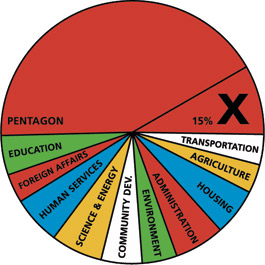
At the national level the True Majority web site asks what 15%, or $60 billion, of the current 2002-2003 fiscal year Pentagon budget of $400 billion could do for the United States, in lieu of the spread of war and domestic discontent:
It's tax time when most of us learn how much we send to the Federal Government, but few of us really know where it goes. Well, here's how Congress allocates the money it controls. That big "X" represents the money we could reallocate by trimming the Pentagon budget just 15%. The retired admirals and generals who advise us agree we could do this just by canceling Cold War weapons systems like nuclear weapons and StarWars, which do nothing to keep us safe.
With that savings, we could fund ALL of the following human needs at no additional taxpayer expense:
Provide basic health and food to the world's poor: $12 billion
Rebuild America's public schools over 10 years: $12 billion
Reduce class size for grades 1-3 to 15 students per class: $11 billion
Reduce debts of impoverished nations: $10 billion
Provide health insurance to all uninsured American kids: $6 billion
Increase federal funding for clean energy and energy efficiency: $6 billion
Public financing of all federal elections: $1 billion
Fully fund Head Start: $2 billion
Total $60 billion
by Larry Taylor
The recent incursion of the United States upon Iraq has prompted Congress to consider supplemental appropriations to pay for that action. Some estimates, according to the National Priorities Project <http://www.nationalpriorities.org>, are the initial costs of that unilateral and preemptive effort may be $100 billion, with the reconstruction of Iraq requiring another $50 billion.
Taking just the $100 billion figure, the NPP estimates that California’s citizens’ share is roughly $10.2 billion, with Fresno’s pro rata share at $86,800,000 on a cash basis.
Since local, state, and federal budgets for 2004 are now being compiled, and some not readily shared or available to the general public, let us first reflect upon the known local effects of California’s recent $25 billion to $35 billion budget shortfall. Then we will compare the state and federal contributions to local government budgets to reflect upon our vulnerability to future cutbacks by either the state or federal government. Finally, we can take a look at what the federal government is proposing in its 2004 budget to see if we can expect help or more debt and fewer services for the citizens of Fresno.
Funding of schools comes largely from the state, and Fresno Unified alone expects a cut of $40,000,000 from last year’s budget, corresponding to 1000-1500 job cuts, plus cutbacks in course offerings and extracurricular activities. The Fresno Bee reported April 7, 2003 (“Supervisors to Consider Slashing 52 Jobs”) that the County of Fresno is to consider cutting 52 jobs by mid-2003, to offset a $4,400,000 budget cut. Most of the lost jobs will be in the District Attorney’s office. Important losses here are units that investigate domestic violence and child abduction cases. Another 400 job cuts are being considered in the county, depending on the state’s budget outlook in a couple months. Some state grant programs are being cut or eliminated.
The budgets of our local governments are susceptible to state and federal takeaways and further in jeopardy to the extent of leverage and dependence those grants convey. The current Fresno City budget, due to end on June 30, is to receive more than $106 million from the federal government and $79 million from the state. Overall that represents 25% of the entire city budget. The County receives nearly $450 million from federal sources and $240 million from state sources, together contributing nearly 50% of the County budget. The city provides police and fire protection; it also provides and maintains parks and recreation facilities and streets, curbs, and gutters. The county provides law enforcement outside of the cities, plus justice administration and health and welfare services for the entire county.
Just two years ago, in 2001, the federal Office of Management and Budget was predicting a federal budget surplus in ten years, by 2011, of over $5.6 trillion. This past February the OMB revised that surplus downward by almost $8 trillion, to a $2.122 trillion deficit. Projected cumulative budget deficits for the period 2004 to 2008 alone represent $1.084 trillion, not including the $100 billion in costs for the attack on Iraq, and not including further incursions in the Middle East or additional costs for reconstruction.
This drastic and rapid reduction in the projected budget surplus, from a strong positive figure to a negative level, and the guarantee of annual deficits into the future is most astonishing. This drain on our national and local resources has been accomplished by the Bush administration’s reduction of taxes to the wealthiest Americans, while increasing military spending and reducing domestic expenditures that help youth, the aged, and such low-income areas as Fresno and the Central Valley.
The Bush Administration’s 2004 budget calls for increasing, in real terms, defense-related activities by 28% and international affairs by 14%, while reducing community and regional development by 13%, unemployment compensation by 25% and education, training, employment, and social services by 5%.
The $100 billion to invade Iraq most likely will lead to further cutbacks on grants to Fresno City and County governments. Fresno’s pro rata share of $86.8 million would have been more productively spent on repairing our school budget, and on ensuring police and fire protection by the City and health and justice services by the County.
There have been long-term dire yet unmet needs for the residents of the Fresno area. Unemployment rates for the past 13 years have been relatively constant, hovering in the mid-teens, with the first three months of 2003 averaging 17%.
Year 2000 Census figures reveal population and 1999 poverty and income figures for the City of Fresno:
Population 427,652
Families living in poverty 21%
Families in poverty with children under age 5 35%
Individuals in poverty 26% (or 112,000 people)
Related children under 18 in poverty 37%
Median household income $32,236
At the national level the True Majority web site asks what 15%, or $60 billion, of the current 2002-2003 fiscal year Pentagon budget of $400 billion could do for the United States, in lieu of the spread of war and domestic discontent:
It's tax time when most of us learn how much we send to the Federal Government, but few of us really know where it goes. Well, here's how Congress allocates the money it controls. That big "X" represents the money we could reallocate by trimming the Pentagon budget just 15%. The retired admirals and generals who advise us agree we could do this just by canceling Cold War weapons systems like nuclear weapons and StarWars, which do nothing to keep us safe.
With that savings, we could fund ALL of the following human needs at no additional taxpayer expense:
Provide basic health and food to the world's poor: $12 billion
Rebuild America's public schools over 10 years: $12 billion
Reduce class size for grades 1-3 to 15 students per class: $11 billion
Reduce debts of impoverished nations: $10 billion
Provide health insurance to all uninsured American kids: $6 billion
Increase federal funding for clean energy and energy efficiency: $6 billion
Public financing of all federal elections: $1 billion
Fully fund Head Start: $2 billion
Total $60 billion
For more information:
http://www.fresnoalliance.com/home
Add Your Comments
We are 100% volunteer and depend on your participation to sustain our efforts!
Donate

$110.00 donated
in the past month
Get Involved
If you'd like to help with maintaining or developing the website, contact us.
Publish
Publish your stories and upcoming events on Indybay.
Topics
More
Search Indybay's Archives
Advanced Search
►
▼
IMC Network