







 Publish to Newswire
 Add an Event
Riots and General Strike mark Anniversary of Algerian Insurrection
BBC report
Sunday, April 20, 2003
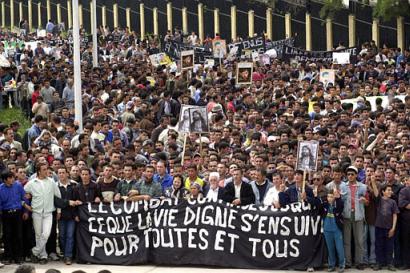
Thousands of Algerian Berbers have brought towns to a standstill in the eastern region of Kabylie, in a mass demonstration for cultural and linguistic rights. They were marking the anniversary of riots in 1980 in the provincial capital, Tizi Ouzou, when protesters demanded recognition for their separate identity from the Arabic-speaking majority.
A general strike closed down businesses and shops in Tizi Ouzou, Bejaia and Bouira on Sunday and in Algiers, several hundred students also demonstrated.
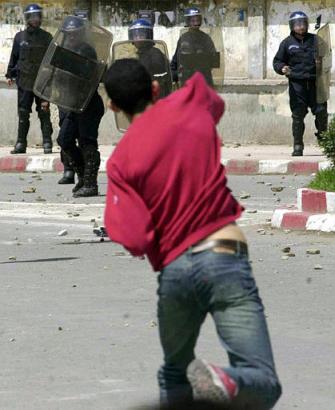
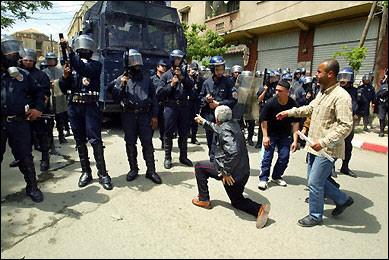
The protests were mainly peaceful but riot police clashed with students outside a theatre in Tizi Ouzou when a 10,000-strong march was diverted away from a prison holding Berber leader Belaid Abrika.
In the Algerian capital, student protesters were prevented by police from leaving campus.
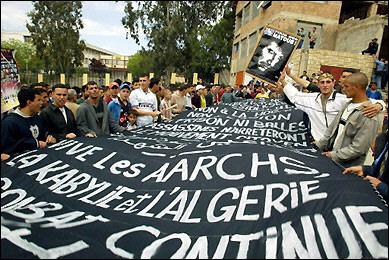
Marchers in Bouira carried black banners and shouted slogans including "Release the prisoners", "No to oppression" and "No to the arrest of youths and demonstrators".
The demonstrations also commemorated protests in April 2001, when dozens of people were killed in clashes with police.
Berbers are believed to make up about 20% of Algeria's population of 30 million.
Demonstrations to mark the Berber Spring are an annual event.
Background: INSURRECTION IN ALGERIA
It’s not at all surprising that news of the insurrection that has been going on in Algeria since April 2001 has not been reported in US media. I learned about it through an Italian anarchist website: www.guerrasociale.org.
The uprising was provoked when police murdered a high school boy. On April 18, 2001, riots began in Beni-Douala, an area of Tizi Ouzou in the region of Kabylia about 70 miles east of Algiers. Riots and demonstrations quickly spread to other villages in the region. Rioters attacked police stations and troop detachments with stones, molotov cocktails and burning tires, and set fire to police vehicles, government offices and courts. Government attempts to quell the uprising failed. From the beginning, the rebels showed an unwillingness to negotiate and refused all representation. By the end of April, targets of collective rage broadened to include tax offices, all sorts of government offices and the offices of political parties. Rebels blockaded the main roads and looted government buildings and other property of the rulers. By the end of a week the entire region of Kabylia was in open insurrection. The state sent in its guard dogs to repress the revolt, leading to open conflicts with deaths and injuries on both sides.
By the end of the first week of May, the insurgent movement began to organize itself in village and neighborhood assemblies (the aarch) that coordinate their activities through a system of apparently mandated and revocable delegates who would be bound to a very interesting “code of honor” a few months later. The only political movement that might have had a chance of recuperating the revolt, the Front of Socialist Forces (FFS) very quickly showed its true colors by offering to aid the president of Algeria, Bouteflika, in organizing a “democratic transition”.
Since then the coordination of aarch has been organizing demonstrations, general strikes, actions against the police and the elections.
By mid-June, the rebellion had spread beyond the borders of Kabylia, and in Kabylia state control had been nearly completely routed. Offices of the national police were thoroughly devastated, and the police themselves were shunned. Because no one in the region would sell them food and other needs, the government was forced to ship in supplies to them by helicopter and heavily armed convoys.
At the end of June, the coordination of the aarch refused to meet with a government representative, clearly expressing the attitude of the insurgents. In mid-July the coordination of Tizi Ouzou adopted the “code of honor” which required delegates to pledge themselves “not to carry forward any activities or affairs that aim to create direct or indirect links to power and its collaborators”, “not to use the movement for partisan ends nor to drag it into electoral competitions or any other possibility for the conquest of power”, “not to accept any political appointments in the institutions of power” among other things. This pledge was put to the test almost immediately when unionists and partisans of the left tried to infiltrate the movement for their own ends. The failure of this opportunistic attempt to hijack the movement was made evident during a general strike on July 26, when demonstrators chanted: “Out with the traitors! Out with the unions!”
Huge demonstrations continued. In mid-August, the insurgents banned all officials from the Soummam valley. This was not just due to a government celebration that was to occur there, but also because government officials had begun to contact certain unidentified delegates of the coordination who supported the idea of negotiation. Rather than weakening the struggle this government ploy led the insurgents to ban all government officials from Kabylia. The minister of the Mujaheedin had to cancel a trip to Tiai Ouzou, and the minister of the interior was greeted with a rain of stones when he came to install a new prefect.
At the beginning of October, the government banned a demonstration that was intended to present a list of demands called the Platform of El-Kseur to president Bouteflika. A massive array of counter-insurgency detachments was used to block the demonstrators. These demands mainly deal with relief of the immediate effects of government repression against the uprising (end of judicial action against insurgents, release of prisoners, etc.), but also include the demand for the immediate departure of all police brigades from the region. The ban of this demonstration provoked further conflicts between insurgents and the forces of order. On October 11, the inter-wilayas coordination (of the aarch and other self-organized assemblies and committees) decided that they would no longer submit the demands of their Platform to any state representative, that the demands were absolutely non-negotiable and that anyone who chose to accept dialogue with the government would be banished from the movement. Disobedience is total: taxes and utility bills are not paid, calls to military service are ignored, the upcoming elections are refused.
On December 6, some self-styled “delegates” claiming to represent the aarch planned to meet with the head of government. In protest a general strike was called in Kabylia. Sit-ins blockading police barracks turned into violent conflicts throughout the region, some of which lasted for three days. Offices of the gas company, of taxes and of the National Organization of the Mujaheedin were burned in Amizour. In El Kseur, there were looting raids On a court and a judge’s house.
The struggle continued throughout December and January with protests and road blockades. It intensified when a delegation from the aarch was arrested in front of the UN office in Algiers on February 7, 2002. On February 12, a general strike was called throughout Kabylia to protest the reappearance of police on the streets. The entire region was shut down. People assembled in front of the police barracks and there were conflicts.
At the end of February, president Bouteflika announced that there would be elections on May 30. The movement responded by confiscating and burning ballot boxes and administrative documents. At the beginning of March it called for a boycott of the elections throughout Algeria.
Bouteflika tried to appease the rebels by offering compromises which were refused and by moving police forces out of two major cities, But he followed this with mass arrests of delegates of the aarch. On March 25, security forces attacked a theater in Tizi Ouzou that was being used as the office of the citizen coordination and 21 delegates were arrested. After police searches many other delegates went into hiding. Soon conflicts broke out. The government issued 400 arrest warrants against delegates, leading to further demonstrations. Conflicts continued throughout April.
Despite government repression, the anti-electoral campaign of the aarch went forward in May with calls to action, marches and the destruction of ballot boxes. Students demanding the release of prisoners greeted president Bouteflika with a rain of stones when he went to the university of Algiers on May 20. The next day the students occupied the university demanding the release of their comrades.
On May 30, election day, the entire region of Kabylia had less than a 2% voter turn-out. People showed their preference for direct action by barricading the streets, occupying the offices of the prefectures and the municipalities, and strewing the public ways with the remains of burned ballot boxes. A general strike paralyzed the region. There were conflicts with the police and election offices were attacked and destroyed. In the whole of Algeria, voter turnout was less than 50%, showing that the refusal of elections had spread beyond the borders of Kabylia.
All through June, rebellion and social conflict continued through out Algeria. On June 19, the government again tried to derail the movement, authorizing movement prisoners to meet to discuss a proposal of a government emissary arranged through the mediation of two supposed delegates. The movement disowned these delegates, and the prisoners refused this government ruse to pressure the movement into negotiation over the Platform of El Kseur in exchange for the provisional release of those arrested. Instead the prisoners issued a communiqué conforming their confidence in the coordination and their unwillingness to negotiate the demands of their Platform or their release and that of all the other prisoners.
By August, violent conflicts and an ultimatum issued by the movement forced Bouteflika to pardon all the arrested delegates of the aarch. Upon release, the delegates declared that the struggle would continue.
In October another election was called. The movement met it with a general strike and demonstrations. There were conflict with the police everywhere. Once again, about half of the eligible Algerians boycotted the elections. In Kabylia, in spite of the participation of the FFS in the elections, 90% of those eligible refused to participate in the elections.
This insurrection is of great interest to anarchists. There are no leaders, no parties, no charismatic spokespeople and no hierarchical or representative organizations of any sort behind it. It has been self-organized by those in struggle in a horizontal method and with specific guidelines to prevent the possibility of recuperation by parties, unions, politicians or other unscrupulous individuals, and these guidelines have been actively reinforced by those in struggle. The movement is equally against all of the contenders for power: the military, the government, Islamic fundamentalist, the left, the unions. It has successfully kept police “quarantined” to their barracks for long periods of time. It has carried out two election boycotts. It has forced the government to release arrested comrades. And it has carried out the daily tasks of an ongoing insurrectionary struggle. All through autonomous direct action.
Update February 2003
Although the Algerian government has been heavily repressing the aarch (village assemblies) insurrection in Kabylia (see the earlier post "Insurrection in Algeria") since the end of October, arresting hundreds of insurgents, the struggle has continued. Several of the imprisoned insurgents held a hunger strike for nearly 6 weeks, stopping at the request of their families and comrades on the outside on January 6. Their have been a series of demonstrations and general strikes in support of the prisoners as well as the ongoing gatherings of supporters outside the prisons.
In addition unrest has spread throughout Algeria. Demonstrations and social violence has occurred in many regions. earlier this month (February), the inhabitants of Tadjenant in the province of Mila, about 200 miles east of Algiers the government palace of the sub-province and of the municipality. They destroyed the local adminstrative offices of the UGTA (the National Association of Unions) as well as the offices of the political parties. The offices os SONELGAZ, the national gas and electric company, was also torched and burned to the ground.
Also in the eastern region of the land, in the province of Skikda, the people of the municipality of Salah Bouchaour went into the roads to block traffic as a protest. The immediate cause of their protest was the fact that after 40 years of independence, promised electricity has not come to their village. Instead the local officials responsible for this task built themselves and their families expensive villas to live in.
In the west of the country, in the province of Chlef. the tension has been very high. In the municipality of Zeboudja, about 13 miles from the capital of the province, thousands of people have taken to the streets to protest. They looted the homes of the sub-provincial head and of the mayor. They first surrounded these government officials homes after noting that they were fed by the group responsible for providing electricity to the village, while the village remained without electricity.
Further west in the province of di Ain Defla, people closed down the offices of the mayor and his collaborators, denying them access. The people of the village point out that their concerns have been ignored by those in power since the time of independence in 1962. Currently, due to harsh winter conditions, the road in and out of the village is impassable and potable drinking water is lacking.
Whether the method of the assemblies, or some other method of self-organization, will develop in these struggles outside of Kabylia is not yet clear. But people are certainly recognizing that those in power are not responsive to their needs and are choosing to fight rather than beg.
Insurgents from Kabylia, associated with the aarch movement are currently planning a demonstration for March 2 in Algiers in response to a visit from French president Chirac.
Donate

$110.00 donated
in the past month
Get Involved
If you'd like to help with maintaining or developing the website, contact us.
Publish
Publish your stories and upcoming events on Indybay.