







 Publish to Newswire
 Add an Event
From the Open-Publishing Calendar
From the Open-Publishing Newswire
Indybay Feature
Thousands protest against U.S. presence in Baghdad
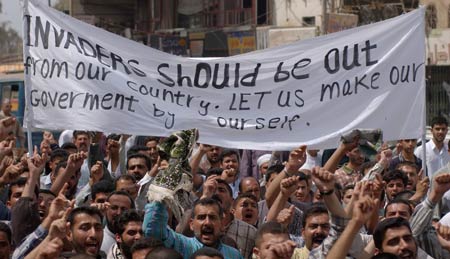
Discontent with the U.S.-led occupation of Iraq burst into the streets of Baghdad yesterday as tens of thousands marched in protest against the presence of U.S. troops.
(Interesting that this is the leading story for the weekend edition of Canada's national newspaper, the Globe and Mail. In contrast Saturday's headliner on CNN covers the arrest of Laci Peterson's husband, a California story.
Mainstream American news appears to purposely avoid the bad news on Iraq that the rest of the world is watching)
(Interesting that this is the leading story for the weekend edition of Canada's national newspaper, the Globe and Mail. In contrast Saturday's headliner on CNN covers the arrest of Laci Peterson's husband, a California story.
Mainstream American news appears to purposely avoid the bad news on Iraq that the rest of the world is watching)
By MARK MacKINNON
From Saturday's Globe and Mail
UPDATED AT 2:22 AM EST Saturday, Apr. 19, 2003
Baghdad — Discontent with the U.S.-led occupation of Iraq burst into the streets of Baghdad yesterday as tens of thousands marched in protest against the presence of U.S. troops.
The demonstrations began shortly after Friday prayers, following sermons from imams who condemned the U.S. military presence and called on Iraq's Sunni and Shia Muslim communities to unite to rebuild the country.
At Baghdad's Abu Haneefa al-Nu'man mosque, Sheik Ahmed al-Kubeisy said U.S. soldiers should leave the country soon, before Iraqis expel them. His sermon was greeted by cheers of "God is Great!" from worshippers.
Other protesters marched through the city centre chanting that Iraq is an Islamic state, not an American one.
The demonstrations were the largest yet in Baghdad and were echoed by a meeting in Saudi Arabia of foreign ministers from the six countries that share a border with Iraq. The neighbours, including Syria, sharply criticized the United States for its mounting pressure on Damascus and urged the "occupying power" to quickly stabilize Iraq and withdraw. They also said they would oppose the lifting of United Nations sanctions against Iraq until a legitimate government was formed by Iraqis.
"Now Iraq is under an occupying power, and any request for lifting sanctions must come when there is a legitimate government which represents the people," said the Saudi foreign minister, Prince Saud al-Faisal, who playing host to ministers from Syria, Turkey, Iran, Kuwait and Jordan, as well as from Egypt and Bahrain.
Ahmed Chalabi, Iraq's controversial pro-Western opposition leader, gave a very different perspective in his first press conference in Baghdad. Speaking to reporters, Mr. Chalabi said he believed transition to a government of Iraqi civilians would take place within weeks. But he said he expects the reconstruction of basic services, including the restoration of electricity in Baghdad, would be done under the leadership of retired U.S. general Jay Garner.
"I expect this stage to take a few weeks," Mr. Chalabi said at his first press conference in Baghdad after 45 years in exile. After that, he said, "an Iraqi interim authority will be chosen by Iraqis and take over the business of governing."
Mr. Chalabi, who is popular among exiles and a favourite of the U.S. administration, has little following inside Iraq and said yesterday he is not seeking political office.
The mounting anger with the U.S. presence in the city has been fuelled by the fact that U.S. soldiers and marines seem to have been very selective in what they have and haven't protected from the looting that has become endemic in this city.
While most former government ministries here, including the health, education, trade, foreign affairs, transportation and agriculture departments, have been pilfered and set ablaze, the oil ministry is uniquely unscathed, having been protected by U.S. troops since their arrival in Baghdad.
That inconsistency has led many Iraqis to accuse the U.S. forces of protecting the oil infrastructure while letting thieves and vandals run rampant through hospitals and schools. There is also widespread frustration that 10 days after U.S. forces entered Baghdad, most of the city is still without electricity.
U.S. officials say the biggest problem is manpower, since many who fled Baghdad are not yet convinced that it's safe to return to the city and resume their jobs.
"Without power, there is no peace," said Haifa Aziz, manager of one of the city's power substations. "For hospitals, for schools, for the people, they need electricity."
The mystery of what happened to Saddam Hussein also looms large. Abu Dhabi television yesterday showed pictures of what it said was the deposed president being greeted by cheering crowds outside a Baghdad mosque, a scene purportedly filmed April 9, the day U.S. forces entered Baghdad.
The videotape showed Mr. Hussein, clad in a black beret and an olive-green military uniform, climbing onto the hood of his car while the crowd chanted: "With our bloods and souls we redeem you, O Saddam!" He then waded into the crowd with a man who looked like his son Qusay.
Abu Dhabi TV also played an audio tape of what it said was a recent speech by Mr. Hussein. "Aggressors are always defeated," the speaker said, addressing the Iraqi people. "Conquered people are the ones who eventually triumph over invaders."
However, an Iraqi diplomat loyal to Mr. Hussein said he believed the ousted president had been killed in the first day of the U.S.-led bombing of Baghdad, citing the fact that he has not received any instructions since the United States tried to assassinate Mr. Hussein with a cruise missile strike that day.
"I know his character," Iraq's ambassador to Serbia, Sami Sadoun, told the Associated Press. "The defence of Baghdad would not have collapsed so quickly if he was not dead."
U.S. forces announced two more captures yesterday. Imad Husayn Abdallah al-Ani, an Iraqi official who had been involved in the country's suspected nerve-gas program, surrendered to U.S. forces and was being interrogated, officials said. Separately, the U.S. military said it had captured Samir Abd al-Aziz al-Najim, the Baath Party regional-command chairman for east Baghdad. Mr. Najim was the four of clubs on the Pentagon's deck of cards showing the most-wanted members of Mr. Hussein's regime.
Some people, of course, are not waiting for final confirmation of the their former president's fate. A gang of youths yesterday tore the head off one of the city's innumerable statues of Mr. Hussein and was later seen driving through the streets of the affluent al-Mansour district, dragging the head behind a battered red truck.
Bell Globemedia
© 2003 Bell Globemedia Interactive Inc. All Rights Reserved.
Photo caption:Sunni Muslims protest against U.S. presence in their country following Friday prayers at the Abu Hanifa mosque in Baghdad Friday.
Photo: Cheryl Diaz Meyer/AP
From Saturday's Globe and Mail
UPDATED AT 2:22 AM EST Saturday, Apr. 19, 2003
Baghdad — Discontent with the U.S.-led occupation of Iraq burst into the streets of Baghdad yesterday as tens of thousands marched in protest against the presence of U.S. troops.
The demonstrations began shortly after Friday prayers, following sermons from imams who condemned the U.S. military presence and called on Iraq's Sunni and Shia Muslim communities to unite to rebuild the country.
At Baghdad's Abu Haneefa al-Nu'man mosque, Sheik Ahmed al-Kubeisy said U.S. soldiers should leave the country soon, before Iraqis expel them. His sermon was greeted by cheers of "God is Great!" from worshippers.
Other protesters marched through the city centre chanting that Iraq is an Islamic state, not an American one.
The demonstrations were the largest yet in Baghdad and were echoed by a meeting in Saudi Arabia of foreign ministers from the six countries that share a border with Iraq. The neighbours, including Syria, sharply criticized the United States for its mounting pressure on Damascus and urged the "occupying power" to quickly stabilize Iraq and withdraw. They also said they would oppose the lifting of United Nations sanctions against Iraq until a legitimate government was formed by Iraqis.
"Now Iraq is under an occupying power, and any request for lifting sanctions must come when there is a legitimate government which represents the people," said the Saudi foreign minister, Prince Saud al-Faisal, who playing host to ministers from Syria, Turkey, Iran, Kuwait and Jordan, as well as from Egypt and Bahrain.
Ahmed Chalabi, Iraq's controversial pro-Western opposition leader, gave a very different perspective in his first press conference in Baghdad. Speaking to reporters, Mr. Chalabi said he believed transition to a government of Iraqi civilians would take place within weeks. But he said he expects the reconstruction of basic services, including the restoration of electricity in Baghdad, would be done under the leadership of retired U.S. general Jay Garner.
"I expect this stage to take a few weeks," Mr. Chalabi said at his first press conference in Baghdad after 45 years in exile. After that, he said, "an Iraqi interim authority will be chosen by Iraqis and take over the business of governing."
Mr. Chalabi, who is popular among exiles and a favourite of the U.S. administration, has little following inside Iraq and said yesterday he is not seeking political office.
The mounting anger with the U.S. presence in the city has been fuelled by the fact that U.S. soldiers and marines seem to have been very selective in what they have and haven't protected from the looting that has become endemic in this city.
While most former government ministries here, including the health, education, trade, foreign affairs, transportation and agriculture departments, have been pilfered and set ablaze, the oil ministry is uniquely unscathed, having been protected by U.S. troops since their arrival in Baghdad.
That inconsistency has led many Iraqis to accuse the U.S. forces of protecting the oil infrastructure while letting thieves and vandals run rampant through hospitals and schools. There is also widespread frustration that 10 days after U.S. forces entered Baghdad, most of the city is still without electricity.
U.S. officials say the biggest problem is manpower, since many who fled Baghdad are not yet convinced that it's safe to return to the city and resume their jobs.
"Without power, there is no peace," said Haifa Aziz, manager of one of the city's power substations. "For hospitals, for schools, for the people, they need electricity."
The mystery of what happened to Saddam Hussein also looms large. Abu Dhabi television yesterday showed pictures of what it said was the deposed president being greeted by cheering crowds outside a Baghdad mosque, a scene purportedly filmed April 9, the day U.S. forces entered Baghdad.
The videotape showed Mr. Hussein, clad in a black beret and an olive-green military uniform, climbing onto the hood of his car while the crowd chanted: "With our bloods and souls we redeem you, O Saddam!" He then waded into the crowd with a man who looked like his son Qusay.
Abu Dhabi TV also played an audio tape of what it said was a recent speech by Mr. Hussein. "Aggressors are always defeated," the speaker said, addressing the Iraqi people. "Conquered people are the ones who eventually triumph over invaders."
However, an Iraqi diplomat loyal to Mr. Hussein said he believed the ousted president had been killed in the first day of the U.S.-led bombing of Baghdad, citing the fact that he has not received any instructions since the United States tried to assassinate Mr. Hussein with a cruise missile strike that day.
"I know his character," Iraq's ambassador to Serbia, Sami Sadoun, told the Associated Press. "The defence of Baghdad would not have collapsed so quickly if he was not dead."
U.S. forces announced two more captures yesterday. Imad Husayn Abdallah al-Ani, an Iraqi official who had been involved in the country's suspected nerve-gas program, surrendered to U.S. forces and was being interrogated, officials said. Separately, the U.S. military said it had captured Samir Abd al-Aziz al-Najim, the Baath Party regional-command chairman for east Baghdad. Mr. Najim was the four of clubs on the Pentagon's deck of cards showing the most-wanted members of Mr. Hussein's regime.
Some people, of course, are not waiting for final confirmation of the their former president's fate. A gang of youths yesterday tore the head off one of the city's innumerable statues of Mr. Hussein and was later seen driving through the streets of the affluent al-Mansour district, dragging the head behind a battered red truck.
Bell Globemedia
© 2003 Bell Globemedia Interactive Inc. All Rights Reserved.
Photo caption:Sunni Muslims protest against U.S. presence in their country following Friday prayers at the Abu Hanifa mosque in Baghdad Friday.
Photo: Cheryl Diaz Meyer/AP
For more information:
http://www.globeandmail.com/servlet/story/...
Add Your Comments
We are 100% volunteer and depend on your participation to sustain our efforts!
Donate

$110.00 donated
in the past month
Get Involved
If you'd like to help with maintaining or developing the website, contact us.
Publish
Publish your stories and upcoming events on Indybay.
Topics
More
Search Indybay's Archives
Advanced Search
►
▼
IMC Network