







 Publish to Newswire
 Add an Event
From the Open-Publishing Calendar
From the Open-Publishing Newswire
Indybay Feature
Four Arguments for the Elimination of Television
Amid trouble with accurate dia reporting, an arab author offers us a review of a polemical 1978 book about television as a ever-biased media
28/07/2002 REVIEW
Jerry Mander shows readers clearly why televison should be abandoned altogether
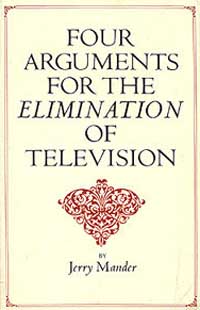
Title: Four Arguments for the Elimination of Television
Author: Jerry Mander
Publisher: William Morrow and Co.
Pages: 371
That television is harmful is a tangible reality easily grasped by any parent of school-aged children. Staring blankly at the screen almost as if in a trance, kids the world over provide evidence daily of the mind-numbing effects of this technology. Yet for some reason, people continue to hold out hope for the redeeming qualities of TV, assuming they exist.
Jerry Mander, in his 1978 classic, Four Arguments for the Elimination of Television, deconstructs the case for TV, even as a potentially positive and educational tool. He is harsh in his critique, brash in some of his statements and prescient in his early understanding of how television impacts society at large.
Mander makes his thesis clear at the very beginning of the book: “Far from being ‘neutral’, television itself predetermines who shall use it, how they will use it, what effects it will have on individual lives, and, if it continues to be widely used, what sorts of political forms will inevitably emerge.”
It is his contention that television is itself the modern incarnation of autocracy. Gone are the days of jack-booted government enforcers. They have been replaced by a technology that so effectively directs mass thought and mass behavior, that people willingly acquiesce to the whims of those in control of the technology.
If this all sounds a bit like an Orwellian rant or a warning about the “brave new world” we may fall into, that’s because Mander was influenced by both George Orwell and Aldous Huxley. In fact, he cites both of their seminal works repeatedly throughout the book. But before readers dismiss Mander as just a doomsday crackpot with mad visions of a looming authoritarian future, consider the absolute sense he makes in Four Arguments for the Elimination of television.
To start, Mander keeps things simple. Although he refers to various studies throughout the book, much of his argumentation is based on good old solid common sense. For instance, he notes early on that television can be used only for certain purposes, most of which are detrimental. To drive this point home, he draws an analogy to the existence of firearms in modern society. He notes that guns have a very specific purpose and they actually predetermine their use as well as the people who use them. Guns are for killing things, plain and simple. And the majority of people who end up using guns are people who kill.
The technology predetermines the outcome. The same, argues Mander, can be said of television. It is simply a matter of mapping TV’s form and function in order arrive at conclusions concerning the detrimental nature of its influence.
Mander’s first argument centers on the mediation of experience. Speaking not so much about television and more so about how society has progressed, he explains that as humans have moved more and more into controlled living and working environments, we have lost touch with true direct experience. To his mind, this has led to a crisis in knowledge. Everything is interpreted and processed and packaged to the point that the true nature of things is completely lost. This alienating experience narrows the field of vision on life.
Secondly, argues Mander, experience itself has been colonized, distilled and condensed. By whom? By those who own and control the media. Mander recognized the problems inherent in consolidation of large media companies back in 1978. The situation is worse now, with only five companies being responsible for nearly all the media production in the United States. With control of media centralized, the human being is at the whim of self-interest. And for these large companies, that self-interest mean making money off the consumer.
It is within his second argument that Mander explains the relationship of advertising to television. A former advertising executive at one of the most successful ad agencies of the 1960s and 1970s, he has a great deal of expertise in this area. He notes that advertising is only necessary when trying to get people to buy things they don’t need.
In business jargon, this is a process of “creation of value”. With humans now separated from nature and stuffed into large cities or suburbs, it is possible to target society with all sorts of products. The isolation within communities is key in this process and television is the tool by which a small number of people can speak to a large number of people about the what they should eat, where they should go, how they should live. Mander laments that all this is artificial in nature.
“A food in its natural state, unprocessed, does not need to be advertised,” says Mander. “Hungry people will find food if it is available. To persuade people to buy the processed version is another matter because it is more expensive, less naturally appealing, less nourishing and often harmful. The need must be created.”
In his third argument, Mander tackles the physiological and psychological effects of television. Written in 1978 when much of the research in these areas was nascent, this section is maybe the weakest in argumentation because of the lack of serious study in these matters. But looking at it retrospectively and drawing upon the research of the 80s and 90s, what Mander says makes a lot of sense.
Indeed, sitting in front of a television set is a mesmerizing experience. You zone out. It is hypnosis of sorts. Measuring brainwaves while watching television reveals an almost zombie-like state. Mander’s point is that in a virtual state of hypnosis, learning cannot take place, assuming that educational programming is being viewed. What can take place is rather akin to brainwashing with images being implanted in the mind for later retrieval when consumer activity takes place.
Additionally, there is concern over the electromagnetic spectra absorbed by the body while watching television.
In his fourth and final argument, Mander explores the inherent biases of the technology. After explaining the manner in which television numbs the mind and sinks the human into boredom, he reveals that there are many tricks used in the media industry to keep people watching.
Because the television screen is so small, a broad range of activity cannot be adequately portrayed. For this reason, television camera-work is largely close-up based. Facial shots and quick cuts from one person to another predominate.
Additionally, it is difficult to convey nuances of emotion on television. This is partly because of technical constraints and because of audience intolerance for inaction. Therefore, content is biased towards action and over-emphasized romance, two things that can be portrayed quite demonstratively.
In the end, Mander comes to the conclusion that television simply cannot be reformed as a technology. Furthermore, because of the detrimental effects it can have, he argues that it should be treated with all the care of nuclear energy or other realistically harmful technologies.
Four Arguments for the Elimination of Television is a book that was ahead of its time. With the more recent developments in computer technology as well as satellite and cable television, this work has more applicability now than ever. As MTV tells our kids what think, as Martha Stewart tells us how to decorate our houses, as Dan Rather tells us what is important in the world each day, we should all give consideration to the points brought up by Mander.
To put it simply, this book is a must read.
Jerry Mander shows readers clearly why televison should be abandoned altogether
Title: Four Arguments for the Elimination of Television
Author: Jerry Mander
Publisher: William Morrow and Co.
Pages: 371
That television is harmful is a tangible reality easily grasped by any parent of school-aged children. Staring blankly at the screen almost as if in a trance, kids the world over provide evidence daily of the mind-numbing effects of this technology. Yet for some reason, people continue to hold out hope for the redeeming qualities of TV, assuming they exist.
Jerry Mander, in his 1978 classic, Four Arguments for the Elimination of Television, deconstructs the case for TV, even as a potentially positive and educational tool. He is harsh in his critique, brash in some of his statements and prescient in his early understanding of how television impacts society at large.
Mander makes his thesis clear at the very beginning of the book: “Far from being ‘neutral’, television itself predetermines who shall use it, how they will use it, what effects it will have on individual lives, and, if it continues to be widely used, what sorts of political forms will inevitably emerge.”
It is his contention that television is itself the modern incarnation of autocracy. Gone are the days of jack-booted government enforcers. They have been replaced by a technology that so effectively directs mass thought and mass behavior, that people willingly acquiesce to the whims of those in control of the technology.
If this all sounds a bit like an Orwellian rant or a warning about the “brave new world” we may fall into, that’s because Mander was influenced by both George Orwell and Aldous Huxley. In fact, he cites both of their seminal works repeatedly throughout the book. But before readers dismiss Mander as just a doomsday crackpot with mad visions of a looming authoritarian future, consider the absolute sense he makes in Four Arguments for the Elimination of television.
To start, Mander keeps things simple. Although he refers to various studies throughout the book, much of his argumentation is based on good old solid common sense. For instance, he notes early on that television can be used only for certain purposes, most of which are detrimental. To drive this point home, he draws an analogy to the existence of firearms in modern society. He notes that guns have a very specific purpose and they actually predetermine their use as well as the people who use them. Guns are for killing things, plain and simple. And the majority of people who end up using guns are people who kill.
The technology predetermines the outcome. The same, argues Mander, can be said of television. It is simply a matter of mapping TV’s form and function in order arrive at conclusions concerning the detrimental nature of its influence.
Mander’s first argument centers on the mediation of experience. Speaking not so much about television and more so about how society has progressed, he explains that as humans have moved more and more into controlled living and working environments, we have lost touch with true direct experience. To his mind, this has led to a crisis in knowledge. Everything is interpreted and processed and packaged to the point that the true nature of things is completely lost. This alienating experience narrows the field of vision on life.
Secondly, argues Mander, experience itself has been colonized, distilled and condensed. By whom? By those who own and control the media. Mander recognized the problems inherent in consolidation of large media companies back in 1978. The situation is worse now, with only five companies being responsible for nearly all the media production in the United States. With control of media centralized, the human being is at the whim of self-interest. And for these large companies, that self-interest mean making money off the consumer.
It is within his second argument that Mander explains the relationship of advertising to television. A former advertising executive at one of the most successful ad agencies of the 1960s and 1970s, he has a great deal of expertise in this area. He notes that advertising is only necessary when trying to get people to buy things they don’t need.
In business jargon, this is a process of “creation of value”. With humans now separated from nature and stuffed into large cities or suburbs, it is possible to target society with all sorts of products. The isolation within communities is key in this process and television is the tool by which a small number of people can speak to a large number of people about the what they should eat, where they should go, how they should live. Mander laments that all this is artificial in nature.
“A food in its natural state, unprocessed, does not need to be advertised,” says Mander. “Hungry people will find food if it is available. To persuade people to buy the processed version is another matter because it is more expensive, less naturally appealing, less nourishing and often harmful. The need must be created.”
In his third argument, Mander tackles the physiological and psychological effects of television. Written in 1978 when much of the research in these areas was nascent, this section is maybe the weakest in argumentation because of the lack of serious study in these matters. But looking at it retrospectively and drawing upon the research of the 80s and 90s, what Mander says makes a lot of sense.
Indeed, sitting in front of a television set is a mesmerizing experience. You zone out. It is hypnosis of sorts. Measuring brainwaves while watching television reveals an almost zombie-like state. Mander’s point is that in a virtual state of hypnosis, learning cannot take place, assuming that educational programming is being viewed. What can take place is rather akin to brainwashing with images being implanted in the mind for later retrieval when consumer activity takes place.
Additionally, there is concern over the electromagnetic spectra absorbed by the body while watching television.
In his fourth and final argument, Mander explores the inherent biases of the technology. After explaining the manner in which television numbs the mind and sinks the human into boredom, he reveals that there are many tricks used in the media industry to keep people watching.
Because the television screen is so small, a broad range of activity cannot be adequately portrayed. For this reason, television camera-work is largely close-up based. Facial shots and quick cuts from one person to another predominate.
Additionally, it is difficult to convey nuances of emotion on television. This is partly because of technical constraints and because of audience intolerance for inaction. Therefore, content is biased towards action and over-emphasized romance, two things that can be portrayed quite demonstratively.
In the end, Mander comes to the conclusion that television simply cannot be reformed as a technology. Furthermore, because of the detrimental effects it can have, he argues that it should be treated with all the care of nuclear energy or other realistically harmful technologies.
Four Arguments for the Elimination of Television is a book that was ahead of its time. With the more recent developments in computer technology as well as satellite and cable television, this work has more applicability now than ever. As MTV tells our kids what think, as Martha Stewart tells us how to decorate our houses, as Dan Rather tells us what is important in the world each day, we should all give consideration to the points brought up by Mander.
To put it simply, this book is a must read.
For more information:
http://www.islam-online.net
Add Your Comments
Latest Comments
Listed below are the latest comments about this post.
These comments are submitted anonymously by website visitors.
TITLE
AUTHOR
DATE
You Mean...
Thu, Apr 10, 2003 8:13PM
Censorship
Thu, Apr 10, 2003 7:05PM
We are 100% volunteer and depend on your participation to sustain our efforts!
Donate

$110.00 donated
in the past month
Get Involved
If you'd like to help with maintaining or developing the website, contact us.
Publish
Publish your stories and upcoming events on Indybay.
Topics
More
Search Indybay's Archives
Advanced Search
►
▼
IMC Network