







 Publish to Newswire
 Add an Event
From the Open-Publishing Calendar
From the Open-Publishing Newswire
Indybay Feature
My Fellow Americans - To HELL With Bush And His War For Oil And Israel
Ali Ismail Abbas, 12, was fast asleep when war shattered his life. A missile obliterated his home and most of his family, leaving him orphaned, badly burned and blowing off both his arms. "It was midnight when the missile fell on us. My father, my mother and my brother died. My mother was five months pregnant," the traumatised boy said....His aunt, three cousins and three other relatives staying with them were also killed in this week's missile strikes on their house in Diala Bridge district east of Baghdad...His aunt, 53, looked after him, feeding him, washing him, comforting him with prayers and repeatedly telling him his parents had gone to heaven.
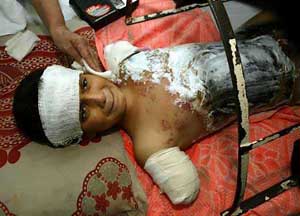
Ali Ismail Abbas, 12, was fast asleep when war shattered his life. A missile obliterated his home and most of his family, leaving him orphaned, badly burned and blowing off both his arms.
"It was midnight when the missile fell on us. My father, my mother and my brother died. My mother was five months pregnant," the traumatised boy said at Baghdad's Kindi hospital.
"Our neighbours pulled me out and brought me here. I was unconscious," he said yesterday.
In addition to the tragedy of losing his parents, he faces the horror of living handicapped. Thinking about his uncertain future he timidly asked whether he could get artificial arms.
"Can you help get my arms back? Do you think the doctors can get me another pair of hands?" Abbas asked.
"If I don't get a pair of hands, I will commit suicide," he said with tears spilling down his cheeks.
Poor shack
His aunt, three cousins and three other relatives staying with them were also killed in this week's missile strikes on their house in Diala Bridge district east of Baghdad.
"We didn't want war. I was scared of this war," said Abbas. "Our house was just a poor shack, why did they want to bomb us?" said the boy, unaware that the area in which he lived was surrounded by military installations.
With a childhood lost and a future clouded by disaster and disability, Abbas poured his heart out as he lay in bed with an improvised wooden cage over his chest to stop his burnt flesh touching the bed covers.
"I wanted to become an army officer when I grow up, but not anymore. Now I want to become a doctor, but how can I? I don't have hands," he said.
His aunt, Jamila Abbas, 53, looked after him, feeding him, washing him, comforting him with prayers and repeatedly telling him his parents had gone to heaven.
Abbas' suffering offered one snapshot of the daily horrors afflicting Iraqi civilians in the devastating U.S.-led war to remove President Saddam Hussain.
At the Kindi hospital, staff were overwhelmed by the sharp rise in casualties since U.S. ground troops moved north to Baghdad on Thursday and intensified their aerial assault.
Ambulance after ambulance raced in with casualties from around the capital. Victim after victim was rushed in, many carried in bed sheets after the stretchers ran out. Doctors struggled to find them beds.
Staff had no time even to clean the blood from trolleys. Patients' screams and parents' cries echoed across the ward.
With many staff unable to reach the hospital due to the bombing, doctors worked round the clock performing surgery, taking blood, giving injections and ferrying the wounded.
Doctor Osama Saleh Al Duleimi, an orthopedic surgeon and assistant director at Kindi, said they were overloaded and suffering shortages of anaesthesia, pain killers and staff.
The International Committee of the Red Cross (ICRC) has been touring hospitals to provide first aid and surgery kits.
"So far hospitals had equipment and medicine to cope but were overwhelmed by the sheer number of casualties coming in at the same time. During fierce bombardment, hospitals received up to 100 casualties per hour," ICRC spokesman Roland Huguenin-Benjamin told Reuters yesterday.
He said hospitals were well-organised and were so far coping, but voiced concern in case the fighting dragged on.
Doctors who treated Iraqi victims of two previous wars say they are taken aback by the injuries they have seen. Most suffered massive trauma and fatal wounds, including head, abdominal and limb injuries from lethal weapons, they said.
"I've been a doctor for 25 years and this is the worst I've seen in terms of the number of casualties and fatal wounds," said Duleimi, 48, who witnessed the 1980-88 Iran-Iraq War and the 1991 Gulf War over Kuwait.
"This is a disaster because they're attacking civilians. We are receiving a lot of civilian casualties," he added.
Washington says it has tried to minimise civilian casualties in its war to oust Saddam but doctors insist many of the victims are civilians caught in aerial and artillery bombardment. There is no independent figure for casualties but hospital sources put them at hundreds of dead and thousands of wounded.
"This war is more destructive than all the previous wars. In the previous battles, the weapons seemed merely disabling; now they're much more lethal," Doctor Sadek Al Mukhtar said.
"Before the war I did not regard America as my enemy. Now I do. There are the military and there are the civilians. War should be against the military. America is killing civilians."
"It was midnight when the missile fell on us. My father, my mother and my brother died. My mother was five months pregnant," the traumatised boy said at Baghdad's Kindi hospital.
"Our neighbours pulled me out and brought me here. I was unconscious," he said yesterday.
In addition to the tragedy of losing his parents, he faces the horror of living handicapped. Thinking about his uncertain future he timidly asked whether he could get artificial arms.
"Can you help get my arms back? Do you think the doctors can get me another pair of hands?" Abbas asked.
"If I don't get a pair of hands, I will commit suicide," he said with tears spilling down his cheeks.
Poor shack
His aunt, three cousins and three other relatives staying with them were also killed in this week's missile strikes on their house in Diala Bridge district east of Baghdad.
"We didn't want war. I was scared of this war," said Abbas. "Our house was just a poor shack, why did they want to bomb us?" said the boy, unaware that the area in which he lived was surrounded by military installations.
With a childhood lost and a future clouded by disaster and disability, Abbas poured his heart out as he lay in bed with an improvised wooden cage over his chest to stop his burnt flesh touching the bed covers.
"I wanted to become an army officer when I grow up, but not anymore. Now I want to become a doctor, but how can I? I don't have hands," he said.
His aunt, Jamila Abbas, 53, looked after him, feeding him, washing him, comforting him with prayers and repeatedly telling him his parents had gone to heaven.
Abbas' suffering offered one snapshot of the daily horrors afflicting Iraqi civilians in the devastating U.S.-led war to remove President Saddam Hussain.
At the Kindi hospital, staff were overwhelmed by the sharp rise in casualties since U.S. ground troops moved north to Baghdad on Thursday and intensified their aerial assault.
Ambulance after ambulance raced in with casualties from around the capital. Victim after victim was rushed in, many carried in bed sheets after the stretchers ran out. Doctors struggled to find them beds.
Staff had no time even to clean the blood from trolleys. Patients' screams and parents' cries echoed across the ward.
With many staff unable to reach the hospital due to the bombing, doctors worked round the clock performing surgery, taking blood, giving injections and ferrying the wounded.
Doctor Osama Saleh Al Duleimi, an orthopedic surgeon and assistant director at Kindi, said they were overloaded and suffering shortages of anaesthesia, pain killers and staff.
The International Committee of the Red Cross (ICRC) has been touring hospitals to provide first aid and surgery kits.
"So far hospitals had equipment and medicine to cope but were overwhelmed by the sheer number of casualties coming in at the same time. During fierce bombardment, hospitals received up to 100 casualties per hour," ICRC spokesman Roland Huguenin-Benjamin told Reuters yesterday.
He said hospitals were well-organised and were so far coping, but voiced concern in case the fighting dragged on.
Doctors who treated Iraqi victims of two previous wars say they are taken aback by the injuries they have seen. Most suffered massive trauma and fatal wounds, including head, abdominal and limb injuries from lethal weapons, they said.
"I've been a doctor for 25 years and this is the worst I've seen in terms of the number of casualties and fatal wounds," said Duleimi, 48, who witnessed the 1980-88 Iran-Iraq War and the 1991 Gulf War over Kuwait.
"This is a disaster because they're attacking civilians. We are receiving a lot of civilian casualties," he added.
Washington says it has tried to minimise civilian casualties in its war to oust Saddam but doctors insist many of the victims are civilians caught in aerial and artillery bombardment. There is no independent figure for casualties but hospital sources put them at hundreds of dead and thousands of wounded.
"This war is more destructive than all the previous wars. In the previous battles, the weapons seemed merely disabling; now they're much more lethal," Doctor Sadek Al Mukhtar said.
"Before the war I did not regard America as my enemy. Now I do. There are the military and there are the civilians. War should be against the military. America is killing civilians."
For more information:
http://www.gulf-news.com/Articles/news.asp...
Add Your Comments
Comments
(Hide Comments)
Why, in the name of humanity, can't the Red Cross, the U.N., someone, anyone, call for a temporary truce in this bloody conflict, at least long enough to get some relief and help to the hospitals caring for innocent victims like that poor kid with both of his arms blown off and half of his body burned?
It's very hard to cry and puke at the same time.
It's very hard to cry and puke at the same time.
For more information:
http://www.indybay.org/news/2003/04/159702...
Well, Gumby, looks like you put your foot in your mouth again.
Those of us who oppose this war do not support Saddam Hussein. When you and your brethren assert this, you are demonstrating one of two things. Either you know that we don't support the Iraqi dictator but want to make us look bad by lying about us. Or you really do believe the lies that someone else is spreading. Either way, I'm here to tell you (for the thousandth time) that we don't support Saddam Hussein. What part of that can't you understand?
As for your charges of treason, exactly how are we "aiding and comforting" the Iraqi dictatorship? I am not sending arms to them, or feeding and housing their soldiers. To assert as much is ludicrous. I (and millions of other Americans) do oppose this war, and one of the reason for this opposition is an unwillingness to allow the deaths of Iraqi civilians who pose no threat to me or any of the rest of us. We do give the Iraqi people our moral support and our prayers, that as many of them as possible may escape this new slaughter. A few peace activists are with Iraqi civilians trying to prevent the illegal bombing of civilian infrastructure by the Anglo-American military. That could be interpreted as "aid and comfort" for Iraqi civilians -- and if it prevents our troops from committing war crimes, it could arguably be a way to protect them from legal and moral jeapardy -- but it sure as hell isn't support for the Iraqi government. I know it may be hard for you to get this through your thick skull, but nowhere in the world is a country's people the same as that country's government. Not in Iraq, and not even here.
If you are charging us with treason, you must rely on the language of what's left of the Constitution. "Treason against the United States, shall consist only in levying war against them, or in adhering to their enemies, giving them aid and comfort." So, what we are doing is treason ONLY IF your enemies are the IRAQI PEOPLE. If that is so, it's high time you fessed up. Otherwise your "case" is just a lot of hot air.
What this adds up to is this: You're either a blowhard bully making false accusations, or you are seeking (or supporting) the mass murder of innocent civilians. Either way you're going to look bad. Better to quit while you're ahead and hold your tongue.
Those of us who oppose this war do not support Saddam Hussein. When you and your brethren assert this, you are demonstrating one of two things. Either you know that we don't support the Iraqi dictator but want to make us look bad by lying about us. Or you really do believe the lies that someone else is spreading. Either way, I'm here to tell you (for the thousandth time) that we don't support Saddam Hussein. What part of that can't you understand?
As for your charges of treason, exactly how are we "aiding and comforting" the Iraqi dictatorship? I am not sending arms to them, or feeding and housing their soldiers. To assert as much is ludicrous. I (and millions of other Americans) do oppose this war, and one of the reason for this opposition is an unwillingness to allow the deaths of Iraqi civilians who pose no threat to me or any of the rest of us. We do give the Iraqi people our moral support and our prayers, that as many of them as possible may escape this new slaughter. A few peace activists are with Iraqi civilians trying to prevent the illegal bombing of civilian infrastructure by the Anglo-American military. That could be interpreted as "aid and comfort" for Iraqi civilians -- and if it prevents our troops from committing war crimes, it could arguably be a way to protect them from legal and moral jeapardy -- but it sure as hell isn't support for the Iraqi government. I know it may be hard for you to get this through your thick skull, but nowhere in the world is a country's people the same as that country's government. Not in Iraq, and not even here.
If you are charging us with treason, you must rely on the language of what's left of the Constitution. "Treason against the United States, shall consist only in levying war against them, or in adhering to their enemies, giving them aid and comfort." So, what we are doing is treason ONLY IF your enemies are the IRAQI PEOPLE. If that is so, it's high time you fessed up. Otherwise your "case" is just a lot of hot air.
What this adds up to is this: You're either a blowhard bully making false accusations, or you are seeking (or supporting) the mass murder of innocent civilians. Either way you're going to look bad. Better to quit while you're ahead and hold your tongue.
Thank you. I didn't bother to reply to "Gumby" myself. I didn't think doing so would have much impact on his misperceptions. Nevertheless, I am grateful for your response. It is a relief to know that those misperceptions aren't shared by everyone.
I see that his comments have now been deleted. In a way, I almost wish that they had be left in place. It seems to me that anyone who could equate caring about the fate of children and other innocent victims of a war, on the one hand, and giving aid and comfort to the enemy, on the other, provides a good object lesson about the kind of attitudes that lead to bloody conflicts in the first place.
I see that his comments have now been deleted. In a way, I almost wish that they had be left in place. It seems to me that anyone who could equate caring about the fate of children and other innocent victims of a war, on the one hand, and giving aid and comfort to the enemy, on the other, provides a good object lesson about the kind of attitudes that lead to bloody conflicts in the first place.
Iraq was complying with the UN.
This is a war that was forced on them by the US. The Iraqi people have long been suffering under genocidal sanctions and are a captive population -- unable to escape the bombardment.
This is just so twisted and sick and it's hard to believe anyone buys all the bullshit being spewed by our government.
If threats from the people of the region is the driving force behind this then the easiest way to confront that is to implement a fair foreign policy which would deflate resentment against us in the region -- like implementing UN resolutions on Israel, stop aiding Israel, and removing sanctions on Iraq which have cost the lives of well over 1 million people.
That this course of action was undertaken instead shows the disdain and hatred average Americans hold for Arabs. This hatred in turn is based on an illusion of Arabs the US population has been fed -- not resembling reality at all.
This is a war that was forced on them by the US. The Iraqi people have long been suffering under genocidal sanctions and are a captive population -- unable to escape the bombardment.
This is just so twisted and sick and it's hard to believe anyone buys all the bullshit being spewed by our government.
If threats from the people of the region is the driving force behind this then the easiest way to confront that is to implement a fair foreign policy which would deflate resentment against us in the region -- like implementing UN resolutions on Israel, stop aiding Israel, and removing sanctions on Iraq which have cost the lives of well over 1 million people.
That this course of action was undertaken instead shows the disdain and hatred average Americans hold for Arabs. This hatred in turn is based on an illusion of Arabs the US population has been fed -- not resembling reality at all.
One of Dr. Saleh’s assistants, a young woman, had pulled some images up on a computer screen in his office. Dr. Saleh invited me to look at them with him. The first image the assistant showed us was of a boy lying naked in the emergency operating theatre. A catheter and tube was attached to his penis. The child’s legs were smooth, but his entire torso was black, and his arms were horribly burned. At about the biceps, the flesh of both arms became charred, black grotesqueries. One of his hands was a twisted, melted claw. His other arm had apparently been burned off at the elbow, and two long bones were sticking out of it. It looked like something that might be found in a barbecue pit.
The child’s face was covered by an anesthesia mask. “This is Ali,” Dr. Saleh said. “He is twelve. He was wounded in a rocket attack the night before last in the southeastern part of Baghdad, about fifteen minutes from here. Ali lost his mother, his father, and his six brothers and sisters. Four homes were destroyed; in one of them, the whole family was killed, eight people.”
It was hard to imagine that the person in the photograph could be alive, but Dr. Saleh said that Ali was still conscious. “I don’t think he will survive, though,” he said in a flat tone. “These burned people have complications after three or four days; in the first week they usually get septicemia.” His assistant was pulling up new images on her monitor. They showed Ali again, on the same bed and in the same position as before, but this time without his charred appendages. Both arms had been amputated, and the stumps were wrapped in white bandages. His torso was covered in some kind of clear grease. The mask had been removed from his face, and he appeared to be sleeping. He had a beautiful head, with the feminine features of a prepubescent boy. In another picture, Ali was awake, staring at the camera with large, expressionless eyes.
Dr. Saleh’s assistant breathed in sharply and put one hand over her mouth. Then she brought up some images of Ali’s family just after the bodies had arrived at the hospital’s morgue. It was difficult to make out what had once been human beings. Cloth stuck to the bodies, bits of bold red-and-green fabric with flower designs. There seemed to be some straw mixed in, and I asked Dr. Saleh if they had been farming people. He said yes, and pointed out Ali’s mother. Her face had been cut in half, as if by a giant cleaver, and her mouth was yawning open. In other pictures, which Dr. Saleh said were of Ali’s father and a younger sister, all I could see was a macabre collection of charred body parts and some red flesh. The body of his brother was all there, it seemed, but from the nose up his head was gone, simply sheared off, like the head of a rubber doll. His mouth, like that of his mother, was open, as if he were screaming.
“Have you seen enough?” the assistant asked me quietly. I didn’t say anything, so she showed me more pictures. After a few minutes of this, Dr. Saleh said,“O.K. This is just part of the tragedy.” He asked me if I wanted to see Ali.
I followed Dr. Saleh to the burn unit, where some men helped us on with green smocks, face masks, gauzy hair nets, and shoe coverings. Then we walked down a bare and quiet hall that reminded me of a prison corridor. The only thing on the walls was a framed portrait of Saddam Hussein. Dr. Saleh opened a door and we went into a small room where an older woman in a black abaya, Ali’s aunt, was sitting in a chair. A tiny window in the far wall of the room let in some sunlight. The aunt was sitting next to a bed on wheels that had a hooplike structure over it. Dr. Saleh carefully pulled back a coarse gray blanket, and I saw Ali’s naked chest, his bandaged stumps, and his face. His large eyes were hazel, flecked with green. He had long eyelashes and wavy brown hair. I didn’t know what to say.
Dr. Saleh asked Ali how he felt. “O.K.,” he said. Wasn’t he in a lot of pain, I said to Dr. Saleh, in a whisper. I spoke in English. “No,” he replied. “Deeply burned patients don’t feel much pain because of the damage to their nerves.” I stared at Ali, who looked back at me and at Dr. Saleh. His aunt got up and stood behind the head of the bed. She said nothing.
I asked Dr. Saleh to ask Ali what he was thinking about. Ali spoke for a moment in Arabic, in a boy’s soft, high-pitched voice. “He doesn’t think of anything, and he doesn’t remember anything,” Dr. Saleh said. He explained that Ali did not know that his family was dead. I asked Ali about school. He was in the sixth grade, he said, and his favorite subject was geography. As he spoke, his aunt stroked his hair. Did he like sports? Yes, he replied, especially volleyball, and also soccer. Was there anything he wanted, or needed? No, nothing. He looked at me and said something that Saleh didn’t translate until I insisted: “He says that Bush is a criminal and he is fighting for oil.” Ali had said this as he had said everything else, without expression. Ali’s aunt began to sob quietly behind him. I asked Ali what he wanted to be when he grew up. “An officer,” he said, and his aunt cried out, “Inshallah”—“If God wills it.”
Dr. Saleh had begun to weep, and I could hear him catching his breath. He tried to compose himself, and we said goodbye to Ali. Neither of us spoke as we walked down the hall to the sterile room, where the orderlies took off our smocks and masks. Dr. Saleh rubbed his eyes and cleared his throat several times. We went back to his office, and he washed his face in a sink. “So it’s untrue what they say about doctors being able to suspend their emotions,” I said.
He looked at me. His eyes were pink. “We are human beings,” he replied. He explained that Ali knew that he had lost his arms, but that he had not acknowledged it yet: “He is conscious. He can see the stumps.” Ali would likely die within three weeks.
Dr. Saleh said that the hospital had taken in about three hundred people who had been injured by the bombing. The doctors had managed to save everyone so far, although twenty people were already dead when they arrived. “War always brings tragedy, fear, pain, and psychological trauma,” he said. “Personally, I feel that problems can be solved by discussion and negotiation and collaboration. When you use military power, it means your brain has stopped. As an Iraqi, I feel that this is my country, and that I should work to maintain it and protect it from invasion, whatever invasion it is. I think any person would take this position when his country is attacked.”
Dr. Saleh has three sons and a daughter. The oldest child is twelve, the same age as Ali. Dr. Saleh works long hours at the hospital, and ever since the city’s telephone exchanges were bombed he hasn’t been able to call home to see how his family is doing. He was worried.
The child’s face was covered by an anesthesia mask. “This is Ali,” Dr. Saleh said. “He is twelve. He was wounded in a rocket attack the night before last in the southeastern part of Baghdad, about fifteen minutes from here. Ali lost his mother, his father, and his six brothers and sisters. Four homes were destroyed; in one of them, the whole family was killed, eight people.”
It was hard to imagine that the person in the photograph could be alive, but Dr. Saleh said that Ali was still conscious. “I don’t think he will survive, though,” he said in a flat tone. “These burned people have complications after three or four days; in the first week they usually get septicemia.” His assistant was pulling up new images on her monitor. They showed Ali again, on the same bed and in the same position as before, but this time without his charred appendages. Both arms had been amputated, and the stumps were wrapped in white bandages. His torso was covered in some kind of clear grease. The mask had been removed from his face, and he appeared to be sleeping. He had a beautiful head, with the feminine features of a prepubescent boy. In another picture, Ali was awake, staring at the camera with large, expressionless eyes.
Dr. Saleh’s assistant breathed in sharply and put one hand over her mouth. Then she brought up some images of Ali’s family just after the bodies had arrived at the hospital’s morgue. It was difficult to make out what had once been human beings. Cloth stuck to the bodies, bits of bold red-and-green fabric with flower designs. There seemed to be some straw mixed in, and I asked Dr. Saleh if they had been farming people. He said yes, and pointed out Ali’s mother. Her face had been cut in half, as if by a giant cleaver, and her mouth was yawning open. In other pictures, which Dr. Saleh said were of Ali’s father and a younger sister, all I could see was a macabre collection of charred body parts and some red flesh. The body of his brother was all there, it seemed, but from the nose up his head was gone, simply sheared off, like the head of a rubber doll. His mouth, like that of his mother, was open, as if he were screaming.
“Have you seen enough?” the assistant asked me quietly. I didn’t say anything, so she showed me more pictures. After a few minutes of this, Dr. Saleh said,“O.K. This is just part of the tragedy.” He asked me if I wanted to see Ali.
I followed Dr. Saleh to the burn unit, where some men helped us on with green smocks, face masks, gauzy hair nets, and shoe coverings. Then we walked down a bare and quiet hall that reminded me of a prison corridor. The only thing on the walls was a framed portrait of Saddam Hussein. Dr. Saleh opened a door and we went into a small room where an older woman in a black abaya, Ali’s aunt, was sitting in a chair. A tiny window in the far wall of the room let in some sunlight. The aunt was sitting next to a bed on wheels that had a hooplike structure over it. Dr. Saleh carefully pulled back a coarse gray blanket, and I saw Ali’s naked chest, his bandaged stumps, and his face. His large eyes were hazel, flecked with green. He had long eyelashes and wavy brown hair. I didn’t know what to say.
Dr. Saleh asked Ali how he felt. “O.K.,” he said. Wasn’t he in a lot of pain, I said to Dr. Saleh, in a whisper. I spoke in English. “No,” he replied. “Deeply burned patients don’t feel much pain because of the damage to their nerves.” I stared at Ali, who looked back at me and at Dr. Saleh. His aunt got up and stood behind the head of the bed. She said nothing.
I asked Dr. Saleh to ask Ali what he was thinking about. Ali spoke for a moment in Arabic, in a boy’s soft, high-pitched voice. “He doesn’t think of anything, and he doesn’t remember anything,” Dr. Saleh said. He explained that Ali did not know that his family was dead. I asked Ali about school. He was in the sixth grade, he said, and his favorite subject was geography. As he spoke, his aunt stroked his hair. Did he like sports? Yes, he replied, especially volleyball, and also soccer. Was there anything he wanted, or needed? No, nothing. He looked at me and said something that Saleh didn’t translate until I insisted: “He says that Bush is a criminal and he is fighting for oil.” Ali had said this as he had said everything else, without expression. Ali’s aunt began to sob quietly behind him. I asked Ali what he wanted to be when he grew up. “An officer,” he said, and his aunt cried out, “Inshallah”—“If God wills it.”
Dr. Saleh had begun to weep, and I could hear him catching his breath. He tried to compose himself, and we said goodbye to Ali. Neither of us spoke as we walked down the hall to the sterile room, where the orderlies took off our smocks and masks. Dr. Saleh rubbed his eyes and cleared his throat several times. We went back to his office, and he washed his face in a sink. “So it’s untrue what they say about doctors being able to suspend their emotions,” I said.
He looked at me. His eyes were pink. “We are human beings,” he replied. He explained that Ali knew that he had lost his arms, but that he had not acknowledged it yet: “He is conscious. He can see the stumps.” Ali would likely die within three weeks.
Dr. Saleh said that the hospital had taken in about three hundred people who had been injured by the bombing. The doctors had managed to save everyone so far, although twenty people were already dead when they arrived. “War always brings tragedy, fear, pain, and psychological trauma,” he said. “Personally, I feel that problems can be solved by discussion and negotiation and collaboration. When you use military power, it means your brain has stopped. As an Iraqi, I feel that this is my country, and that I should work to maintain it and protect it from invasion, whatever invasion it is. I think any person would take this position when his country is attacked.”
Dr. Saleh has three sons and a daughter. The oldest child is twelve, the same age as Ali. Dr. Saleh works long hours at the hospital, and ever since the city’s telephone exchanges were bombed he hasn’t been able to call home to see how his family is doing. He was worried.
For more information:
http://www.newyorker.com/fact/content/?030...
News From BBC Website Link Below:
--
An Iraqi boy who had both arms blown off and was orphaned when a missile hit his Baghdad home has been offered help from around the world. A former Indian royal Maharani Gayatri Devi from Jaipur said she would pay for a pair of artificial limbs for Ali Ismail Abbas, aged 12.
"I have to find out the whereabouts of the boy and where he can be operated upon. If the facilities are good in Iraq then he can be operated in Iraq or else anywhere in the world," she said.
The British clinic which makes prosthetic limbs for Heather Mills, the wife of the pop star Paul McCartney, has also offered to treat Ali Ismail Abbas.
"This is a humanitarian issue," said David Hills, manager of the Dorset Orthopaedic Company.
"We all feel a certain amount of guilt for what is going in Iraq, even if we know that this war is necessary as a means to an end... it would be an ideal opportunity to help."
(More at the link below)
--
An Iraqi boy who had both arms blown off and was orphaned when a missile hit his Baghdad home has been offered help from around the world. A former Indian royal Maharani Gayatri Devi from Jaipur said she would pay for a pair of artificial limbs for Ali Ismail Abbas, aged 12.
"I have to find out the whereabouts of the boy and where he can be operated upon. If the facilities are good in Iraq then he can be operated in Iraq or else anywhere in the world," she said.
The British clinic which makes prosthetic limbs for Heather Mills, the wife of the pop star Paul McCartney, has also offered to treat Ali Ismail Abbas.
"This is a humanitarian issue," said David Hills, manager of the Dorset Orthopaedic Company.
"We all feel a certain amount of guilt for what is going in Iraq, even if we know that this war is necessary as a means to an end... it would be an ideal opportunity to help."
(More at the link below)
For more information:
http://news.bbc.co.uk/1/hi/world/middle_ea...
Looks as if the US Marines have already decided this kid should die. Probably don't want him to be a living reminder of W's butchery.
The Times of London
April 12, 2003
Ali 'dead in days' if he stays in siege hospital
From Janine di Giovanni in Saddam City
THE world of Ali Ismail Abbas has shrunk to four dirty walls and a polyester blanket. Burns cover more than 35 per cent of his body. His arms, blown off in an American rocket attack on his house two weeks ago that killed his parents, stop just below his shoulders.
His body has been so ravaged by war that even he cannot bear to look at it. He asks his aunt, Jumeira Abbas, to cover his torso with a towel.
“Oh God, I want my hands back,” he whimpers, his face — the only part of his body untouched by injury — crumpling in tears.
The room where Ali lies on a dirty bed is unsterile and his burns are at risk of becoming infected. Mowafak Gorea, the director of the hospital, says wearily that if the child is not moved within days he will die from septicemia.
But Ali is at risk from another, more imminent danger. The hospital where he lies in agony — there are no painkillers strong enough to reduce his pain — is under siege from looters and rogue militias. There is an iron gate in front of the hospital, but it is not strong enough to protect the patients in the hallways whose bodies are peppered with shrapnel.
Outside, the streets of Saddam City — now renamed Revolution City — are full of looters, Fedayin and foreign fighters and it looks more like Mogadishu or Beirut than a city under American control.
Earlier in the day, a fighter from Syria was dragged into the hospital from the street by enraged locals after being found at a checkpoint with an explosive strapped to his body. His fate hung in the balance.
“Now we don’t know who is fighting who outside,” Dr Gorea said.
A handful of civilians have banded together, armed with Kalashnikovs and long knives, to protect the hospital, the last functioning vestige of this chaotic slum. Their commander is a local sheikh who was imprisoned and tortured for nine years under Saddam Hussein’s regime and who cannot remember how old he is because of his “lost years”.
The motley defenders stand guard, watching as lorries unload more casualties inside the gates, but hour by hour the streets descend further into anarchy. Checkpoints, armed by whoever has a gun and decides to control that portion of the turf, spring up suddenly and without warning. “Where are the Americans?” screamed one armed civilian who now controls a checkpoint near the hospital. “We thought they were coming to help us!” It is a complaint that is heard frequently in Revolution City, the home of nearly a million Shias who have not forgotten that they were badly let down after the last Gulf War, when they tried to rise up against the Iraqi President. A small group of US Marines said that they were trying to secure the hospital, and a few tanks were moving in. But trying to control the volatile neighbourhood in the wake of Saddam’s downfall seems a Herculean task.
Revolution City hospital is now the only functioning hospital in Baghdad. The others, including al-Kindi, where Ali was first taken two weeks ago after a rocket crashed into the house where he was sleeping, have been gutted.
It is believed that al-Kindi has now been taken over by a Shia sheikh from Najaf who is using it as a base. Some of the drugs that have been stolen from al-Kindi and other wards were handed over, ironically, by looters to Revolution Hospital. “But I will not touch them; they are stolen goods,” says Dr Gorea, a surgeon who has not left the inside of the hospital for 23 days and who has not seen nor had word of his own family for a week.
For more than 300 patients, many of whom were taken by double-decker bus as the other Baghdad hospitals were stripped, he has only 22 doctors and 120 staff. It is a third of the staff that he had before the war. While he says that they have enough medical supplies and a generator pumps electricity and water, those staff are nearing exhaustion.
Some of them, such as Ali Ismail’s devoted nurse, Fatin, continue to work through the madness. She tends Ali, wiping his brow and trying to help him to sleep at night when the pain is the worse. Sometimes he accidentally calls her Hannan, then apologises: “My wounds hurt so much, and I feel like I have a brick on my brain,” he says. “I can’t remember much of anything.”
He does, however, remember his dead parents: his mother, who was five months’ pregnant when she died, and his father, a taxi driver. He remembers his six sisters, most of whom were injured in the rocket attack and whom he has not seen since. He weeps when he thinks of his favourite brother, Abbas, who was also killed when the missile struck.
“We used to play football together,” he says. “We used to fish together. Now how can I do that without my hands?” Dr Gorea says that Ali seems to have improved, but is doubtful that he will make a full recovery. Unless he is moved, the doctor believes that he could die within days.
Médicins Sans Frontières, when contacted by The Times about Ali, said that it could not help. US Marines, also contacted by The Times, said that even if he were removed, his injuries were so devastating that he probably had only a one in five chance of survival.
“If he were in the US, with excellent medical treatment, he would have a 50-50 chance,” one said. “I know it’s sad, but given the fact that he has 35 per cent burns, it is probably around 20 per cent.”
Civil affairs officers based at the Palestine Hotel did begin making inquiries about airlifting Ali, but had to make sure that the area was secure before they could go in. “We can’t send a chopper in there unless it is safe,” one said.
One thing is certain: Revolution City is not yet safe. As Ali’s fate was being decided, he asked for one small thing — a kebab. The hospital cannot supply food and Ali has been eating only rice and milk. The thought of the sandwich brought a slight smile to his face. Outside, the streets of Baghdad were full of smoke, shops were closed, looting was widespread and there was less chance of finding a kebab than of the Americans securing peace within a few days.
“You have seen one Ali, but there are thousands of Alis in this city,” Dr Gorea said. “He has been promised so much. He will die before those promises are fulfilled.”
How to help
The appeal set up to help Ali Ismail Abbas has raised £50,000 in four days. The picture of Ali, 12, lying badly burnt in a Baghdad hospital became a focus of concern for casualties of war after its publication this week.
On Tuesday the Limbless Association started Ali’s Fund for the Limbless of Iraq to provide prosthetic body parts for him and other victims of the war. A spokeswoman said that the response had been “absolutely phenomenal”.
To make a donation to Ali’s Fund: contact the Limbless Association on 020-8788 1777 or http://www.limbless-association.org.
The British Red Cross, on behalf of the International Committee of the Red Cross: 08705 125 125 or http://www.redcross.org.uk/iraqcrisis.
Unicef is also raising money for the 12 million children of Iraq: http://www.unicef.org.uk/emergency or 08457 312 312.
The Times of London
April 12, 2003
Ali 'dead in days' if he stays in siege hospital
From Janine di Giovanni in Saddam City
THE world of Ali Ismail Abbas has shrunk to four dirty walls and a polyester blanket. Burns cover more than 35 per cent of his body. His arms, blown off in an American rocket attack on his house two weeks ago that killed his parents, stop just below his shoulders.
His body has been so ravaged by war that even he cannot bear to look at it. He asks his aunt, Jumeira Abbas, to cover his torso with a towel.
“Oh God, I want my hands back,” he whimpers, his face — the only part of his body untouched by injury — crumpling in tears.
The room where Ali lies on a dirty bed is unsterile and his burns are at risk of becoming infected. Mowafak Gorea, the director of the hospital, says wearily that if the child is not moved within days he will die from septicemia.
But Ali is at risk from another, more imminent danger. The hospital where he lies in agony — there are no painkillers strong enough to reduce his pain — is under siege from looters and rogue militias. There is an iron gate in front of the hospital, but it is not strong enough to protect the patients in the hallways whose bodies are peppered with shrapnel.
Outside, the streets of Saddam City — now renamed Revolution City — are full of looters, Fedayin and foreign fighters and it looks more like Mogadishu or Beirut than a city under American control.
Earlier in the day, a fighter from Syria was dragged into the hospital from the street by enraged locals after being found at a checkpoint with an explosive strapped to his body. His fate hung in the balance.
“Now we don’t know who is fighting who outside,” Dr Gorea said.
A handful of civilians have banded together, armed with Kalashnikovs and long knives, to protect the hospital, the last functioning vestige of this chaotic slum. Their commander is a local sheikh who was imprisoned and tortured for nine years under Saddam Hussein’s regime and who cannot remember how old he is because of his “lost years”.
The motley defenders stand guard, watching as lorries unload more casualties inside the gates, but hour by hour the streets descend further into anarchy. Checkpoints, armed by whoever has a gun and decides to control that portion of the turf, spring up suddenly and without warning. “Where are the Americans?” screamed one armed civilian who now controls a checkpoint near the hospital. “We thought they were coming to help us!” It is a complaint that is heard frequently in Revolution City, the home of nearly a million Shias who have not forgotten that they were badly let down after the last Gulf War, when they tried to rise up against the Iraqi President. A small group of US Marines said that they were trying to secure the hospital, and a few tanks were moving in. But trying to control the volatile neighbourhood in the wake of Saddam’s downfall seems a Herculean task.
Revolution City hospital is now the only functioning hospital in Baghdad. The others, including al-Kindi, where Ali was first taken two weeks ago after a rocket crashed into the house where he was sleeping, have been gutted.
It is believed that al-Kindi has now been taken over by a Shia sheikh from Najaf who is using it as a base. Some of the drugs that have been stolen from al-Kindi and other wards were handed over, ironically, by looters to Revolution Hospital. “But I will not touch them; they are stolen goods,” says Dr Gorea, a surgeon who has not left the inside of the hospital for 23 days and who has not seen nor had word of his own family for a week.
For more than 300 patients, many of whom were taken by double-decker bus as the other Baghdad hospitals were stripped, he has only 22 doctors and 120 staff. It is a third of the staff that he had before the war. While he says that they have enough medical supplies and a generator pumps electricity and water, those staff are nearing exhaustion.
Some of them, such as Ali Ismail’s devoted nurse, Fatin, continue to work through the madness. She tends Ali, wiping his brow and trying to help him to sleep at night when the pain is the worse. Sometimes he accidentally calls her Hannan, then apologises: “My wounds hurt so much, and I feel like I have a brick on my brain,” he says. “I can’t remember much of anything.”
He does, however, remember his dead parents: his mother, who was five months’ pregnant when she died, and his father, a taxi driver. He remembers his six sisters, most of whom were injured in the rocket attack and whom he has not seen since. He weeps when he thinks of his favourite brother, Abbas, who was also killed when the missile struck.
“We used to play football together,” he says. “We used to fish together. Now how can I do that without my hands?” Dr Gorea says that Ali seems to have improved, but is doubtful that he will make a full recovery. Unless he is moved, the doctor believes that he could die within days.
Médicins Sans Frontières, when contacted by The Times about Ali, said that it could not help. US Marines, also contacted by The Times, said that even if he were removed, his injuries were so devastating that he probably had only a one in five chance of survival.
“If he were in the US, with excellent medical treatment, he would have a 50-50 chance,” one said. “I know it’s sad, but given the fact that he has 35 per cent burns, it is probably around 20 per cent.”
Civil affairs officers based at the Palestine Hotel did begin making inquiries about airlifting Ali, but had to make sure that the area was secure before they could go in. “We can’t send a chopper in there unless it is safe,” one said.
One thing is certain: Revolution City is not yet safe. As Ali’s fate was being decided, he asked for one small thing — a kebab. The hospital cannot supply food and Ali has been eating only rice and milk. The thought of the sandwich brought a slight smile to his face. Outside, the streets of Baghdad were full of smoke, shops were closed, looting was widespread and there was less chance of finding a kebab than of the Americans securing peace within a few days.
“You have seen one Ali, but there are thousands of Alis in this city,” Dr Gorea said. “He has been promised so much. He will die before those promises are fulfilled.”
How to help
The appeal set up to help Ali Ismail Abbas has raised £50,000 in four days. The picture of Ali, 12, lying badly burnt in a Baghdad hospital became a focus of concern for casualties of war after its publication this week.
On Tuesday the Limbless Association started Ali’s Fund for the Limbless of Iraq to provide prosthetic body parts for him and other victims of the war. A spokeswoman said that the response had been “absolutely phenomenal”.
To make a donation to Ali’s Fund: contact the Limbless Association on 020-8788 1777 or http://www.limbless-association.org.
The British Red Cross, on behalf of the International Committee of the Red Cross: 08705 125 125 or http://www.redcross.org.uk/iraqcrisis.
Unicef is also raising money for the 12 million children of Iraq: http://www.unicef.org.uk/emergency or 08457 312 312.
It would be nice to see some of the same concern shown for Isreali victims of suicide bombers.
Israelis are not the only one's dying.
"Israelis are not the only one's dying."
And that precludes the possibility of expressing sympathy for the death of Israeli civilians exactly how?
@%<
And that precludes the possibility of expressing sympathy for the death of Israeli civilians exactly how?
@%<
Not one iota. But this series of posts isn't about injured Israelis so please do not distract from an innocent child who has nothing to do with what is going on in Iraq let alone Israel.
Hundreds of Iraqis are killed every day for a policy of declawing Iraq so it is not a threat to Israel. Dozens of Palestinians are being murdered by Israelis every day. One or two Israelis are killed once a blue moon but these are the only victims pro-Israelis deem worthy to mourn.
David, please consider enlisting in the Zionist army. Please help us wipe every last one of those wicked Palestinians off the face of the Earth!
Many of us in the US have been working the phones and emails contacting anyone we can think of to make this happen for this young man. It looks as if it might. Keep your finger's crossed...Bush's everlasting war horror picture might get a second chance afterall.
http://www.cnn.com/2003/WORLD/meast/04/15/sprj.irq.int.ali.kuwait/index.html
http://www.cnn.com/2003/WORLD/meast/04/15/sprj.irq.int.ali.kuwait/index.html
We are 100% volunteer and depend on your participation to sustain our efforts!
Donate

$185.00 donated
in the past month
Get Involved
If you'd like to help with maintaining or developing the website, contact us.
Publish
Publish your stories and upcoming events on Indybay.
Topics
More
Search Indybay's Archives
Advanced Search
►
▼
IMC Network