







 Publish to Newswire
 Add an Event
From the Open-Publishing Calendar
From the Open-Publishing Newswire
Indybay Feature
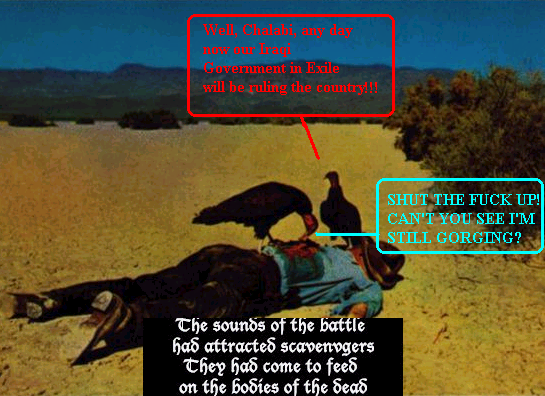
Powell Prevails Over Rumsfeld: Bad Guy Chalabi Wont Succeed Hussein!
What can be said of Chalabi? Actually a lot has been said. He's a millionaire capitalist, an embezzler, and atrocity exhibiter, who while chronicling the many crimes of Saddam Hussein not once brought up the harm and deaths caused by U.S Sanctions. It would be nice if the carpet baggers were kept completely away from an interim government.
Saturday, April 5, 2003
By TIM JOHNSON
KNIGHT RIDDER NEWSPAPERS
WASHINGTON - The White House said Friday that it will establish a "broad-based" interim authority to help govern Iraq once fighting dies down, and said it will include a spectrum of ethnic and religious groups as well as longtime Iraqi exiles and others still living in the war-ravaged country.
National Security Adviser Condoleezza Rice said the interim authority may begin to take shape even before U.S.-led troops topple Saddam Hussein and wipe out all armed resistance.
Her announcement marked a triumph for those in the Bush administration, particularly Secretary of State Colin L. Powell, who had sought to derail a plan by Pentagon hawks to install a London-based exile, Ahmed Chalabi, as a virtual successor to Hussein. Chalabi has lived abroad for more than four decades.
Defense Secretary Donald H. Rumsfeld wanted Chalabi to head the interim administration, but the CIA and State Department argued that he has little popular support inside the country and would be perceived around the world as a U.S.-imposed puppet.
The Pentagon has been reticent to detail the role of its new Office for Reconstruction and Humanitarian Assistance, headed by retired Army Lt. Gen. Jay Garner. He is overseeing plans from a hotel in Kuwait City to run an interim administration for postwar Iraq, with help from scores of Iraqi exiles on three- and six-month contracts.
Garner's office will work with the interim authority and international agencies "to make sure that the Iraqi people are getting back on their feet, that life is returning to normal, that health care can be delivered, that people can go back to school, that agriculture is running," Rice said.
Rice pledged that the transitional authority would be "run by Iraqis" and that Washington wanted only to ensure that the nation remains whole, at peace with its neighbors, free of weapons of mass destruction, and on the path to democracy.
"The interim authority will not be a coalition-imposed provisional government," Rice said.
She said its leaders would not be limited to exiles, although she said many of them "have carried the flame for a free Iraq for decades."
The Bush administration is "committed" to working with the United Nations in rebuilding Iraq, Rice said, but she emphasized that the U.S.-led "coalition will naturally have the leading role for a period of time."
The role of the United Nations "is yet to be determined" beyond an initial humanitarian capacity, she said, hinting that she saw no need for a broader, nation-building function.
"I would just caution that Iraq is not East Timor, or Kosovo, or Afghanistan," she said. "Iraq is unique."
Although those places were broken states or regions, she said, Iraq has more of the institutional scaffolding of a prosperous nation. "This is an educated population, a sophisticated population that has lived under a tyrannical regime in a reign of fear."
Rice demurred when asked how Iraqis would be chosen for a role in an interim authority.
"You're going to see leadership emerge," Rice said. "And so it's not as if somebody is picking these people."
Powell was backed by British Prime Minister Tony Blair, who wanted a larger U.N. role in selecting the interim administration, and by the CIA and the military's Joint Chiefs of Staff.
"The issue was Ahmed Chalabi," said one senior administration official, who spoke on condition of anonymity. "The agency [CIA] has good reason to believe he's not entirely straight. The State Department doesn't think he can hold it together, doesn't think that he's well-respected inside Iraq."
What may have tipped the long-running battle between the Powell and Rumsfeld factions is growing evidence that the intelligence about Iraq provided by Chalabi and his Iraqi National Congress, an umbrella group of anti-Hussein factions, has mostly been wrong.
"We're 16 days into this and guess what?" said the senior official. "Most of what he said [about popular uprisings and immediate popular support for invading U.S. and British forces] hasn't exactly panned out."
Iraq's 25 million people include Shiite and Sunni Muslims, ethnic Arabs, Kurds, and Turkmen. Some analysts fear that once Hussein's iron fist is lifted, future leaders will face a rocky road in keeping the nation together.
Powell, speaking at the State Department, sounded upbeat.
"The day of liberation is drawing near," he said, adding that the composition of an interim Iraqi authority must be "representative of all the groups who have an interest in the future of Iraq."
The White House had practical considerations to weigh as it cast a broad net for staffing Iraq's interim government, in part because Congress has indicated it wants oversight of postwar reconstruction to rest as much as possible with the State Department.
In approving nearly $79 billion to pay for the war and homeland security this week, the House and Senate rewrote Bush's request for postwar funding by directing Iraq reconstruction money to the State Department instead of the Pentagon.
Legislators from both parties have expressed concern over the composition of a postwar authority, debating whether expatriate Iraqis should hold the upper hand in running the country as U.S. officials scramble to look for trustworthy Iraqis who have lived quietly under Saddam's rule.
"It may be that some [exiles] who have been out of touch for a long while will find this to be very daunting," said Sen. Richard Lugar, the Republican chairman of the Senate Foreign Relations Committee. "Maybe the people who have been inside the country have been so cowed by their circumstances that they really haven't been able to think through what this is all about.
"We could get into such a doctrinal dispute back here that we don't find anybody," Lugar said. "The talent search is of the essence."
By TIM JOHNSON
KNIGHT RIDDER NEWSPAPERS
WASHINGTON - The White House said Friday that it will establish a "broad-based" interim authority to help govern Iraq once fighting dies down, and said it will include a spectrum of ethnic and religious groups as well as longtime Iraqi exiles and others still living in the war-ravaged country.
National Security Adviser Condoleezza Rice said the interim authority may begin to take shape even before U.S.-led troops topple Saddam Hussein and wipe out all armed resistance.
Her announcement marked a triumph for those in the Bush administration, particularly Secretary of State Colin L. Powell, who had sought to derail a plan by Pentagon hawks to install a London-based exile, Ahmed Chalabi, as a virtual successor to Hussein. Chalabi has lived abroad for more than four decades.
Defense Secretary Donald H. Rumsfeld wanted Chalabi to head the interim administration, but the CIA and State Department argued that he has little popular support inside the country and would be perceived around the world as a U.S.-imposed puppet.
The Pentagon has been reticent to detail the role of its new Office for Reconstruction and Humanitarian Assistance, headed by retired Army Lt. Gen. Jay Garner. He is overseeing plans from a hotel in Kuwait City to run an interim administration for postwar Iraq, with help from scores of Iraqi exiles on three- and six-month contracts.
Garner's office will work with the interim authority and international agencies "to make sure that the Iraqi people are getting back on their feet, that life is returning to normal, that health care can be delivered, that people can go back to school, that agriculture is running," Rice said.
Rice pledged that the transitional authority would be "run by Iraqis" and that Washington wanted only to ensure that the nation remains whole, at peace with its neighbors, free of weapons of mass destruction, and on the path to democracy.
"The interim authority will not be a coalition-imposed provisional government," Rice said.
She said its leaders would not be limited to exiles, although she said many of them "have carried the flame for a free Iraq for decades."
The Bush administration is "committed" to working with the United Nations in rebuilding Iraq, Rice said, but she emphasized that the U.S.-led "coalition will naturally have the leading role for a period of time."
The role of the United Nations "is yet to be determined" beyond an initial humanitarian capacity, she said, hinting that she saw no need for a broader, nation-building function.
"I would just caution that Iraq is not East Timor, or Kosovo, or Afghanistan," she said. "Iraq is unique."
Although those places were broken states or regions, she said, Iraq has more of the institutional scaffolding of a prosperous nation. "This is an educated population, a sophisticated population that has lived under a tyrannical regime in a reign of fear."
Rice demurred when asked how Iraqis would be chosen for a role in an interim authority.
"You're going to see leadership emerge," Rice said. "And so it's not as if somebody is picking these people."
Powell was backed by British Prime Minister Tony Blair, who wanted a larger U.N. role in selecting the interim administration, and by the CIA and the military's Joint Chiefs of Staff.
"The issue was Ahmed Chalabi," said one senior administration official, who spoke on condition of anonymity. "The agency [CIA] has good reason to believe he's not entirely straight. The State Department doesn't think he can hold it together, doesn't think that he's well-respected inside Iraq."
What may have tipped the long-running battle between the Powell and Rumsfeld factions is growing evidence that the intelligence about Iraq provided by Chalabi and his Iraqi National Congress, an umbrella group of anti-Hussein factions, has mostly been wrong.
"We're 16 days into this and guess what?" said the senior official. "Most of what he said [about popular uprisings and immediate popular support for invading U.S. and British forces] hasn't exactly panned out."
Iraq's 25 million people include Shiite and Sunni Muslims, ethnic Arabs, Kurds, and Turkmen. Some analysts fear that once Hussein's iron fist is lifted, future leaders will face a rocky road in keeping the nation together.
Powell, speaking at the State Department, sounded upbeat.
"The day of liberation is drawing near," he said, adding that the composition of an interim Iraqi authority must be "representative of all the groups who have an interest in the future of Iraq."
The White House had practical considerations to weigh as it cast a broad net for staffing Iraq's interim government, in part because Congress has indicated it wants oversight of postwar reconstruction to rest as much as possible with the State Department.
In approving nearly $79 billion to pay for the war and homeland security this week, the House and Senate rewrote Bush's request for postwar funding by directing Iraq reconstruction money to the State Department instead of the Pentagon.
Legislators from both parties have expressed concern over the composition of a postwar authority, debating whether expatriate Iraqis should hold the upper hand in running the country as U.S. officials scramble to look for trustworthy Iraqis who have lived quietly under Saddam's rule.
"It may be that some [exiles] who have been out of touch for a long while will find this to be very daunting," said Sen. Richard Lugar, the Republican chairman of the Senate Foreign Relations Committee. "Maybe the people who have been inside the country have been so cowed by their circumstances that they really haven't been able to think through what this is all about.
"We could get into such a doctrinal dispute back here that we don't find anybody," Lugar said. "The talent search is of the essence."
For more information:
http://www.northjersey.com/page.php?qstr=e...
Add Your Comments
We are 100% volunteer and depend on your participation to sustain our efforts!
Donate

$110.00 donated
in the past month
Get Involved
If you'd like to help with maintaining or developing the website, contact us.
Publish
Publish your stories and upcoming events on Indybay.
Topics
More
Search Indybay's Archives
Advanced Search
►
▼
IMC Network