







 Publish to Newswire
 Add an Event
From the Open-Publishing Calendar
From the Open-Publishing Newswire
Indybay Feature
ARTISTS ANNOUNCE LONDON - NEW HAVEN ANTIWAR ART SHOWS
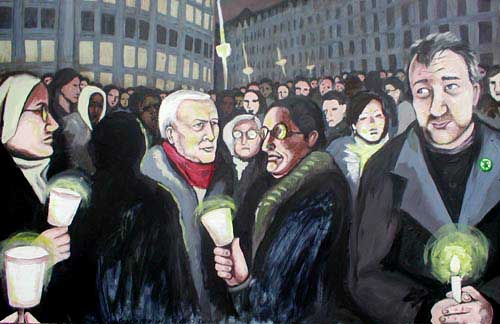
U.K. Stuckist Artist, Ella Guru, painted this work titled, "Candlelit vigil in Trafalgar Square, 18/01/03." The Painting portrays a demonstration held by CND (Campaign for Nuclear Disarmament) and attended by former Labor Minister Tony Benn.
Last January I wrote and posted on my Art For A Change website, an essay about the International Stuckist Art movement... that essay can be read, here: http://www.art-for-a-change.com/News/stuckist.htm
The Stuckists are not just another bunch of trendy Artists, their most recent exhibits are co-coordinated to open simultaneously in London and New Haven, CT, and these exhibitions are harbingers of things to come in the Art world.
Titled "War on Blair" (London exhibit) and "War on Bush" (New Haven exhibit), the exhibitions lambaste the war against Iraq through Paintings, Prints, and other works of Art. Stuckism advocates realism in Painting and art making, and calls for an abandonment of "conceptual" gimmickry. The Press Release for the antiwar exhibitions follows:
PRESS RELEASE - for immediate release 2.4.03
"WAR ON BLAIR" Painting, photography and prints, including anti-war demos. Stuckists and guests protest at Tony Blair's war in Iraq. 4-27 April 2003, Wed-Sat 12-6 pm.
"The War on Blair " exhibition documents the outrage of Stuckists and guest artists over the war in Iraq.
It is the sister show of "The War on Bush", launched 21 March 2003 by the New Haven Stuckists in the United States. UK show organizer Ella Guru said, "We believe that Bush and Blair are putting the entire world in danger. By ignoring the UN they set a new precedent for any country to be able to attack anyone at any time.
"My painting "Candlelit vigil in Trafalgar Square, 18/01/03" depicts a protest held by CND and Tony Benn in solidarity with American protests taking place the same day. Similarly, we are holding protest art
exhibitions at the same time. People all over the world object to this war. Public opinion continues to
grow in opposition, contrary to government media spin saying otherwise."
Nic Watson, the organizer of the simultaneous US Stuckist show said, "Bush and Blair have hypocritically betrayed their own standards and principles. If there is international law it applies equally to them as it does to Saddam Hussein and Bin Laden. The message they are sending is that it is OK to break the law when it suits you. What kind of example is that?"
The New Haven group, dressed up as clowns, held a mock trial of President Bush on the steps of the New
Haven Federal Courthouse. "Obviously Saddam is a bad guy and he needs to go, but we're opposed to how it's being handled," American Stuckist Jesse Richards said. "We're also worried about stability in that region."
The Stuckists were founded in London in 1999 by artists Charles Thomson and Billy Childish with twelve
artists and named after an insult by one of Charles Saatchi's favorite artists, Tracey Emin, to ex-boyfriend Childish: "You are stuck. Stuck! Stuck! Stuck!" There are now 60 groups round the world. The Stuckists believe in painting and are anti-conceptual art, which they see as being idiotic. They want to bring back spiritual values into art, which they feel has been hijacked by shallow gimmickry because of elitist and commercial interests.
MEDIA INFO:
The Stuckism International Centre-London,
3 Charlotte Road London EC2A 3DH
Tel: 020 7613 0988
Email: stuckism [at] yahoo.co.uk
London show organizers: Ella Guru and Sexton Ming,
American show organizers: Jesse Richards, Nic Watson,
Catherine Chow and Marisa Shepherd
The Stuckism International Center-USA,
817 Chapel St. Suite 3F New Haven, CT. 06511
(+1) 203-675-2117 or by email: stuckism_usa [at] yahoo.com
Images are available on request Artists are available for interview.
Web site: http://www.stuckism.com
The Stuckists are not just another bunch of trendy Artists, their most recent exhibits are co-coordinated to open simultaneously in London and New Haven, CT, and these exhibitions are harbingers of things to come in the Art world.
Titled "War on Blair" (London exhibit) and "War on Bush" (New Haven exhibit), the exhibitions lambaste the war against Iraq through Paintings, Prints, and other works of Art. Stuckism advocates realism in Painting and art making, and calls for an abandonment of "conceptual" gimmickry. The Press Release for the antiwar exhibitions follows:
PRESS RELEASE - for immediate release 2.4.03
"WAR ON BLAIR" Painting, photography and prints, including anti-war demos. Stuckists and guests protest at Tony Blair's war in Iraq. 4-27 April 2003, Wed-Sat 12-6 pm.
"The War on Blair " exhibition documents the outrage of Stuckists and guest artists over the war in Iraq.
It is the sister show of "The War on Bush", launched 21 March 2003 by the New Haven Stuckists in the United States. UK show organizer Ella Guru said, "We believe that Bush and Blair are putting the entire world in danger. By ignoring the UN they set a new precedent for any country to be able to attack anyone at any time.
"My painting "Candlelit vigil in Trafalgar Square, 18/01/03" depicts a protest held by CND and Tony Benn in solidarity with American protests taking place the same day. Similarly, we are holding protest art
exhibitions at the same time. People all over the world object to this war. Public opinion continues to
grow in opposition, contrary to government media spin saying otherwise."
Nic Watson, the organizer of the simultaneous US Stuckist show said, "Bush and Blair have hypocritically betrayed their own standards and principles. If there is international law it applies equally to them as it does to Saddam Hussein and Bin Laden. The message they are sending is that it is OK to break the law when it suits you. What kind of example is that?"
The New Haven group, dressed up as clowns, held a mock trial of President Bush on the steps of the New
Haven Federal Courthouse. "Obviously Saddam is a bad guy and he needs to go, but we're opposed to how it's being handled," American Stuckist Jesse Richards said. "We're also worried about stability in that region."
The Stuckists were founded in London in 1999 by artists Charles Thomson and Billy Childish with twelve
artists and named after an insult by one of Charles Saatchi's favorite artists, Tracey Emin, to ex-boyfriend Childish: "You are stuck. Stuck! Stuck! Stuck!" There are now 60 groups round the world. The Stuckists believe in painting and are anti-conceptual art, which they see as being idiotic. They want to bring back spiritual values into art, which they feel has been hijacked by shallow gimmickry because of elitist and commercial interests.
MEDIA INFO:
The Stuckism International Centre-London,
3 Charlotte Road London EC2A 3DH
Tel: 020 7613 0988
Email: stuckism [at] yahoo.co.uk
London show organizers: Ella Guru and Sexton Ming,
American show organizers: Jesse Richards, Nic Watson,
Catherine Chow and Marisa Shepherd
The Stuckism International Center-USA,
817 Chapel St. Suite 3F New Haven, CT. 06511
(+1) 203-675-2117 or by email: stuckism_usa [at] yahoo.com
Images are available on request Artists are available for interview.
Web site: http://www.stuckism.com
For more information:
http://www.art-for-a-change.com
Add Your Comments
Comments
(Hide Comments)
http://www.peacesymbol.org/peacesymbol.htm
A history of the Campaign for Nuclear Disarmament (CND) logo
One of the most widely known symbols in the world, in Britain it is
recognised as standing for nuclear disarmament – and in particular as the
logo of the Campaign for Nuclear Disarmament (CND). In the United States
and much of the rest of the world it is known more broadly as the peace
symbol. It was designed in 1958 by Gerald Holtom, a professional designer
and artist and a graduate of the Royal College of Arts. He showed his
preliminary sketches to a small group of people in the Peace News office
in North London and to the Direct Action Committee Against Nuclear War,
one of several smaller organisations that came together to set up CND.
The Direct Action Committee had already planned what was to be the first
major anti- nuclear march, from London to Aldermaston, where British
nuclear weapons were and still are manufactured. It was on that march,
over the 1958 Easter weekend that the symbol first appeared in public.
Five hundred cardboard lollipops on sticks were produced. Half were black
on white and half white on green. Just as the church’s liturgical colours
change over Easter, so the colours were to change, “from Winter to
Spring, from Death to Life.” Black and white would be displayed on Good
Friday and Saturday, green and white on Easter Sunday and Monday.
The first badges were made by Eric Austin of Kensington CND using white
clay with the symbol painted black. Again there was a conscious symbolism
. They were distributed with a note explaining that in the event of a
nuclear war, these fired pottery badges would be among the few human
artifacts to survive the nuclear inferno. These early ceramic badges can
still be found and one, lent by CND, was included in the Imperial War
Museum’s 1999/2000 exhibition From the Bomb to the Beatles.
What does it mean?
Gerald Holtom, a conscientious objector who had worked on a farm in
Norfolk during the Second World War, explained that the symbol
incorporated the semaphore letters N(uclear) and D(isarmament). He later
wrote to Hugh Brock, editor of Peace News, explaining the genesis of his
idea in greater, more personal depth:
I was in despair. Deep despair. I drew myself: the representative of an
individual in despair, with hands palm outstretched outwards and
downwards in the manner of Goya’s peasant before the firing squad. I
formalised the drawing into a line and put a circle round it.
Eric Austin added his own interpretation of the design: "the gesture of
despair had long been associated with the death of Man and the circle
with the unborn child."
Gerald Holtom had originally considered using the Christian cross symbol
within a circle as the motif for the march but various priests he had
approached with the suggestion were not happy at the idea of using the
cross on a protest march. Later, ironically, Christian CND were to use the
symbol with the central stroke extended upwards to form the upright of a
cross. This adaptation of the design was only one of many subsequently
invented by various groups within CND and for specific occasions – with a
cross below as a women’s symbol, with a daffodil or a thistle incorporated
by CND Cymru and Scottish CND, with little legs for a sponsored walk etc.
Whether Gerald Holtom would have approved of some of the more light-
hearted versions is open to doubt.
The symbol almost at once crossed the Atlantic. Bayard Rustin, a close
associate of Martin Luther King had come over from the US in order to
take part in that first Aldermaston March. He took the symbol back to the
United States where it was used on civil rights marches. Later it appeared
on anti-Vietnam War demonstrations and was even seen daubed in protest
on their helmets by American GIs. Simpler to draw than the Picasso peace
dove, it became known, first in the US and then round the world as the
peace symbol. It appeared on the walls of Prague when the Soviet tanks
invaded in 1968, on the Berlin Wall, in Sarajevo and Belgrade, on the graves
of the victims of military dictators from the Greek Colonels to the
Argentinian junta, and most recently in East Timor.
There have been claims that the symbol has older, occult or anti-Christian
associations. In South Africa, under the apartheid regime, there was an
official attempt to ban it. Various far-right and fundamentalist American
groups have also spread the idea of Satanic associations or condemned it
as a Communist sign. However the origins and the ideas behind the symbol
have been clearly described, both in letters and in interviews, by Gerald
Holtom and his original, first sketches are now on display as part of the
Commonweal Collection in Bradford.
Although specifically designed for the anti- nuclear movement it has quite
deliberately never been copyrighted. No one has to pay or to seek
permission before they use it. A symbol of freedom, it is free for all. This of
course sometimes leads to its use, or misuse, in circumstances that CND
and the peace movement find distasteful. It is also often exploited for
commercial, advertising or generally fashion purposes. We can’t stop this
happening and have no intention of copyrighting it. All we can do is to ask
commercial users if they would like to make a donation. Any money
received is used for CND’s peace education and information work.
A history of the Campaign for Nuclear Disarmament (CND) logo
One of the most widely known symbols in the world, in Britain it is
recognised as standing for nuclear disarmament – and in particular as the
logo of the Campaign for Nuclear Disarmament (CND). In the United States
and much of the rest of the world it is known more broadly as the peace
symbol. It was designed in 1958 by Gerald Holtom, a professional designer
and artist and a graduate of the Royal College of Arts. He showed his
preliminary sketches to a small group of people in the Peace News office
in North London and to the Direct Action Committee Against Nuclear War,
one of several smaller organisations that came together to set up CND.
The Direct Action Committee had already planned what was to be the first
major anti- nuclear march, from London to Aldermaston, where British
nuclear weapons were and still are manufactured. It was on that march,
over the 1958 Easter weekend that the symbol first appeared in public.
Five hundred cardboard lollipops on sticks were produced. Half were black
on white and half white on green. Just as the church’s liturgical colours
change over Easter, so the colours were to change, “from Winter to
Spring, from Death to Life.” Black and white would be displayed on Good
Friday and Saturday, green and white on Easter Sunday and Monday.
The first badges were made by Eric Austin of Kensington CND using white
clay with the symbol painted black. Again there was a conscious symbolism
. They were distributed with a note explaining that in the event of a
nuclear war, these fired pottery badges would be among the few human
artifacts to survive the nuclear inferno. These early ceramic badges can
still be found and one, lent by CND, was included in the Imperial War
Museum’s 1999/2000 exhibition From the Bomb to the Beatles.
What does it mean?
Gerald Holtom, a conscientious objector who had worked on a farm in
Norfolk during the Second World War, explained that the symbol
incorporated the semaphore letters N(uclear) and D(isarmament). He later
wrote to Hugh Brock, editor of Peace News, explaining the genesis of his
idea in greater, more personal depth:
I was in despair. Deep despair. I drew myself: the representative of an
individual in despair, with hands palm outstretched outwards and
downwards in the manner of Goya’s peasant before the firing squad. I
formalised the drawing into a line and put a circle round it.
Eric Austin added his own interpretation of the design: "the gesture of
despair had long been associated with the death of Man and the circle
with the unborn child."
Gerald Holtom had originally considered using the Christian cross symbol
within a circle as the motif for the march but various priests he had
approached with the suggestion were not happy at the idea of using the
cross on a protest march. Later, ironically, Christian CND were to use the
symbol with the central stroke extended upwards to form the upright of a
cross. This adaptation of the design was only one of many subsequently
invented by various groups within CND and for specific occasions – with a
cross below as a women’s symbol, with a daffodil or a thistle incorporated
by CND Cymru and Scottish CND, with little legs for a sponsored walk etc.
Whether Gerald Holtom would have approved of some of the more light-
hearted versions is open to doubt.
The symbol almost at once crossed the Atlantic. Bayard Rustin, a close
associate of Martin Luther King had come over from the US in order to
take part in that first Aldermaston March. He took the symbol back to the
United States where it was used on civil rights marches. Later it appeared
on anti-Vietnam War demonstrations and was even seen daubed in protest
on their helmets by American GIs. Simpler to draw than the Picasso peace
dove, it became known, first in the US and then round the world as the
peace symbol. It appeared on the walls of Prague when the Soviet tanks
invaded in 1968, on the Berlin Wall, in Sarajevo and Belgrade, on the graves
of the victims of military dictators from the Greek Colonels to the
Argentinian junta, and most recently in East Timor.
There have been claims that the symbol has older, occult or anti-Christian
associations. In South Africa, under the apartheid regime, there was an
official attempt to ban it. Various far-right and fundamentalist American
groups have also spread the idea of Satanic associations or condemned it
as a Communist sign. However the origins and the ideas behind the symbol
have been clearly described, both in letters and in interviews, by Gerald
Holtom and his original, first sketches are now on display as part of the
Commonweal Collection in Bradford.
Although specifically designed for the anti- nuclear movement it has quite
deliberately never been copyrighted. No one has to pay or to seek
permission before they use it. A symbol of freedom, it is free for all. This of
course sometimes leads to its use, or misuse, in circumstances that CND
and the peace movement find distasteful. It is also often exploited for
commercial, advertising or generally fashion purposes. We can’t stop this
happening and have no intention of copyrighting it. All we can do is to ask
commercial users if they would like to make a donation. Any money
received is used for CND’s peace education and information work.
We are 100% volunteer and depend on your participation to sustain our efforts!
Donate

$110.00 donated
in the past month
Get Involved
If you'd like to help with maintaining or developing the website, contact us.
Publish
Publish your stories and upcoming events on Indybay.
Topics
More
Search Indybay's Archives
Advanced Search
►
▼
IMC Network