







 Publish to Newswire
 Add an Event
From the Open-Publishing Calendar
From the Open-Publishing Newswire
Indybay Feature
What to do with photos of dead Iraqis on cover of USA Today/NYT?
After seeing the past few NYT and USA Today cover photos, it doesn't seem that images of death are going to be the force that turns Americans off of this war.
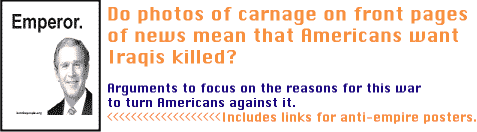
For anti-empire posters visit http://lovethepeople.org
After seeing the past few NYT and USA Today cover photos, it doesn't seem that images of death are going to be the force that turns Americans off of this war. Photos of dead Iraqis, some of "soldiers in civilian clothing" (or, in other words, people who look like civilians), have been front in center the mainstream image campaign for this war. Does seeing death and carnage provoke stronger support for this war? And if so, then how can the anti-war movement use the "death caused by war" argument to end this war?
First, I think that many (perhaps nearly most) Americans do want to see Middle Eastern (at least Middle Eastern adult men) dead from the war. In the minds of many, these men are the enemy, and deserve to die. As one thirteen year old student in my class said the week war started when talking about why a man who looked like he was from the Middle East was harassed was because the man looked "like a terrorist." This description of the man was in lieu of saying he looked Middle Eastern. To my student like-a-terrorist was a word that meant Middle Eastern or Arab. I don't think that my student came up with this connection on his own; as I am sure neither would few reading this paper. For years, decades, Americans have had Arab and terrorist linked by coverage of political struggles taking place in the Middle East. And while analyzing the racist and political reasons for this connection are beyond the scope of this paper, I do think it is important to point out that for many Americans, Arabs are terrorists. For these people, terrorists killed the 3,000 in the World Trade Center, and therefore a war on terrorism involves killing Arabs.
With this in mind - the fact that many Americans want Arabs dead - we face two challenges in trying to stop a war against an Arab nation. First, we need to address the moral dimensions of what it means to want to kill for racist and nationalistic reasons. Second, we need to stop this war within the context of many Americans happy to see Arabs killed. The first challenge requires that we focus on the humanity of the people whose nation we are destroying, and whom we are killing. It also requires that we address the moral dimensions of war, placing this war within this discussion. The second challenge requires that we address the reasons for this war, and the reasons that Arabs are made into our enemies. We need to explain why these reasons, or the goals of this war, are not aligned with the interests and values of the American people.
I think we should be very careful about how we focus on the humanity of the Arab people. Death-ins of "civilians" are not effective if the corporate media thinks they can show real carnage to build support for the war. Additionally, focusing on just women and children misses the point that almost all (not just the 65% or so of the Arab population who happen to be female or young) are human. Related, many of the soldiers have no power in any of the things going on around them - just as with most Americans. And, it can be argued, that even the most resistant to the US invasion are reacting as we would expect any person would - defending their home, regardless of who governs it. Focusing on humanity requires complex images and arguments. Images to build this argument should include as many ways for Americans to connect with the people of Iraq. Examples of how to do this include photos of ordinary families living in both rural and urban areas, information on the diversity within Iraq, stories about individuals in Iraq, presentations of the art, culture and history of Iraq and other Arab states and honest information about how the current Iraqi government has violated the human rights of these people. For us to make the case that the Iraqi people are human, we must be consistent and specific in our opposition to all violations of the rights of the people living in Iraq and the region. Americans do not need more propaganda in this area - as this dehumanizes the people into props for either for or against this war. I think we should make it a top priority to introduce Americans to Iraq in a complex, complete, diverse and human way.
War itself must also be discussed in a complex and multi-faceted way. We need to start asking at every possible opportunity why this war is occurring. Rather than make the claim that war is always wrong, we need to address the moral dimensions of THIS war. And since this, as with the humanity of the people of Iraq, is a complex moral issue, we are best served without propaganda in addressing this issue. We should publicly accept that some people might reason that this war is moral and just. And then we should demand that they explain why. Our efforts should be to keep the issue framed as a moral one - we should be working the keep the discussion focused on the moral dimensions of this war. And to do this, we need to accept that it is possible for some people to consider wars as just and morally acceptable, rather than just reject these people as fools. The more we get people to think of this war as a specific case, the more likely they will begin to see why we find it to be unjust and immoral. But arguing against all war (in less you are a pacifist, in which case your beliefs mandate that you take this stand) weakens our case against this war. I think that our most powerful arguments are based on the reasons why this war is a mistake for the United States, in both moral and practical dimensions.
Addressing the moral dimensions of war, and the human costs, is not enough. We also need to address why the reasons for this war are against the interests and values of the American people. Once again, I think we need to view this war in complex ways, and focus not only the human and other costs of it, but also on the reasons for these costs. Americans have a history are paying huge costs for wars that we believe are just or necessary. World War II is a big part of our mythology; we are a nation willing to pay dearly when we are led to believe it is the right thing to do. World War II is a good example, since in the end - with the horrors of the Holocaust - war was clearly justified in the minds of most Americans. The costs made sense - both in terms of the lives of Americans and our foes alike. This supports my central claim that it is not enough to just focus on the costs and the moral issues of the reality of war. The reasons for war are just as important.
I think we need to focus on a single and clear reason for this war - an umbrella idea under which all other reasons can reasonably and logically fit. I suggest we make this reason be empire - with our central claim being that this war is an effort to expand American Empire. We need to then frame this empire as an agent of the few rich and powerful that want to destroy American democracy at home. We can build this case by making it clear that we are patriots who believe in the value of democracy at home and abroad. We can then build on the specifics (things we have already done, but without a strong unifying emphasis): Bush was not elected by either popular or electoral processes - he was appointed by the Supreme Court and his brother in Florida, Bush and Ashcroft used the terrorism to promote their agenda to curb civil liberties and to strengthen the state as it prepared to expand its empire, Bush has not been serious about ending terrorism by under funding local efforts, opposing the federalization of airport security at first and issuing vague and useless homeland security warnings, and Bush has exploited the terrorist incidents further by trying to link it to Iraq. All of these things can be framed as acts of empire. Additionally, the WTO and IMF protests and other struggles also can be framed as resistance to expansion of empire. We should make every effort to link Bush to empire. This war is a war for empire. The loss of civil rights is to prepare for empire.
Empire is a useful concept, as it is hard for empire to be seen as anything but bad in the minds of most Americans. It goes against our mythology and history. It is about power to the few, domination, international intervention and the end of democracy. It requires constant war, suppression of rights and is immoral. Christian religion opposes empire in most of its teachings and myths. The Jewish people were victims of an immoral and vast Roman Empire - Jesus was killed by imperial interests (even if the history was rewritten, I think most progressive Christians know that Jesus was a threat to empire, and that is why he was killed). Indeed, the Romans put Christians on display to die and the Roman Empire fell when Christianity was co-opted into it. These symbols and myths work in our favor when we make Bush an Emperor, this war a war for empire, and Ashcroft an enemy of the Republic. (Think Star Wars - this is how Americans view empire.) Other examples of empire as bad are the Evil Soviet Empire (Reagan), the Nazi Empire, the Napoleon Empire and the British Empire over the American Colonies. Cast Bush in this light, and we at least have found a handle that most Americans can hold onto as we criticize this war.
I think that this part of our campaign - connecting this war and Bush to the idea of empire - is the part for which propaganda and simplicity make sense (as opposed to images of war and discussions of the complex and moral dimensions of war). Empire is just a handle, a way to get people to start connecting the war to the underlying reasons. While death is an issue that demands respect and careful imagery (or we risk exploiting or degrading death), empire is less personal. We can resort to stereotypes, caricatures and simplistic images. I propose that we start doing this at every turn. When we are not talking about the morality of war, we should be connecting this war to empire. We should be making every effort to connect Bush to empire. We should be doing this in visible, symbolic and dramatic ways. And as we do this, we should stop useless campaigns - such as "Peace is Patriotic" and "I Support the Troops," which only draw attention to our weaknesses. Rather than say we are patriotic; we should make the claim that a war for empire is a challenge to everything American stands for. And rather than say that we support the troops, we should say that no American should die for empire.
After seeing the past few NYT and USA Today cover photos, it doesn't seem that images of death are going to be the force that turns Americans off of this war. Photos of dead Iraqis, some of "soldiers in civilian clothing" (or, in other words, people who look like civilians), have been front in center the mainstream image campaign for this war. Does seeing death and carnage provoke stronger support for this war? And if so, then how can the anti-war movement use the "death caused by war" argument to end this war?
First, I think that many (perhaps nearly most) Americans do want to see Middle Eastern (at least Middle Eastern adult men) dead from the war. In the minds of many, these men are the enemy, and deserve to die. As one thirteen year old student in my class said the week war started when talking about why a man who looked like he was from the Middle East was harassed was because the man looked "like a terrorist." This description of the man was in lieu of saying he looked Middle Eastern. To my student like-a-terrorist was a word that meant Middle Eastern or Arab. I don't think that my student came up with this connection on his own; as I am sure neither would few reading this paper. For years, decades, Americans have had Arab and terrorist linked by coverage of political struggles taking place in the Middle East. And while analyzing the racist and political reasons for this connection are beyond the scope of this paper, I do think it is important to point out that for many Americans, Arabs are terrorists. For these people, terrorists killed the 3,000 in the World Trade Center, and therefore a war on terrorism involves killing Arabs.
With this in mind - the fact that many Americans want Arabs dead - we face two challenges in trying to stop a war against an Arab nation. First, we need to address the moral dimensions of what it means to want to kill for racist and nationalistic reasons. Second, we need to stop this war within the context of many Americans happy to see Arabs killed. The first challenge requires that we focus on the humanity of the people whose nation we are destroying, and whom we are killing. It also requires that we address the moral dimensions of war, placing this war within this discussion. The second challenge requires that we address the reasons for this war, and the reasons that Arabs are made into our enemies. We need to explain why these reasons, or the goals of this war, are not aligned with the interests and values of the American people.
I think we should be very careful about how we focus on the humanity of the Arab people. Death-ins of "civilians" are not effective if the corporate media thinks they can show real carnage to build support for the war. Additionally, focusing on just women and children misses the point that almost all (not just the 65% or so of the Arab population who happen to be female or young) are human. Related, many of the soldiers have no power in any of the things going on around them - just as with most Americans. And, it can be argued, that even the most resistant to the US invasion are reacting as we would expect any person would - defending their home, regardless of who governs it. Focusing on humanity requires complex images and arguments. Images to build this argument should include as many ways for Americans to connect with the people of Iraq. Examples of how to do this include photos of ordinary families living in both rural and urban areas, information on the diversity within Iraq, stories about individuals in Iraq, presentations of the art, culture and history of Iraq and other Arab states and honest information about how the current Iraqi government has violated the human rights of these people. For us to make the case that the Iraqi people are human, we must be consistent and specific in our opposition to all violations of the rights of the people living in Iraq and the region. Americans do not need more propaganda in this area - as this dehumanizes the people into props for either for or against this war. I think we should make it a top priority to introduce Americans to Iraq in a complex, complete, diverse and human way.
War itself must also be discussed in a complex and multi-faceted way. We need to start asking at every possible opportunity why this war is occurring. Rather than make the claim that war is always wrong, we need to address the moral dimensions of THIS war. And since this, as with the humanity of the people of Iraq, is a complex moral issue, we are best served without propaganda in addressing this issue. We should publicly accept that some people might reason that this war is moral and just. And then we should demand that they explain why. Our efforts should be to keep the issue framed as a moral one - we should be working the keep the discussion focused on the moral dimensions of this war. And to do this, we need to accept that it is possible for some people to consider wars as just and morally acceptable, rather than just reject these people as fools. The more we get people to think of this war as a specific case, the more likely they will begin to see why we find it to be unjust and immoral. But arguing against all war (in less you are a pacifist, in which case your beliefs mandate that you take this stand) weakens our case against this war. I think that our most powerful arguments are based on the reasons why this war is a mistake for the United States, in both moral and practical dimensions.
Addressing the moral dimensions of war, and the human costs, is not enough. We also need to address why the reasons for this war are against the interests and values of the American people. Once again, I think we need to view this war in complex ways, and focus not only the human and other costs of it, but also on the reasons for these costs. Americans have a history are paying huge costs for wars that we believe are just or necessary. World War II is a big part of our mythology; we are a nation willing to pay dearly when we are led to believe it is the right thing to do. World War II is a good example, since in the end - with the horrors of the Holocaust - war was clearly justified in the minds of most Americans. The costs made sense - both in terms of the lives of Americans and our foes alike. This supports my central claim that it is not enough to just focus on the costs and the moral issues of the reality of war. The reasons for war are just as important.
I think we need to focus on a single and clear reason for this war - an umbrella idea under which all other reasons can reasonably and logically fit. I suggest we make this reason be empire - with our central claim being that this war is an effort to expand American Empire. We need to then frame this empire as an agent of the few rich and powerful that want to destroy American democracy at home. We can build this case by making it clear that we are patriots who believe in the value of democracy at home and abroad. We can then build on the specifics (things we have already done, but without a strong unifying emphasis): Bush was not elected by either popular or electoral processes - he was appointed by the Supreme Court and his brother in Florida, Bush and Ashcroft used the terrorism to promote their agenda to curb civil liberties and to strengthen the state as it prepared to expand its empire, Bush has not been serious about ending terrorism by under funding local efforts, opposing the federalization of airport security at first and issuing vague and useless homeland security warnings, and Bush has exploited the terrorist incidents further by trying to link it to Iraq. All of these things can be framed as acts of empire. Additionally, the WTO and IMF protests and other struggles also can be framed as resistance to expansion of empire. We should make every effort to link Bush to empire. This war is a war for empire. The loss of civil rights is to prepare for empire.
Empire is a useful concept, as it is hard for empire to be seen as anything but bad in the minds of most Americans. It goes against our mythology and history. It is about power to the few, domination, international intervention and the end of democracy. It requires constant war, suppression of rights and is immoral. Christian religion opposes empire in most of its teachings and myths. The Jewish people were victims of an immoral and vast Roman Empire - Jesus was killed by imperial interests (even if the history was rewritten, I think most progressive Christians know that Jesus was a threat to empire, and that is why he was killed). Indeed, the Romans put Christians on display to die and the Roman Empire fell when Christianity was co-opted into it. These symbols and myths work in our favor when we make Bush an Emperor, this war a war for empire, and Ashcroft an enemy of the Republic. (Think Star Wars - this is how Americans view empire.) Other examples of empire as bad are the Evil Soviet Empire (Reagan), the Nazi Empire, the Napoleon Empire and the British Empire over the American Colonies. Cast Bush in this light, and we at least have found a handle that most Americans can hold onto as we criticize this war.
I think that this part of our campaign - connecting this war and Bush to the idea of empire - is the part for which propaganda and simplicity make sense (as opposed to images of war and discussions of the complex and moral dimensions of war). Empire is just a handle, a way to get people to start connecting the war to the underlying reasons. While death is an issue that demands respect and careful imagery (or we risk exploiting or degrading death), empire is less personal. We can resort to stereotypes, caricatures and simplistic images. I propose that we start doing this at every turn. When we are not talking about the morality of war, we should be connecting this war to empire. We should be making every effort to connect Bush to empire. We should be doing this in visible, symbolic and dramatic ways. And as we do this, we should stop useless campaigns - such as "Peace is Patriotic" and "I Support the Troops," which only draw attention to our weaknesses. Rather than say we are patriotic; we should make the claim that a war for empire is a challenge to everything American stands for. And rather than say that we support the troops, we should say that no American should die for empire.
For more information:
http://lovethepeople.org
Add Your Comments
Latest Comments
Listed below are the latest comments about this post.
These comments are submitted anonymously by website visitors.
TITLE
AUTHOR
DATE
dead iraqis
Sun, Mar 30, 2003 8:21PM
This war is based on racist attitudes Americans hold towards Arabs
Sun, Mar 30, 2003 4:44PM
We are 100% volunteer and depend on your participation to sustain our efforts!
Donate

$110.00 donated
in the past month
Get Involved
If you'd like to help with maintaining or developing the website, contact us.
Publish
Publish your stories and upcoming events on Indybay.
Topics
More
Search Indybay's Archives
Advanced Search
►
▼
IMC Network