







 Publish to Newswire
 Add an Event
From the Open-Publishing Calendar
From the Open-Publishing Newswire
Indybay Feature
Pictures taken by ISM activists in Iraq and Palestinian Occupied Territories
Source: Colorado Campaign for Middle East Peace (CCMEP)
Iraq
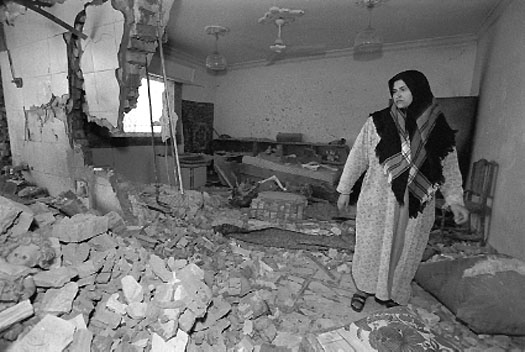
Dr. Gasim Risun's home was hit by a U.S. missile that did not explode, but damaged his two story brick home, seriously injuring his wife and three children. The home was well away from downtown Baghdad and not near any military or industrial site.
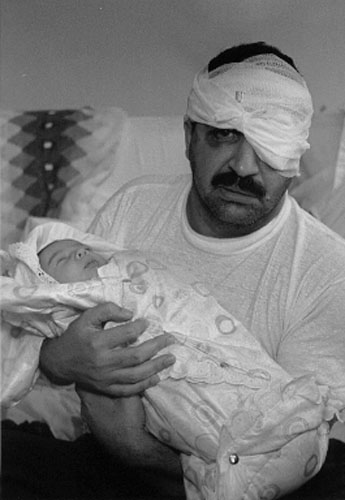
Dr. Gasim Risun, holding his son, age 3 weeks. He was wounded by a Dec. 1998 "Desert Fox" missile.
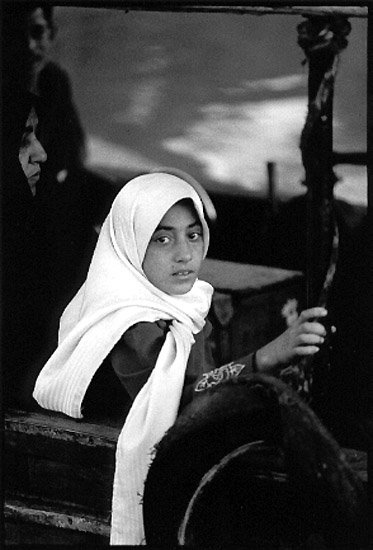
Girl in a water taxi on the way to Basrah where life seems as it was 4,000 yrs ago
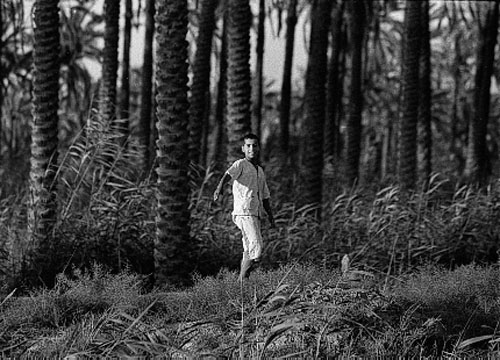
A boy walks on a river bank, the eastern bank of the Shatt al Arab, near Basrah, past a grove of datepalm trees. Iraq was once the largest exporter of dates in the world.
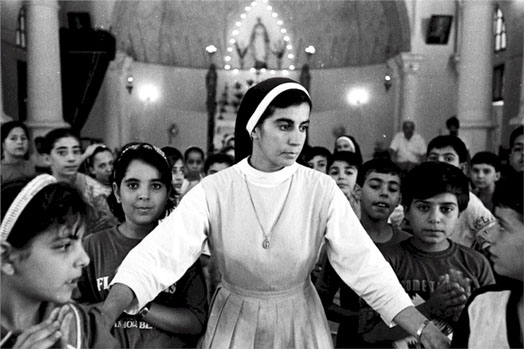
Sister Yvette shepards the 1st Communion class at Caldean Catholic Church; Basrah, Iraq.
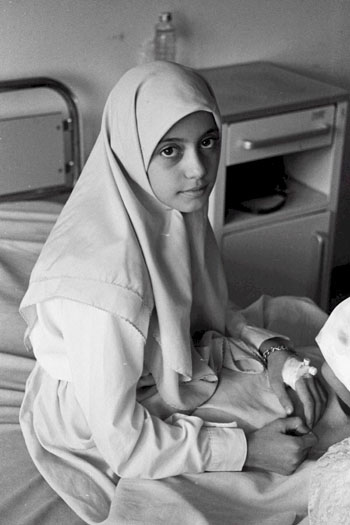
Girl in a hospital with Leukemia. The medicine she needs may not be available.
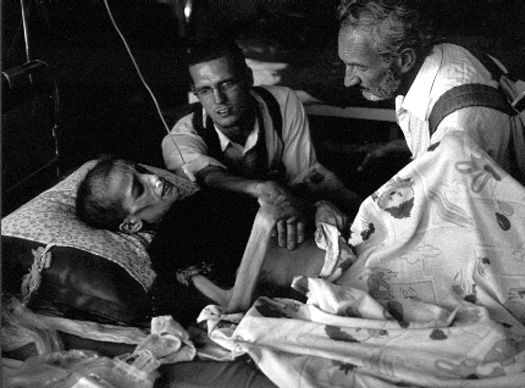

Incinerated image of an Iraqi mother holding her baby (center-right); inside the Al-Ameriyah public bomb shelter that was bombed by the U.S. and allies on Feb. 13, 1991 -- during the Gulf War. Iraq estimates that 1,200 people (all mothers, children, or older people) were killed in the early morning attack. (photo, Mark Schneider, 1/00)

Iraqi Mother with her terminally ill child in the main pediatric hospital in Baghdad. UNICEF has reported that from 1990 to 1999, over 500,000 infants and babies have been killed by the U.S. led sanctions. Many of the young children die from easily curable diseases (giardiasis, disenterry, respiratory infections) but Iraq has not been allowed (because of U.S. objections) to import enough medicines to treat these diseases, nor has Iraq been allowed to fully repair its water treatment system (intentionally bombed by the U.S. and its allies during the Gulf War). (photo, Karen Norder, 1/00)

Haiydr, 11 years old, with his mother in the main pediatric hospital in Baghdad. Haiydr has leukemia and (as of Jan, 2000) Iraqi doctors gave him just months to live. He is an example of the seemingly invisible consequence of the U.S. led sanctions against Iraq. Before the Gulf War, Iraq had one of the best health-care systems in the middle east, and could have treated Haiydr. The U.S. does not allow Iraq to import enough medicines and equipment to help Haiydr. Further, incidences of childhood leukemia and other cancers have skyrocketed since the Gulf War. Doctors and scientists in Iraq and abroad point to the U.S. use of depleted uranium during the Gulf War as the main culprit in Iraq's unprecedented cancer rates. (photo, Mark Schneider, 1/00)

Um Rayda, relative of several victims of the U.S. bombing of the Al-Ameriyah bomb shelter -- Feb. 13th, 1991. Nearly 1,200 people were killed in the attack.

Iraqi children in the northern city of Mosul; their school (behind them) was bombed by the U.S. on 11/21/99. The U.S. dropped a "concrete" bomb at 1:20pm, just moments before the 400 children were to be let out for an afternoon recess. Dozens of students and teachers were wounded by the shrapnel. According to the school principal: "There was an air-raid siren but we continued the lesson and never expected to be bombed because this was a residential area. In spite of all this we are not afraid -- but the children will hate the American administration. If children were outside they would have been killed by shrapnel -- only by the grace of God was this not another Al-Ameriyah.”
Palestinian Occupied Territories

Coloradoans came upon this small food shop as it was still smoking and burning two hours after the Israeli military had blown it up with dynamite. The Israelis claimed it was a bomb factory. August 5, 2002 (photo: Sam Messier)


A little boy threw a molotov cocktail shown burning next to an Israeli armored personnel carrier in Nablus. Right after it was thrown the soldier in the APC started shooting into an apartment building-the opposite direction of where the molotov came from. Therefore showing that he had no idea where it came from. August 5, 2002 (photo: Jill Dreier) Story:

Israeli Occupation Force terrorize Palestinians in Nablus under invasion. August 5, 2002 (photo: Sam Messier)

Israeli armored personnel carriers near Nablus. August 5, 2002 (photo: Sam Messier)
BEFORE

Father and son clean the street a bit as a water main was destroyed by the IOF in their part of Old City. August 5, 2002 (photo: tiros)
AFTER

This street was virtually totaled by the IOF as they ripped through the stores and ransacked them, in many cases looting and purposefully destroying food stuffs. August 5, 2002 (photo: tiros)

These apc's (armored personnel carries) were stationed in the site of soap factory that was completely demolished and left as rubble and dust. August 4, 2002 (photo: tiros)

Soldiers stand stare as they are on guard in the center of Nablus August 4, 2002 (photo: tiros)

IOF tanks leave little but destruction in their wake. August 4, 2002 (photo: tiros)

During the second day of the IOF siege of Nablus, more than 150 were detained and journalists were given mixed messages about coverage. A Japanese cameraman was detained, handcuffed and held with a M-16 to his head for ten minutes as his video tapes were confiscated. After being authorized by a senior officer on site, one of my cameras was ripped from my hands and I was physically threatened by another soldier before the senior officer intervened, returning my camera. August 4, 2002 (photo: tiros)

This is the latest most sophisticated set of tanks that have entered the Nablus siege fleet. These use similar technology as the Apache Helicopters and are capable of tremendous damage. August 4, 2002 (photo: tiros)

This ambulance was detained by the IOF as it was trying to get to a 16 year heart attack patient, who's heart failed after the heavy explosion detonated by the IOF in her neighbor's house. The IOF routinely make ambulances wait for passage. August 4, 2002 (photo: tiros)

A main street in the Casbah. The IOF has focused on decommissioning the future economic possibilities of Nablus. August 4, 2002 (photo: tiros) Around the time the Israelis were destroying the world famous Casbah of Nablus, radio stations across America were playing "Rock the Casbah" by The Clash in apparent solidarity with Israel's invasion.

Nablus City Center under siege... August 4, 2002 (photo: tiros)

The Israeli Military occupied and began a siege of Nablus and the Old City center with more than 140 tanks. 3 people were killed, at least 10 injured, 50 men arrested, house demolitions including a soap factory and school occurred. August 3, 2002 (photo: tiros)

During the first day of the siege in Nablus more than fifty Palestinian men and one woman were held for hours in the hot sun, arrested, blindfolded and placed on a bus to be taken. August 3, 2002 (photo: tiros)

The tanks played cat and mouse with the children from the Balata refugee camp, three people were shot that day. One 17 year old was hit in the head with shrapnel after the tanks fired a shot to mark their exit. August 1, 2002


12/20/01: Netta Golan, Israeli activist, digging and removing an earthen roadblock recently constructed by Israel. The roadblock, among several dozen in the West Bank, prohibits the Palestinians of Harris village from freely coming and going. An Israeli military checkpoint is stationed 100 yards from the village, keeping a vigilant watch. Netta was along with three dozen internationals who attempted to remove the roadblock.


12/20/01: An Israeli soldier deciding what to do while three dozen internationals piece by piece, mostly using their bare hands, dismantle a earthen roadblock recently constructed by Israel to maintain security. For the villagers Israelis means living in fear of being shot without warning, prohibited from freely traveling even out of their village, lost of jobs and much more.


12/21/01: Aisa Souf, the man in the wheelchair, told us that six months ago his village, without provocation, was invaded by Israeli soldiers who fired tear gas and sound bombs. When he attempted to gather the neighborhood children he was shot by the soldiers who proceeded to kick his paralyzed body. After weeks in intensive care and months of rehabilitation, he recently returned home. Formerly a school gym teacher, his nine brothers support Aisa, his wife and their newborn (in the picture held by Aisa's father.)


12/23/01: Home in Salfit that was partially demolished on Dec. 14th, the same night and place where an Israeli death-squad murdered six men. Several eyewitnesses saw Palestinian men lay down their guns, forced to lay down on the ground and then summarily executed. Several homes in Salfit were bulldozed by the Israeli military. Why? Collective punishment.

Liz,on right, from Michigan attempts to communicate with Israeli soldiers as they approach our line. Int’l media on left. Tension was mounting – two jeeps and an APC (armored personnel carrier) were forming up to challenge our thin line. We were only about 13 making a blockade so that students could liberate and dismantle the checkpoint about 300 yards up the road.

A cameraman with the Associated Press gets into position just before the Israesl military attacks our line.

Two Israeli military jeeps (and an APC in the background, center) sandwich a Palestinian taxi-van, just seconds before the soldiers throw rounds of tear-gas at the dozen internationals lying on the ground. TV cameras from several local and international networks were on hand.

An Israeli soldier in action throwing a can of tear gas towards our line of 15 internationals.


Two Israeli soldiers are viciously attacking the peaceful international protestors, dragging bodies across the ground, kicking, kneeing, punching and at least one case, jabbing with their guns.

Israeli soldiers grabbing and trying to drag internationals off the road. Nadya Waziri, of Boulder, Colorado (in blue) attempts to use her body as a wedge to help the international on the ground.

Internationals getting physically attacked by the Israeli military. Trevor, center-bottom, was dragged, kicked and jabbed with a gun.

An Israeli soldier scolding Trevor, of Seattle, Washington, trying to force him off the road. Moments before the soldier had dragged, kicked and jabbed Trevor using his M-16.

Trevor Baumgartnet of Seattle, Washington is on the receiving end of an Israeli M-16 rifle butt. (a noticeable welt was Trevor's injury). The soldiers, however, grew frustrated with our disciplined nonviolence and promptly retreated. (photo courtesy of George Rousesopoulos)

The crowded conditions of the Dehaisheh Refugee Camp (near Bethlehem).

During the first Intifada (1987 to 1994), under total Israeli military control, the only entrance for Palestinians living in Dehaisheh Refugee camp is this one-person-at-a-time turnstile. Over 12,000 Palestinians live in the camp. Now in Palestinian controlled "area a" there are 14 entrances to the camp, funded and maintained by the United Nations Refugee & Work program, founded specially in 1948 for Palestinian refugees forced out of Israel.


4/7/02: Image of a Palestinian Man being Arrested by the IDF in Ramallah (photo: Arraf / Shapiro)

United Nations vehicle destroyed by Israeli military in Jenin Refugee Camp. May 11, 2002 (photo: robinson)

4/13/02: Israeli military brought in yellow box for snipers to shoot into Church of the Nativity (credit: Marla)

4/13/02: Israeli military brought in construction crane and hoisted yellow box for snipers to shoot into Church of the Nativity (credit: Marla)
VIDEO of speaker and noise being pumped out:
http://www.ccmep.org/Mov00323.mpg

4/13/02: Israeli military brought in mini-surveillance blimps that hover over Bethlehem (credit: Marla)

4/6/02: Scene of Israeli Destruction in Ramallah

4/6/02: People Walking Streets of Ramallah During Israeli Siege (credit: Joyce Ajlouny)

Bethlehem, Church of the Nativity on Fire, 4/6/02

Bethlehem, Israeli tanks near Church of the Nativity, 4/6/02

Israeli tanks and armored personnel carriers invade Bethlehem, 4/6/02

4/6/02: Palestinian Walking Through Street of Ramallah During Israeli military siege

4/6/02: Courtyard in Ramallah During Israeli Siege

British Citizen Kunle Ibidun peacefully approaches an Israeli armored personnel carrier during a protest of over 100 internationals in Beit Jala (near Bethlehem). Moments after this photo were taken the Israeli military fired live ammunition at the peaceful crowd. Eight people were shot, including Kunle Ibidun.

4/1/02: 100+ Internationals Peacefully March into Beit Jala....Moments after this photo was taken the Israeli military fired live ammunition injuring 8 people, including 2 journalists.

A peace activist receives treatment at a hospital after being injured when Israeli soldiers opened fired at a demonstration of international peace activists in the West Bank town of Beit Jala, near Bethlehem, April 1, 2002. Five foreign peace marchers and a Palestinian television cameraman were injured by shrapnel when Israeli soldiers fired at their feet, witnesses said. Firing started when about 100 demonstrators, including Palestinians and foreigners, marched near a church carrying a sign saying "We want peace not war," they said. REUTERS/Magnus Johansson

An Australian peace activist receives treatment at a hospital after being injured when Israeli soldiers opened fire at a demonstration of international peace activists, in the West Bank town of Beit Jala near Bethlehem, April 1, 2002. - Reuters
For more information:
http://www.ccmep.org/
Add Your Comments
Latest Comments
Listed below are the latest comments about this post.
These comments are submitted anonymously by website visitors.
TITLE
AUTHOR
DATE
We Americans Have Blood on our Hands
Sun, Dec 15, 2002 1:00PM
...
Sun, Dec 15, 2002 9:18AM
We are 100% volunteer and depend on your participation to sustain our efforts!
Donate

$110.00 donated
in the past month
Get Involved
If you'd like to help with maintaining or developing the website, contact us.
Publish
Publish your stories and upcoming events on Indybay.
Topics
More
Search Indybay's Archives
Advanced Search
►
▼
IMC Network