







 Publish to Newswire
 Add an Event
From the Open-Publishing Calendar
From the Open-Publishing Newswire
Indybay Feature
EMERGENCY ACTION- STOP REPRESSION IN QUITO! NOT FTAA! VIVA QUITO!
Emergency demonstration against repression in Ecuador.
SOLIDARITY WITH ECUADORAN MASS ACTION AT THE FTAA SUMMIT
FRI NOV 1, 5PM
Chevron-Texaco
575 Market (between 1st and 2nd)
SOLIDARITY WITH ECUADORAN MASS ACTION AT THE FTAA SUMMIT
FRI NOV 1, 5PM
Chevron-Texaco
575 Market (between 1st and 2nd)
NO FTAA! VIVA QUITO! STOP THE REPRESSION!
EMERGENCY DEMONSTRATION
SOLIDARITY WITH ECUADORAN MASS ACTION AT THE FTAA SUMMIT
FRI NOV 1, 5PM
Chevron-Texaco
575 Market (between 1st and 2nd)
San Francisco
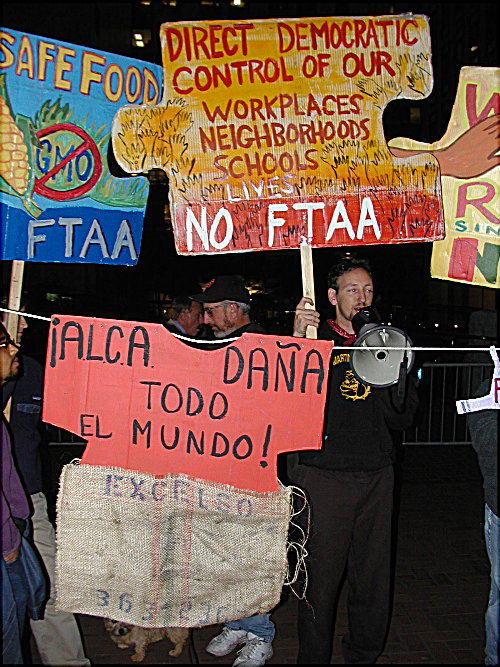
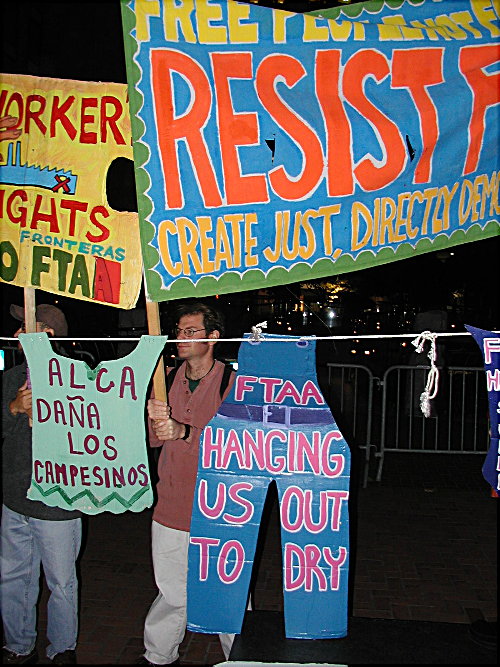
Today (Wed Oct 30), 500 students from the Central University of Ecuador marched on the corporate businessmen of the Americas Business Forum, who will bring their FTAA wish list to tomorrow's closed-door FTAA Summit with government trade ministers. The student demonstration was attacked with tear gas, bullets were fired, students arrested and two students beaten by police and hospitalized. Tomorrow all of the caravans from the country will arrive and the mass actions will begin. The popular movement in Ecuador is confronting global capital's most important meeting of the year in Quito, Ecuador-- the Free Trade Area of the America's Summit. Also today, 44 women from Movimiento Mujeres Luchando por la Vida occupied McDonalds in Quito. Solidarity actions are taking place across the America's and in Europe.
Chevron-Texaco is one of the corporations meeting in the America's Business Forum and has a 30 year history of extracting oil and destroying local communities and ecosystems in Ecuador. Their Quito facilities are a target of the demonstrations by Ecuadorans from the Amazon region who demand ChevronTexaco "clean up and pay up: their damages.
Ecuador`s social movements say the FTAA represents a death sentence for small farmers, indigenous cultures, local food systems, and endangered forests, that it will create a whole new set of rights for transnational corporations at the expense of local communities, that it will deal a devastating blow to the productive capacity of small countries like Ecuador. They also protest against the militarization of the region under Plan Colombia, the military arm of the economic domination strategy encoded in the FTAA. The FTAA puts more power and wealth in the hands of a few corporations and the governments they control, increasing poverty, disempowerment, poison air and water, militarization, unaffordable medicine and misery in the Bay Area and across the Americas.
Initiated by Action for Local Global Justice and Amazon Watch
EMERGENCY DEMONSTRATION
SOLIDARITY WITH ECUADORAN MASS ACTION AT THE FTAA SUMMIT
FRI NOV 1, 5PM
Chevron-Texaco
575 Market (between 1st and 2nd)
San Francisco
Today (Wed Oct 30), 500 students from the Central University of Ecuador marched on the corporate businessmen of the Americas Business Forum, who will bring their FTAA wish list to tomorrow's closed-door FTAA Summit with government trade ministers. The student demonstration was attacked with tear gas, bullets were fired, students arrested and two students beaten by police and hospitalized. Tomorrow all of the caravans from the country will arrive and the mass actions will begin. The popular movement in Ecuador is confronting global capital's most important meeting of the year in Quito, Ecuador-- the Free Trade Area of the America's Summit. Also today, 44 women from Movimiento Mujeres Luchando por la Vida occupied McDonalds in Quito. Solidarity actions are taking place across the America's and in Europe.
Chevron-Texaco is one of the corporations meeting in the America's Business Forum and has a 30 year history of extracting oil and destroying local communities and ecosystems in Ecuador. Their Quito facilities are a target of the demonstrations by Ecuadorans from the Amazon region who demand ChevronTexaco "clean up and pay up: their damages.
Ecuador`s social movements say the FTAA represents a death sentence for small farmers, indigenous cultures, local food systems, and endangered forests, that it will create a whole new set of rights for transnational corporations at the expense of local communities, that it will deal a devastating blow to the productive capacity of small countries like Ecuador. They also protest against the militarization of the region under Plan Colombia, the military arm of the economic domination strategy encoded in the FTAA. The FTAA puts more power and wealth in the hands of a few corporations and the governments they control, increasing poverty, disempowerment, poison air and water, militarization, unaffordable medicine and misery in the Bay Area and across the Americas.
Initiated by Action for Local Global Justice and Amazon Watch
For more information:
http://stopftaa.org/sf
Add Your Comments
Comments
(Hide Comments)
Only 500 protesters? From the photos it looks more like 5000.
Only 500 protesters? From the photos it looks more like 5000.
Only 500 protesters? From the photos it looks more like 5000.
I am always fascinated by all this ruckus down in Ecuador, and how easily the people are willing to go out on the streets and protest, when they already know they will be gassed and shot at with water cannons.
Something tells me (of course, I don't have any facts on hand) that these Ecuadorian anti-capitalist groups are funded through United States organizations. I mean, seriously, the interest of saving the rainforest is the last thing on most Ecuadorians' minds (I'm sure they'd all rather have well-paying jobs and provide for their families). What's the whole point of them going to college to begin with if they just plan to shut out the very companies that could provide them with possible higher paying jobs than the respective (or even nonexistent) Ecuadorian company?
I guess the indios' protest is a whole different situation. But what worries me is that this type of hooliganism (protection of the environment, civil liberties) is only a very recent phenomena in the United States, and usually a characteristic of post industrial society. I mean, hell, the EPA has only been spouting out restrictions since the early 1970s, at the very same time when Green Peace came out of the closet. These two organizations, unlike anything the world had ever seen, were established of course in the most economically advanced capitalist society (USA).
I was wondering if anyone had any feedback on how this type of thought could possibly hinder, even stop, development right in its tracks. Of course, you can turn to the US and say that, if anything, the economy has blossomed since the 1970s (minus the Carter years). But this after the fact that industrialization had time to set in place.
It almost seems as if these types of movements are by-products of consumer society. Can you imagine "environmentally conscious" people protesting the mining of the Mesabi Range during Bessemer's day? And as a result, could you begin to imagine how much longer it would have taken to develop a transnational railroad?
Something tells me (of course, I don't have any facts on hand) that these Ecuadorian anti-capitalist groups are funded through United States organizations. I mean, seriously, the interest of saving the rainforest is the last thing on most Ecuadorians' minds (I'm sure they'd all rather have well-paying jobs and provide for their families). What's the whole point of them going to college to begin with if they just plan to shut out the very companies that could provide them with possible higher paying jobs than the respective (or even nonexistent) Ecuadorian company?
I guess the indios' protest is a whole different situation. But what worries me is that this type of hooliganism (protection of the environment, civil liberties) is only a very recent phenomena in the United States, and usually a characteristic of post industrial society. I mean, hell, the EPA has only been spouting out restrictions since the early 1970s, at the very same time when Green Peace came out of the closet. These two organizations, unlike anything the world had ever seen, were established of course in the most economically advanced capitalist society (USA).
I was wondering if anyone had any feedback on how this type of thought could possibly hinder, even stop, development right in its tracks. Of course, you can turn to the US and say that, if anything, the economy has blossomed since the 1970s (minus the Carter years). But this after the fact that industrialization had time to set in place.
It almost seems as if these types of movements are by-products of consumer society. Can you imagine "environmentally conscious" people protesting the mining of the Mesabi Range during Bessemer's day? And as a result, could you begin to imagine how much longer it would have taken to develop a transnational railroad?
Seems the previous writer is not aware of the 90 percent of people in the south who want the US and its criminal corporations out of the hemisphere - if not farther. The issues of poverty, environmental destruction and fake democracy are the same thing. The US and its drug-numbed citizens are so used to thinking in divided-up ways that they are pointless to talk to - and irrelevant - except for their guns.
A new day dawned in Latin America a year ago with the collapse of neo-liberalism in Argentina. Growth is good? Ha! The US is the sickest country by every measure - drugs, suicides, child abuse, pollution, sick priests, crooked businessmen and politicians. ANd more...
The FTAA is dead. Long live the new socialism
A new day dawned in Latin America a year ago with the collapse of neo-liberalism in Argentina. Growth is good? Ha! The US is the sickest country by every measure - drugs, suicides, child abuse, pollution, sick priests, crooked businessmen and politicians. ANd more...
The FTAA is dead. Long live the new socialism
There are two ways that I have interpreted your response, Marti.
Either you are saying that: (a) people in Latin America prefer to live at their current state, or one found possibly three hundred years ago with the arrival of European colonials or (b) the people of Latin America are comparing their own development and advancement against the West, and falling short, they only thing they can effectively do is criticize it.
The only problem I have with you criticizing the United States in the way that you do is that people from Latin America remain the largest migrating population to the United States today. Call it geographical coincidence, call it psychological perversion, that fact still remains. The question I have for you, if these people are truly concerned with "drugs, suicides, child abuse, pollution, sick priests, crooked businessmen and politicians", why would they migrate to (according to you) the creator of it all?
True, the United States does have a track record of problems relating to corporate corruption, drugs, suicides, pollution, and pervert priests, but I would like to think (from my experiences) that South America suffers from these problems in greater number, otherwise they would not migrate to begin with.
Unfortunately I fail to make any connection between corporate corruption and "poverty, environmental destruction, and fake democracy".
I guess you could suppose that international corporations drive a society into greater poverty, but you would have to prove to me that local firms are able to offer higher wages than foreign firms (which is entirely unfounded). (read up on how wages are determined in a market)
Environmental destruction is a part of industrial growth, like it or not. If South Americans prefer not to experience industrial growth, they simply could deny the contracts proposed by international firms and remain under conditions of 40 year life spans, witch-doctor voodoo, and a largely uneducated society. I guess this comes down to a issue of preference (but I hope that we can assume that South Americans in general prefer longer lives to shorter ones).
And to address "fake democracy". To use your own example of Argentina, political corruption runs rampant throughout Latin America. Menem in Argentina had half of his family shipped in from Syria to serve government positions. Nevermind his ability to handle the funds given to him by the IMF. And as a result of the American corporations? Far from your imagination. I could not imagine the boys at OPEC holding banners for Chavez in Venezuela, or even the boys of the National Mining Association sending Congratulations Cards to Lagos in Chile.
Your comments on "a new socialism" are a bit comical also. I imagine that you are referring to the Scandanavia style socialism in Northern Europe. Well, the only problem is that these countries are already (and have been for quite awhile) developed. Like I said, these type of "socialist issues" are a by-product of advanced industrialization and not suitable for environments of developing countries. I have to agree that there may be some discontent with many people in South America over certain issues (including historical circumstances, possible economic development comparisons), but most people who do work for International firms remain happy, successful, and disregard any connection between their work place and the United States as a whole. It would be crazy to think any other way.
I have to address one more thing: "The US is the sickest country by every measure."
http://www.preda.org/archives/r9503011.htm
(check out about half way down for the discussion of Colombia)
http://news.bbc.co.uk/1/hi/world/americas/583197.stm
Argentina suffers from amazing amounts of police corruption. (which I am sure you are aware of) You think the cops are bad with profiling in the United States, I think these guys read Facundo on a daily basis.
http://www.sbg.ac.at/ipk/avstudio/pierofun/mexico/air.htm
I'm sure you have heard plenty more of the stories of los chicos callejeros (the children who live on the street) in most South American countries.
The fact of the matter is most (if not all) Latin American countries are in shambles. Underdeveloped, malnourished, crime-ridden.. by no standard equal to life people enjoy in the United States... and the idea that American corporation (and not the respective political and economic institutions) could be responsible for this is absolutely crazy. Can you prove that there is a correlation between US corporation involvement in a country and societal failure? Or even a correlation between US corporation involvement in a country and a decline in the standard of living.. (that would be better).
Either you are saying that: (a) people in Latin America prefer to live at their current state, or one found possibly three hundred years ago with the arrival of European colonials or (b) the people of Latin America are comparing their own development and advancement against the West, and falling short, they only thing they can effectively do is criticize it.
The only problem I have with you criticizing the United States in the way that you do is that people from Latin America remain the largest migrating population to the United States today. Call it geographical coincidence, call it psychological perversion, that fact still remains. The question I have for you, if these people are truly concerned with "drugs, suicides, child abuse, pollution, sick priests, crooked businessmen and politicians", why would they migrate to (according to you) the creator of it all?
True, the United States does have a track record of problems relating to corporate corruption, drugs, suicides, pollution, and pervert priests, but I would like to think (from my experiences) that South America suffers from these problems in greater number, otherwise they would not migrate to begin with.
Unfortunately I fail to make any connection between corporate corruption and "poverty, environmental destruction, and fake democracy".
I guess you could suppose that international corporations drive a society into greater poverty, but you would have to prove to me that local firms are able to offer higher wages than foreign firms (which is entirely unfounded). (read up on how wages are determined in a market)
Environmental destruction is a part of industrial growth, like it or not. If South Americans prefer not to experience industrial growth, they simply could deny the contracts proposed by international firms and remain under conditions of 40 year life spans, witch-doctor voodoo, and a largely uneducated society. I guess this comes down to a issue of preference (but I hope that we can assume that South Americans in general prefer longer lives to shorter ones).
And to address "fake democracy". To use your own example of Argentina, political corruption runs rampant throughout Latin America. Menem in Argentina had half of his family shipped in from Syria to serve government positions. Nevermind his ability to handle the funds given to him by the IMF. And as a result of the American corporations? Far from your imagination. I could not imagine the boys at OPEC holding banners for Chavez in Venezuela, or even the boys of the National Mining Association sending Congratulations Cards to Lagos in Chile.
Your comments on "a new socialism" are a bit comical also. I imagine that you are referring to the Scandanavia style socialism in Northern Europe. Well, the only problem is that these countries are already (and have been for quite awhile) developed. Like I said, these type of "socialist issues" are a by-product of advanced industrialization and not suitable for environments of developing countries. I have to agree that there may be some discontent with many people in South America over certain issues (including historical circumstances, possible economic development comparisons), but most people who do work for International firms remain happy, successful, and disregard any connection between their work place and the United States as a whole. It would be crazy to think any other way.
I have to address one more thing: "The US is the sickest country by every measure."
http://www.preda.org/archives/r9503011.htm
(check out about half way down for the discussion of Colombia)
http://news.bbc.co.uk/1/hi/world/americas/583197.stm
Argentina suffers from amazing amounts of police corruption. (which I am sure you are aware of) You think the cops are bad with profiling in the United States, I think these guys read Facundo on a daily basis.
http://www.sbg.ac.at/ipk/avstudio/pierofun/mexico/air.htm
I'm sure you have heard plenty more of the stories of los chicos callejeros (the children who live on the street) in most South American countries.
The fact of the matter is most (if not all) Latin American countries are in shambles. Underdeveloped, malnourished, crime-ridden.. by no standard equal to life people enjoy in the United States... and the idea that American corporation (and not the respective political and economic institutions) could be responsible for this is absolutely crazy. Can you prove that there is a correlation between US corporation involvement in a country and societal failure? Or even a correlation between US corporation involvement in a country and a decline in the standard of living.. (that would be better).
To add one more comment:
If anything the right-wingers' idea of developing within is the best idea I have heard yet. (Read up on a man named Coronel Seineldin). Sure, he's a racist, but if anything the guy has a vision of Argentina developing on its own and without the IMF's help. Socialism, as we have seen in the past, is largely unviable in a developing country. It simply leads to more poverty and self-destruction, because it does not foster development. True, industrialization from within takes longer (how much longer, I cannot say), but it seems to be a longer lasting, more stable transition.
http://www.seineldin.8m.net/
If anything the right-wingers' idea of developing within is the best idea I have heard yet. (Read up on a man named Coronel Seineldin). Sure, he's a racist, but if anything the guy has a vision of Argentina developing on its own and without the IMF's help. Socialism, as we have seen in the past, is largely unviable in a developing country. It simply leads to more poverty and self-destruction, because it does not foster development. True, industrialization from within takes longer (how much longer, I cannot say), but it seems to be a longer lasting, more stable transition.
http://www.seineldin.8m.net/
Juan Brujo and some others,
Rather than making superficial comparisons as to how corrupt the government is in places like Columbia and Argentina versus that of the U.S., why not do some homework and find out how problems in those countries are directly related to U.S. foreign policy, a long history of covert CIA operations, multinational corporations such as Citibank, Cocal Cola, and guess who...oil!, tourism, and the "war" on drugs and terrorism, which began long before 9/11. Find out just how many, or actually how few people, benefit from those higher corporate wages you refer to, much like here in the U.S. Find out how many indigenous people have been slaughtered or driven from their land so that U.S. mining companies can ravage the countryside. Sure, their governments allow this, but when was the last time that government truly spoke for the people?
As for your experience in the south, what is it? I've been working as an anthropologist and activist in Central and South America for 7 years and have intimate knowledge of many of these countries. I have seen the effects first hand of the global economy, tourism, the so-called "good" ecotourism, false propaganda supported by the U.S. media, U.S. puppet regimes, "counter-insurgencies" against peasant workers and unionists perpetrated by individuals/groups either on the CIA payroll or the payroll of U.S. corporations such as Coca Cola; many of whom were trained at the School of the Americas in Georgia, and the list goes on and on and on and.... I will not debate all of the nuances of each of these points because the participants, agendas, and results are glaringly obvious and readily availabe. I can put you onto some sources of info if you're sincerely interested.
Rather than making superficial comparisons as to how corrupt the government is in places like Columbia and Argentina versus that of the U.S., why not do some homework and find out how problems in those countries are directly related to U.S. foreign policy, a long history of covert CIA operations, multinational corporations such as Citibank, Cocal Cola, and guess who...oil!, tourism, and the "war" on drugs and terrorism, which began long before 9/11. Find out just how many, or actually how few people, benefit from those higher corporate wages you refer to, much like here in the U.S. Find out how many indigenous people have been slaughtered or driven from their land so that U.S. mining companies can ravage the countryside. Sure, their governments allow this, but when was the last time that government truly spoke for the people?
As for your experience in the south, what is it? I've been working as an anthropologist and activist in Central and South America for 7 years and have intimate knowledge of many of these countries. I have seen the effects first hand of the global economy, tourism, the so-called "good" ecotourism, false propaganda supported by the U.S. media, U.S. puppet regimes, "counter-insurgencies" against peasant workers and unionists perpetrated by individuals/groups either on the CIA payroll or the payroll of U.S. corporations such as Coca Cola; many of whom were trained at the School of the Americas in Georgia, and the list goes on and on and on and.... I will not debate all of the nuances of each of these points because the participants, agendas, and results are glaringly obvious and readily availabe. I can put you onto some sources of info if you're sincerely interested.
We are 100% volunteer and depend on your participation to sustain our efforts!
Donate

$110.00 donated
in the past month
Get Involved
If you'd like to help with maintaining or developing the website, contact us.
Publish
Publish your stories and upcoming events on Indybay.
Topics
More
Search Indybay's Archives
Advanced Search
►
▼
IMC Network