







 Publish to Newswire
 Add an Event
From the Open-Publishing Calendar
From the Open-Publishing Newswire
Indybay Feature
Fresno Demonstration - Don't Attack Iraq!
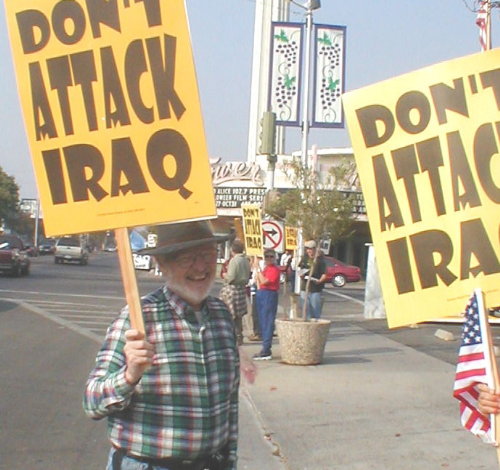
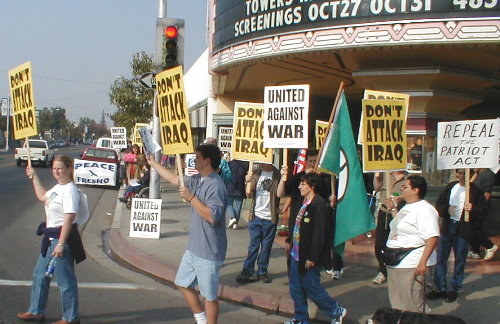
The anti-war movement is building momentum in this community as over 200 people came out today to protest the Bush administrations war plans.
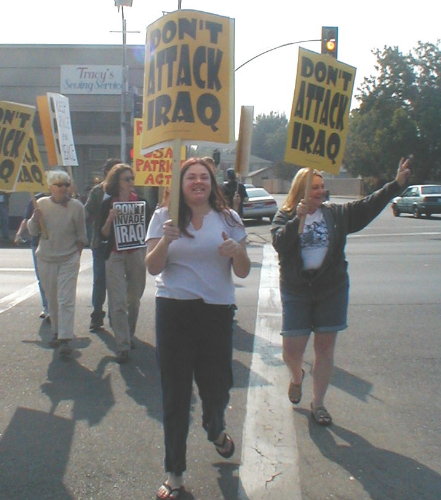
DON’T ATTACK IRAQ!
By Mike Rhodes
October 26, 2002
Fresno, California
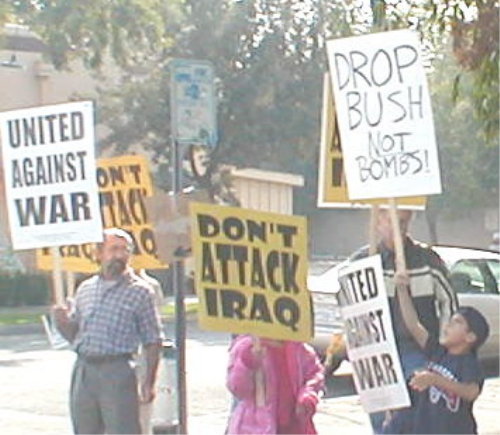
The anti-war movement is building momentum in this community as over 200 people came out today to protest the Bush administrations war plans. The demonstration, in the Tower District of central Fresno, was held in conjunction with the national day of protest called by the Not in my Name coalition http://www.internationalanswer.org
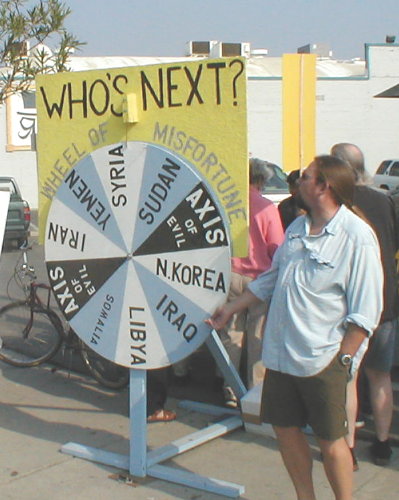
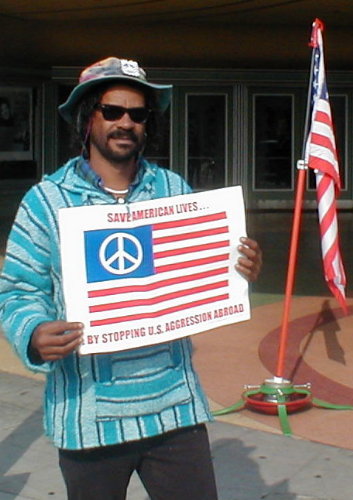
Fresno has seen a steady increase in participation at the rallies and events organized by Peace Fresno http://www.fresnoalliance.com/peacefresno/ . The participants at today’s event on both sides of Olive Avenue stretched from Broadway to VanNess. A large group marched in a circle in the crosswalk as the light changed on Wishon and Olive. Jim Bartrum brought out his Wheel of misfortune, the Fresno Center for Nonviolence raised funds selling books and CD’s on the parking lot, and signatures were gathered for the Not In My Name campaign. It was a festive event and everyone seemed to be enjoying themselves. Several homemade signs honored Senator Paul Wellstone and the work he did in the progressive movement.
A group of youth organized a follow up demonstration on Shaw and Blackstone where many of the signs and banners were taken after this demonstration. The Southeast corner of Shaw and Blackstone is the location for the Peace Fresno demonstrations every Friday starting at 4:30 PM.
People wanting to get more involved with Peace Fresno or the anti war movement in Fresno can contact Camille Russell at (559) 276-2592 or the Fresno Center For Nonviolence at 23PEACE (237-3223) camillerussellhi [at] yahoo.com
Mike Rhodes
Editor
Community Alliance magazine
P.O. Box 5077
Fresno Ca 93755
(559) 226-0477
AllianceEditor [at] attbi.com
http://www.fresnoalliance.com/home/
By Mike Rhodes
October 26, 2002
Fresno, California
The anti-war movement is building momentum in this community as over 200 people came out today to protest the Bush administrations war plans. The demonstration, in the Tower District of central Fresno, was held in conjunction with the national day of protest called by the Not in my Name coalition http://www.internationalanswer.org
Fresno has seen a steady increase in participation at the rallies and events organized by Peace Fresno http://www.fresnoalliance.com/peacefresno/ . The participants at today’s event on both sides of Olive Avenue stretched from Broadway to VanNess. A large group marched in a circle in the crosswalk as the light changed on Wishon and Olive. Jim Bartrum brought out his Wheel of misfortune, the Fresno Center for Nonviolence raised funds selling books and CD’s on the parking lot, and signatures were gathered for the Not In My Name campaign. It was a festive event and everyone seemed to be enjoying themselves. Several homemade signs honored Senator Paul Wellstone and the work he did in the progressive movement.
A group of youth organized a follow up demonstration on Shaw and Blackstone where many of the signs and banners were taken after this demonstration. The Southeast corner of Shaw and Blackstone is the location for the Peace Fresno demonstrations every Friday starting at 4:30 PM.
People wanting to get more involved with Peace Fresno or the anti war movement in Fresno can contact Camille Russell at (559) 276-2592 or the Fresno Center For Nonviolence at 23PEACE (237-3223) camillerussellhi [at] yahoo.com
Mike Rhodes
Editor
Community Alliance magazine
P.O. Box 5077
Fresno Ca 93755
(559) 226-0477
AllianceEditor [at] attbi.com
http://www.fresnoalliance.com/home/
For more information:
http://www.fresnoalliance.com/home/
Add Your Comments
Comments
(Hide Comments)
Correction: The October 26 demonstrations throughout the country were organized by:
International A.N.S.W.E.R.
(Act Now to Stop War & End Racism)
National Office:
39 W. 14 St., #206, NY, NY 10011 · (212) 633-6646
info [at] internationalanswer.org · http://www.internationalanswer.org
Washington DC Office:
1830 Connecticut Ave. NW, Washington, DC 20009 · (202) 332-5757
International A.N.S.W.E.R.
(Act Now to Stop War & End Racism)
National Office:
39 W. 14 St., #206, NY, NY 10011 · (212) 633-6646
info [at] internationalanswer.org · http://www.internationalanswer.org
Washington DC Office:
1830 Connecticut Ave. NW, Washington, DC 20009 · (202) 332-5757
Yeah Fresno!!!!
Keep up the good work!
Keep up the good work!
Thank you Mike for the speedy posting. Congratulations to all who participated in and publicized the Fresno A.N.S.W.E.R. solidarity protests! The peace and social justice community in Fresno is alive and well! 110 people signed letters to our congressional representatives opposing war in Iraq. An additional 78 people signed the Not in Our Name "Pledge of Resistance."
This website is "awesome". Kudos to the web designer. I hope to be out there with all of you sometime soon.
I wasn't able to be there on Saturday - I was with you in spirit. People are against this war - keep knocking keep knocking!
jeremy
For more information:
http://www.waddama.com
A response I received from Diane regarding the war...
jeremy October 25, 2002
Mr. Jeremy Hofer
415 E. Yale
Fresno, California 93704
Dear Mr. Hofer:
Thank you for your letter about my vote for the Resolution
authorizing the use of force against Iraq.
This was not an easy decision and it came after a great deal
of thought, consideration, and study. While I continue to have
serious concerns about a pre-emptive, unilateral attack against Iraq,
I voted for the Resolution because I believe it will encourage the
United Nations to pass a new, robust Security Council Resolution
to compel disarmament of Iraq's weapons of mass destruction and
avoid war. I have been reassured by statements made by the
President in his address to the United Nations on September 12th
which conveyed a commitment to work with the U.N. towards that
goal.
There can be no doubt that Saddam Hussein and his arsenal
of chemical and biological weapons pose a real and persuasive
threat to the safety and security of the United States, the Persian
Gulf, and the Middle East. We must push for a resolution now or
risk paying a high price later.
Attached please find a copy of the floor statement I made
on the subject which fully express my views. I understand the
seriousness of this vote and I thank you for sharing your views with
me.
Again, thank you for writing. I hope you will continue to
keep me informed of your views and concerns. If you should have
any further questions or comments, please do not hesitate to call
my Washington, D.C. staff at (202) 224-3841.
Senate
STATEMENT OF U.S. SENATOR DIANNE FEINSTEIN
The Right Course on Iraq
October 10, 2002
Mrs. FEINSTEIN. Mr. President, I have come to the floor to state
that, after much deliberation, I have decided to vote for the
Resolution introduced by Senators Lieberman, Warner, Bayh and
McCain.
In two prior floor statements, I have expressed my views. Rather
than repeat them here, I ask unanimous consent to include them in
the Record right after these remarks.
I serve as the Senior Senator from California, representing 35
million people. That is a formidable task. People have weighed in
by the tens of thousands. If I were just to cast a representative vote
based on those who have voiced their opinions with my office
and with no other factors I would have to vote against this
resolution.
But as a member of the Intelligence Committee, as someone who
has read and discussed and studied the history of Iraq, the record of
obfuscation and the terror Saddam Hussein has sown, one comes to
the conclusion that he remains a consequential threat.
Although the ties between Saddam Hussein and Al Qaeda are
tenuous, there should be no question that his entire government is
forged and held together by terror:
The terror of secret police in station wagons on street
corners watching;
The terror forged through assassinations and brutal murders
of anyone who disagrees with him;
And yes even of his own family members.
While the distance between the United States and Iraq is great,
Saddam Hussein's ability to use his chemical and biological
weapons against us is not constrained by geography it can be
accomplished in a number of different ways which is what
makes this threat so real and persuasive.
I supported the Levin Amendment, which authorized use of force
pursuant to U.N. Security Council action, because it was the
strongest resolution supporting a multilateral effort.
And, I believe a multilateral effort, through the United Nations,
provides a strong moral imprimatur and as such is preferable to
America's taking pre-emptive action that could have consequences
tomorrow and years after that consequences we cannot imagine
or even begin to understand today.
The original resolution sent to Congress by the President would
have authorized a broad and sweeping use of force whenever or
wherever he deemed necessary literally any place on earth.
It would have authorized the newly promulgated national security
strategy of unilateral pre-emptive use of force in the defense of the
nation in the war on terror.
The resolution before us does not grant such a sweeping use of
force. Rather, the use of force is confined to Iraq and targeted
toward forcing Iraq to comply with 16 Security Council resolutions
passed in the wake of the Persian Gulf War in 1991.
Most importantly, I believe the Lieberman resolution becomes a
catalyst to encourage prompt, forceful and effective action by the
United Nations to compel this long sought-after and much-evaded
disarmament of weapons of mass destruction.
Disarming Iraq under Saddam Hussein is necessary and vital to the
safety and security of America, the Persian Gulf and the Middle
East let there be no doubt about this.
But the decision to cast this vote does not come lightly. I continue
to have serious concerns that there are those in the Administration
who would seek to use this authorization for a unilateral, pre-
emptive attack against Iraq.
I believe this would be a terrible mistake.
But I am reassured by statements made by the President in his
address to the United Nations on September 12, which conveyed a
major shift in the Administration's approach turning away from a
pre-emptive strategy and, instead, engaging and challenging the
U.N. Security Council to compel Iraq's disarmament and back this
with force.
I deeply believe that it is vital for the U.N. Security Council to
approve a new, robust resolution requiring full and unconditional
access to search for and destroy all weapons of mass destruction.
Unfortunately, the Security Council has not yet taken this action.
Nor do we, at this time, know if they will.
If one believes Iraq is a real threat, and I do, and if the United
Nations fails to act, then the only alternative is military action led
by the United States.
Ironically, this authorization of use of force may well prompt the
Security Council to act. Because if they do not, the United Nations
becomes a paper tiger unable to enforce its mandates and unwilling
to meet the challenge of this new day of danger.
For the past 11 years, Saddam Hussein has prevaricated,
manipulated, deceived and violated every agreement he has made
to disarm.
If the past is prologue, this record means that arms inspections,
alone, will not force disarmament.
The great danger is a nuclear one. If Saddam Hussein achieves
nuclear capability, the risk increases exponentially and the balance
of power shifts radically in a deeply menacing way.
As I said on this floor in earlier remarks, I believe that Saddam
Hussein rules by terror and has squirreled away stores of biological
and chemical weapons. He has used them on Kurdish villages and
in his invasion of Iran.
Evidence indicates that he is engaged in developing nuclear
weapons. However, today the best authorities I could find indicate
he does not yet have nuclear capability. But this is only a question
of time.
And we cannot let Saddam Hussein become a nuclear power.
And, so, it is my intention to vote yes on the resolution before us.
I do so with the hope that the United Nations will rise to the
challenge and with the trust that the Administration forge a
coalition rather than go it alone.
And I do so with the fervent prayer that it will not be necessary to
place America's fighting forces or innocent civilians anywhere in
harm's way.
Senate
STATEMENT OF U.S. SENATOR DIANNE FEINSTEIN
War and Peace Are Not Partisan Issues
September 25, 2002
Mrs. FEINSTEIN.
I am deeply saddened by recent comments made by the President and
Vice President which imply that Democrats are not protective of our
Nation's security. Nothing is further from the truth.
There is no shortage of courage and bravery and patriotism on this
side of the aisle. We, too, have our heroes who prove that: Senator
Max Cleland, Senator Daniel Inouye, former Senator Bob Kerrey, and
Senator John Kerry, people who fought with bravery and distinction
in major conflicts this Nation has had.
Even to imply the Democrats are not interested in the security of the
American people is not only wrong, but in the present pre-election
period I believe it is also base.
Last night, it was reported the Vice President went so far as to state
that American security would be enhanced if a certain GOP candidate
was elected to the House of Representatives. This very statement,
carried by major newspapers, jaundiced any fair discussion in this
pre-election period.
One might ask why? The reason is both the President and the Vice
President have an extraordinary bully pulpit with a very long reach.
It makes up about 95 percent of everything that reaches the American
public; the remaining 5 percent is scattered among whoever is able to
receive it.
If this debate is politicized in the heat of an election and the decision
is made for the wrong reasons -- out of fear; if we do not carry out the
public trust that is invested in us and make the decision for the right
reasons, then we betray our trust. And no election is worth doing
that.
I share the concern of the majority leader, and I hope it is not too late
to end this politicization. But there is only one way. Shortly, we in
Congress will begin debate on whether to authorize the President the
authority to use force against Iraq. It is, in effect, a declaration of
war.
The President has sent a draft resolution. He made his case before the
United Nations. Today he seeks the support of the international
community. Now it is our job, our constitutional duty, to debate this
resolution.
But we must do so in an atmosphere that is true. The decision to go
to war is perhaps the most grave and significant decision any nation
makes.
It is a decision that must be made on its own merits, with a timetable
determined by the cause and the case and not based on political
considerations and upcoming elections. I believe that deeply.
A declaration of war against Iraq is the most serious decision many
Members will ever make as Senators. It is a life or death decision for
the American men and women we put into harm's way, for the
innocent Iraqi people who will be killed, for the repercussions it will
have throughout the Persian Gulf, the Middle East and the Arab
world, and throughout our own country and the rest of the world.
Congress must not rush to judgment before it has had ample
opportunity to answer the many questions that still remain regarding
why a war, a preemptive war, should be fought at this time against
Iraq.
For example, what is the immediate threat to American security to
justify an attack on another sovereign nation?
How would such a war be conducted?
How would we respond to Iraq's use of chemical or biological
weapons, to an attack on Israel, or to a ricochet of terrorist incidents
in our country and around the world?
And what are our responsibilities for postwar stability once Saddam
Hussein is ousted? How do we prevent civil war between the Sunnis
and the Shias?
No one questions that Saddam Hussein is an evil man, or the potential
of Iraq acquiring the nuclear capability within the next 5 to 7 years is
a possibility. We believe it is.
There is reason to believe that Saddam Hussein has squirreled away
biological and chemical weapons. But they are most likely close to
civilians: in tunnels, under mosques, around schools and hospitals,
and inside palaces or in mobile vehicles.
This is not sufficient reason to preemptively attack another sovereign
nation -- for the first time in this Nation's history -- without first
being
provoked by an attack against our homeland, our people, or our
interests. It is not sufficient reason to put our service men and women
in harm's way when there are real, viable options short of war left on
the table.
There is no question this country should take steps to disarm Iraq.
Saddam Hussein, with chemical and biological weapons, represents
a real threat to his own people, to the Middle East region, and to the
international security.
The question is, Is use of force the first option or the last option? In
my view, it should be the last. In my view, working with the
international community, doing all we can to disarm Iraq before
jumping to military force, remains an option.
If Saddam Hussein balks at inspectors, if he starts playing games, if
he continues to thwart the will of the international community, then
the use of force by the United States has a moral imprimatur and is
the only remaining viable answer.
There is no question that Iraq is in direct violation of international
law, numerous U.N. Security Council resolutions, and that he poses
a threat in the region. Nobody debates that.
But there is no persuasive evidence that Iraq is prepared to unleash its
biological or chemical weapons today.
Although he used them against the Kurds in 1987 and 1988, and
against Iran in their decade-long war, he has not used them in over 10
years, and he knows what will happen to him if he does. Saddam
may be homicidal, but he is not suicidal.
Likewise, there is no persuasive evidence that he possesses nuclear
weapons today. He may be trying to gain these weapons, but he
remains years away. So instead of rushing to war, I believe we should
proceed in a calm, methodical, and nonpolitical manner.
The United States should work through the United Nations Security
Council -- as the President himself suggested in a September 12
speech to the United Nations and as Secretary of State Colin Powell
is now trying to do -- to obtain full and unconditional access for arms
inspectors, and hopefully accompanied by a United Nations military
force.
We should seek the complete destruction of Iraqi weapons of mass
destruction and the means to deliver them.
This approach should be our first option, not window dressing or an
option to be dismissed out-of-hand.
And we should do this not for idealistic reasons but because it is in
our national security interests to do so.
Indeed, the benefit of pursuing a multilateral approach was seen
clearly when Saudi Arabia suggested that, if the United States were
working through the United Nations, it would grant U.S. forces
access to its bases.
Action against Iraq becomes much more complicated, from a military
perspective, if there are no landing or flyover rights in other Arab
countries; and managing the aftermath becomes much more difficult
if we find the entire Arab world against us.
So I believe that if the United States fails in its efforts to compel
Iraqi compliance with a United Nations inspection, verification,
and destruction regime -- either because other countries threaten a
veto in the Security Council or the United Nations is unable to
muster the muscle and will to enforce its own resolutions -- then
the United States, with or without willing partners in the
international community, must be prepared to go it alone.
But we must be clear. If we go to war, it should be to force Iraq to
disarm.
This time, too, it is critical that the United States stays the course
on the war on terror.
In every book you read on Osama bin Laden, you see that he
believed that we would never stay the course in a war against him.
We would hit a camp once and then disappear.
As happened before, we would go to Somalia, get into trouble in
Mogadishu, and we would turn tail and run. Bin Laden bet on that.
He cannot be right about that. We have much to do to win this
war.
Many of those who perpetrated the September 11 terrorist attacks
remain at large, including two-thirds of the Al-Qaeda leadership;
the Taliban and its leader, Mullah Omar; not to mention thousands
of terrorists sympathetic to Al-Qaeda worldwide, including in our
own country.
Afghanistan remains a fragile and unstable country. The United
States must continue our efforts to rebuild this country. We cannot
repeat what was done to it since 1979. We must continue our
efforts to rebuild Afghanistan, the Afghan economy, to assure that
the Taliban and Al-Qaeda do not return to power there -- because
they will if they can. We must protect and stabilize the
Government of Hamid Karzai. And any effort in Iraq must not
detract from our war on terror.
The President has rightly pointed out that the war on terror will be
a long and hard-fought battle, and it is not just against Al-Qaeda. It
is Hezbollah, which equals Al-Qaeda in its reach, in its
viciousness, in its malevolence, and its evil. We must not take our
eye off this ball.
The President must come forward to explain not only how we fight
this two-front war without allowing one front to jeopardize our
interests in the other, but also what we would do in the event of a
major strike against Israel.
I have come to this floor before and indicated that there is ample
evidence that rockets are being shipped out of Iran, through Syria
and into southern Lebanon -- Katyusha rockets with extended
range anywhere from 8,000 to 10,000, to hit Israel's industrial zone
north of Haifa, should we attack Iraq.
What do we do then? What is our commitment, and what will the
other Arab States do? I think we ought to know this. I think as
prudent leaders, as part of a debate in the greatest deliberative body
in the world, we ought to know these things before going into it, so
there are no surprises.
Finally, it is critical that if and as we consider any use of force
against Iraq that we have a clear understanding of the aftermath.
Who would do the rebuilding? Who would pay for it? Who would
run any new government? And could that government provide
security? Could it prevent a bigger and more brutal battle between
the Sunni and the Shia.
That is not a question to overlook. Read the history on Iraq. You
will see the brutality and the viciousness, the attack of one tribe on
the other that has characterized Iraqi history from the time of
ancient Mesopotamia.
There are a lot of grievances out there to be settled, big grievances
between the Shia majority and the ruling Sunni Baath party
minority.
As General Shalikashvili made clear in his recent testimony before
the Senate Armed Services Committee, planning for a post-conflict
situation, winning the peace, is every bit as important as planning
for the conflict itself.
And until the planning for post-war Iraq is in place -- and it is not
now -- we should not rush to initiate combat. In fact, every general
with whom I have talked -- and I have talked with several -- has
urged caution. Every general with whom I have talked, privately,
believes this war could end up being much more difficult than
some expect it to be.
So to simply rush ahead and authorize the President to use force
now, before these questions are answered, and without an
imminent threat -- save what some hope to gain from this issue in
the elections -- would be a grave error.
Congress must debate these issues fully, thoroughly, on a schedule,
and with a timetable driven only by the merits of the issues. We
must then move forward to pass a resolution tailored to the specific
circumstances and giving the President the proper authority he
needs to safeguard U.S. national interests.
So much is at stake here. American lives are at stake. We do not
know how many, but I know one thing: It is not going to be like
the gulf war. This war will be in cities. This will be street to street
and house to house. We might send in the B-2s, the B-52s and the
117s, and they might drop huge numbers of laser-guided missiles
and precision bombs. We will kill a lot of people.
And then do we risk what may happen with the chemical and
biologicals squirreled away? Do they go up in those attacks? Or
are they released over innocent people? I have never heard one
person discuss this, and it is time that we do so.
We are not a mercenary nation. This is not our heart. It is not our
soul. And we have never engaged in a preemptive attack on
another sovereign nation.
It may well be that untold numbers of lives are at stake elsewhere
in the Persian Gulf, in the Middle East, and yes, right here in the
USA.
Matters of war and peace, of life and death, must not be held in the
grip of shortsighted, partisan rancor. I for one refuse to make it so.
I respectfully suggest the Administration do the same. The stakes
are simply too high.
Senate
STATEMENT OF U.S. SENATOR DIANNE FEINSTEIN
More Questions Than Answers on Iraq
September 05, 2002
Mrs. FEINSTEIN. Madam President, I rise today to express my
growing concern that we may shortly be faced with a decision to
unilaterally invade another nation-state, and that is the State of Iraq
This concern has been heightened by the news of today's
assassination attempt of Afghan President Hamid Karzai in
Kandahar. Earlier on, a car bomb exploded in central Kabul, killing
at least 22 people.
This event, in my view, underscores the point that our primary
focus must remain on our immediate war on terrorism being waged
in troubled Afghanistan, where our soldiers are on the front line.
As a matter of fact, preliminary reports indicate it was Americans
who took down the attempted assassins.
While I welcome President Bush's recent statement indicating he
will seek congressional approval of such a use of force, I believe
any action in Iraq at this time, without allied support, without
United Nations support, and without a compelling case for just
cause, would be both morally wrong and politically mistaken.
I just returned from a trip to Europe. As part of my role as
chairman of the Appropriations Subcommittee on Military
Construction, I toured U.S. military bases and met with a variety of
individuals. They included members of the intelligence
community, the military, and the International Atomic Energy
Agency.
I was shocked at how dramatically perceptions in Europe have
shifted since September 11 toward our country. All of the
sympathy and concern we received in the wake of the terrorist
attacks has apparently vanished, replaced by the sense that the
United States is becoming an arrogant and aggressive power, a
nation that simply gives orders, a nation that neither listens nor
hears.
When I was in Europe, much attention was given to the absence of
Presidential participation at the Summit on Sustainable
Development in Johannesburg. And this, on top of our rejection of
the Kyoto treaty, our casting of aspersions on international accords
such as the International Criminal Court, the Anti-Ballistic Missile
and Landmine treaties, has led to a growing belief, right or wrong,
that the United States is using its power in an increasingly
unilateral and somewhat arrogant manner.
Above all, there is our approach to Iraq and our perceived
readiness to invade that nation unilaterally.
I believe we have to ask many critical questions, most of which are
unanswered.
Questions about the ongoing war on terrorism. How do we stay the
course, root out terrorism and, at the same time, initiate war with a
nation-state which, to this day, remains unconnected to 9/11.
Questions about the extent of Saddam Hussein's weapons of mass
destruction and about who will get to them first.
Questions about going it alone in Iraq .
Questions about casualties and cost.
Questions about collateral human damage--civilians killed in the
short term and in the long run.
Questions about the future of Iraq , about whether we can honestly
expect a democracy to be created out of a nation consumed by
tribal factionalism.
And questions about what the long-term impact might be on the
Arab world, on the Middle East.
What if Iraq attacks Israel? What will we do, and what will the
world do?
Present United States policy toward Iraq stands in stark contrast to
how we conducted Operation Desert Storm just over a decade ago.
Then, the first Bush administration spent several months building a
broad-based coalition that included 30 nations, including many in
the Islamic world. It sought and received resolutions supporting the
use of force against Iraq from the United States Congress and the
United Nations Security Council, and American and international
public opinion stood firmly behind such action. Today, no nation is
firmly allied with the United States on this issue.
At the very least, I believe we should launch a major diplomatic
effort with the United Nations, our allies, and our Arab friends,
with the goal of delivering an ultimatum to Saddam Hussein:
Either open up or go down.
If he does not comply with this demand, it will give the United
States added moral and diplomatic strength to any future effort. It
will help unite the world community behind us.
Additionally, I am very concerned that the United States stay the
course on our war against terrorism. To date, there is no direct
connection between Saddam Hussein's Iraq and the 9/11 attacks
that has been substantiated.
This means staying the course in our war against terrorism, part of
which exists in Afghanistan. The government of Hamid Karzai is
fragile at best. Today should show that. During its first 6 months in
power, two Cabinet officials have been assassinated. Today,
President Karzai himself barely escaped an assassination attempt,
and a major act of terrorism has killed many in central Kabul. The
Karzai government must have security and stability, or it will
perish and so will democracy.
Additionally, we know the Taliban and al-Qaida lurk in the remote
mountains, waiting for an opportune moment to come back. If
Afghanistan cannot be stabilized, if its streets and homes cannot be
made secure, and if its first democratic government cannot survive,
this will be a very serious setback.
Afghanistan is our beachhead in the war on terror. We cannot lose
it, or we lose the war on terror. We must put al-Qaeda, Hamas,
Hezbollah, and a host of other terrorist groups out of business
before they can strike out again at America and our interests.
That is why concentrating on this war--the critical war against
terrorism--is so important.
An attack on Iraq at this time would only deflect from this war, by
diverting attention and forces away from bringing to justice the
perpetrators of 9/11. Can we afford to do this?
If there is an imminent threat to the United States or to our
interests, then we must act. At this moment, however, I do not
believe such a threat exists. No one doubts that Iraq has chemical
or biological weapons and the means to deliver them. They have
used them on at least three occasions, but they have not used them
in the last 10 years, and I believe they know what will happen if
they do use them.
What is less clear, however, is the status of Iraq's nuclear weapons
capability. In 1981, Israel destroyed the Osiraq reactor provided by
France. While Iraq continues to seek to develop nuclear capability,
there is no evidence I have found that Iraq is nuclear capable today.
So there is no imminent threat.
Secretary Rumsfeld has claimed that if we wait for Iraq to develop
nuclear weapons, then it will be too late. He is right. The key is to
find a way to stop Iraqi nuclear ambition, and stop it now, which is
why opening Iraq's borders to a search and destroy mission for
weapons of mass destruction, conducted by our allies, our friends
in the Arab world, and the United Nations, is critical.
I believe this requires renewed diplomatic efforts on our part, with
the United Nations, with our allies, and with friendly Arab nations.
We must stop Iraq from becoming nuclear capable. And the world
in turn must respond. Otherwise, an attack becomes the only
alternative.
As Gen. Wesley Clark recently stated:
In the war on terrorism, alliances are not an obstacle to victory.
They're the key to it.
By acting unilaterally, the United States not only runs the risk of
isolating these long-standing allies, but also of solidifying the
entire Arab world sharply against us. This may not result in any
direct or traditional military response against the United States, but
what about a personal jihad throughout this country--a jihad of
bombs and other terrorist acts carried out throughout the world?
There are people out there eminently capable and able to finance
doing just that.
With the Israeli-Palestinian conflict not yet under control, a United
States attack on Iraq would certainly fuel the fire of Islamic
fanaticism, uniting the Arab world against the West and Israel. The
consequences could be unprecedented and beyond our present
comprehension.
The Israeli-Palestinian situation should be our highest priority.
This conflict must be resolved. The United States must use its
influence and leadership here, with the Israelis, the Palestinians,
and the surrounding Arab world. Here, too, we must stay the
course.
At the same time, there is some troubling evidence today of the
preparation of a second front in southern Lebanon to attack Israel
in the event we attack Iraq . Ambassador Dennis Ross recently told
me of thousands--he mentioned 10,000--extended-range Katyusha
rockets that have been moved through Syria from Iran and into
southern Lebanon, for an attack on Israel. He said they had been
extended so that they could hit at the major Israeli industrial zone
north of Haifa. I believe this has been confirmed.
In the face of all of this, assume we do attack Iraq . Consider that
we mobilize 250,000 to 300,000 soldiers, our aircraft carriers, our
B-52s, our 117s. This will not be another Desert Storm where
exposed Iraqi troops are routed in the open desert, overwhelmed by
American airpower.
This war will be waged in Baghdad, in Tikrit, and in other cities. It
will be waged from house to house and palace to palace, from
street to street and school to school and hospital to hospital.
We will certainly kill many Iraqis, and how many of our own will
be killed? And will we stay the course once the body bags start
coming back to Dover? Will Americans stand up and say, ``More''?
I think not.
Then there are the thousands of innocent Iraqi civilians civilians
already brutalized by the last 12 years--who will become casualties
in this war.
America has never been an aggressor nation unless attacked, as we
were at Pearl Harbor and on September 11, or our interests and our
allies were attacked. We have never initiated a major invasion
against another nation-state, which leads to the question of whether
a preemptive war is the morally right, legally right, or the
politically right way for the United States to proceed.
Lastly, there is the immensely complicated question of the Iraqi
nation Saddam Hussein now has and what will happen if he is
overthrown. Have we really thought out our options here? Have we
taken into account the deep tribal factionalism and divisions, the
bitter and often bloody rivalries among the Shia majority, the
ruling Sunni minority, and the Kurds, that lie at the very root of
Iraq ? Will we protect the Kurds from possible genocide? How
long will we stay to secure a new government? And who would
replace Saddam Hussein?
Let's be realistic. A democracy is not likely to emerge. One must
look closely at the history of Iraq to draw such a conclusion, and I
have.
Madam President, I would like to quote from the recently
published book, ``The Reckoning: Iraq and the Legacy of Saddam
Hussein'' by Sandra Mackey. She writes:
When [Saddam Hussein] finally loses his grip on power either
politically or physically, he will leave Iraq much as it was when the
British created it--torn by tribalism and uncertain in its identity. It
is this Iraq that threatens to inflict its communal grievances, its
decades of non-cooperation, and its festering suspicions and
entrenched hatreds on the Persian Gulf, the lifeline of our global
economy.
In light of such conditions, is the United States ready to be an
occupational force? It could take many years for the seeds of a
stable pluralist society to flourish in Iraq . Are we really ready to
spend a generation there?
Given what is at stake here--American lives, American prestige,
and America's respect for the rule of law--we find ourselves at a
critical crossroad.
Again, according to Sandra Mackey:
.... the time is fast approaching when the United States, for a series
of perilous reasons, will be forced to look beyond Hussein to Iraq
itself. That is when all Americans will pay the price for what has
been a long night of ignorance about the land between the rivers.
In closing, I am very happy to see that President Bush will now
seek congressional approval regarding military action. So this
debate has just begun.
I look forward to working with my colleagues in the Congress to
ensure we not only ask the questions but see that the answers are
moral, see that they are legal, see that they are befitting the greatest
democracy on Earth, and see whether they are worth, for the first
time, the United States of America making a unilateral attack on
another nation-state.
Sincerely yours,
Dianne Feinstein
United States Senator
http://feinstein.senate.gov
jeremy October 25, 2002
Mr. Jeremy Hofer
415 E. Yale
Fresno, California 93704
Dear Mr. Hofer:
Thank you for your letter about my vote for the Resolution
authorizing the use of force against Iraq.
This was not an easy decision and it came after a great deal
of thought, consideration, and study. While I continue to have
serious concerns about a pre-emptive, unilateral attack against Iraq,
I voted for the Resolution because I believe it will encourage the
United Nations to pass a new, robust Security Council Resolution
to compel disarmament of Iraq's weapons of mass destruction and
avoid war. I have been reassured by statements made by the
President in his address to the United Nations on September 12th
which conveyed a commitment to work with the U.N. towards that
goal.
There can be no doubt that Saddam Hussein and his arsenal
of chemical and biological weapons pose a real and persuasive
threat to the safety and security of the United States, the Persian
Gulf, and the Middle East. We must push for a resolution now or
risk paying a high price later.
Attached please find a copy of the floor statement I made
on the subject which fully express my views. I understand the
seriousness of this vote and I thank you for sharing your views with
me.
Again, thank you for writing. I hope you will continue to
keep me informed of your views and concerns. If you should have
any further questions or comments, please do not hesitate to call
my Washington, D.C. staff at (202) 224-3841.
Senate
STATEMENT OF U.S. SENATOR DIANNE FEINSTEIN
The Right Course on Iraq
October 10, 2002
Mrs. FEINSTEIN. Mr. President, I have come to the floor to state
that, after much deliberation, I have decided to vote for the
Resolution introduced by Senators Lieberman, Warner, Bayh and
McCain.
In two prior floor statements, I have expressed my views. Rather
than repeat them here, I ask unanimous consent to include them in
the Record right after these remarks.
I serve as the Senior Senator from California, representing 35
million people. That is a formidable task. People have weighed in
by the tens of thousands. If I were just to cast a representative vote
based on those who have voiced their opinions with my office
and with no other factors I would have to vote against this
resolution.
But as a member of the Intelligence Committee, as someone who
has read and discussed and studied the history of Iraq, the record of
obfuscation and the terror Saddam Hussein has sown, one comes to
the conclusion that he remains a consequential threat.
Although the ties between Saddam Hussein and Al Qaeda are
tenuous, there should be no question that his entire government is
forged and held together by terror:
The terror of secret police in station wagons on street
corners watching;
The terror forged through assassinations and brutal murders
of anyone who disagrees with him;
And yes even of his own family members.
While the distance between the United States and Iraq is great,
Saddam Hussein's ability to use his chemical and biological
weapons against us is not constrained by geography it can be
accomplished in a number of different ways which is what
makes this threat so real and persuasive.
I supported the Levin Amendment, which authorized use of force
pursuant to U.N. Security Council action, because it was the
strongest resolution supporting a multilateral effort.
And, I believe a multilateral effort, through the United Nations,
provides a strong moral imprimatur and as such is preferable to
America's taking pre-emptive action that could have consequences
tomorrow and years after that consequences we cannot imagine
or even begin to understand today.
The original resolution sent to Congress by the President would
have authorized a broad and sweeping use of force whenever or
wherever he deemed necessary literally any place on earth.
It would have authorized the newly promulgated national security
strategy of unilateral pre-emptive use of force in the defense of the
nation in the war on terror.
The resolution before us does not grant such a sweeping use of
force. Rather, the use of force is confined to Iraq and targeted
toward forcing Iraq to comply with 16 Security Council resolutions
passed in the wake of the Persian Gulf War in 1991.
Most importantly, I believe the Lieberman resolution becomes a
catalyst to encourage prompt, forceful and effective action by the
United Nations to compel this long sought-after and much-evaded
disarmament of weapons of mass destruction.
Disarming Iraq under Saddam Hussein is necessary and vital to the
safety and security of America, the Persian Gulf and the Middle
East let there be no doubt about this.
But the decision to cast this vote does not come lightly. I continue
to have serious concerns that there are those in the Administration
who would seek to use this authorization for a unilateral, pre-
emptive attack against Iraq.
I believe this would be a terrible mistake.
But I am reassured by statements made by the President in his
address to the United Nations on September 12, which conveyed a
major shift in the Administration's approach turning away from a
pre-emptive strategy and, instead, engaging and challenging the
U.N. Security Council to compel Iraq's disarmament and back this
with force.
I deeply believe that it is vital for the U.N. Security Council to
approve a new, robust resolution requiring full and unconditional
access to search for and destroy all weapons of mass destruction.
Unfortunately, the Security Council has not yet taken this action.
Nor do we, at this time, know if they will.
If one believes Iraq is a real threat, and I do, and if the United
Nations fails to act, then the only alternative is military action led
by the United States.
Ironically, this authorization of use of force may well prompt the
Security Council to act. Because if they do not, the United Nations
becomes a paper tiger unable to enforce its mandates and unwilling
to meet the challenge of this new day of danger.
For the past 11 years, Saddam Hussein has prevaricated,
manipulated, deceived and violated every agreement he has made
to disarm.
If the past is prologue, this record means that arms inspections,
alone, will not force disarmament.
The great danger is a nuclear one. If Saddam Hussein achieves
nuclear capability, the risk increases exponentially and the balance
of power shifts radically in a deeply menacing way.
As I said on this floor in earlier remarks, I believe that Saddam
Hussein rules by terror and has squirreled away stores of biological
and chemical weapons. He has used them on Kurdish villages and
in his invasion of Iran.
Evidence indicates that he is engaged in developing nuclear
weapons. However, today the best authorities I could find indicate
he does not yet have nuclear capability. But this is only a question
of time.
And we cannot let Saddam Hussein become a nuclear power.
And, so, it is my intention to vote yes on the resolution before us.
I do so with the hope that the United Nations will rise to the
challenge and with the trust that the Administration forge a
coalition rather than go it alone.
And I do so with the fervent prayer that it will not be necessary to
place America's fighting forces or innocent civilians anywhere in
harm's way.
Senate
STATEMENT OF U.S. SENATOR DIANNE FEINSTEIN
War and Peace Are Not Partisan Issues
September 25, 2002
Mrs. FEINSTEIN.
I am deeply saddened by recent comments made by the President and
Vice President which imply that Democrats are not protective of our
Nation's security. Nothing is further from the truth.
There is no shortage of courage and bravery and patriotism on this
side of the aisle. We, too, have our heroes who prove that: Senator
Max Cleland, Senator Daniel Inouye, former Senator Bob Kerrey, and
Senator John Kerry, people who fought with bravery and distinction
in major conflicts this Nation has had.
Even to imply the Democrats are not interested in the security of the
American people is not only wrong, but in the present pre-election
period I believe it is also base.
Last night, it was reported the Vice President went so far as to state
that American security would be enhanced if a certain GOP candidate
was elected to the House of Representatives. This very statement,
carried by major newspapers, jaundiced any fair discussion in this
pre-election period.
One might ask why? The reason is both the President and the Vice
President have an extraordinary bully pulpit with a very long reach.
It makes up about 95 percent of everything that reaches the American
public; the remaining 5 percent is scattered among whoever is able to
receive it.
If this debate is politicized in the heat of an election and the decision
is made for the wrong reasons -- out of fear; if we do not carry out the
public trust that is invested in us and make the decision for the right
reasons, then we betray our trust. And no election is worth doing
that.
I share the concern of the majority leader, and I hope it is not too late
to end this politicization. But there is only one way. Shortly, we in
Congress will begin debate on whether to authorize the President the
authority to use force against Iraq. It is, in effect, a declaration of
war.
The President has sent a draft resolution. He made his case before the
United Nations. Today he seeks the support of the international
community. Now it is our job, our constitutional duty, to debate this
resolution.
But we must do so in an atmosphere that is true. The decision to go
to war is perhaps the most grave and significant decision any nation
makes.
It is a decision that must be made on its own merits, with a timetable
determined by the cause and the case and not based on political
considerations and upcoming elections. I believe that deeply.
A declaration of war against Iraq is the most serious decision many
Members will ever make as Senators. It is a life or death decision for
the American men and women we put into harm's way, for the
innocent Iraqi people who will be killed, for the repercussions it will
have throughout the Persian Gulf, the Middle East and the Arab
world, and throughout our own country and the rest of the world.
Congress must not rush to judgment before it has had ample
opportunity to answer the many questions that still remain regarding
why a war, a preemptive war, should be fought at this time against
Iraq.
For example, what is the immediate threat to American security to
justify an attack on another sovereign nation?
How would such a war be conducted?
How would we respond to Iraq's use of chemical or biological
weapons, to an attack on Israel, or to a ricochet of terrorist incidents
in our country and around the world?
And what are our responsibilities for postwar stability once Saddam
Hussein is ousted? How do we prevent civil war between the Sunnis
and the Shias?
No one questions that Saddam Hussein is an evil man, or the potential
of Iraq acquiring the nuclear capability within the next 5 to 7 years is
a possibility. We believe it is.
There is reason to believe that Saddam Hussein has squirreled away
biological and chemical weapons. But they are most likely close to
civilians: in tunnels, under mosques, around schools and hospitals,
and inside palaces or in mobile vehicles.
This is not sufficient reason to preemptively attack another sovereign
nation -- for the first time in this Nation's history -- without first
being
provoked by an attack against our homeland, our people, or our
interests. It is not sufficient reason to put our service men and women
in harm's way when there are real, viable options short of war left on
the table.
There is no question this country should take steps to disarm Iraq.
Saddam Hussein, with chemical and biological weapons, represents
a real threat to his own people, to the Middle East region, and to the
international security.
The question is, Is use of force the first option or the last option? In
my view, it should be the last. In my view, working with the
international community, doing all we can to disarm Iraq before
jumping to military force, remains an option.
If Saddam Hussein balks at inspectors, if he starts playing games, if
he continues to thwart the will of the international community, then
the use of force by the United States has a moral imprimatur and is
the only remaining viable answer.
There is no question that Iraq is in direct violation of international
law, numerous U.N. Security Council resolutions, and that he poses
a threat in the region. Nobody debates that.
But there is no persuasive evidence that Iraq is prepared to unleash its
biological or chemical weapons today.
Although he used them against the Kurds in 1987 and 1988, and
against Iran in their decade-long war, he has not used them in over 10
years, and he knows what will happen to him if he does. Saddam
may be homicidal, but he is not suicidal.
Likewise, there is no persuasive evidence that he possesses nuclear
weapons today. He may be trying to gain these weapons, but he
remains years away. So instead of rushing to war, I believe we should
proceed in a calm, methodical, and nonpolitical manner.
The United States should work through the United Nations Security
Council -- as the President himself suggested in a September 12
speech to the United Nations and as Secretary of State Colin Powell
is now trying to do -- to obtain full and unconditional access for arms
inspectors, and hopefully accompanied by a United Nations military
force.
We should seek the complete destruction of Iraqi weapons of mass
destruction and the means to deliver them.
This approach should be our first option, not window dressing or an
option to be dismissed out-of-hand.
And we should do this not for idealistic reasons but because it is in
our national security interests to do so.
Indeed, the benefit of pursuing a multilateral approach was seen
clearly when Saudi Arabia suggested that, if the United States were
working through the United Nations, it would grant U.S. forces
access to its bases.
Action against Iraq becomes much more complicated, from a military
perspective, if there are no landing or flyover rights in other Arab
countries; and managing the aftermath becomes much more difficult
if we find the entire Arab world against us.
So I believe that if the United States fails in its efforts to compel
Iraqi compliance with a United Nations inspection, verification,
and destruction regime -- either because other countries threaten a
veto in the Security Council or the United Nations is unable to
muster the muscle and will to enforce its own resolutions -- then
the United States, with or without willing partners in the
international community, must be prepared to go it alone.
But we must be clear. If we go to war, it should be to force Iraq to
disarm.
This time, too, it is critical that the United States stays the course
on the war on terror.
In every book you read on Osama bin Laden, you see that he
believed that we would never stay the course in a war against him.
We would hit a camp once and then disappear.
As happened before, we would go to Somalia, get into trouble in
Mogadishu, and we would turn tail and run. Bin Laden bet on that.
He cannot be right about that. We have much to do to win this
war.
Many of those who perpetrated the September 11 terrorist attacks
remain at large, including two-thirds of the Al-Qaeda leadership;
the Taliban and its leader, Mullah Omar; not to mention thousands
of terrorists sympathetic to Al-Qaeda worldwide, including in our
own country.
Afghanistan remains a fragile and unstable country. The United
States must continue our efforts to rebuild this country. We cannot
repeat what was done to it since 1979. We must continue our
efforts to rebuild Afghanistan, the Afghan economy, to assure that
the Taliban and Al-Qaeda do not return to power there -- because
they will if they can. We must protect and stabilize the
Government of Hamid Karzai. And any effort in Iraq must not
detract from our war on terror.
The President has rightly pointed out that the war on terror will be
a long and hard-fought battle, and it is not just against Al-Qaeda. It
is Hezbollah, which equals Al-Qaeda in its reach, in its
viciousness, in its malevolence, and its evil. We must not take our
eye off this ball.
The President must come forward to explain not only how we fight
this two-front war without allowing one front to jeopardize our
interests in the other, but also what we would do in the event of a
major strike against Israel.
I have come to this floor before and indicated that there is ample
evidence that rockets are being shipped out of Iran, through Syria
and into southern Lebanon -- Katyusha rockets with extended
range anywhere from 8,000 to 10,000, to hit Israel's industrial zone
north of Haifa, should we attack Iraq.
What do we do then? What is our commitment, and what will the
other Arab States do? I think we ought to know this. I think as
prudent leaders, as part of a debate in the greatest deliberative body
in the world, we ought to know these things before going into it, so
there are no surprises.
Finally, it is critical that if and as we consider any use of force
against Iraq that we have a clear understanding of the aftermath.
Who would do the rebuilding? Who would pay for it? Who would
run any new government? And could that government provide
security? Could it prevent a bigger and more brutal battle between
the Sunni and the Shia.
That is not a question to overlook. Read the history on Iraq. You
will see the brutality and the viciousness, the attack of one tribe on
the other that has characterized Iraqi history from the time of
ancient Mesopotamia.
There are a lot of grievances out there to be settled, big grievances
between the Shia majority and the ruling Sunni Baath party
minority.
As General Shalikashvili made clear in his recent testimony before
the Senate Armed Services Committee, planning for a post-conflict
situation, winning the peace, is every bit as important as planning
for the conflict itself.
And until the planning for post-war Iraq is in place -- and it is not
now -- we should not rush to initiate combat. In fact, every general
with whom I have talked -- and I have talked with several -- has
urged caution. Every general with whom I have talked, privately,
believes this war could end up being much more difficult than
some expect it to be.
So to simply rush ahead and authorize the President to use force
now, before these questions are answered, and without an
imminent threat -- save what some hope to gain from this issue in
the elections -- would be a grave error.
Congress must debate these issues fully, thoroughly, on a schedule,
and with a timetable driven only by the merits of the issues. We
must then move forward to pass a resolution tailored to the specific
circumstances and giving the President the proper authority he
needs to safeguard U.S. national interests.
So much is at stake here. American lives are at stake. We do not
know how many, but I know one thing: It is not going to be like
the gulf war. This war will be in cities. This will be street to street
and house to house. We might send in the B-2s, the B-52s and the
117s, and they might drop huge numbers of laser-guided missiles
and precision bombs. We will kill a lot of people.
And then do we risk what may happen with the chemical and
biologicals squirreled away? Do they go up in those attacks? Or
are they released over innocent people? I have never heard one
person discuss this, and it is time that we do so.
We are not a mercenary nation. This is not our heart. It is not our
soul. And we have never engaged in a preemptive attack on
another sovereign nation.
It may well be that untold numbers of lives are at stake elsewhere
in the Persian Gulf, in the Middle East, and yes, right here in the
USA.
Matters of war and peace, of life and death, must not be held in the
grip of shortsighted, partisan rancor. I for one refuse to make it so.
I respectfully suggest the Administration do the same. The stakes
are simply too high.
Senate
STATEMENT OF U.S. SENATOR DIANNE FEINSTEIN
More Questions Than Answers on Iraq
September 05, 2002
Mrs. FEINSTEIN. Madam President, I rise today to express my
growing concern that we may shortly be faced with a decision to
unilaterally invade another nation-state, and that is the State of Iraq
This concern has been heightened by the news of today's
assassination attempt of Afghan President Hamid Karzai in
Kandahar. Earlier on, a car bomb exploded in central Kabul, killing
at least 22 people.
This event, in my view, underscores the point that our primary
focus must remain on our immediate war on terrorism being waged
in troubled Afghanistan, where our soldiers are on the front line.
As a matter of fact, preliminary reports indicate it was Americans
who took down the attempted assassins.
While I welcome President Bush's recent statement indicating he
will seek congressional approval of such a use of force, I believe
any action in Iraq at this time, without allied support, without
United Nations support, and without a compelling case for just
cause, would be both morally wrong and politically mistaken.
I just returned from a trip to Europe. As part of my role as
chairman of the Appropriations Subcommittee on Military
Construction, I toured U.S. military bases and met with a variety of
individuals. They included members of the intelligence
community, the military, and the International Atomic Energy
Agency.
I was shocked at how dramatically perceptions in Europe have
shifted since September 11 toward our country. All of the
sympathy and concern we received in the wake of the terrorist
attacks has apparently vanished, replaced by the sense that the
United States is becoming an arrogant and aggressive power, a
nation that simply gives orders, a nation that neither listens nor
hears.
When I was in Europe, much attention was given to the absence of
Presidential participation at the Summit on Sustainable
Development in Johannesburg. And this, on top of our rejection of
the Kyoto treaty, our casting of aspersions on international accords
such as the International Criminal Court, the Anti-Ballistic Missile
and Landmine treaties, has led to a growing belief, right or wrong,
that the United States is using its power in an increasingly
unilateral and somewhat arrogant manner.
Above all, there is our approach to Iraq and our perceived
readiness to invade that nation unilaterally.
I believe we have to ask many critical questions, most of which are
unanswered.
Questions about the ongoing war on terrorism. How do we stay the
course, root out terrorism and, at the same time, initiate war with a
nation-state which, to this day, remains unconnected to 9/11.
Questions about the extent of Saddam Hussein's weapons of mass
destruction and about who will get to them first.
Questions about going it alone in Iraq .
Questions about casualties and cost.
Questions about collateral human damage--civilians killed in the
short term and in the long run.
Questions about the future of Iraq , about whether we can honestly
expect a democracy to be created out of a nation consumed by
tribal factionalism.
And questions about what the long-term impact might be on the
Arab world, on the Middle East.
What if Iraq attacks Israel? What will we do, and what will the
world do?
Present United States policy toward Iraq stands in stark contrast to
how we conducted Operation Desert Storm just over a decade ago.
Then, the first Bush administration spent several months building a
broad-based coalition that included 30 nations, including many in
the Islamic world. It sought and received resolutions supporting the
use of force against Iraq from the United States Congress and the
United Nations Security Council, and American and international
public opinion stood firmly behind such action. Today, no nation is
firmly allied with the United States on this issue.
At the very least, I believe we should launch a major diplomatic
effort with the United Nations, our allies, and our Arab friends,
with the goal of delivering an ultimatum to Saddam Hussein:
Either open up or go down.
If he does not comply with this demand, it will give the United
States added moral and diplomatic strength to any future effort. It
will help unite the world community behind us.
Additionally, I am very concerned that the United States stay the
course on our war against terrorism. To date, there is no direct
connection between Saddam Hussein's Iraq and the 9/11 attacks
that has been substantiated.
This means staying the course in our war against terrorism, part of
which exists in Afghanistan. The government of Hamid Karzai is
fragile at best. Today should show that. During its first 6 months in
power, two Cabinet officials have been assassinated. Today,
President Karzai himself barely escaped an assassination attempt,
and a major act of terrorism has killed many in central Kabul. The
Karzai government must have security and stability, or it will
perish and so will democracy.
Additionally, we know the Taliban and al-Qaida lurk in the remote
mountains, waiting for an opportune moment to come back. If
Afghanistan cannot be stabilized, if its streets and homes cannot be
made secure, and if its first democratic government cannot survive,
this will be a very serious setback.
Afghanistan is our beachhead in the war on terror. We cannot lose
it, or we lose the war on terror. We must put al-Qaeda, Hamas,
Hezbollah, and a host of other terrorist groups out of business
before they can strike out again at America and our interests.
That is why concentrating on this war--the critical war against
terrorism--is so important.
An attack on Iraq at this time would only deflect from this war, by
diverting attention and forces away from bringing to justice the
perpetrators of 9/11. Can we afford to do this?
If there is an imminent threat to the United States or to our
interests, then we must act. At this moment, however, I do not
believe such a threat exists. No one doubts that Iraq has chemical
or biological weapons and the means to deliver them. They have
used them on at least three occasions, but they have not used them
in the last 10 years, and I believe they know what will happen if
they do use them.
What is less clear, however, is the status of Iraq's nuclear weapons
capability. In 1981, Israel destroyed the Osiraq reactor provided by
France. While Iraq continues to seek to develop nuclear capability,
there is no evidence I have found that Iraq is nuclear capable today.
So there is no imminent threat.
Secretary Rumsfeld has claimed that if we wait for Iraq to develop
nuclear weapons, then it will be too late. He is right. The key is to
find a way to stop Iraqi nuclear ambition, and stop it now, which is
why opening Iraq's borders to a search and destroy mission for
weapons of mass destruction, conducted by our allies, our friends
in the Arab world, and the United Nations, is critical.
I believe this requires renewed diplomatic efforts on our part, with
the United Nations, with our allies, and with friendly Arab nations.
We must stop Iraq from becoming nuclear capable. And the world
in turn must respond. Otherwise, an attack becomes the only
alternative.
As Gen. Wesley Clark recently stated:
In the war on terrorism, alliances are not an obstacle to victory.
They're the key to it.
By acting unilaterally, the United States not only runs the risk of
isolating these long-standing allies, but also of solidifying the
entire Arab world sharply against us. This may not result in any
direct or traditional military response against the United States, but
what about a personal jihad throughout this country--a jihad of
bombs and other terrorist acts carried out throughout the world?
There are people out there eminently capable and able to finance
doing just that.
With the Israeli-Palestinian conflict not yet under control, a United
States attack on Iraq would certainly fuel the fire of Islamic
fanaticism, uniting the Arab world against the West and Israel. The
consequences could be unprecedented and beyond our present
comprehension.
The Israeli-Palestinian situation should be our highest priority.
This conflict must be resolved. The United States must use its
influence and leadership here, with the Israelis, the Palestinians,
and the surrounding Arab world. Here, too, we must stay the
course.
At the same time, there is some troubling evidence today of the
preparation of a second front in southern Lebanon to attack Israel
in the event we attack Iraq . Ambassador Dennis Ross recently told
me of thousands--he mentioned 10,000--extended-range Katyusha
rockets that have been moved through Syria from Iran and into
southern Lebanon, for an attack on Israel. He said they had been
extended so that they could hit at the major Israeli industrial zone
north of Haifa. I believe this has been confirmed.
In the face of all of this, assume we do attack Iraq . Consider that
we mobilize 250,000 to 300,000 soldiers, our aircraft carriers, our
B-52s, our 117s. This will not be another Desert Storm where
exposed Iraqi troops are routed in the open desert, overwhelmed by
American airpower.
This war will be waged in Baghdad, in Tikrit, and in other cities. It
will be waged from house to house and palace to palace, from
street to street and school to school and hospital to hospital.
We will certainly kill many Iraqis, and how many of our own will
be killed? And will we stay the course once the body bags start
coming back to Dover? Will Americans stand up and say, ``More''?
I think not.
Then there are the thousands of innocent Iraqi civilians civilians
already brutalized by the last 12 years--who will become casualties
in this war.
America has never been an aggressor nation unless attacked, as we
were at Pearl Harbor and on September 11, or our interests and our
allies were attacked. We have never initiated a major invasion
against another nation-state, which leads to the question of whether
a preemptive war is the morally right, legally right, or the
politically right way for the United States to proceed.
Lastly, there is the immensely complicated question of the Iraqi
nation Saddam Hussein now has and what will happen if he is
overthrown. Have we really thought out our options here? Have we
taken into account the deep tribal factionalism and divisions, the
bitter and often bloody rivalries among the Shia majority, the
ruling Sunni minority, and the Kurds, that lie at the very root of
Iraq ? Will we protect the Kurds from possible genocide? How
long will we stay to secure a new government? And who would
replace Saddam Hussein?
Let's be realistic. A democracy is not likely to emerge. One must
look closely at the history of Iraq to draw such a conclusion, and I
have.
Madam President, I would like to quote from the recently
published book, ``The Reckoning: Iraq and the Legacy of Saddam
Hussein'' by Sandra Mackey. She writes:
When [Saddam Hussein] finally loses his grip on power either
politically or physically, he will leave Iraq much as it was when the
British created it--torn by tribalism and uncertain in its identity. It
is this Iraq that threatens to inflict its communal grievances, its
decades of non-cooperation, and its festering suspicions and
entrenched hatreds on the Persian Gulf, the lifeline of our global
economy.
In light of such conditions, is the United States ready to be an
occupational force? It could take many years for the seeds of a
stable pluralist society to flourish in Iraq . Are we really ready to
spend a generation there?
Given what is at stake here--American lives, American prestige,
and America's respect for the rule of law--we find ourselves at a
critical crossroad.
Again, according to Sandra Mackey:
.... the time is fast approaching when the United States, for a series
of perilous reasons, will be forced to look beyond Hussein to Iraq
itself. That is when all Americans will pay the price for what has
been a long night of ignorance about the land between the rivers.
In closing, I am very happy to see that President Bush will now
seek congressional approval regarding military action. So this
debate has just begun.
I look forward to working with my colleagues in the Congress to
ensure we not only ask the questions but see that the answers are
moral, see that they are legal, see that they are befitting the greatest
democracy on Earth, and see whether they are worth, for the first
time, the United States of America making a unilateral attack on
another nation-state.
Sincerely yours,
Dianne Feinstein
United States Senator
http://feinstein.senate.gov
Dianne Feinstein was not elected to agonize and posture and soul-search and take good care of Israel. She was elected to represent the people of California in the U.S. Senate, something which she is obviously unwilling to do or incapable of doing.
Dianne Feinstein was not elected to agonize and posture and soul-search and take good care of Israel. She was elected to represent the people of California in the U.S. Senate, something which she is obviously unwilling to do or incapable of doing.
I was up at the San Francisco demonstration with 79,999 others. It was quite empowering to be with a crowd that size all focused on opposition to bombing Iraq. I was pleasantly suprised to return home the next day and read about the demonstration in the Tower District. Have another in the TD and I'll definitely be there.
I'm glad to see people in that valley of hell care. Seriously I live in San Diego now because Corcoran was driving me crazy. That valley is a horrible place to live. I'm going to Corcoran this weekend and was to organize a protest. please write me or call my brother Jesse in corcoran at 559 992 1165. hope to hear from you.
Thank s Mike for showing the Solidarity in Fresno!!!!!!!!!
What an incredible turn out....just think how much we could do with more support both in numbers and in money for the progessive groups like PEACE FRESNO. The passion is there....just need the money. I was also with you in Spirit as I protested in St. Paul...please see their site at http://www.tc.indymedia.com....It was organized by a catholic church..one of the most progressive forces in that state. We marched for No War in Iraq....for Social Justice..and in Memory of those killed in the Wellstone Crash....everyone dedicated to keep his hope, and dreams alive for Peace and Social Justice...we thank you for your solidarity in recognizing him and his work. The little man can and did make a difference.....We are all Paul Wellstone!.......Every Friday you are in my heart and mind....may you grow in strength and numbers Peace Fresno! You are making a difference and hopefully soon there will be a "regime change" in Fresno. --------Peace, Ann
What an incredible turn out....just think how much we could do with more support both in numbers and in money for the progessive groups like PEACE FRESNO. The passion is there....just need the money. I was also with you in Spirit as I protested in St. Paul...please see their site at http://www.tc.indymedia.com....It was organized by a catholic church..one of the most progressive forces in that state. We marched for No War in Iraq....for Social Justice..and in Memory of those killed in the Wellstone Crash....everyone dedicated to keep his hope, and dreams alive for Peace and Social Justice...we thank you for your solidarity in recognizing him and his work. The little man can and did make a difference.....We are all Paul Wellstone!.......Every Friday you are in my heart and mind....may you grow in strength and numbers Peace Fresno! You are making a difference and hopefully soon there will be a "regime change" in Fresno. --------Peace, Ann
Hello Fresno
Aren't you the folks who elected Gary Condit?
Ha ha ha ha ha ha ha
Talk about zero credibility
Aren't you the folks who elected Gary Condit?
Ha ha ha ha ha ha ha
Talk about zero credibility
You must have the IQ of Dubba,,,,,that would be Modesto, CA,,,,,haa haa haa,,,,open a newpaper/book once in awhile....maybe you can develop your own views and not the creepy conservatives rhedoric.
OK there Chairborne Ranger. You lead your air farce, Little Lord Fauntleroy.
The above comment was bought/brought to you by Sharon & Co. Our leader has spoken.
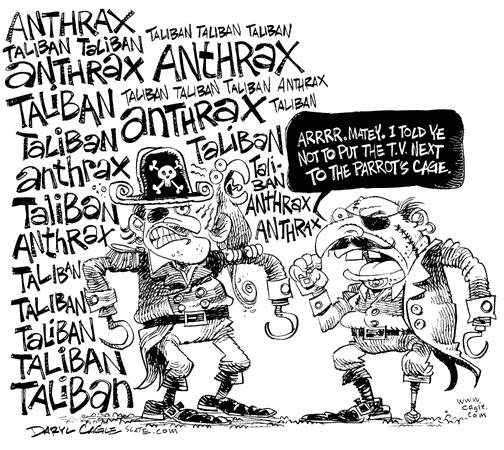
My Lord. The protest scene is getting so cliche I have to check my calendar to see which war their protesting against. I wonder if long haired Torries got out and protested George Wahington's Declaration of Independence from Britiain.
I can hear it now: "No Blood for Tea! No Blood for Tea! England is a peaceful nation! All they want is our money and our Rights! Don't Fight! Cooperate!"
Nevermind that Freedom and Liberty was what was really being fought for, then as well as now. But, alas, it's like trying to explain water to a fish. They have so much of it, for so long, they can't imagine ever doing without it, or who put it there for them to enjoy.
America is free because America is strong. We have been attacked by evil men with evil plans time and time again. This time is no different. Every time we decided to fight, we won. Every time we decided to settle, we lost, and had to face the problem again, later, at a much higher price of lives and suffering.
It's just that simple folks. Don'tcha just love da Truth!
I can hear it now: "No Blood for Tea! No Blood for Tea! England is a peaceful nation! All they want is our money and our Rights! Don't Fight! Cooperate!"
Nevermind that Freedom and Liberty was what was really being fought for, then as well as now. But, alas, it's like trying to explain water to a fish. They have so much of it, for so long, they can't imagine ever doing without it, or who put it there for them to enjoy.
America is free because America is strong. We have been attacked by evil men with evil plans time and time again. This time is no different. Every time we decided to fight, we won. Every time we decided to settle, we lost, and had to face the problem again, later, at a much higher price of lives and suffering.
It's just that simple folks. Don'tcha just love da Truth!
Actually, one of the big issues in separation from the British was naval press, where colonists were forcibly and arbitrarily conscripted into the British navy to fight in their wars .......
The American Revolution was largely Middle Class but it was inspired by many of the same people later behind the French Revolution. Tom Paine was clearly a Socialist and the last thing even the rich fighting the Revolution would have wanted was the situation we have now with a fugurehead President who controls the military.
Even aside from politics, from a purely psychological perspective the Left would resemble the Rebels and the right the Loyalists... The tendency to justify the status quo and support one's leaders would have lead one to be a Loyalist whereas youthful rebellion would have lead to things like the Boston Tea Party. One must also remember that Jefferson and Paine were for religious freedom in a way few on the Right would support or understand (afterall as deists they were not really Chistians and the jingoistic religousity of todays Republicans would have scared them) Some of the libertine stuff Ben Franklin was into would scare the modern Religious RIght.
The American Revolution's support for militias was pretty much a rejection of a national army and the stipulations that soldiers could not be stationed in private people's homes was also a strong rejection of the British military many in the Colonies saw as an oppressor (and parts of the Constitution were designed to prevent that here)
While the American Revolution was Middle Class in origin it was a proDemocracy movement and really did help to start the later Revolutions in Europe. While the connections between 1776, 1789, the 1840s, the 1870s and 1917 are often ignored, one can see a clear movement that began in the US and was only slowed down by the antiRevolutionary apathy that followed the disaster of Stalin's rule in the USSR.
The left and protest movements today can trace many of their roots back to 1776 (and earlier uprisings in Europe) and even the demands havn't changed that much (Puerto Rico, the West Bank and Gaza still being colonies and US troops in the Middle East and the Americas looking not to dissimilar from the Red Coats )
Even aside from politics, from a purely psychological perspective the Left would resemble the Rebels and the right the Loyalists... The tendency to justify the status quo and support one's leaders would have lead one to be a Loyalist whereas youthful rebellion would have lead to things like the Boston Tea Party. One must also remember that Jefferson and Paine were for religious freedom in a way few on the Right would support or understand (afterall as deists they were not really Chistians and the jingoistic religousity of todays Republicans would have scared them) Some of the libertine stuff Ben Franklin was into would scare the modern Religious RIght.
The American Revolution's support for militias was pretty much a rejection of a national army and the stipulations that soldiers could not be stationed in private people's homes was also a strong rejection of the British military many in the Colonies saw as an oppressor (and parts of the Constitution were designed to prevent that here)
While the American Revolution was Middle Class in origin it was a proDemocracy movement and really did help to start the later Revolutions in Europe. While the connections between 1776, 1789, the 1840s, the 1870s and 1917 are often ignored, one can see a clear movement that began in the US and was only slowed down by the antiRevolutionary apathy that followed the disaster of Stalin's rule in the USSR.
The left and protest movements today can trace many of their roots back to 1776 (and earlier uprisings in Europe) and even the demands havn't changed that much (Puerto Rico, the West Bank and Gaza still being colonies and US troops in the Middle East and the Americas looking not to dissimilar from the Red Coats )
And Jefferson, lining people up on the White House lawn in front of a firing squad for treason, that would be more Democrat or more Republican?
All of our founding fathers believed in Peace Through Strength. That's why Washington wintered at Valley Forge and crossed the Deleware - to kill the British, not to protest them. And he turned down the tidy sum of $100,000 for his services as commander in cheif of the contenental army. He said that the money should be spent on chaplains, so that the country could be founded on a firm belief in God, and the teachings of Jesus Christ. Boy, you're right. He does sound just like a modern Democrat.
We fight back, when we get attacked. No Pearl Harbor; no Atom Bomb. No 9-11; no War on Terrorism. America is purely reactionary, militarily. We don't covet one inch of anyone else's land. Do YOU want any part of Afghanistan?? If America could move to MARS we'd leave this diseased terrorist cesspool behind. We do more than anyone else to try to make the world a better place (#1 contributor of humanitarian aid, #1 supplier of foreign aid ($$$), we stopped Hitler, Small Pox...) and we don't hate anyone who doesn't attack us first. What do we get for it? Terrorism, and multinational hatred. Not even the French like us. But they were Bloody Glad to see us in 1942. Funny how things change. Nobody loves a soldier until the enemy's at the doorstep.
Immigrants flock to America from all over the world, and have since the country began. They come here to get away from the oppressive, polluted, corrupt, unproductive countries they leave behind. They come here to make a better life for themselves because they can't have a better life wherever it is they come from. From the picture of America you seem to paint, all these immigrants should be going the other way.
We didn't fight the American Revolution so that we could become the new British Empire. We put an end to global colonization (Yes, it happens a bit. But nothing like before. Israel occupies Palestine. Turkey occupies half of Cyprus. Where's the U.N. on that one?)
We didn't fight WWI so that we could occupy and control Austria or Germany.
We didn't fight WWII so that we could become the new third reich.
We didn't fight Korea so that we could occupy and control the Korean Peninsula.
We didn't fight Vietnam so that we could occupy and control Vietnam.
We didn't fight the Cold War to occupy and control Russia.
We didn't fight the Gulf War to occupy and control Kuwait, or Iraq, or Saudi Arabia
We didn't fight in Bosnia, Serbia, Kosovo, or Somalia to occupy or control those countries.
We are not fighting the war on terrorism to occupy or control the middle east oil supply. We're trying to stop the terrorist supply. Not oil. Terrorist. We'll set up non-terrorist countries in Afghanistan and Iraq and any other countries that want to attack us, and then we will leave. Just like we did in Germany, Italy & Japan.
Don't you get tired of being wrong all the time? If, five years from now, Iraq and Kuwait and Afghanistan are free, secular democracies, less like Hitler's germany and more like Shroder's germany, will you say 'okay, the war on terror was a good thing.'
Somehow I doubt it.
All of our founding fathers believed in Peace Through Strength. That's why Washington wintered at Valley Forge and crossed the Deleware - to kill the British, not to protest them. And he turned down the tidy sum of $100,000 for his services as commander in cheif of the contenental army. He said that the money should be spent on chaplains, so that the country could be founded on a firm belief in God, and the teachings of Jesus Christ. Boy, you're right. He does sound just like a modern Democrat.
We fight back, when we get attacked. No Pearl Harbor; no Atom Bomb. No 9-11; no War on Terrorism. America is purely reactionary, militarily. We don't covet one inch of anyone else's land. Do YOU want any part of Afghanistan?? If America could move to MARS we'd leave this diseased terrorist cesspool behind. We do more than anyone else to try to make the world a better place (#1 contributor of humanitarian aid, #1 supplier of foreign aid ($$$), we stopped Hitler, Small Pox...) and we don't hate anyone who doesn't attack us first. What do we get for it? Terrorism, and multinational hatred. Not even the French like us. But they were Bloody Glad to see us in 1942. Funny how things change. Nobody loves a soldier until the enemy's at the doorstep.
Immigrants flock to America from all over the world, and have since the country began. They come here to get away from the oppressive, polluted, corrupt, unproductive countries they leave behind. They come here to make a better life for themselves because they can't have a better life wherever it is they come from. From the picture of America you seem to paint, all these immigrants should be going the other way.
We didn't fight the American Revolution so that we could become the new British Empire. We put an end to global colonization (Yes, it happens a bit. But nothing like before. Israel occupies Palestine. Turkey occupies half of Cyprus. Where's the U.N. on that one?)
We didn't fight WWI so that we could occupy and control Austria or Germany.
We didn't fight WWII so that we could become the new third reich.
We didn't fight Korea so that we could occupy and control the Korean Peninsula.
We didn't fight Vietnam so that we could occupy and control Vietnam.
We didn't fight the Cold War to occupy and control Russia.
We didn't fight the Gulf War to occupy and control Kuwait, or Iraq, or Saudi Arabia
We didn't fight in Bosnia, Serbia, Kosovo, or Somalia to occupy or control those countries.
We are not fighting the war on terrorism to occupy or control the middle east oil supply. We're trying to stop the terrorist supply. Not oil. Terrorist. We'll set up non-terrorist countries in Afghanistan and Iraq and any other countries that want to attack us, and then we will leave. Just like we did in Germany, Italy & Japan.
Don't you get tired of being wrong all the time? If, five years from now, Iraq and Kuwait and Afghanistan are free, secular democracies, less like Hitler's germany and more like Shroder's germany, will you say 'okay, the war on terror was a good thing.'
Somehow I doubt it.
And Jefferson, lining people up on the White House lawn in front of a firing squad for treason, that would be more Democrat or more Republican???
"Iraq and Kuwait and Afghanistan are free, secular democracies,"
You mean how after the first Gulf war Iraq and Kuwait became a democracies?
You mean how after the first Gulf war Iraq and Kuwait became a democracies?
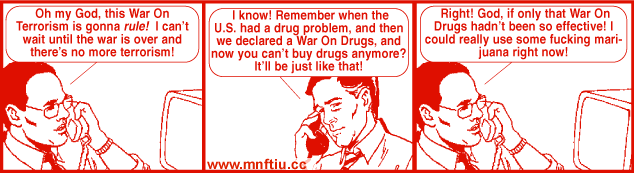
"We didn't fight WWI so that we could occupy and control Austria or Germany. "
Exactly why did the US fight WWI, both sides looked equally bad in that war if you ask me. I guess it resulted in the USSR and the creation of the modern Middle East so...
"We didn't fight Korea so that we could occupy and control the Korean Peninsula. "
Well the US does have bases there and the locals want the bases out (I'll give it another year or two before the Koreans finally kick the US out)
"We didn't fight Vietnam so that we could occupy and control Vietnam."
The US lost that war.
"We didn't fight the Cold War to occupy and control Russia."
The US didnt really fight the Cold War. There were Red Scares and wars in the third world over nationalizations of industries but the US didnt exacly defend E Europe....
"We didn't fight the Gulf War to occupy and control Kuwait, or Iraq, or Saudi Arabia"
Well the US has troops in all three countries. The bases in Saudi Arabia and Yemen are not really about Iraq so...
"We didn't fight in Bosnia, Serbia, Kosovo, or Somalia to occupy or control those countries."
The US lost Somolia and Kosovo was about European stabiity and justifying NATOs existance... and we do have troops in Germany, Italy etc...
Exactly why did the US fight WWI, both sides looked equally bad in that war if you ask me. I guess it resulted in the USSR and the creation of the modern Middle East so...
"We didn't fight Korea so that we could occupy and control the Korean Peninsula. "
Well the US does have bases there and the locals want the bases out (I'll give it another year or two before the Koreans finally kick the US out)
"We didn't fight Vietnam so that we could occupy and control Vietnam."
The US lost that war.
"We didn't fight the Cold War to occupy and control Russia."
The US didnt really fight the Cold War. There were Red Scares and wars in the third world over nationalizations of industries but the US didnt exacly defend E Europe....
"We didn't fight the Gulf War to occupy and control Kuwait, or Iraq, or Saudi Arabia"
Well the US has troops in all three countries. The bases in Saudi Arabia and Yemen are not really about Iraq so...
"We didn't fight in Bosnia, Serbia, Kosovo, or Somalia to occupy or control those countries."
The US lost Somolia and Kosovo was about European stabiity and justifying NATOs existance... and we do have troops in Germany, Italy etc...
"We didn't fight WWI so that we could occupy and control Austria or Germany.
We didn't fight WWII so that we could become the new third reich.
We didn't fight Korea so that we could occupy and control the Korean Peninsula.
We didn't fight Vietnam so that we could occupy and control Vietnam.
We didn't fight the Cold War to occupy and control Russia.
We didn't fight the Gulf War to occupy and control Kuwait, or Iraq, or Saudi Arabia
We didn't fight in Bosnia, Serbia, Kosovo, or Somalia to occupy or control those countries."
Hmmmm, that's funny. I guess US military bases just ACCIDENTALLY got built in ALL of those places ......
We didn't fight WWII so that we could become the new third reich.
We didn't fight Korea so that we could occupy and control the Korean Peninsula.
We didn't fight Vietnam so that we could occupy and control Vietnam.
We didn't fight the Cold War to occupy and control Russia.
We didn't fight the Gulf War to occupy and control Kuwait, or Iraq, or Saudi Arabia
We didn't fight in Bosnia, Serbia, Kosovo, or Somalia to occupy or control those countries."
Hmmmm, that's funny. I guess US military bases just ACCIDENTALLY got built in ALL of those places ......
Lets see, America is a global Emprial Power bent on global domination, and has never done anything right.
When it looks like America has done something right, it has really done something wrong, and just made it seem to be right.
American gets involved in other people's business all the time, like we're the world's policeman. Like that time when we went over to Germany and Japan in the 1940's and got all involved in Hitler and Tojo's private business, like killing 6 million Jews. Like that time when we kept Stalin from swallowing up West Berlin while people climed over barbed wire and through machine gun fire to get out of the east and escape to the west. Or the time when we toppled Saddam Hussein so that the people in Iraq could live without a sadistic dictator and the people in New York could live without a nuclear bomb going off in their city - no wait, we're doing that one right now.
Corporations are evil.
Republicans are evil.
America is evil.
George bush is evil.
Man! You guys gotta get over to this 'Brave and Insolent Youth' page. This guy named Andrew McCrae just shot a cop in the head in cold blood (he really did, he's in the news, he got caught) and he published a manifesto, and you guys agree with him like 110%.
Come to think of it, you sound kinda like the Taliban, too. Did you all go to school together in Kandahar in the 90's? Mohammad Atta- played QB and a little half back. Yea, yea, I think I remember when you guys came and played football at our school. You all had red footballs with clocks on them and wires sticking out. I remember - gimme a 'J' gimme a 'I'... what's that spell? 'JIHAD' okay, yea, 'The Hijackers'. What ever happened to Moe anyway? That game was a blowout.
When it looks like America has done something right, it has really done something wrong, and just made it seem to be right.
American gets involved in other people's business all the time, like we're the world's policeman. Like that time when we went over to Germany and Japan in the 1940's and got all involved in Hitler and Tojo's private business, like killing 6 million Jews. Like that time when we kept Stalin from swallowing up West Berlin while people climed over barbed wire and through machine gun fire to get out of the east and escape to the west. Or the time when we toppled Saddam Hussein so that the people in Iraq could live without a sadistic dictator and the people in New York could live without a nuclear bomb going off in their city - no wait, we're doing that one right now.
Corporations are evil.
Republicans are evil.
America is evil.
George bush is evil.
Man! You guys gotta get over to this 'Brave and Insolent Youth' page. This guy named Andrew McCrae just shot a cop in the head in cold blood (he really did, he's in the news, he got caught) and he published a manifesto, and you guys agree with him like 110%.
Come to think of it, you sound kinda like the Taliban, too. Did you all go to school together in Kandahar in the 90's? Mohammad Atta- played QB and a little half back. Yea, yea, I think I remember when you guys came and played football at our school. You all had red footballs with clocks on them and wires sticking out. I remember - gimme a 'J' gimme a 'I'... what's that spell? 'JIHAD' okay, yea, 'The Hijackers'. What ever happened to Moe anyway? That game was a blowout.
Yeah, you're right. America is not global, America is not imperial. America is not powerful.
Corporations are good.
Republicans are good.
America is good.
George bush is good.
That one single man got killed is VERY important to the world. Thousands and thousands of people are shot every day around the world, but this one had a uniform and he was American so that's why this is so important.
(/sarcasm off)
By the way, America didn't decide to go and get involved in Hitler's business. It did everything it could to stay out of it and let him kill all the Jews he liked, until Germany declared war on America.
"Or the time when we toppled Saddam Hussein"
When the hell was this ?? Where the hell do you get your news? Didn't you happen to notice, Saddam is still around? I think you mean "that time when we said we were going to topple Saddam but all we really did was drop lots of bombs on the people, instead, because we were stupid incompetant assholes."
Corporations are good.
Republicans are good.
America is good.
George bush is good.
That one single man got killed is VERY important to the world. Thousands and thousands of people are shot every day around the world, but this one had a uniform and he was American so that's why this is so important.
(/sarcasm off)
By the way, America didn't decide to go and get involved in Hitler's business. It did everything it could to stay out of it and let him kill all the Jews he liked, until Germany declared war on America.
"Or the time when we toppled Saddam Hussein"
When the hell was this ?? Where the hell do you get your news? Didn't you happen to notice, Saddam is still around? I think you mean "that time when we said we were going to topple Saddam but all we really did was drop lots of bombs on the people, instead, because we were stupid incompetant assholes."
"And Jefferson, lining people up on the White House lawn in front of a firing squad for treason, that would be more Democrat or more Republican? All of our founding fathers believed in Peace Through Strength"
I was close to convinced the American Revolution was a good thing until Eric goes and ruins it by comparing the people behind it to Stalin...
I guess in his logic since there was some firing squad Jefferson took part in (although Im not sure which one he is trying to reference), firing squads MUST be good. I guess there is always the danger that if you act badly in front of kids they will want to follow your example... (daddy was into heroin so it must be good -> daddy was into firing squads so they must be good) Im guessing Eric is also proSlavery since the "founding fathers" kept slaves (even while writing about how this was morally wrong)
Personally I dont really like firing squads, genocide,slavery etc.. but I still think Paine, Franklin and Jefferson has SOME good ideas... and while these ideas may have come from Locke And Rouseau, they were first put into practice in the US (inspiring later Revolutions in France and Russia)
I was close to convinced the American Revolution was a good thing until Eric goes and ruins it by comparing the people behind it to Stalin...
I guess in his logic since there was some firing squad Jefferson took part in (although Im not sure which one he is trying to reference), firing squads MUST be good. I guess there is always the danger that if you act badly in front of kids they will want to follow your example... (daddy was into heroin so it must be good -> daddy was into firing squads so they must be good) Im guessing Eric is also proSlavery since the "founding fathers" kept slaves (even while writing about how this was morally wrong)
Personally I dont really like firing squads, genocide,slavery etc.. but I still think Paine, Franklin and Jefferson has SOME good ideas... and while these ideas may have come from Locke And Rouseau, they were first put into practice in the US (inspiring later Revolutions in France and Russia)
I think everyone would be very surprised to see how unapologistic our founding fathers really were. They would not have debated how legitimate it was to attack nation that threathened THEIR peace and liberty. They would not have sat idly by while endless debates resloved what was the proper way to go about protecting the country from it's enemies.
And yes, Thomas Jefferson had traitors shot on the white house lawn. 25 of them, for treason against America.
All of these men were militarists. Except for Franklin, they all actually ordered soldiers to fire on the enemy. And Franklin, for all his Libertine Views, was best friends with a dozen militarists.
And no, you weren't just about to think that the American revolution was a good thing. You were about to think that the Soviet revolution was a good thing. Do you know they all had guaranteed pensions! Man! What a country we'd be if we all had guaranteed pensions. I got stuck with Free Speech, and Freedom and Liberty. Dang. I guess some people are just lucky enough to get born into a Marxist country.
America IS good. No sarcasm needed. I'll wait while your brain reformats.
And yes, Thomas Jefferson had traitors shot on the white house lawn. 25 of them, for treason against America.
All of these men were militarists. Except for Franklin, they all actually ordered soldiers to fire on the enemy. And Franklin, for all his Libertine Views, was best friends with a dozen militarists.
And no, you weren't just about to think that the American revolution was a good thing. You were about to think that the Soviet revolution was a good thing. Do you know they all had guaranteed pensions! Man! What a country we'd be if we all had guaranteed pensions. I got stuck with Free Speech, and Freedom and Liberty. Dang. I guess some people are just lucky enough to get born into a Marxist country.
America IS good. No sarcasm needed. I'll wait while your brain reformats.
"And yes, Thomas Jefferson had traitors shot on the white house lawn. 25 of them, for treason against America. "
If only the US could still be like the Taliban today...
If only the US could still be like the Taliban today...
Eric, I know you like public executions and are depressed the Taliban is gone, but your secret desires are being projected on rather peaceful people. Maybe you are getting Robspierre and Jefferson confused?
Thomas Jefferson on treason
--------------------------------------------------------------------------------
Treason. This, when real, merits the highest punishment. But most codes extend their definition of treason to acts not really against one’s country. They do not distinguish between acts against the government and acts against the oppressions of the government; the latter are virtues; yet they have furnished more victims to the executioner than the former; because real treasons are rare; oppressions frequent. The unsuccessful strugglers against tyranny, have been the chief martyrs of treason laws in all countries.
Reformation of government with our neighbors, being as much wanted now as religion is, or ever was anywhere, we should not wish then, to give up to the executioner, the patriot who fails, and flees to us. Treasons then, taking the simulated with the real, are sufficiently punished by exile.
—Heads of consideration on the establishment of extradition treaties, 22 March 1792
Thomas Jefferson on treason
--------------------------------------------------------------------------------
Treason. This, when real, merits the highest punishment. But most codes extend their definition of treason to acts not really against one’s country. They do not distinguish between acts against the government and acts against the oppressions of the government; the latter are virtues; yet they have furnished more victims to the executioner than the former; because real treasons are rare; oppressions frequent. The unsuccessful strugglers against tyranny, have been the chief martyrs of treason laws in all countries.
Reformation of government with our neighbors, being as much wanted now as religion is, or ever was anywhere, we should not wish then, to give up to the executioner, the patriot who fails, and flees to us. Treasons then, taking the simulated with the real, are sufficiently punished by exile.
—Heads of consideration on the establishment of extradition treaties, 22 March 1792
Erich, I'd still like to know when the hell it was we "toppled" Saddam.
July 4, 1776
Treason in Philadelphia
By SHAWN POGUEMAHONE
Royal Press Writer
PHILADELPHIA (RP)--
As darkness falls over Philadelphia, one can barely make out the hand-painted warning on the white gable wall: "You are Now Entering Free Philly," it says, an ominous reminder to outsiders that this is rebel terrority, home of the Minutemen, the ruthless armed wing of the Continental Congress. It is here, deep in rebel country that this reporter dared venture to obtain an exclusive eyewitness account of the signing of the so-called 'Declaration of Independence'.
"Come in this way," says my unnamed source, ushering me through the back door of an unnamed tavern on an unnamed street in Philadelphia.
We take our seats in a dark tavern booth. Forgetting where I am, I stupidly ask for a cup of tea.
"Hush," my companion hisses, "There are Minutemen about, you fool! If they hear you asking for tea, they'll kill you in a minute, man!" I hastily apologize for my egregious error, and my companion asks the publican for two cups of "tea substitute." We are given cups of an oily black liquid known to the locals as "coffee." As we drink the bitter, awful stuff, my companion spins his tale of being held hostage in the sweltering July heat by the Minuteman-linked Continental Congress and forced to commit treason by signing the document.
"It was Jefferson who forced us to sign," says my unnamed source, referring to slave-owner and self-admitted 'patriot' Thomas Jefferson. "Jefferson may look like an letter-writin', book readin', pony-tail wearin', wine-makin' fancy-boy, but he's a murderin' bastard, that one. It was Jefferson who fired the first shot at Lexington and Concord." Although my anonymous source did not witness the shooting first-hand, he has it on good authority from the first cousin of a friend's mother's great-aunt's dressmaker that the first shot was most definitely fired by Jefferson.
http://members.tripod.com/mise_eire/treason.html
Treason in Philadelphia
By SHAWN POGUEMAHONE
Royal Press Writer
PHILADELPHIA (RP)--
As darkness falls over Philadelphia, one can barely make out the hand-painted warning on the white gable wall: "You are Now Entering Free Philly," it says, an ominous reminder to outsiders that this is rebel terrority, home of the Minutemen, the ruthless armed wing of the Continental Congress. It is here, deep in rebel country that this reporter dared venture to obtain an exclusive eyewitness account of the signing of the so-called 'Declaration of Independence'.
"Come in this way," says my unnamed source, ushering me through the back door of an unnamed tavern on an unnamed street in Philadelphia.
We take our seats in a dark tavern booth. Forgetting where I am, I stupidly ask for a cup of tea.
"Hush," my companion hisses, "There are Minutemen about, you fool! If they hear you asking for tea, they'll kill you in a minute, man!" I hastily apologize for my egregious error, and my companion asks the publican for two cups of "tea substitute." We are given cups of an oily black liquid known to the locals as "coffee." As we drink the bitter, awful stuff, my companion spins his tale of being held hostage in the sweltering July heat by the Minuteman-linked Continental Congress and forced to commit treason by signing the document.
"It was Jefferson who forced us to sign," says my unnamed source, referring to slave-owner and self-admitted 'patriot' Thomas Jefferson. "Jefferson may look like an letter-writin', book readin', pony-tail wearin', wine-makin' fancy-boy, but he's a murderin' bastard, that one. It was Jefferson who fired the first shot at Lexington and Concord." Although my anonymous source did not witness the shooting first-hand, he has it on good authority from the first cousin of a friend's mother's great-aunt's dressmaker that the first shot was most definitely fired by Jefferson.
http://members.tripod.com/mise_eire/treason.html
That article doesn't say when it was that we, as you claimed, "toppled Saddam".
Or would you rather just not answer this rather embarrassing question?
Or would you rather just not answer this rather embarrassing question?
"Ignorance is preferable to error, and he is less remote from the truth who believes nothing than he who believes what is wrong."
-Thomas Jefferson (Notes on Virginia, 1782)
--------------------------------------------------------------------------------
It spite of Christian right attempts to rewrite history to make Jefferson into a Christian, little about his philosophy resembles that of Christianity. Although Jefferson in the Declaration of Independence wrote of the Laws of Nature and of Nature's God, there exists nothing in the Declaration about Christianity.
Although Jefferson believed in a Creator, his concept of it resembled that of the god of deism (the term "Nature's God" used by deists of the time). With his scientific bent, Jefferson sought to organize his thoughts on religion. He rejected the superstitions and mysticism of Christianity and even went so far as to edit the gospels, removing the miracles and mysticism of Jesus (see The Jefferson Bible) leaving only what he deemed the correct moral philosophy of Jesus.
Distortions of history occur in the minds of many Christians whenever they see the word "God" embossed in statue or memorial concrete . For example, those who visit the Jefferson Memorial in Washington will read Jefferson's words engraved: "I have sworn upon the altar of God eternal hostility against every from of tyranny over the mind of man." When they see the word "God" many Christians see this as "proof" of his Christianity without thinking that 'God' can have many definitions ranging from nature to supernatural. Yet how many of them realize that this passage aimed at attacking the tyranny of the Christian clergy of Philadelphia, or that Jefferson's God was not the personal god of Christianity? Those memorial words came from a letter written to Benjamin Rush in 1800 in response to Rush's warning about the Philadelphia clergy attacking Jefferson (Jefferson was seen as an infidel by his enemies during his election for President). The complete statement reads as follows:
"The returning good sense of our country threatens abortion to their hopes, & they [the clergy] believe that any portion of power confided to me, will be exerted in opposition to their schemes. And they believe rightly; for I have sworn upon the altar of God, eternal hostility against every form of tyranny over the mind of man. But this is all they have to fear from me: & enough too in their opinion, & this is the cause of their printing lying pamphlets against me. . ."
Jefferson aimed at laissez-faire liberalism in the name of individual freedom, He felt that any form of government control, not only of religion, but of individual mercantilism consisted of tyranny. He thought that our civil rights have no dependence on our religious opinions, any more than our opinions in physics or geometry.
If anything can clear of the misconceptions of Jeffersonian history, it can come best from the author himself. Although Jefferson had a complex view of religion, too vast for this article, the following quotes provide a glimpse of how Thomas Jefferson viewed the corruptions of Christianity and religion.
--------------------------------------------------------------------------------
Millions of innocent men, women and children, since the introduction of Christianity, have been burnt, tortured, fined and imprisoned; yet we have not advanced one inch towards uniformity.
-Thomas Jefferson, Notes on Virginia, 1782.
--------------------------------------------------------------------------------
But it does me no injury for my neighbor to say there are twenty gods or no God. It neither picks my pocket nor breaks my leg.
-Thomas Jefferson, Notes on Virginia, 1782.
--------------------------------------------------------------------------------
What is it men cannot be made to believe!
-Thomas Jefferson to Richard Henry Lee, April 22, 1786. (on the British regarding America, but quoted here for its universal appeal.)
--------------------------------------------------------------------------------
Question with boldness even the existence of a god; because if there be one he must approve of the homage of reason more than that of blindfolded fear.
-Thomas Jefferson, Letter to Peter Carr, August 10, 1787
--------------------------------------------------------------------------------
Where the preamble declares, that coercion is a departure from the plan of the holy author of our religion, an amendment was proposed by inserting "Jesus Christ," so that it would read "A departure from the plan of Jesus Christ, the holy author of our religion;" the insertion was rejected by the great majority, in proof that they meant to comprehend, within the mantle of its protection, the Jew and the Gentile, the Christian and Mohammedan, the Hindoo and Infidel of every denomination.
-Thomas Jefferson, Autobiography, in reference to the Virginia Act for Religious Freedom
--------------------------------------------------------------------------------
I concur with you strictly in your opinion of the comparative merits of atheism and demonism, and really see nothing but the latter in the being worshipped by many who think themselves Christians.
-Thomas Jefferson, letter to Richard Price, Jan. 8, 1789 (Richard Price had written to TJ on Oct. 26. about the harm done by religion and wrote "Would not Society be better without Such religions? Is Atheism less pernicious than Demonism?")
--------------------------------------------------------------------------------
I never submitted the whole system of my opinions to the creed of any party of men whatever in religion, in philosophy, in politics, or in anything else where I was capable of thinking for myself. Such an addiction is the last degradation of a free and moral agent.
-Thomas Jefferson, letter to Francis Hopkinson, March 13, 1789
--------------------------------------------------------------------------------
They [the clergy] believe that any portion of power confided to me, will be exerted in opposition to their schemes. And they believe rightly; for I have sworn upon the altar of god, eternal hostility against every form of tyranny over the mind of man. But this is all they have to fear from me: and enough, too, in their opinion.
-Thomas Jefferson to Dr. Benjamin Rush, Sept. 23, 1800
--------------------------------------------------------------------------------
Believing with you that religion is a matter which lies solely between man and his God, that he owes account to none other for his faith or his worship, that the legislative powers of government reach actions only, and not opinions, I contemplate with sovereign reverence that act of the whole American people which declared that their legislature should 'make no law respecting an establishment of religion, or prohibiting the free exercise thereof,' thus building a wall of separation between church and State.
-Thomas Jefferson, letter to Danbury Baptist Association, CT., Jan. 1, 1802
--------------------------------------------------------------------------------
History, I believe, furnishes no example of a priest-ridden people maintaining a free civil government. This marks the lowest grade of ignorance of which their civil as well as religious leaders will always avail themselves for their own purposes.
-Thomas Jefferson to Alexander von Humboldt, Dec. 6, 1813.
--------------------------------------------------------------------------------
The whole history of these books [the Gospels] is so defective and doubtful that it seems vain to attempt minute enquiry into it: and such tricks have been played with their text, and with the texts of other books relating to them, that we have a right, from that cause, to entertain much doubt what parts of them are genuine. In the New Testament there is internal evidence that parts of it have proceeded from an extraordinary man; and that other parts are of the fabric of very inferior minds. It is as easy to separate those parts, as to pick out diamonds from dunghills.
-Thomas Jefferson, letter to John Adams, January 24, 1814
--------------------------------------------------------------------------------
Christianity neither is, nor ever was a part of the common law.
-Thomas Jefferson, letter to Dr. Thomas Cooper, February 10, 1814
--------------------------------------------------------------------------------
In every country and in every age, the priest has been hostile to liberty. He is always in alliance with the despot, abetting his abuses in return for protection to his own.
-Thomas Jefferson, letter to Horatio G. Spafford, March 17, 1814
--------------------------------------------------------------------------------
If we did a good act merely from love of God and a belief that it is pleasing to Him, whence arises the morality of the Atheist? ...Their virtue, then, must have had some other foundation than the love of God.
-Thomas Jefferson, Letter to Thomas Law, June 13, 1814
--------------------------------------------------------------------------------
You say you are a Calvinist. I am not. I am of a sect by myself, as far as I know.
-Thomas Jefferson, letter to Ezra Stiles Ely, June 25, 1819
--------------------------------------------------------------------------------
As you say of yourslef, I too am an Epicurian. I consider the genuine (not the imputed) doctrines of Epicurus as containing everything rational in moral philosophy which Greece and Rome have left us.
-Thomas Jefferson, letter to William Short, Oct. 31, 1819
--------------------------------------------------------------------------------
Among the sayings and discourses imputed to him [Jesus] by his biographers, I find many passages of fine imagination, correct morality, and of the most lovely benevolence; and others again of so much ignorance, so much absurdity, so much untruth, charlatanism, and imposture, as to pronounce it impossible that such contradictions should have proceeded from the same being.
-Thomas Jefferson, letter to William Short, April 13, 1820
--------------------------------------------------------------------------------
To talk of immaterial existences is to talk of nothings. To say that the human soul, angels, god, are immaterial, is to say they are nothings, or that there is no god, no angels, no soul. I cannot reason otherwise: but I believe I am supported in my creed of materialism by Locke, Tracy, and Stewart. At what age of the Christian church this heresy of immaterialism, this masked atheism, crept in, I do not know. But heresy it certainly is.
-Thomas Jefferson, letter to John Adams, Aug. 15, 1820
--------------------------------------------------------------------------------
Man once surrendering his reason, has no remaining guard against absurdities the most monstrous, and like a ship without rudder, is the sport of every wind.
-Thomas Jefferson to James Smith, 1822.
--------------------------------------------------------------------------------
I can never join Calvin in addressing his god. He was indeed an Atheist, which I can never be; or rather his religion was Daemonism. If ever man worshipped a false god, he did.
-Thomas Jefferson, letter to John Adams, April 11, 1823
--------------------------------------------------------------------------------
And the day will come when the mystical generation of Jesus, by the supreme being as his father in the womb of a virgin will be classed with the fable of the generation of Minerve in the brain of Jupiter. But may we hope that the dawn of reason and freedom of thought in these United States will do away with this artificial scaffolding, and restore to us the primitive and genuine doctrines of this most venerated reformer of human errors.
-Thomas Jefferson, Letter to John Adams, April 11, 1823
--------------------------------------------------------------------------------
It is between fifty and sixty years since I read it [the Apocalypse], and I then considered it merely the ravings of a maniac, no more worthy nor capable of explanation than the incoherences of our own nightly dreams.
-Thomas Jefferson, letter to General Alexander Smyth, Jan. 17, 1825
http://www.nobeliefs.com/jefferson.htm
-Thomas Jefferson (Notes on Virginia, 1782)
--------------------------------------------------------------------------------
It spite of Christian right attempts to rewrite history to make Jefferson into a Christian, little about his philosophy resembles that of Christianity. Although Jefferson in the Declaration of Independence wrote of the Laws of Nature and of Nature's God, there exists nothing in the Declaration about Christianity.
Although Jefferson believed in a Creator, his concept of it resembled that of the god of deism (the term "Nature's God" used by deists of the time). With his scientific bent, Jefferson sought to organize his thoughts on religion. He rejected the superstitions and mysticism of Christianity and even went so far as to edit the gospels, removing the miracles and mysticism of Jesus (see The Jefferson Bible) leaving only what he deemed the correct moral philosophy of Jesus.
Distortions of history occur in the minds of many Christians whenever they see the word "God" embossed in statue or memorial concrete . For example, those who visit the Jefferson Memorial in Washington will read Jefferson's words engraved: "I have sworn upon the altar of God eternal hostility against every from of tyranny over the mind of man." When they see the word "God" many Christians see this as "proof" of his Christianity without thinking that 'God' can have many definitions ranging from nature to supernatural. Yet how many of them realize that this passage aimed at attacking the tyranny of the Christian clergy of Philadelphia, or that Jefferson's God was not the personal god of Christianity? Those memorial words came from a letter written to Benjamin Rush in 1800 in response to Rush's warning about the Philadelphia clergy attacking Jefferson (Jefferson was seen as an infidel by his enemies during his election for President). The complete statement reads as follows:
"The returning good sense of our country threatens abortion to their hopes, & they [the clergy] believe that any portion of power confided to me, will be exerted in opposition to their schemes. And they believe rightly; for I have sworn upon the altar of God, eternal hostility against every form of tyranny over the mind of man. But this is all they have to fear from me: & enough too in their opinion, & this is the cause of their printing lying pamphlets against me. . ."
Jefferson aimed at laissez-faire liberalism in the name of individual freedom, He felt that any form of government control, not only of religion, but of individual mercantilism consisted of tyranny. He thought that our civil rights have no dependence on our religious opinions, any more than our opinions in physics or geometry.
If anything can clear of the misconceptions of Jeffersonian history, it can come best from the author himself. Although Jefferson had a complex view of religion, too vast for this article, the following quotes provide a glimpse of how Thomas Jefferson viewed the corruptions of Christianity and religion.
--------------------------------------------------------------------------------
Millions of innocent men, women and children, since the introduction of Christianity, have been burnt, tortured, fined and imprisoned; yet we have not advanced one inch towards uniformity.
-Thomas Jefferson, Notes on Virginia, 1782.
--------------------------------------------------------------------------------
But it does me no injury for my neighbor to say there are twenty gods or no God. It neither picks my pocket nor breaks my leg.
-Thomas Jefferson, Notes on Virginia, 1782.
--------------------------------------------------------------------------------
What is it men cannot be made to believe!
-Thomas Jefferson to Richard Henry Lee, April 22, 1786. (on the British regarding America, but quoted here for its universal appeal.)
--------------------------------------------------------------------------------
Question with boldness even the existence of a god; because if there be one he must approve of the homage of reason more than that of blindfolded fear.
-Thomas Jefferson, Letter to Peter Carr, August 10, 1787
--------------------------------------------------------------------------------
Where the preamble declares, that coercion is a departure from the plan of the holy author of our religion, an amendment was proposed by inserting "Jesus Christ," so that it would read "A departure from the plan of Jesus Christ, the holy author of our religion;" the insertion was rejected by the great majority, in proof that they meant to comprehend, within the mantle of its protection, the Jew and the Gentile, the Christian and Mohammedan, the Hindoo and Infidel of every denomination.
-Thomas Jefferson, Autobiography, in reference to the Virginia Act for Religious Freedom
--------------------------------------------------------------------------------
I concur with you strictly in your opinion of the comparative merits of atheism and demonism, and really see nothing but the latter in the being worshipped by many who think themselves Christians.
-Thomas Jefferson, letter to Richard Price, Jan. 8, 1789 (Richard Price had written to TJ on Oct. 26. about the harm done by religion and wrote "Would not Society be better without Such religions? Is Atheism less pernicious than Demonism?")
--------------------------------------------------------------------------------
I never submitted the whole system of my opinions to the creed of any party of men whatever in religion, in philosophy, in politics, or in anything else where I was capable of thinking for myself. Such an addiction is the last degradation of a free and moral agent.
-Thomas Jefferson, letter to Francis Hopkinson, March 13, 1789
--------------------------------------------------------------------------------
They [the clergy] believe that any portion of power confided to me, will be exerted in opposition to their schemes. And they believe rightly; for I have sworn upon the altar of god, eternal hostility against every form of tyranny over the mind of man. But this is all they have to fear from me: and enough, too, in their opinion.
-Thomas Jefferson to Dr. Benjamin Rush, Sept. 23, 1800
--------------------------------------------------------------------------------
Believing with you that religion is a matter which lies solely between man and his God, that he owes account to none other for his faith or his worship, that the legislative powers of government reach actions only, and not opinions, I contemplate with sovereign reverence that act of the whole American people which declared that their legislature should 'make no law respecting an establishment of religion, or prohibiting the free exercise thereof,' thus building a wall of separation between church and State.
-Thomas Jefferson, letter to Danbury Baptist Association, CT., Jan. 1, 1802
--------------------------------------------------------------------------------
History, I believe, furnishes no example of a priest-ridden people maintaining a free civil government. This marks the lowest grade of ignorance of which their civil as well as religious leaders will always avail themselves for their own purposes.
-Thomas Jefferson to Alexander von Humboldt, Dec. 6, 1813.
--------------------------------------------------------------------------------
The whole history of these books [the Gospels] is so defective and doubtful that it seems vain to attempt minute enquiry into it: and such tricks have been played with their text, and with the texts of other books relating to them, that we have a right, from that cause, to entertain much doubt what parts of them are genuine. In the New Testament there is internal evidence that parts of it have proceeded from an extraordinary man; and that other parts are of the fabric of very inferior minds. It is as easy to separate those parts, as to pick out diamonds from dunghills.
-Thomas Jefferson, letter to John Adams, January 24, 1814
--------------------------------------------------------------------------------
Christianity neither is, nor ever was a part of the common law.
-Thomas Jefferson, letter to Dr. Thomas Cooper, February 10, 1814
--------------------------------------------------------------------------------
In every country and in every age, the priest has been hostile to liberty. He is always in alliance with the despot, abetting his abuses in return for protection to his own.
-Thomas Jefferson, letter to Horatio G. Spafford, March 17, 1814
--------------------------------------------------------------------------------
If we did a good act merely from love of God and a belief that it is pleasing to Him, whence arises the morality of the Atheist? ...Their virtue, then, must have had some other foundation than the love of God.
-Thomas Jefferson, Letter to Thomas Law, June 13, 1814
--------------------------------------------------------------------------------
You say you are a Calvinist. I am not. I am of a sect by myself, as far as I know.
-Thomas Jefferson, letter to Ezra Stiles Ely, June 25, 1819
--------------------------------------------------------------------------------
As you say of yourslef, I too am an Epicurian. I consider the genuine (not the imputed) doctrines of Epicurus as containing everything rational in moral philosophy which Greece and Rome have left us.
-Thomas Jefferson, letter to William Short, Oct. 31, 1819
--------------------------------------------------------------------------------
Among the sayings and discourses imputed to him [Jesus] by his biographers, I find many passages of fine imagination, correct morality, and of the most lovely benevolence; and others again of so much ignorance, so much absurdity, so much untruth, charlatanism, and imposture, as to pronounce it impossible that such contradictions should have proceeded from the same being.
-Thomas Jefferson, letter to William Short, April 13, 1820
--------------------------------------------------------------------------------
To talk of immaterial existences is to talk of nothings. To say that the human soul, angels, god, are immaterial, is to say they are nothings, or that there is no god, no angels, no soul. I cannot reason otherwise: but I believe I am supported in my creed of materialism by Locke, Tracy, and Stewart. At what age of the Christian church this heresy of immaterialism, this masked atheism, crept in, I do not know. But heresy it certainly is.
-Thomas Jefferson, letter to John Adams, Aug. 15, 1820
--------------------------------------------------------------------------------
Man once surrendering his reason, has no remaining guard against absurdities the most monstrous, and like a ship without rudder, is the sport of every wind.
-Thomas Jefferson to James Smith, 1822.
--------------------------------------------------------------------------------
I can never join Calvin in addressing his god. He was indeed an Atheist, which I can never be; or rather his religion was Daemonism. If ever man worshipped a false god, he did.
-Thomas Jefferson, letter to John Adams, April 11, 1823
--------------------------------------------------------------------------------
And the day will come when the mystical generation of Jesus, by the supreme being as his father in the womb of a virgin will be classed with the fable of the generation of Minerve in the brain of Jupiter. But may we hope that the dawn of reason and freedom of thought in these United States will do away with this artificial scaffolding, and restore to us the primitive and genuine doctrines of this most venerated reformer of human errors.
-Thomas Jefferson, Letter to John Adams, April 11, 1823
--------------------------------------------------------------------------------
It is between fifty and sixty years since I read it [the Apocalypse], and I then considered it merely the ravings of a maniac, no more worthy nor capable of explanation than the incoherences of our own nightly dreams.
-Thomas Jefferson, letter to General Alexander Smyth, Jan. 17, 1825
http://www.nobeliefs.com/jefferson.htm
Or the time when we toppled Saddam Hussein so that the people in Iraq could live without a sadistic dictator and the people in New York could live without a nuclear bomb going off in their city...
vvvvvvvvvvvvvvvvvvvvvvvvvvvvvvvvvvvvvvvvvvvvvv
>...no wait, we're doing that one right now.<
^^^^^^^^^^^^^^^^^^^^^^^^^^^^^^^^^^^^^^^^^^^^^^
Read the whole post, and it will make more sense. No, I do not believe that we have yet toppled Saddam.
Otherwise, this is an unnecessary post. But I'm having fun.
Nuff with Jefferson. Do Linclon. Show me how he really wanted to emancipate the slaves so he could own them all for hiself, or whatever it is you all believe. Or something modern. Like Rosevelt. He fought a war against the 3rd Reich. Show me examples of how wrong he was to stop them 3rd Reichers.
Or did we not stop them either? What version do you all use now days? Hitlers dead, or hitler's still alive, and their cloning his DNA to make new Israeli PM's. The sub refrences get so muddled sometimes. You compared Jefferson to the Taliban to some French guy and back to himself again, I think.
As for offending your many sensibilities, I profusely apologize. I too, am a peaceful person. Never hurt anyone who wasn't trying to hurt me. I just believe that peace is acheived through different means. Peace through hoping for the best just doesn't seem to have worked many times in, oh, world history. Peace through strength might be imperfect, but it's the best solution I've seen.
Now c'mon, I know you got some good junk on Linclon.
vvvvvvvvvvvvvvvvvvvvvvvvvvvvvvvvvvvvvvvvvvvvvv
>...no wait, we're doing that one right now.<
^^^^^^^^^^^^^^^^^^^^^^^^^^^^^^^^^^^^^^^^^^^^^^
Read the whole post, and it will make more sense. No, I do not believe that we have yet toppled Saddam.
Otherwise, this is an unnecessary post. But I'm having fun.
Nuff with Jefferson. Do Linclon. Show me how he really wanted to emancipate the slaves so he could own them all for hiself, or whatever it is you all believe. Or something modern. Like Rosevelt. He fought a war against the 3rd Reich. Show me examples of how wrong he was to stop them 3rd Reichers.
Or did we not stop them either? What version do you all use now days? Hitlers dead, or hitler's still alive, and their cloning his DNA to make new Israeli PM's. The sub refrences get so muddled sometimes. You compared Jefferson to the Taliban to some French guy and back to himself again, I think.
As for offending your many sensibilities, I profusely apologize. I too, am a peaceful person. Never hurt anyone who wasn't trying to hurt me. I just believe that peace is acheived through different means. Peace through hoping for the best just doesn't seem to have worked many times in, oh, world history. Peace through strength might be imperfect, but it's the best solution I've seen.
Now c'mon, I know you got some good junk on Linclon.
History, I believe, furnishes no example of a priest-ridden people maintaining a free civil government. This marks the lowest grade of ignorance of which their civil as well as religious leaders will always avail themselves for their own purposes.
-Thomas Jefferson to Alexander von Humboldt, Dec. 6, 1813.
-Thomas Jefferson to Alexander von Humboldt, Dec. 6, 1813.
Thomas Paine clearly shows the single strain of radicalism that lead from the US Recolution to the Soviet Revolution and the protests of today...
Thomas Paine was not yet a Socialist but his ideas both inspired the American Revolution, the French Revolution and later many of Marx's ideas (although its interesting to se that what he proposed in the late 1700s was somewhat more similar to the modern welfare state than Communism)
From "The Rights of Man"
George Washington
PRESIDENT OF THE UNITED STATES OF AMERICA
SIR,
I present you a small treatise in defence of those principles of freedom which your exemplary virtue hath so eminently contributed to establish. That the Rights of Man may become as universal as your benevolence can wish, and that you may enjoy the happiness of seeing the New World regenerate the Old, is the prayer of
SIR,
Your much obliged, and
Obedient humble Servant,
THOMAS PAINE
http://www.infidels.org/library/historical/thomas_paine/rights_of_man/part1.html
From Second Section of "The Rights of Man"
As revolutions have begun (and as the probability is always greater against a thing beginning, than of proceeding after it has begun), it is natural to expect that other revolutions will follow. The amazing and still increasing expenses with which old governments are conducted, the numerous wars they engage in or provoke, the embarrassments they throw in the way of universal civilisation and commerce, and the oppression and usurpation acted at home, have wearied out the patience, and exhausted the property of the world. In such a situation, and with such examples already existing, revolutions are to be looked for. They are become subjects of universal conversation, and may be considered as the Order of the day.
If systems of government can be introduced less expensive and more productive of general happiness than those which have existed, all attempts to oppose their progress will in the end be fruitless. Reason, like time, will make its own way, and prejudice will fall in a combat with interest. If universal peace, civilisation, and commerce are ever to be the happy lot of man, it cannot be accomplished but by a revolution in the system of governments. All the monarchical governments are military. War is their trade, plunder and revenue their objects. While such governments continue, peace has not the absolute security of a day. What is the history of all monarchical governments but a disgustful picture of human wretchedness, and the accidental respite of a few years' repose? Wearied with war, and tired with human butchery, they sat down to rest, and called it peace. This certainly is not the condition that heaven intended for man; and if this be monarchy, well might monarchy be reckoned among the sins of the Jews.
The revolutions which formerly took place in the world had nothing in them that interested the bulk of mankind. They extended only to a change of persons and measures, but not of principles, and rose or fell among the common transactions of the moment. What we now behold may not improperly be called a "counter-revolution." Conquest and tyranny, at some earlier period, dispossessed man of his rights, and he is now recovering them. And as the tide of all human affairs has its ebb and flow in directions contrary to each other, so also is it in this. Government founded on a moral theory, on a system of universal peace, on the indefeasible hereditary Rights of Man, is now revolving from west to east by a stronger impulse than the government of the sword revolved from east to west. It interests not particular individuals, but nations in its progress, and promises a new era to the human race.
...
Various forms of government have affected to style themselves a republic. Poland calls itself a republic, which is an hereditary aristocracy, with what is called an elective monarchy. Holland calls itself a republic, which is chiefly aristocratical, with an hereditary stadtholdership. But the government of America, which is wholly on the system of representation, is the only real Republic, in character and in practice, that now exists. Its government has no other object than the public business of the nation, and therefore it is properly a republic; and the Americans have taken care that this, and no other, shall always be the object of their government, by their rejecting everything hereditary, and establishing governments on the system of representation only. Those who have said that a republic is not a form of government calculated for countries of great extent, mistook, in the first place, the business of a government, for a form of government; for the res-publica equally appertains to every extent of territory and population. And, in the second place, if they meant anything with respect to form, it was the simple democratical form, such as was the mode of government in the ancient democracies, in which there was no representation. The case, therefore, is not, that a republic cannot be extensive, but that it cannot be extensive on the simple democratical form; and the question naturally presents itself, What is the best form of government for conducting the Res-Publica, or the Public Business of a nation, after it becomes too extensive and populous for the simple democratical form? It cannot be monarchy, because monarchy is subject to an objection of the same amount to which the simple democratical form was subject.
...
It is time that nations should be rational, and not be governed like animals, for the pleasure of their riders. To read the history of kings, a man would be almost inclined to suppose that government consisted in stag-hunting, and that every nation paid a million a-year to a huntsman. Man ought to have pride, or shame enough to blush at being thus imposed upon, and when he feels his proper character he will. Upon all subjects of this nature, there is often passing in the mind, a train of ideas he has not yet accustomed himself to encourage and communicate. Restrained by something that puts on the character of prudence, he acts the hypocrite upon himself as well as to others. It is, however, curious to observe how soon this spell can be dissolved. A single expression, boldly conceived and uttered, will sometimes put a whole company into their proper feelings: and whole nations are acted on in the same manner.
As to the offices of which any civil government may be composed, it matters but little by what names they are described. In the routine of business, as before observed, whether a man be styled a president, a king, an emperor, a senator, or anything else, it is impossible that any service he can perform, can merit from a nation more than ten thousand pounds a year; and as no man should be paid beyond his services, so every man of a proper heart will not accept more. Public money ought to be touched with the most scrupulous consciousness of honour. It is not the produce of riches only, but of the hard earnings of labour and poverty. It is drawn even from the bitterness of want and misery. Not a beggar passes, or perishes in the streets, whose mite is not in that mass.
...
The first step, therefore, of practical relief, would be to abolish the poor-rates entirely, and in lieu thereof, to make a remission of taxes to the poor of double the amount of the present poor-rates, viz., four millions annually out of the surplus taxes. By this measure, the poor would be benefited two millions, and the house-keepers two millions. This alone would be equal to a reduction of one hundred and twenty millions of the National Debt, and consequently equal to the whole expense of the American War.
It will then remain to be considered, which is the most effectual mode of distributing this remission of four millions.
http://www.infidels.org/library/historical/thomas_paine/rights_of_man/part2.html
Thomas Paine was not yet a Socialist but his ideas both inspired the American Revolution, the French Revolution and later many of Marx's ideas (although its interesting to se that what he proposed in the late 1700s was somewhat more similar to the modern welfare state than Communism)
From "The Rights of Man"
George Washington
PRESIDENT OF THE UNITED STATES OF AMERICA
SIR,
I present you a small treatise in defence of those principles of freedom which your exemplary virtue hath so eminently contributed to establish. That the Rights of Man may become as universal as your benevolence can wish, and that you may enjoy the happiness of seeing the New World regenerate the Old, is the prayer of
SIR,
Your much obliged, and
Obedient humble Servant,
THOMAS PAINE
http://www.infidels.org/library/historical/thomas_paine/rights_of_man/part1.html
From Second Section of "The Rights of Man"
As revolutions have begun (and as the probability is always greater against a thing beginning, than of proceeding after it has begun), it is natural to expect that other revolutions will follow. The amazing and still increasing expenses with which old governments are conducted, the numerous wars they engage in or provoke, the embarrassments they throw in the way of universal civilisation and commerce, and the oppression and usurpation acted at home, have wearied out the patience, and exhausted the property of the world. In such a situation, and with such examples already existing, revolutions are to be looked for. They are become subjects of universal conversation, and may be considered as the Order of the day.
If systems of government can be introduced less expensive and more productive of general happiness than those which have existed, all attempts to oppose their progress will in the end be fruitless. Reason, like time, will make its own way, and prejudice will fall in a combat with interest. If universal peace, civilisation, and commerce are ever to be the happy lot of man, it cannot be accomplished but by a revolution in the system of governments. All the monarchical governments are military. War is their trade, plunder and revenue their objects. While such governments continue, peace has not the absolute security of a day. What is the history of all monarchical governments but a disgustful picture of human wretchedness, and the accidental respite of a few years' repose? Wearied with war, and tired with human butchery, they sat down to rest, and called it peace. This certainly is not the condition that heaven intended for man; and if this be monarchy, well might monarchy be reckoned among the sins of the Jews.
The revolutions which formerly took place in the world had nothing in them that interested the bulk of mankind. They extended only to a change of persons and measures, but not of principles, and rose or fell among the common transactions of the moment. What we now behold may not improperly be called a "counter-revolution." Conquest and tyranny, at some earlier period, dispossessed man of his rights, and he is now recovering them. And as the tide of all human affairs has its ebb and flow in directions contrary to each other, so also is it in this. Government founded on a moral theory, on a system of universal peace, on the indefeasible hereditary Rights of Man, is now revolving from west to east by a stronger impulse than the government of the sword revolved from east to west. It interests not particular individuals, but nations in its progress, and promises a new era to the human race.
...
Various forms of government have affected to style themselves a republic. Poland calls itself a republic, which is an hereditary aristocracy, with what is called an elective monarchy. Holland calls itself a republic, which is chiefly aristocratical, with an hereditary stadtholdership. But the government of America, which is wholly on the system of representation, is the only real Republic, in character and in practice, that now exists. Its government has no other object than the public business of the nation, and therefore it is properly a republic; and the Americans have taken care that this, and no other, shall always be the object of their government, by their rejecting everything hereditary, and establishing governments on the system of representation only. Those who have said that a republic is not a form of government calculated for countries of great extent, mistook, in the first place, the business of a government, for a form of government; for the res-publica equally appertains to every extent of territory and population. And, in the second place, if they meant anything with respect to form, it was the simple democratical form, such as was the mode of government in the ancient democracies, in which there was no representation. The case, therefore, is not, that a republic cannot be extensive, but that it cannot be extensive on the simple democratical form; and the question naturally presents itself, What is the best form of government for conducting the Res-Publica, or the Public Business of a nation, after it becomes too extensive and populous for the simple democratical form? It cannot be monarchy, because monarchy is subject to an objection of the same amount to which the simple democratical form was subject.
...
It is time that nations should be rational, and not be governed like animals, for the pleasure of their riders. To read the history of kings, a man would be almost inclined to suppose that government consisted in stag-hunting, and that every nation paid a million a-year to a huntsman. Man ought to have pride, or shame enough to blush at being thus imposed upon, and when he feels his proper character he will. Upon all subjects of this nature, there is often passing in the mind, a train of ideas he has not yet accustomed himself to encourage and communicate. Restrained by something that puts on the character of prudence, he acts the hypocrite upon himself as well as to others. It is, however, curious to observe how soon this spell can be dissolved. A single expression, boldly conceived and uttered, will sometimes put a whole company into their proper feelings: and whole nations are acted on in the same manner.
As to the offices of which any civil government may be composed, it matters but little by what names they are described. In the routine of business, as before observed, whether a man be styled a president, a king, an emperor, a senator, or anything else, it is impossible that any service he can perform, can merit from a nation more than ten thousand pounds a year; and as no man should be paid beyond his services, so every man of a proper heart will not accept more. Public money ought to be touched with the most scrupulous consciousness of honour. It is not the produce of riches only, but of the hard earnings of labour and poverty. It is drawn even from the bitterness of want and misery. Not a beggar passes, or perishes in the streets, whose mite is not in that mass.
...
The first step, therefore, of practical relief, would be to abolish the poor-rates entirely, and in lieu thereof, to make a remission of taxes to the poor of double the amount of the present poor-rates, viz., four millions annually out of the surplus taxes. By this measure, the poor would be benefited two millions, and the house-keepers two millions. This alone would be equal to a reduction of one hundred and twenty millions of the National Debt, and consequently equal to the whole expense of the American War.
It will then remain to be considered, which is the most effectual mode of distributing this remission of four millions.
http://www.infidels.org/library/historical/thomas_paine/rights_of_man/part2.html
"Or something modern. Like Rosevelt. He fought a war against the 3rd Reich. Show me examples of how wrong he was to stop them 3rd Reichers."
Roosevelt was a Dem. The Reps sure thought he was wrong to go fight the Nazis, they didn't let him until Germany declared war on the states and the Reps didn't have any choice anymore.
Chew on that.
Roosevelt was a Dem. The Reps sure thought he was wrong to go fight the Nazis, they didn't let him until Germany declared war on the states and the Reps didn't have any choice anymore.
Chew on that.
It's time to impeach Bush...you can stand out on the corner all you want and protest but like it or not it's going to happen. Republicans and fascists with signs have no effect on an impeachment that must happen if we are going to have peace.
We are 100% volunteer and depend on your participation to sustain our efforts!
Donate

$115.00 donated
in the past month
Get Involved
If you'd like to help with maintaining or developing the website, contact us.
Publish
Publish your stories and upcoming events on Indybay.
Topics
More
Search Indybay's Archives
Advanced Search
►
▼
IMC Network