







 Publish to Newswire
 Add an Event
Another Critical Mass citation found NOT GUILTY
In the afternoon on the day of the October Berkeley Critical Mass (Friday, October 11, 2002), Meggs went to trial with his video evidence. The officer did not appear, and Meggs was found not guilty.
"I told the commissioner I was sorry that the officer was not present and that he had to miss the video evidence," Meggs told a crowd at a book release party at AK Press later that evening, after the ride. "I wish I'd had the chance to expose the officer before the court."
After contributors and appreciators of the new Critical Mass book, "Critical Mass: Bicycling's Defiant Celebration" (edited by Chris Carlsson) had given readings and extemporaneous thoughts, the video evidence was shown as a short attraction before Ted White's documentary, "Critical Mass: We are traffic".
The crowd so loved the video that it is posted here for your edification.
The original story, which included two photos taken
from this video, is posted in another story:
http://www.indybay.org/news/2002/06/132999
For more information about Berkeley Critical Mass,
check
http://www.berkeleycriticalmass.org
For more information about the book, check
http://www.akpress.org
and for more about the 10th Anniversary of Critical Mass, check
http://www.critical-mass.org/10/
I love it "you're riding in the wrong lane" ?????????
and "where's your permit" LOL.
A bent rider.
You need a permit to ride in a group of bikes??? These guys are nuts.
The interesting thing about the action at the Fed Bldg was to see the contrast between some of the Federal Marshalls - one had so much stuff on him he looked like a suicide bomber - and the lower level pigs, who were always wide-eyed or bulging veined maniacs. The marshall with the flack jacket was just like a normal person, treated protestors respectfully, showed no fear, no rushing, no rudeness, and was extremely organized and helpful - I kept staring at him, thinking, who *is* this guy?? He was like 3 inches deep in gear, almost michelin like. A regular pig, like a CHP or a Berkeley cop, like these clowns, would probably quickly ignite himself in any serious gear. They have to get their jollies off bikers.
Check it out I tried to keep the cops from DESTROYING a milk crate and chair of a homeless man. I took the case to the PRC and they failed to defend the human rights of a person to his basic support materials. The cops made a big deal out of how you can get that chair for "like 15 bucks at K-Mart" and the like.
I guess their wallets are so stuffed, they have no sensitivity to or even any idea of what it's like to be on the required losing end of this "capitalist" system.
Here's the story in more detail:
http://www.bclu.org/stories/abuse_reports/abuse-20001017.html
You asked "I wonder when the local activist community will embrace larger, more frightening, and more intense police brutality struggles".
There are organizations which attempt to do just that.
CopWatch, for example. There are quite a few more and they do a lot of hard work. But I imagine everyone working on Police Accountability would be quick to agree that a lot more needs to be done.
And this October 22, a Tuesday, there is a demonstration at 4 PM, 14th and Broadway, Oakland (and then at 5 PM, Frank O'Gawa Plaza).
There have been commendable campaigns around recent police killings of innocent people here in the Bay Area.
But don't belittle the need for people to defend their right to use public space, especially for demonstrations. The right to dissent, the right to break the stranglehold on public activity, are very important. A world without such challenges -- unless they were somehow no longer necessary thanks to leaps of positive evolution -- would be very terrifying indeed.
=v= I agree that local activists could do more about police brutality, though we haven't been entirely absent. There have been Critical Mass contingents in the October 22 protests, for example. (Unfortunately, in San Francisco the presence of bicycles prompted the police to use motorcycles for crowd control, which is a violation of policy for demonstrations on foot!)
I think Critical Mass or bicycle-related campaigns would be 1000 times more effective if they incorporated class analysis into their poliitics, or if they tried to tie their police problems to the overwhelming police state problems that exist independent of people riding bikes.
The "we could do more" translates into serious co-ordination, serious networking, and serious organization, all of which run absolutely antithetical to the bourgeois social club known as "bay area anarchism"
Why organize when we could have random, unaccountable "affinity groups" sprouting up here and there that collectively accomplish an annoying buzz in everyone's ear
"I think Critical Mass or bicycle-related campaigns would be 1000 times more effective if they incorporated class analysis into their poliitics"
Would you care to give a hypothetical example of what such an incorporation would look like?
Here are three suggested areas I'd like to hear your ideas on:
a) Critical Mass (a very broad concept)
b) Winning a bicycle lane on a street
c) Defeating a parking garage and advocating for car-free housing instead
- acknowledging that not everyone who drives a car is the enemy. the enemy is the rich and a system of class. anarchists fight for a society free from class and property hierarchies, as all communists do.
- acknowledging that if critical mass is to be a meaningful movement for social change, it must be within the context of class struggle, as earlier stated. this means that some average worker who drives a car deserves the solidarity of critical mass, not deranged attacks from some yuppie bike-riding nut
- in cases of police brutality, acknowledging that the harrassment faced by bike riders pales in comparison to the harrassment faced by car drivers who are poor or black or in the wrong neighborhood at the wrong time
for instance, "car-free housing" .... does that mean that CM'ers would support housing which gentrifies a neighborhood if it was "car-free"? without qualification, that is what it means.
I think you're right in that class analysis in general should be used more often. But I'll tell you one thing. As a bicyclist and pedestrians, I feel oppressed, that's right, oppressed, by all these goddamn deadly hunks of metal zooming around MY streets. Whether it's a rich white male yuppie or disabled black lesbian on the dole, someone behind the wheel of a ton of metal has a certain power relationship to an unprotected human being. (This power relationship is clearly one reason behind the popularity of SUVs, and cars in general.)
Since I think most struggles against a form of oppression are best fought by those oppressed, yes, you see middle-class white guys on bikes corking in Critical Mass and pissing off presumed working-class pickup-truck drivers shouting that they want to get home after "working for a living". It's problematic, but what can we do about it?
"Since I think most struggles against a form of oppression are best fought by those oppressed, yes, you see middle-class white guys on bikes corking in Critical Mass and pissing off presumed working-class pickup-truck drivers shouting that they want to get home after "working for a living". It's problematic, but what can we do about it?"
As you stated, you dont think "class" is relevant to social change. Those who think "class" is irrelevant to social change are commonly called Fascists (fascism in the context of it being a reaction to class-based movements of the time) or Republicans.
I'm sorry you feel "oppressed" by the hypothetical black lesbian mother who doesnt have the time or energy to cart her kids to day care, get to work, etc on a bike. I think it is unreasonable for you to ask people to give up their cars because you feel "oppressed" -- which is really just a dramatic word for "inconvenienced"
I understand that people who ride bikes are in conflict with the cars on the road, and there should be civic improvements to make it safer. As we all know, part of that civic improvement is to convince bike riders to think of safety just as much as we are convincing drivers to think of safety.
Many times as a pedestrian, I feel "oppressed" by bike riders who choose to ride on the sidewalk. Again, this is not really oppression and is more akin to annoyance.
Maybe you are a single-issue liberal who puts public transportation issues above all others. If so, please don't suggest that your activism is in any way "anarchist" in nature. Anarchism has always been a class-based philosophy similar to the tradition of communism and socialism.
As for making Critical Mass relevant to class struggle politics, I have posted some suggestions but all in all I am not a CM activist so it is really on you all to figure it out.
Does the death of 50,000 people a year just in the US alone count as an inconvenience? How about the fact that useful land is used for parking that could be used for housing, parks, social space?
I'm not a single-issue liberal, and I don't agree that anarchism is "class-based". I see anarchism as the repudiation of all forms of domination. I see that certain recent trends of thought extend our realm of what forms of domination matter to include, among others, the inherent domination of technology and industrialism, the actual domination of capitalist technology given its owners' desires, the domination of animals and nature in general, the domination of public social space by various interests, and the domination and alienation involved in mass use of motorcars.
You can say cars don't matter or you can delve a little deeper and see how they are an effect and a cause of capitalism's domination of our physical, social, and mental environment and that they are capitalism's greatest success story of the 20th century.
As long as you acknowledge that this isnt the end of the story. What if you are a cop on a bike? What happens to the power relationship? What if you make $1 million a year, what happens to the power relationship? What if you come from a privileged upper-class background, what happens to the power relationship? Your view that someone with a car can run over someone on a bike is a highly simplified view of power relationships.
"Does the death of 50,000 people a year just in the US alone count as an inconvenience?"
Yeah, actually. Nearly the same amount of people die from starvation in just a day or two in this world. And yes, wealthy American bike riders directly contribute to that.
"I see anarchism as the repudiation of all forms of domination. I see that certain recent trends of thought extend our realm of what forms of domination matter to include, among others, the inherent domination of technology and industrialism, the actual domination of capitalist technology given its owners' desires, the domination of animals and nature in general, the domination of public social space by various interests, and the domination and alienation involved in mass use of motorcars."
Given that, you should at least acknowledge that you are breaking with anarchist tradition and nearly 90% of anarchist thought, and consider calling yourself something else (like a "primitivist" seems more close to what you are, although many primitivists also argue against the use of bikes since the majority of bike riders did not contribute any labor towards creating their bike and probably would not mine the materials needed to make their bike if they were left to their own devices to get one).
The destruction of anarchism is caused by the destruction of class analysis. It is why most of the world considers anarchists (especially U.S. anarchists) a joke.
Class contradictions and class warfare are the engine of history. This is the fundamental basis for anarchist or communist change. If you are going to throw that analysis away, *at least* acknowledge that you are left with a new theory which is mostly incoherent. In other words, you cannot kick out the foundation and still claim that it is the same house.
So, I'll acknowledge that I'm breaking with much anarchist thought, and that I'll read more anarchist and Marxist literature and look at the class struggle, but I would like to see you and others acknowledge the reality of these other forms of domination (particularly of technology).
And, no, I don't consider myself a primitivist; I like technology, it keeps me alive and all. I think that we as a society need to look long and hard at which technologies to keep, which to throw away, and which to pursue in the future (pollution cleanup would be high on my personal list). Obviously such a societal inspection will be influenced by the structure of that society; in fact, I don't think that our (US) present society would even consent to begin such an examination. Western Europe is a little better on that front but not much. As long as capitalism is around, many fundamentally bad technologies that allow industrial capitalism to exist will remain.
with regards to anarchists and police brutality - that doesn't match my impressions. I know that October 22 & refuse and resist are mostly socialist, but what exactly do you think the black bloc and the anarchists (besides social anarchists) are all doing with their time - Pacifism as Pathology - and so forth.
Jason Meggs has lawsuits pending against about 6 police departments. He's suing the sacramento police for millions of dollars. he has video of showing up for the ride there and the police follow about 35 riders with 9 police cars and a helicopter as they toot along playing funk music - that has some indirect effect on the police brutality issue - they aren't scared and running away.
Also, Berkeley critical mass (SF doesn't so much) very frequently chooses themes for each month, when someone has another issue to promote. We once had a violent clash with the police during the solidarity with indigenous people of Ecuador who are oppressed by oil multinationals mass in February of a year ago, and the police were very irate when someone let off a firework that they had, and burned a dollar sign - and so they seized the couch and crushed it with a garbage truck and smashed someone's sound system and arrested two.
There is a line of thinking that "how can you be bicycle lane activists" or XX daily living issue "when people are suffering". Sometimes this argument comes in the form of liberals caring about an issue in another country when there are still US poor people etc. This type of argument is both accurate in some ways, yet doesn't work. If we were to all rank the hundreds of issues in order of importance - like class before race, race before gender, gender before homophobia, homophobia before traffic politics etc. then supposedly everyone would have to work on issue #1 in importance, but then everything else would be ignored until it gets much worse. everyone should pick 2 or 3 things, and trust that other people out their are working on their couple of things too.
Although the recent hype about Critical Mass celebrates its "leaderless resistance," I do agree there are informal leaders. Perhaps they do "get it" or whatever, but that doesn't say much about CM as a movement in and of itself being relatively devoid of class politics.
Public transit is a key issue of class, I agree. I don't agree that most people who drive are rich, though. I would argue that the demographic of bicycling enthusiasts is generally middle- to upper-class, but I don't think this is really relevant to the discussion. Demographics are not the argument, politics are the argument. Many seasoned Critical Mass'ers who also identify as anti-capitalist politically still hand-wring over the question of whether all drivers are the enemy, regardless of their class or social position. That illustrates to me a lack of class politics within CM.
"I know that October 22 & refuse and resist are mostly socialist, but what exactly do you think the black bloc and the anarchists (besides social anarchists) are all doing with their time"
You tell me. I don't know of any organized (or unorganized for that matter) anarchist resistance to the police state in the Bay Area. If I am wrong, please tell me so I can hook up with those people. But almost all police brutality campaigns are liberal or MLM groups -- except for the aforementioned lawsuits which target police harrassment of bicyclists, which is where this conversation started in the first place.
"If we were to all rank the hundreds of issues in order of importance - like class before race, race before gender, gender before homophobia, homophobia before traffic politics etc. then supposedly everyone would have to work on issue #1 in importance, but then everything else would be ignored until it gets much worse. everyone should pick 2 or 3 things, and trust that other people out their are working on their couple of things too."
This is where you lose me. Anti-capitalists ... anarchists, communists, etc agree that class politics is central to all of these issues. For instance, anarchists do not support black nationalist struggles for the large part. This is because class solidarity is more relevant to anarchists than racial solidarity. Obviously there are exceptions, but you can see my point which is that class analysis is central to anarchism.
All in all, the point is not that Critical Mass is bad. But in a vacuum without class analysis politics, it is hard to say it is anarchist. In the Bay Area, where anarchist organizing is almost non-existent aside from lifestyle-oriented politics and the occasional small isolated demo, it is even more important that anarchist-leaning protests and events clarify what they are about, lest they drift into the incoherence of primitivist-style activism which has already been displayed on this message thread.
They actually arrested at least four.
One of those arrested was a very defiant young woman (and mother) who was yanked to the pavement by her hair in front of numerous witnesses, while she was walking with a couple of people to the "Public Safety" building to support the two who had been arrested.
She was charged with "inciting a riot" because she had spoken on a borrowed bullhorn.
She spoke about keeping the peace and about her role as "a worker in this town" (Berkeley). She said, "I don't have a lot of money". Amongst many other things.
I should upload the video of that.
That woman suffered tremendously because of the police actions. She was subsequently targeted repeatedly by police abusing the power to "5150" someone (take into custody for a purported psychological condition) -- exacerbated by her outrageously false charge. This further jeopardized her custody of her child as well as her freedom. They took her repeatedly to Alameda County Mental Health where they attempted to forcibly inject her with tranquilizers and other drugs, which she resisted. And she wasn't even on the ride...she was talking about being there to make sure no one was violent...
One demonstrator was permanently injured by a police officer, Reese #6, who has a pattern and practice of attacking and injuring demonstrators. Another was arrested whlie walking after the main demonstration.
This is just from one incident at one Critical Mass in one city. But to say that CM as a movement has no class consciousness or no class analysis is missing the mark.
Granted, there's been a publicly expressed sentiment that the Berkeley Critical Mass should remain what it is and does best, and not become wedded to any particular political bent or orientation. That doesn't prevent people on the ride from protesting oil wars, resource exploitation, global warming, traffic deaths, the incredible waste of designing the "first world" around the automobile -- the staggering waste -- the immense militarization accompaniment -- the destruction of the character of cities -- urban flight, the "brain drain" to the suburbs -- a million forms of environmental racism, like lead poisoning inner city kids, or people not being able to get to jobs her in the belly of the beast, but abroad, the impacts on traditional peoples has been catastrophic...
Riders have been known to swirl through gas stations, hand out literature to drivers and pedestrians, break the mass to let buses and trains through (or a particularly sympathetic driver with a special need) and so on...
All of that directly relates to class issues.
The motorcar is a tremendous class issue. The world can't support the first world's addiction, let alone allow the rest of the world to start to drive. Anyone who is driving is pulling privilege over most of the world. Yes in this wealthy country it has become a "necessity" to drive. All the more reason for people to oppose those chains of bondage.
Critical Mass is one breakthrough towards changing that. It's shortsighted to demand that Critical Mass take on the entire burden of analysis, however, although very much welcome that the issue be dealt with. It's almost like saying the town square needs a class analysis because people brought soap boxes.
True enough, but how best accomplished? And should soap boxes in and of themselves, or public spaces in and of themselves, be politicized? One of the beauties of CM is its fluidity, and its inclusiveness, by simply riding together and experiencing the direct action of creating another world of experience and interaction within the hulking crust of the old, we break down barriers and build solidarity...
Mister C speaks of a house without a foundation. Well CM may be creating a new form of foundation, ineffable but alive between people, upon which to explore and intimate the foundation which you speak of if they have not already done so. But it is true that despite all the great things about CM, it is not in and of itself an explicit movement with with a well-developed program for reorganizing all of society. However it provides spaces and inspiration for and builds community for doing just that. Which may be much more valuable in the end than all the theorizing and analyzing one would like to do about the present situation if it can actually help lead to reaching a better next situation.
One of the articles in the new book edited by Chris Carlsson is entitled (more or less), "How 'bout another round of existential whup-ass for your flagging civic libido" by Josh Wilson. That article goes into some depth about this issue (is CM merely hedonistic or naive, clumped with raves, garage bands, Burning Man, and public art). Granted he uses the term "democracy" (like many do) to suggest something quite a bit more pure but it's worth a read as is the entire fabulous book, if you wish to better understand the value and basis and such of Critical Mass. See the first post for information on finding it, or just go to your favorite indy book store.
One of the reasons people propose that CM remain more celebration than protest (independent of the ideology espoused) is not just to keep it alive and open to all and help prevent cooption, but to reduce the amount of repression directed at the ride. I'd like to hear some criticisms of that. It's long befuddled me whether CM is better as a really radical expression or a more mainstream expression. Depending on circumstances, either or both can be "best" for the overall benefit to social enlightenment.
Nevertheless many grumble that CM is not radical enough, or too radical. The need for alternative actions (such as the amazingly great demonstration against Plan Colombia and all Oil Wars, *before* the big 10th Anniversary ride in SF) is very real. These can take the form of a CM but with a unified and explicit purpose. Reclaim the Streets actions in many places including Berkeley have employed critical mass rides as a component of the demonstration. The Bike the Bridge! movement is one local creative form of riding a bicycle en masse in protest, with an explicit purpose (http://www.bikethebridge.org/). Grassroots efforts have brought many varied bicycle-based actions to fruition all over the globe. CM in some ways has obfuscated or taken the space which those (more rare and typically smaller) demonstrations previously held, while at the same time has allowed new networking and new actions to be realized.
Perhaps I'm getting a bit far afield.
To close, "Bay Area" Reclaim the Streets has this website for the Ecuador Emergency Action, http://guest.xinet.com/bike/past_actions/ecuador/
There were a number of stories on this IMC site as well, including a relatively recent one regarding a resounding victory at the Police Review Commission -- granted a very hard-won and initially only symbolic victory, won "within the system".
There is an ongoing lawsuit concurrent with that PRC based on the same issues.
thankye thankye for a whole lotta instigatin', the cm world has been needing these kinds of questions for some time. just so you know there's a local email list called sf-critical-mass [at] topica.com which you can subscribe to at sf-critical-mass-subscribe [at] topica.com, they need to hear this stuff too. and umpteen bazillion other lists all over the world, at least one of which purports to be a global discussion forum.
Soooooooo where ta begin? some replies to your suggestions.
but fist let me agree that "Critical Mass or bicycle-related campaigns would be 1000 times more effective if they incorporated class analysis into their poliitics, or if they tried to tie their police problems to the overwhelming police state problems that exist independent of people riding bikes"
just realize some do. there is no lockstep on any issue in the cm world except that it is nonhierarchical with no formal ideology. you don't even have to ride a bike. and bike activists do speak of social justice ya know. there is a problem with expanding the debate amongst some bicycle activist groups, some would prefer it jusst be about facilities and funding rather than the big picture. and there *are* right wing people in the bicycle world, so politicizing such transportation issues can be divisive and embittered however necessary such political expression may be
"acknowledging that not everyone who drives a car is the enemy. the enemy is the rich and a system of class. anarchists fight for a society free from class and property hierarchies, as all communists do. "
there's a lot of effort in the cm world to not harangue individual motorists. usually a small subset of the crowd if any will engage in this. they're known as the "testosterone brigade" (trypically adolescent males). much has been written about how to deal with this. a lot of the perception of being villanized is in the minds of the uninformed public. you can sit in your car and (yes you will be waiting) be given flowers, flyers, smiles, cheers. if you smile and wave you will almost invariably get adoring and energetic positive response. pretty nice from people who normally get a-dooring response from generally not energetic and negative people driving cars...ut oh there goe the bias...try riding a bike and you'll see what i mean tho. it's mean streets and metal impersonable causticness. like walking betwen chain saws wielded by zombie sleepwalkers with blinddrs on. okay nuff.
oh but i must say, being cheerful to drivers as human beings is for many of us, in spite of how horrible we view their actions. but ya know many people who ride cm drive cars too, at least a little, and some don't think anything of it. cars are like radiation fallout. they're everywhere, everything is contaminated right now.
"- acknowledging that if critical mass is to be a meaningful movement for social change, it must be within the context of class struggle, as earlier stated. this means that some average worker who drives a car deserves the solidarity of critical mass, not deranged attacks from some yuppie bike-riding nut "
here cm really could use some consciousness lifting. usually the mechanism for that in the cm world is word of mouth and 'xerocracy': making a flyer with your ideas and passing it out. but a float, a banner, a speech, a song all communicate. and yes i'm talking to you you're a smart person mista c and your input would be really good
> "- in cases of police brutality, acknowledging that the harrassment faced by bike riders pales in comparison to the harrassment faced by car drivers who are poor or black or in the wrong neighborhood at the wrong time"
this i have a huge problem with.
what the fuck are you trying to say, no poor blacks ride bikes?
hello!!! the bicycle is the world's number one vehicle in no small part because the WORLD IS POOR. AND NOT ENTIRELY COINCIDENTALLY, OF COLOR.
not to mention resource extraction (eread: OIL) makes countries and peoples poor
some bike activists have tried to address this issue one way or another. example, incorporating language about bike riding into efforts to deal with the "driving while black" problem. do you know how many black kids get stopped on bikes? and how that leads to other shit? get real!
bike activists got the law changed that let cops confiscate unregistered bikes. a lotta people were getting their bikes taken by cops (the biggest bike thieves in my opinion). and the registration really only encourages bike theft and discourages sharing bikes.
thee's a perception in some activist ghettos that bike activists are all white and rich, and you can certainly see evidence of that cuz the ones who've finally started to work the system despite the monopoly tend to be those of means, and means falls along mean lines of race, class and privilege all too often in this collapitalist suckstem. it bugs the hell out of some of the bike activists too. but some of the best advocates out there are diverse. women, seniors, children, people below the poverty line and hell yeah people of color do exist in the bike movement although even here in the bay area a lot more links need to be made, and some people do try
actually public officials are sometimes explicit that the reason they think bikes are trodden on is cuz they're poor. cars are such a social status issue in this society many can't see beyond that to how valiantly the people who risk life and limb and turn away from that consumer class crap are when they say no to the fancy car
> "for instance, "car-free housing" .... does that mean that CM'ers would support housing which gentrifies a neighborhood if it was "car-free"? without qualification, that is what it means. "
uh, yer missin an important intrinsique point here mista c, nobody speaks for cmers, any more than any one can speak for caterpillars, zebras or martians.
so let's rephrase. how 'bout anti-car activists? some would, some wouldn't. personally i like the notion that car-free cities will bring pe9ople together and help reverse the cycle of urban decline, create more diverse and more natural neighborhoods. check out this article in SLINGSHOT
http://slingshot.tao.ca/displaybi.php?0069010
so yeah, gentrification needs to be in mind. creating affordable housing is important, preserving neighborhood diversity is important, etc. etc., plus any development in "this system" wiuth or without car parking needs to be dealing with the likely profiteering of the developer
if i was just anyone and i said i support housing would you be so quick to bring up the issue of gentrification? i hope so...but i do detect some car-owner defensiveness in some of your statements so i gotsta wonda..
making housing car-free allows more housing, higher densities, and a more livable city where publi transit is more likely to work, more likely to become freely available with comprehensive coverage.
that's a class issue. being able to GET AROUND is such a class issue. so independent of the issue of how bad the development is, it's going to be less bad if it is car-free. even if the car-free housing is so desirable that only rich peopl elive in some of the developments they're living without their gold encrusted armored mobiles don'thya getit? they're gonna walk the streets and take publi transit more. or at least take taxis. not that i'm for such a class imbalance period. but if we have no class imbalance how do you propose that we organize our cities and public spaces so everyone gets their needs met and can share the wealth?
i guess finally, you spoke of fascism relating to those who do not have class consciousness and speak of cm not having a class consciousness and yet i look at motorvehicle dependence and dominance as a form of fascism and ignorance of global class issues
please do continue to push the envelope on what cm can mean
if you see critical mass as its own phenomenon and not a political event, then the comments on here shouldnt make a difference and it is just yet another person talking about making cm more radical, which is what makes cm great after all, etc etc ...
if you do see critical mass as a political event or would like it to be, then the comments about class analysis should be welcomed, not met with (bikebell's words) "bike-owner defensiveness". especially given the xerocratic playing field, the more it is said the better?
the views expressed by another cm enthusiast on this message in which she/he subordinates class analysis to car/bike analysis is the resulting confusion when practice overwhelms theory. indymedia has the same problem -- it is considered "everyone/everything is indymedia" by many people and so its effectiveness as a radical thing is mitigated.
people who are interested in radical change with both indymedia and critical mass should not be so intertwined in a sense of ownership and personal pride that these essential criticisms are immediately deflected.
"Riders have been known to swirl through gas stations, hand out literature to drivers and pedestrians, break the mass to let buses and trains through (or a particularly sympathetic driver with a special need) and so on... "
Even in San Francisco back during the crackdown by Willie Brown there was a push to get to the UPS strike. In Berkeley riders consistently made the trip to support the YMCA Unionization efforts (easy, just around the corner) but also the Rubber Stamp Workers' strike, and even made the trip down to Emeryville for the Border's Books effort. There's nothing like seeing a huge happy energetic mass show up and do the slow roll along a picket line, slapping high-fives and sharing cheers.
Recent efforts at SF Mass include the Mayday ride up a freeway entrance:
http://www.indybay.org/news/2002/04/125137_comment.php#125138
and support of the demonstration against Abercrombie-Fitch:
http://www.indybay.org/news/2002/04/125136.php
and in July (?) a swing by the strike at the Marriot (?) hotel in the Marina, which was very upbeat although only a determined fraction of the tail end of the mass finally made it there (100 riders?).
But as you can see from the comments in the two stories listed, not all massers necessarily agree or understand what's going on when these special solidarity or direct action events occur. Kind of like society in microcosm...
Besides talking about why we do it personally, and showing the essential class issues raised, what are we supposed to do, circle the Pacific Coast Stock Exchange?
Oh wait, we already did that in 1993.
I guess what I'm confused about is, how would we be 1,000 times more effective? I want to be 1,000 times more effective. How do we do this?
It's simple, free, fun, exciting (for participants and spectators) effective, impactful...
Having been thru similar police abuse, I appreciate the effort Jason made!
CM gets people who have power to THINK.
Hum. That'd be a good line of inquiry. If the cops would ever turn over any statistical analysis maybe we could make an informed comparison. Hopefully the end result would be solidarity against police brutality and harassment. Or on a grander scale, solidarity in pursuit of a society which has no and needs no police.
In the meantime, if acknowledgements are sought..
How about all demonstrators acknowledge that Critical Mass has received a lot more police abuses than normal demonstrations?
How about acknowledging that cars have killed a lot more bicyclists than bicyclists have killed people in cars?
Or that when aggressive or inattentive drivers kill or injure bicyclists, cops are likely to fault the bicyclist no matter how clearly the motorist is at fault. Studies have shown this to be true, but anyone in the bicycle world knows it from experience.
As far as I know drivers as a class have yet to organize to change any of these problems. Yet they're complicit on a daily basis.
How about drivers acknowledge that bicyclists are carrying a hell of a lot of weight right now by organizing against the enormous car problem and by trying so hard not to contribute to the problem, and that their slack is on our backs? Are we their slaves?
No matter how nice you are on a bicycle, you are suffering injustice on a daily basis.
Your lungs are being permanently damaged.
Your ears are being permanently damaged.
Your body is being threatened by people who at best aren't paying attention
Your taxes (if you pay taxes) are subsidizing the motor monopoly
Your common interest in resources, nature, public space -- the entire world -- is being stolen and/or abused.
~ ~ ~
Wayyy back in 1998, when bicyclists went to the Police Review Board in San Francisco about the wave of harassment (both everyday and during Critical Mass) that was endemic and pervasive at the time, one of the high brass in the police department (who happened to be a black man) said "the car is king". He went on to urge the establishment/mainstream bicyclists to divide and conquer the movement by working with police against the radical and "bad apple" crowd.
THE CAR IS KING.
Truth is stranger than fiction. Detroit bought the LA metro system and dismantled it in what, the 50's?
How many LEV, ULEV and ZEV vehicles do you see on the road with American logos?
BTW, does CM tend to pull over for these vehicles or are they considered part of the problem too?
In my experience "minorities" are disproportionately likely to be targeted by police at Critical Mass.
That and visible organizers (unless they try to sell out to police).
And as far as discrimination, I can attest from personal experience that ONLY PEOPLE ON BICYCLES tend to get arrested.
Fre
> C.M.
What is a ruling class person? Is it like Mayor Rybak of Minneapolis who masses there, along with Alderman Zimmerman? How about other politicians in other areas (sorry, don't have the names handy) that mass in other cities. Is it like the upper class lawyers, doctors, accountants, stock brokers, bankers programmers etc. who mass in cities all over the world?
I've only been on about 50 masses, but in that time, I've seen people of all classes and political backgrounds. One of the beauties of the mass is that it has no political agenda or manifesto. Anyone trying to create one is robbing CM from the masses and asserting hierarchical control.
CM is much more effective just as it is: classless, agendaless, freeform, and a heck of a lot of fun!
Oh yeah - it tends to be the upper class that embrace bicycles most fully as a choice rather than as a necessity. I ride a bike and avoid cars as a conscious choice about how I live my life. I make no apologies for having the means to live a nice lifestyle, but have elected to not make car culture part of that lifestyle. I have also been arrested on a Critical Mass (charges dropped). My observation is that upper class people are busted on CM as much as lower class.
In other words, Class is totally irrelevant to CM.
Cars Suck. Bikes are Great. CM is fun and Effective. This is true even if you have money.
The question is: effective at doing what?
=v= Certainly one can obtain a richer understanding of any political or social happening, and even enrich that happening, by subjecting it to a class analysis. Whose class analysis, though? A lot of people would answer, "Marx's," but which variety? And which faction of that variety?
In 1962, social movements in the U.S. broke free from the stifling dogma and factionalism of what was called the Old Left. The "New Left" focused on action that was informed, but not straightjacketed, by class analyses. It accomplished much in that decade, but before the end of that decade, the dogmas caught up and every struggle was consumed by factionalism.
I wouldn't like to see that happen to Critical Mass.
In 1998 there were posters around the Mission district of San Francisco that exhorted people to vandalize SUVs. These had the eyes and ears of the Bay Area, but when the person behind the posters finally spoke, he said, "The automobile is a key commodity of modern bourgeois society, ...." Whatever he said after that doesn't matter, because he lost 99% of his audience as soon as he uttered the b-word.
=v= I'm something of a social theory wonk myself, and I would also argue that Critical Mass would benefit from sociological and postmodern analyses, but again, which ones?
I've seen decades of demonstrations where factions of class analyses showed up to peddle newspapers and argue with each other, or where bald white guys in glasses spent the whole time arguing over whether "postmodern" should have a hyphen in it. You need a graduate degree just to participate. I'm glad CM is inherently about action, so we can avoid that.
=v= Don't make the mistake of thinking that there aren't people amongst Critical Mass making these class analyses, because there are. But don't also make the mistake of thinking there's any kind of central ideology that's going to inform all of CM, or every will be. Aside from, of course, the exhortation of that famed social theorist, Freddie Mercury: "Get on your bikes and ride!"
<_Jym_>
There indeed are some cyclists who view the issue solidly as bicycles vs. cars where there are no variations between people of either group. And who have no sympathy for working class individuals who are forced to live a long distance from their job due to housing prices, and lack of BART routes, and lack of jobs near home, even though they might have decent driving behavior, and they didn't choose to be trapped in a system that makes some people pay a huge chunk of their income for the vehicle.
And there are others who do not have a 'systems' style of political analysis emphasizing societal institutions, but rather a perspective where the individual and their choices are what is most significant - so they might view their ability to make consumer choices such as boycotting mc donald's and the gas station, and buying organic, and carefully reading each label so that they don't purchase a gram of GMO food - as their only power for influencing the system. And if only everyone got their personal lifestyle choices, such as driving vs. biking, in order, all the problems would go away (when really they wouldn't at all - because power is controlled by a few).
HOWEVER, I have personally observed many energetic critical mass participants who are more enlightened - so they would not personally be guilty of classism. But the point remains, how could a demonstration like critical mass ever really transform into something that is so much more than it is right now. It can't embrace every issue at once, and even the most enlightened participants couldn't physically express this.They don't really have a mechanism for that other than their choosing particular destinations that could have symbolic significance. Even controlling odd behavior by a few participants is a struggle.
Where have you heard this kind of analysis before? Specifically:
1) Intellectualism or arguments are something only old white people do, we don't need justifications for our actions.
2) Our movement is about action! (tm) and all these silly appeals to class analysis only detract from our broader goal, which is ... action! (tm)
I'll give you a hint. His name starts with an M and ends with an I.
The lessons of history, if you choose to learn something from those who came before you, is that movements without some kind of theoretical foundation tend to drift to liberalism at best, fascism at worst.
This might not be a problem for you if you are not a political person. But if you are to call yourself an anarchist, and claim to be working as an anarchist towards anarchist goals, then you cannot just dismiss these arguments.
Not only is it short-sighted, but utterly ineffective as an ultra-leftist or anarchist strategy for social change. If you placate the forces of reaction while acting defensive against anyone with a class analysis critique of your "action" ... what choice do you have besides spending hours and hours of your time fighting for something which ultimately you might not want?
The most likely course of action for "greens" in the USA is to lose the fight against class collaboration, and end up like the Nazi Greens -- just when you think you've saved your little earth, you are carted off to the camps. Please -- learn from history.
"In every German breast the German forest quivers with its caverns and ravines, crags and boulders, waters and winds, legends and fairy tales, with its songs and its melodies, and awakens a powerful yearning and a longing for home; in all German souls the German forest lives and weaves with its depth and breadth, its stillness and strength, its might and dignity, its riches and its beauty -- it is the source of German inwardness, of the German soul, of German freedom. Therefore protect and care for the German forest for the sake of the elders and the youth, and join the new German "League for the Protection and Consecration of the German Forest."
Just to add a report from the trenches, I worked as a secretary at one of the worst real estate firms in San Francisco. I can't give their name because it would be giving away too much info.
Whatever. One of the main executives at that place was a San Francisco Critical Mass fanatic, and would constantly be telling people about it, giving reports from it, etc. He really thought he had one up on people because he was "for the earth" and he even went so far as to one time say that "what did Mexicans ever do for the environment in San Francisco," i.e. he was saying that his involvement with Critical Mass overwhelmed the harm he was doing in promoting hyper-gentrification at the height of the dot-com boom.
And we are supposed to swallow that this kind of cross-class racism is "just as good" as a movement with an entrenched class analysis? I feel so bad for all the anarchists who came before us ... they must be rolling in their graves.
Well, this conundrum is resolved if you consider the possibility that an open, free-for-all, whatever happens is all good mentality is not an effective strategy for social change.
gt; I'll give you a hint. His name starts with an M and ends with an I.
=v= Malcolm I?
<_Jym_>P.S.: The argument you're refuting is not what I wrote.
 "Above all, it is the young who succumb to this magic.
   They experience the triumph of the motorcar with the full
   temperament of their impressionable hearts.  It must be
   seen as a sign of the invigorating power of our people
   that they give themselves with such fanatic devotion to
   this invention, the invention which provides the basis
   and structure of our modern traffic."
       -- Adolf Hitler
EDITOR's NOTE: a font tag was removed from this post because it was messing up the rest of the page, imc-sf-editorial@indymedia.org
Where have you heard this kind of analysis before? Specifically: 1) Intellectualism or arguments are something only old white people do, we don't need justifications for our actions. 2) Our movement is about action! (tm) and all these silly appeals to class analysis only detract from our broader goal, which is ... action! (tm)Sounds like...George Bush on the warpath! Doesn't sound like...General Strike of Oakland! But they're similar! It's inherent in any successful uprising that there will be a lot of ACTION, with or without explicit ANALYSIS. The ANALYSIS comes from lots of preparation, shared knowledge, shared frustration, and a perfect moment that crystalizes that action. Laying the groundwork for uprisings requires education. Presently there is a lot of education and frustration taking place, but nowhere nearly as much as needs to happen. What I'm getting at is that the two perspectives: on the one hand, don't constrain, weaken, box in, or otherwise kill our movement with factionalism and browbeating it into any one ideology against the other, don't have a movement without a carefully thought out, fundamental and explicit critique are not mutually exclusive. People bring their many analyses to Critical Mass. Some might be as outrageous as the landlord saying mass over Mexicans. Others are may be prudish about simple notions of bike lanes and whether to follow traffic laws. Some have a sweeping analysis which may be limited in scope to some -ism such as environmentalism, or classism, or racism, communism, anarchism, republicanism, even corporatism, and on and on, with all shades and flip-floppings under the sun. Many if not all people want to relate person-to-person, in public, in action. Lots of people with lots of different possibly conflicting notions can ride in Critical Mass side by side and have a good time, and can you name ANYPLACE else that people can do that? Obviously this can be frustrating for some. But there need to be spaces which are spaces, not straightjackets, for the organic reconstruction of culture. Right now people are not creating culture, the consumption machine is creating their culture. And car culture, a subset, has so alienated people and so stolen public space that the creation of culture, the act of simply getting to know people and potentially debating and building a credible collective sense of analysis, has been stolen. Maybe CM only works for certain types of "hands-on" people. Maybe others need to do different things to deal with their approach to the world. That's fine. Do so. The fact is that Critical Mass, to the extent that it expresses any ideology, is going to be a reflection of the collective cultures (yes, plural) of the participants, and that collective of cultures can either evolve, or not evolve. To stop the evolution is to stop the potential for a consensus realization not only that another world is possible, but of what that world might look like.
The new improved Critical Class Mass might benefit from signs such as "honk for global equity" and "we pity you slaves of the autofascist rolling prison induction" er...no maybe not that. :)
Flyers could discuss issues of class and transportation. There are many. The means of production and the means of locomotion are inextricably linked, for starters.
Any suggestions?
p.s. But the idea that by riding together we're fascists is to discredit every social movement which resorted to direct action.
There are all kinds of social movements. Direct action is a tactic used by social movements. This does not mean that all social movements are ones that we agree with. You could have an Islamic fundamentalist social movement. You could have a fascist social movement. You could have a capitalist social movement.
Or you could have a single-issue social movement that exhibits qualities of all those political tendencies, because it is politically undefined.
Um. You honestly want me to name a place where people with conflicting political ideas can get together and have fun? At a nightclub. At a baseball game. At a roller-skating rink. At the beach. et cetera and et cetera.
As has been stated, if critical mass as a phenomenon is what's important to you, then sure, organically construct whatever you want. If you want to say that "people getting together in a political vacuum aside from enthusiasm for bike lane lobbying" is in and of itself somehow revolutionary or advances anarchist social change, then we will have a disagreement.
You should really try it...it's not quite so mainstream an activity...
Nightclubs, baseball games, roller-skating rinks: all commercial venues, with bouncers, with protocols, with owners, none of which inherently push the envelope of the status quo. Going to those venues is not liberating or self-defining in the public space. It's confining and submissive to definition in the private space. You aren't likely to be targeted by police for participating. The establishment will not see you as a threat to capital, to monopoly, to control. You aren't visibly confronting a monopoly. If anything you're endorsing or supporting one, as the corporate logos gleam overhead and you purchase $5 beef franks...
Walking along the beach is not so commercial and yes there are revolutionary elements to simply enjoying nature these days at the very least but it is different because it is not something people do dynamically and collectively in unlimited numbers.
I think there is a class analysis and there is a political aspect to Critical Mass which is powerful if only implicit, not explicit. Like any social movement, not everyone is on the same page. And the lack of formal definition certainly allows that diversity to be extensive.
Again, you should really try it. And bring your ideas.
Live Wild or [We All on Many Levels] Die.
"Dictators ride to and fro upon tigers which they dare not dismount. And the tigers are getting hungry."
-- Sir Winston Churchill
"The dialectic confirms the ultimate victory of the bicycletariat!" - a massing parent
I guess your logic is kind of like the temporary autonomous zone fantasy. If 10 regular people sit in a park and have a picnic, it is a picnic. If 10 people who affiliate themselves with anarchists sit in the park and have a picnic, it is a revolutionary autonomous zone.
The difference between the two? There is none that I can notice. It basically boils down to a deformed Berkeley-style elitism, which is when you do something recreational, it is a "threat to capital" but other people's ways of congregating are "consumerist."
Given your logic, are we also to assume that Oakland sideshows are revolutionary? The cops might harrass you, it is seen as a self-defining, new "space" for social interaction, it is an obvious threat to Oakland PD's control (given their heavy-handed reaction), it isn't commercial, and you don't have to pay.
With your logic, I am led to believe that sideshows are a revolutionary social movement. And what's more --- it is an activity inherently tied to flagrantly celebrating the automobile!
So, what I am wondering ... is there a "powerful" and "implicit" class-based movement going on with the Oakland sideshows? And if so, do you think Critical Mass will show their solidarity for these events which "push the envelope" in the same way CM does?
The idea that Critical Mass is identical to an Oakland sideshow is of interest. I can appreciate that people are taking back public space to do something they are interested in, and that they have defied laws to do so.
On the other hand, there are some very significant differences. Critical Mass occurs (or, was originally intended to occur) during rush hour. In fact, for your class analysis, it was originally advertised as and intended to be a "commute home together" and was originally called the "commute clot". It was supposed to happen only on the "last working friday" of the month. In the end, people didn't follow that and the original idea was lost somewhat -- it's no longer called a commute and it happens on the last Friday, even if that happens to be a holiday.
But the proximity to the end of the work week, and the public visibility, is very different from a sideshow. In addition, with Critical Mass there is a direct conflict with business as usual, unlike the sideshows which are done on "somewhat empty streets in warehouse district areas". Furthermore, the ride itself is not inherently dangerous to the public (*-see below). If anything, Critical Mass promotes health and life, whereas a sideshow with black clouds of burning rubber, screaming tires, revving engines, and bodily harm including fatality, is rather different.
In addition, in a sideshow, you have a spectator sport. Only those of the motor class get to be those watched, and only a few participate at a time. If not, serious conflict is inevitable above and beyond that which already occurs. Only so many cars can do donuts in an interesection. Only so many cars can drag race on a given street.
With Critical Mass, there is an unlimited fluidity and an inherent noncompetitive, cooperative cohesion in action.
Critical Mass is a flock of birds, sideshows are a cockfight.
Finally, and perhaps most importantly, a sideshow celebrates wealth and violence with a supreme symbol and implement of that wealth and violence and oppression (the motorcar, the most salient domestic program of the military industrial complex) handed down by a corporatist system of global resource extraction. It is an expression of the violence of that subservient, but oppressive, class.
Again, there is an inherent political message when an openly invited group of (mostly) bicyclists takes over the streets. People read into it on many levels, which is inherent to their freedom to perceive and to participate in the realization of the event. To make it their own. Just because there is no leader espousing a specific ideology does not mean that there is no communication of message, or inherent act of addressing issues of class. Quite the contrary.
~ ~ ~
"If 10 regular people sit in a park and have a picnic, it is a picnic. If 10 people who affiliate themselves with anarchists sit in the park and have a picnic, it is a revolutionary autonomous zone. "
Actually I think that's true! I'd much rather be at an Anarchist picnic.
"basically boils down to a deformed Berkeley-style elitism"
I once saw a picnic/meeting of some radicals in a Berkeley park. The police rolled by videotaping the participants. The participants jeered and called out comments to the police. It horrified me that they were treating the picnicers this way for their political beliefs. That's not elitism, but it could be called Berkeley style. If that's elitism, then you're being elitist simply by having a perspective that you are advocating and (hopefully) living by at least somewhat...
Perhaps your perspective, in addition to ignoring or denying the incredible class disparity of the motorcar,
is further tainted by provincialism?
-respondent P
*-Don't bother raising the ambulance red herring, to claim that CM endangers the public. While there is some truth to that in cases for it is inherent in any demonstration or traffic that some delays of others may occur, note that cars delay emergency vehicles much more than Critical Mass does. Cops tried that one in Eugene and lost. There is quite a bit of video footage out there showing how quickly Critical Mass can vacate the street in an emergency, allowing emergency vehicles to pass. Cops have abused that by using the good faith of the demonstrators to get in and cause harm.
Critical Mass tends to be a mixture of mostly white activists and yuppies who like biking. Critical masses tend to happen in rich areas. The traffic that is blocked is therefore often mainly traffic of wealthier motorists and some of the class based analysis against critical Mass should probably take that into account.
Critical mass style actions could be a useful tool for the antiwar movement but in and of itself Critical Mass is a protest about the use of cars.
In many poor countries poorer people bike and the wealthy are the only ones with cars, but in the US only wealthier cities are designed for bikes so you end up with almost the opposite situation (and the pricing of bikes reflects this in that you can buy an old used car for the same price as many new bikes at Bay Area stores)
Attacking Bay Area anarchists for being wealthy is redundant. Its expensive to live here and other Communist groups have a deep hold on many of the poorer communities that anarchist rarely recognize (or even know about). If all anarchists here are capable of is riding bikes around the city, at least thats something. The antiwar movement , labor actions, and the struggle for freedom in Palestine will be lead by various Communist groups because liberals and anarchists are too busy with their lifestyle oriented protests. As long as there is resistance to the war and the labor movement keeps growing this isnt a problem; just dont get one here and denounce the Communists for actions YOU arent willing to help out with.
"The Revolution
Will Not Be Motorized"
You will not be able to drive thru, brother.
You will not be able to drive in, fill up, and cruise out.
You will not be able to lose yourself on the strip,
Cruise the strip while taking calls on the cell.
Because the revolution will not be motorized.
The revolution will not be motorized.
The revolution will not be brought to you by Chevron
With three levels of octane and free cups for the kids.
The revolution will not show you pictures of Henry Ford
Blowing a bugle and leading a charge of raging SUVs
yearning to park at strip malls and walk only on concrete
while dreaming dreams of a better land with more free parking.
The revolution will not be motorized.
The revolution will not be brought to you
by the stockholders of Royal Dutch Shell or Exxon.
The revolution will not put a tiger in your tank.
The revolution will not satisfy your sexual needs
with more horsepower and less gas mileage.
The revolution will not come with fine Corinthian leather,
because the revolution will not be motorized, Brother.
There will be no pictures of you and Willie May
driving a stolen BMW down the block
or trying to fill your tank for under $1 per gallon.
Now one will be able to predict the winner at any time
or report from countless severed neighborhoods
yearning to throw off the weight of too much asphalt.
The revolution will not be motorized.
There will be no pictures of OJ
riding in a white Ford Bronco in the instant replay.
There will be no pictures of OJ
riding in a white Ford Bronco in the instant replay.
There will be no pictures of Michael Moore
chasing the head of GM around with a microphone.
There will be no slow motion or still life of your car,
or any car, rolling freely down an open road, carefree and happy.
BP, Exxon, Chevron, Shell, GM, Toyota,
and all the rest will not longer be
so damned relevant. No one will care
about the size of your engine, or your
wheels, or your back seat because people
will be tearing up the asphalt, looking for a brighter day.
The revolution will not be motorized.
There will be no highlights on the eleven o'clock news
and no pictures of angry motorists
and cyclists fighting each other
over a bit of roadway.
The theme song will not be written
by the Ad men from Madison avenue
and it will not have a catchy phrase
that tells you to buy a bigger house,
further from everyone else.
The revolution will not be motorized.
The revolution will not roll down its power windows,
light it's cigarette from the dash board,
or pollute your air with carbon monoxide.
The revolution will not kill people for profit.
The revolution will not make war for oil.
The revolution will not put you in the driver's seat.
The revolution will not be motorized,
will not be motorized,
will not be motorized,
will not be motorized.
The revolution will not run on gasoline.
The revolution will not be motorized.
The revolution will live!
I'm sorry to read your derisive comments against sideshows. But, given the moral and intellectual superiority of activist recreation in Berkeley over Oakland youth recreation, I can suggest a few ways to move forward in the spirit of culturally obliterating these ignorants:
We should convince Oakland Police to break up sideshows with their bike patrols. If they stopped sideshows on bikes instead of in their own horrible cars, OPD would in fact be putting on a critical mass every time they broke up one of these "black clouds" (or did you say "black crowds"? either way...) Not only will OPD be increasing the amount of critical masses that take place, they will also be "making it their own" as you say. Each car that OPD steals from an Oakland kid will be one step closer to the velorution! And, as everyone knows the "incredible class disparity of the motorcar," it will also be class war as the downtrodden Berkeley bike enthusiasts descend on the upper-class neighborhoods of East Oakland in support of their cycling comrades (bike class vs. motor class, the "engine" of social change)
By the way I for one would really like to see your answers to the questions posed to you above that you have not yet addressed.
Which questions should be addressed?
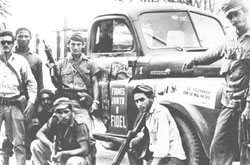
The Vietnam War was won with bicycles. There are at least two books in existence about the history of bicycles in war.
Martin Caidin wrote one in 1974, it's wonderful.
Someone else wrote on recently and I wonder how much it's a copy of the earlier book, yet doesn't even cite it as a reference.
Here's a review from Amazon.com by someone at Fort Bragg:
THIS BOOK REVEALS THE SECRETS THAT WIN WARS, May 8, 1998
Reviewer: Dynmicpara [at] aol.com from Ft. Bragg, NC
What most people do not realize is that the reality of war is not the same as you read in the history books. A lot of things take place that go unheralded, one of these remarkable things is the use of bicycles by infantry troops to get around the battlefield. This is THE seminal book on the subject that brings home the beginnings of military bicycle use in the Boer War, culminating in entire German infantry battalions on bicycles sweeping across Russia in WWI; a stunning victory forgotten by our pre-occupation with the deadlock in the trenches. Or Lettow-Vorbeck's success in Africa. Even there, bikes were used to seize bridges with the speed and silence that go hand in hand with bikes.
Later Caidin and co-author Jay Barbree outline how in WWII bikes were the secret weapon that the Japanese used to over-run Malaya, Singapore infiltrating through the jungles and British linear defenses. The Germans used bicycle troops or Radfahrtruppes across Europe to act as a mobile reserve and spearhead force. The Finnish Jaegers used bikes to defeat the Red Army. Again, because these were sometimes our "enemies", we have failed to date to capitalize on the bike for today's light infantry and special operations choosing instead to foot slog at less than 1 mph.
As stunning historians, the writers describe the amazing British Commando bike raid on Bruneval radar station that success hinged on being 8 miles away and infiltrating by bike to surprise the German guards. After WWII, its the Viet Minh learning from the Japanese to use bikes as supply tools to lay siege to the French at Dien Bien Phu. After this victory, they use bikes against us to move supplies down the Ho Chi Minh trail that we are unable to stop by air strikes.
The sum total of this work is that there is no reason why we do not capitalize on bicycle mobility to achieve the same effects the enemy has used against us. The Swiss and several other countries use bikes today to move 100 miles a day or 10-25 miles in under an hour...while we ! foot slog and demand motor vehicles deliver us directly on top of the targets, a predictable tactic that gets men killed.
In a way this book is a secret weapon to silence the critics and propel us to move faster with stealth along the battlefield. I highly recommend it and hope it is put back in print updated by advocates like myself and my associates who have actually aidropped folding Mountain Bikes for the U.S. military today.
This is a book whose time has come. It should be on the required reading list of every freedom defending Army.
Airborne!!
Mike Sparks
1st Tactical Studies Group (A)
But, the current way the Bay Area is setup makes it so few peopel can live near where they work.
I work in SF and during the dot com boom I saw many of my bosses and other rich yuppies who LOVED Critical Mass. Many of my richer coworkers could afford to live near the office and biking was an option for them but not for many of the other workers who could not afford the city and had to take Cal Train.
Biking seemed to serve two purposes for the proCapitalist green yuppie dot commers:
1. It was a recreational activity (like going to Tahoe) that people could do after work in the city (and Justin Herman plaza was near S Park so it was a perfect location for many dot com types)
2. It allowed many former leftists to feel like they still had some radicalism in them despite the fact that they spent all day watching the stock market. But, a lot of the radicalism was an expression of yuppie power; "we may be young but we own the world and can block traffic and do whatever we want to have fun".
Some of this is no longer the case since the dot coms went bust, but the former activists who sold their souls to corporate America have for the most part NOT come back out onto the streets. And since 9/11 most of the politics seems to have disappeared from the few radical communities that WERE somewhat behind Critical Mass. Perhaps people are burned out but I havnt seen any anarchist presence at a protest or direct action since May Day.
Critical Mass could serve a purpose since bikes are useful and masses of bikes could be a great tactical tool. But for now much of Critical Mass still seems to still be young white hipsters announcing their privelige to the world.
Give me a break....
Blocking city street has the effect of raising conciousness about an issue but has less of a direct effect in terms of achieving an actual goal. I havnt met TOO many workers who are pissed off by Critical Mass since most workers downtown neither bike nor drive to work (since the city is so crowded every one of my coworkers uses public transportation). I dont think Critical Mass as a tactic is that antiworking class but as a movement it seems a little apolitical.If the goal is to reduce car driving, a push for public transport rather than bikes seems like it would reach out to a broader community. Even then, its an important issue but hardly a radical one that should be the main focus of anarchists or any other group that seeks larger societal change (especially in these times of war, lost civil liberties, and cultural regression).
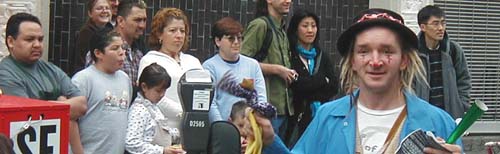
and the cops were taking photos from those locations.
but i kind of doubt their ability to make such an effective statement!
maybe it's just that post the orchestrated 9-11scam, people are letting themselves be pushed into right wing perspectives.
stop dwelling on people's color and presumed class and start looking at what they're doing, and where we can be going, all this "well you just aren't good enough no matter what, i can find some argument or example of why you're a failure" is divisive and prevents evolution.
problem?
how about propose a solution!
Subject: RE: Critical Class/Class Mass debate
Hi ya'll...
I would like to respond to this because it's finally on a level where
I feel I am able to participate.
I like what you said, Jym, when you wrote:
"I'm glad CM is inherently about action,"
This is one of the reasons I so dearly love attending Critical Mass!
Of course at times I wonder why people are a part of this ride.
What makes them motivate themselves to get on their bike and ride on over to
join CM? I've even begun to interview people on their thoughts about CM and
why they participate. Recently I've really become quite involved in riding
and absolutely LOVE my bike, and these kind of things do hold a great interest
to me. What makes CM and its riders tick? But after receiving word about the
postings on indybay, and reading through a long list of accusations and
rebuttals, I felt almost immediately removed from CM. I can see, or rather
understand where people are going with their comments, but I felt it wasn't in
any way, shape or form in the spirit of CM and merely a spit-in-your-face
debate. I should, however, note that I'm assuming that the individuals
writing on indybay were in some way speaking on the behalf of CM. And if so,
maybe this side of CM needs to be looked at and discussed, kinda like
suggested in Jym's e-mail. But I would also hate for any kind of division to
form in CM.
Speaking for myself, CM is a ride where I get to see many different
types of people come out to celebrate and protest and ride with their friends
and community. I've seen people share their drinks and food with one another
as well as their lively sides. Strangers meet other strangers and realize
we're really not that strange at all. Personally speakin', I've been able to
spark up all kinds of conversations on just about any topic with random bikers
and ride away feeling that much richer than before. I've also been given the
chance to finally surround myself with other individuals from my community who
have some common beliefs and hopes for the outlook of our society, near and at
large.
If this sounds emotionally bent, I most definitely agree, but this
is the kind of spirit I derive from CM. I'm not at all saying you all should
be feeling or deriving this too. I realize everyone's got a different reason
for being out on the roads. All these Friday rides (where ever it should fall
in the month) can mean a million different things. Even the ride themselves
will be somewhat different from the ones before (sometimes even completely
different all together. But are the differences so important that people need
to start labeling CM as a certain type of fraction of society? I thought
there wasn't supposed to be any kind of defined organization around CM but
simply a mass of bicyclists taking a bike ride together.
In sharing these opinions, I'd like to extend a hand out to others
who aren't involved in this conversation to come forward and speak their mind.
CM consists of anyone whose ever rode in one. I'd be interested to hear what
it means for them.
as always,
peace and bike grease,
s.g.
The presumptions about class and race are made by you! The points being made by the photograph include an audience/spectator vs. performer/circus-clown dynamic existing at "protest" events, the tactical effectiveness of "celebrations" when most people are pissed off, and the condescension inherent in a puppet/clown strategy for organizing.
Don't misrepresent the SFBC!
First of all, we're talking about Critical Mass here, not the San Francisco Bicycle Coalition.
But more importantly, SFBC DID NOT ENDORSE GAVIN NEWSOM.
GAVIN NEWSOM was one of the candidates that returned their questionaire, and of course he tried to make himself look as progressive as possible to get the bike vote. But that's not SFBC's fault, they're just posting the answers they got.
Newsom, by the way, was claiming to be working on a public bikes project when a group of bike radicals beat him to it, giving away public bikes on the street which got a bunch of press coverage and a sheepish admission that they "beat me to it" from Newsom.
I do think SFBC should get their links together, as right now it has the replies under the subheading of "endorsements", which is confusing -- because "endorsements" really means a survey of who was and WHO WAS NOT endorsed. Newsom, again, WAS NOT ENDORSED.
So don't misrepresent, that's scary.
What's more, let's not try to act like Gavin Newsom just made his bicycling resume look good for the bike coalition application. Newsom has a large constituency of wealthy bike enthusiasts who he has always worked with.
Also, you can take a look at the Bike the Bridge Coalition, which lists many Critical Mass-affiliated people, and lists Gavin Newsom as a "Friendly Supporter":
http://guest.xinet.com/bike/btbc/contact.html
I guess that's politics.
Gavin is well aware that appealing to the bike lobby means appealing to the wealthy voter class:
"Sell your car; buy a bicycle and Muni pass." - Gavin Newsom ... a radical message no matter who delivers it?
http://www.newcolonist.com/sffewwords.html
And don't forget the Bike to Work Week, a dismal array of politicians like Newsom in league with the fucking police:
"Next week is National Bike to Work Week, and the bike coalitions around the Bay Area are getting politicians and law enforcement brass on two wheels for a one-day photo op, complete with stylish lender bikes for the short rides. They're urging the rest of us to do the same (on our own wheels) that week. If the San Francisco mayor, several supervisors, a congressman and several San Jose City Council people can ride to work one day, I'll give it a whirl. I don't need a lender bike, either..."
http://www.bikefed.org/cl_issue_18.htm
In fact, Mr Newsom and Mr Meggs worked together on a campaign to stop a bike toll on the Golden Gate Bridge:
"Dear Mr. Meggs:
Thank you for the information, dated February 11, regarding the proposed toll for bicyclists on the Golden Gate Bridge.
Keep up the good work.
Sincerely,
Gavin Newsom"
It was during this campaign that Newsom was able to give his quote: "We should be paying bicyclists to go across the bridge, not charging them."
Mr Newsom then introduced a resolution to prevent this from happening, and the political relationship was sealed.
Now. Some will snicker when it is said that non-class-oriented campaigns and single-issue campaigns have the danger of drifting into liberalism, and beyond into fascism. Gavin Newsom is a fascist who believes in social cleansing. He also believes in "bicycle rights". Any serious class struggle organization would rather spit on Mr Newsom than use him to stop a bike toll on the bridge. An alliance between the bicycling enthusiasts and a fascist politician with an aggressive anti-workingclass agenda is EXACTLY the danger of single-issue campaigns that discard class consciousness.
And you've noticed that he (like a wide array of politicians, from lefty to righty) has decided to make himself look pro-bike, pro-pedestrian, pro-transit. Heck, maybe he is. I really am not familiar enough with SF politics at present to say.
After that, what are you really communicating?
"I guess that's politics".
Yes, it's politics that so many groups working on most any issues will try to get the candidates in an election to say something about how they stand. While this might help a liar to get elected, at least the liar would then be known to have gone back on his or her word.
With regards to the SFBC, why don't you write them and suggest that they rename their "endorsements" page their "maybe, maybe not endorsements page"?SFBC was very clear on the page itself.
The candidate stuff from the Bike the Bridge! Coalition is from 1997-1998 or so. You neglected to mention that it states a disclaimer, that public representatives are listed only for their "support of equal access, not because of their affiliation with any political party, and their recognition [there] is not an endorsement of those candidates over any others. The Bike the Bridge! Coalition is non-partisan. Please notify us of anyone you feel should be included." Personally I felt queesie about doing that. My political knowledge and ability is essentially being learned by doing. I try things, read about things, hear about things, and keep looking for what I think is a good way to do things. I evolve. Your input is valuable to me, but please be more substantive (e.g., your last paragraph) rather than all these red herrings and guilt by association (what are you, the FBI?).
Like, it's pretty outrageous for you to make the claim that, "Mr Newsom then introduced a resolution to prevent this from happening, and the political relationship [with myself, Jason Meggs] was sealed."
What relationship? I don't live in SF, I don't vote in SF, I don't work for Newsom, I doubt if he'd recognize me. I used to send letters to all the SF Supervisors about issues in SF because I worked on regional campaigns. Sometimes they replied. Does that make me a supporter of Newsom? Or a supporter of Measure N? Hardly!!!
I am not ignorant of the idea that "single-issue campaigns have the danger of drifting into liberalism, and beyond into fascism". The campaign for equal access to the Bay Bridge certainly showed me a lot about how a grassroots movement gets played and attacked from outside and within, how the corporate mass media will solidify around profit lines overnight, how agencies manipulate, how vicious they can be while maintaining a public face, how supportive people are misinformed, how stakes get raised and betrayal rears its ugly head, ways that divide and conquer strategies come in many forms, and above all how the big money pushes have the ability to WAIT, because they know that all the momentum will die if they pull away for a few months or years, and may never be redeveloped.
A noted Anarchist historian once conferred that "any victory under capitalism is a defeat, and any defeat is an opportunity for victory" with regards to the Bay Bridge struggle.
Check http://www.oaklandbridge.org/ for some good exposes.
I don't have time right now to tell the whole story of intrigue, profiteering, deception, manipulation, divide-and-conquer strategies, selective flouting of the state's own laws, and more.
Meanwhile, I have to wonder if you've got another agenda than you're relating. All this google search type stuff ("bike - Newsom - Meggs" I presume) is not really saying anything substantive about the bicycle movement except that we're active and lobby politicians, and don't stop them if they help. Look at what Mayor Brown did to Critical Mass (the original issue here) in an across-the-board attack on alternative transportation for wealthy developers (it wasn't about bikes!), using Critical Mass SF as a smokescreen, a minority to scapegoat. Yet SFBC still works with the Mayor to try to push for exactly the opposite.
Does that make them supporters of Mayor Brown? Or any of the myriad things Brown does?
If you're in prison and you lobby the warden for a library, or healthier food, or other rights, does that mean you support prisons? What if your prison all but makes you work for American Airlines or some other corporation, does that make you support them as well?
Is your point that SFBC should be doing things differently? That's of interest, tell them (I am not them!). Meanwhile they're a political organization working in a political environment. Would you rather there was no group looking out for the interests of bicyclists? Given the amount of community building and expansion of scope which the SFBC has facilitated (e.g., the new group for Liveable Cities) you'd better make a really good argument!
In any event, you're an anonymous someone attacking me the public activist. Join the cops, the car industry, a whole slew of big nasties. The only difference is you're ostensibly representing yourself as being against fascism and liberalism. If you really want to talk about how I or the bicycle movement can be more effective, why don't you contact me directly.
I might add that some of the "single issue" campaigns I've worked on include:
Food Not Bombs
Homes Not Jails
No on Prop 21
CopWatch
October 22nd
Reclaim the Streets
Free Radio Berkeley
Equal access to bridges (http://www.bikethebridge.org/)
Saving the Redwoods
Stopping cancer where it starts
Pesticide "reform"
Organic food availability
Yes on O (Berkeley organic/fair trade/shade grown coffee initiative)
No on P (Save affordable housing in Berkeley)
Meggs v. DeZerega (successful defense of tenancy rights versus an eviction, helping tenants across the state)
Stop the War
Pro-Choice campaigns
Berkeley Partners for Parks
Campaign against the widening of I-80
Berkeley Community Media
A number of election campaigns, which does not constitute an endorsement of this system, but rather a recognition that it exists.
Critical Mass
Community bulk buying
Mardis Gras
Mayday
People's Park
Saving urban trees
And lots more.
I donate my money and labor.
If you really want to paint me as the bad guy, please do be more substantive.
thanks!
-Jason Meggs
the point is a political argument about tactics and strategies, namely if it is justified to suggest that class politics could/should play a bigger role in critical mass and other similar protests/events.
Agreed, for when a discussion degenerates to this level it reflects poorly on the arguments of those who are causing that degeneration.
"The point is a political argument about tactics and strategies, namely if it is justified to suggest that class politics could/should play a bigger role in critical mass and other similar protests/events."
That discussion is most welcome. So far the side which has suggested it has failed to explore what that would look like, has failed to answer numerous questions or concede obvious points, has made repeated and obvious red herring arguments, attacked people personally with specious misinformation including the race card and accusations of fascism, and appears to have agendas very different from the prima facie argument.
As someone who would like to see movements in general incorporate more of a class analysis, and to see everyday projects and efforts share a class analysis, I'm let down.
Better to say, "I don't know how" than to launch into an attack on people and projects and movements which could and should be your allies.
Build solidarity not strife.
Well you try to be nice and all you get is called specious, baiting, etc.
The fact is someone said there should be more class analysis in CM, to which half a dozen CM'ers ranted on about how that is stupid, it couldnt be done anyway, how CM already held a few signs up for colombia, etc etc etc. Then, after a number of excellent points were made about the inconsistency of the "CM is anarchist" and "CM supports the most oppressed class, bike riders" and even a real life example was given about bike lobbying collaboration with fascists, all we get in return is crying about how unfair the political argument is.
Go tell Gavin Newsom, maybe he'll introduce a resolution for you.
Critical Mass is NOT a revolutionary tactic. Nor is it an anarchist tactic. At least not in its current formation. It is one tactic that can be used for any number of political tendencies, and in the Bay Area, it seems to be on a linear continuum between ecological liberalism and yuppie bike fashion.
If you can't hear that without throwing a temper tantrum or being personally insulted, then you need to grow up. Politics is not about your ego or your standing in a social circle.
But it would be great if CM could be more political and the protest this Friday seems to have a strong focus on class so....
1) is it justified to say that cm would benefit from class analysis?
2) is it justified to question whether cm is a political / anarchist project at all?
to me its good to talk about these things.

Long time no see, from sea to shining sea, I was wondering but decided not to suggest what the C stands for.
Thank you for resetting the debate.
"To me it is good to talk about these things" as well.
You posed two questions for discussion:
1) is it justified to say that cm would benefit from class analysis?
Yes. Go for it.
2) is it justified to question whether cm is a political / anarchist project at all?
Yes. Mostly, I'd like to hear any evidence to the contrary.
Policial project? Yes. Bicyclists taking the streets joyously, militantly and without apology is political and their doing so has certainly influenced the political world here in the Bay Area. The widespread perception amongst participants is that they are
demonstrating, even if they differ somewhat in what that demonstration is.
Anarchist project?
Yes. Although it is true that "You certainly don't have to be an anarchist to participate in Critical Mass, but like so many other things in life (from going on a picnic to making love), anarchist principles are in effect" (from a New Rider Guide at http://guest.xinet.com/bike/newrider/). Many who participate probably don't even know that some organizers and participants consider it an anarchist project.
You have earlier referenced an historical perspective on the origins and basis of anarchism. There are many colloquial, conventional, and historical, interpretations of anarchism. In the most basic and barebones definition, anarchism is simply a society in the absence of a government. How one envisions the absence of government can vary widely. However, dictionaries in my experience tend to describe this practice as guided by "a political theory holding all forms of governmental authority to be unnecessary and undesirable and advocating a society based on voluntary cooperation and free association of individuals and groups" (Webster's).
Actually I rather like Emma Goldman's definition as found at this website:
http://sunsite.berkeley.edu/Goldman/Curricula/FreeExpression/definition.html
Quoting from that page:
"I shall begin with a definition.... Anarchism: The philosophy of a new social order based on liberty unrestricted by man-made law; the theory that all forms of government rest on violence, and are therefore wrong and harmful, as well as unnecessary."
This definition, similar to that of Webster's above, is not a statement explicitly made by the Critical Mass phenomenon, but some would consider it an implicit statement in practice. While Critical Mass is "just a bike ride", anarchists who define themselves under the above have much to enjoy in Critical Mass as it is self-governed, and largely beholden to no forces of hierarchical coercion.
Emma continues:
"Anarchism, then, really stands for the liberation of the human mind from the dominion of religion; the liberation of the human body from the dominion of property: liberation from the shackles and restraint of government. Anarchism stands for a social order based on the free grouping of individuals for the purpose of producing real social wealth; an order that will guarantee to every human being free access to the earth and full enjoyment of the necessities of life, according to individual desires, tastes, and inclinations."
Critical Mass can and does do all of this for many of her participants. Furthermore Critical Mass produces real social wealth. When we participate in Critical Mass many of us if not all of us are much more freed to access "full enjoyment" according to individual inclinations. Perhaps there is no coincidence that a critical mass-related affinity group is called the "Committee for Full Enjoyment".
http://www.talkfastrideslow.org/faq/faq.html
Caressing evocations of Goldman's phrases by turns,
A) "liberation of the human mind from the dominion of religion": Much has been said in recent decades on the notion that the automobile has become society's new God. Everywhere, all powerful, omniscient, the focus of or surrogate for spiritual pursuit. See the excellent trading cards at
http://yorick.infinitejest.org:81/1/cards.html
An appropriate one on God is of course, posted above (petroleum...cars...call him a pagan I suppose if you see them as two gods, especially as he worships money as well).
B) "the liberation of the human body from the dominion of property": But for their steel steeds (whether a $5.00 clunker or a $5000 titanium superbike with lead lined tires) the human bodies of Critical Mass are set free to sail on air in a flock of fellows. Lest my waxing poetic remind you of fascism, let me address factually that Critical Mass reclaims the streets from cars. Public space has been essentially privatized for the use of the motor monopoly. So while our spirits soar and our bodies breeze, we sail unfettered on the asphalt rivers which were once and will yet again be our commons.
C) "liberation from the shackles and restraint of government": Critical Mass entities have repeatedly successfully resisted efforts to shut down or otherwise coopt or control their rides. The result, you can now take to the streets without imminent fear of police brutality, false arrest and citation, or otherwise suffering the state's penal dictum in your face.
And Emma finishes (if this is still her being quoted):
"Anarchism... is the great, surging, living truth that is reconstructing the world, and that will usher in the Dawn."
Critical Mass is an example of an upsurgence which truly is reconstructing our social world, at least for those participating and those fortunates whom are in turn touched. That reconstruction certainly feels to me to be ushering in a form of dawn cracking across the great gray facade of modern society, and does bring me closer to a living truth. I know that many others who participate feel this way.
There can be a distinction between whether a project or phenomenon specifically promotes or proselytizes a formal concept of anarchism, and whether a project simply emerges from actions purely anarchist in nature.
Whether you believe that an enormous power structure of exploitation and control is subverted when Critical Mass takes to the streets or not, consider that Critical Mass means:
a) No formal leaders, no formal hierarchies
b) Government control is secondary to what works in practice between people
c) Voluntary cooperation
d) Free association
e) "User development" of the practice
However, Critical Mass does not always conform to some anarchist ideals, such as consensus. There has certainly been disagreement as to what the ride should do or where the ride should go, and how the riders should act. In these cases, there is no formal mechanism for resolving conflicts. Various forms of voting, lobbying and outreach between participants, and if disagreements are so unresolvable, simply parting ways (multiple simultaneous Critical Mass rides) have all occurred. The time and space for entering into extensive mediation or negotiations is rarely present just before the ride, although consensus negotiations between individuals are known to happen often and "on the fly". If someone were to decide to "block" (bloc? :), well, their attempt to block would probably be about as effective as they could (if necessary) physically block people and then convince them to change behavior. Limits on communication include space constraints (distance, range of voice) as well as time constraints.
The creation of email forums has helped with this at times, and certainly there are communities of participants who meet in person on an ongoing basis, if organically rather than at a set time and place.
An important issue is whether motorists are having their rights violated, and whether they get to participate in the determination of Critical Mass. Considering that motorists have been critical massing (in the worst senses) for decades with lethal result and a massive impact on the commons, I leave it to them to organize a forum and offer means of consensus regarding our public spaces.
* * *
Actually, while people often celebrate in glee that bicycling is a wonderful form of "anarchy" -- something I felt and heard long before Critical Mass showed up (that's another discussion, but related -- try substituting the word "bicycling" or the phrase "bicycle transportation" for "Critical Mass" in this thread) -- it's quite humorous that any theoretical anarchists would so strongly disagree that Critical Mass is an anarchist event or practice.
The label of "anarchy" applied to Critical Mass has quite often come from the government, their police, and the corporate media. And gosh, since when have those camps demonstrated a grasp of what anarchism is really all about?
* * *
So tell me, which definition(s) of anarchism are you operating under, can you point to any resources by which an informed comparison and analysis may be made?
-listenin'
p.s. While I respect your fear of single issue activism, note that Emma Goldman's first "single-issue" campaign was for the eight-hour day. Although she was counseled that such reforms were inadequate short of the complete overthrow of the capitalist system, she soon realized after going on a speaking tour, face to face with people directly affected, that "specific efforts for improvement such as higher wages and shorter hours, far from being a diversion were part of the revolutionary transformation of society."
http://www.geocities.com/Paris/2159/redemm.html
Goldman also worked on such "single-issue" campaigns as Reproductive Rights and Ending Gender Oppression.
or it is some people riding bikes, just like a bike club. did you see when San Francisco shut down all of downtown to cars so that Lance Armstrong et al could do circles for a few hours? I bet that pissed off some innocent drivers, but it didn't matter because it was lane Armstrong.
and i'd rather be artsy-fartsy than farting plumes of burned blood of the earth
I have tried to make this post less rambly, but there is so much i tried to mention. The role of CM in this city, and the ideas behind it, is a great framework for making sense of relationships here. We can build strong alliances and i'm curious what will happen. I have a lot to learn.
And you know that slow down my pay rate
Down to zero
No alignment make it kinda hard to steer though
Motherfuckers laughin'
but it beats the AC transit blues
Shit, my car is better than my shoes
At 6 a.m., the Buick plowed into a 29-year-old man on a mountain bike from behind at 30th Street and Telegraph Avenue in Oakland, knocking him 150 feet and dragging his bike six blocks, police said. The man, whose name was not released, was in fair condition at Highland Hospital in Oakland.
After hitting the bicyclist, the driver speeded up and continued south on Telegraph, the car's windshield shattered, police said.
"No remorse whatsoever," said Oakland traffic Officer Dan Tirapelli. "He knew exactly what he was doing. He wanted to get away no matter what the cost."
Frederique David, 28, of Oakland was working nearby when she heard the crash. She saw the injured bicyclist lying face-down on the ground.
"I'm very upset about it," David said. "It's very upsetting to know that this person was continuing this (in San Francisco). That's really horrible."
Here's a photo from a ride last spring in Sacramento, in which the small rag tag team of demonstrators (mostly young, mostly white, mostly poor (for this culture)) deliberately went on a long loop through a low income minority neighborhood. Funk music was playing on the sound system. People cheered, danced and waved from their porches, honked and waved from their cars, and danced alongside the ride.
This photo shows a kid who was riding double on a bike, then hopped off and ran to join the ride while his friends biked along.
My point is, Critical Mass brings a lot of cheer and, can bring people together. It builds community and solidarity and joy. It is liberating.
The potential for this has just begun to be realized. Anyone with a critique of Critical Mass should be positively acting to realize the potential of Critical Mass unless their real agenda is to drag it down and snuff that potential. The best way to bring issues about Critical Mass to Critical Mass is to engage, participate, comunicate, and propose and initiate ACTIONS that support your goals.
How can you claim to be an anarchist if you can't coexist or even work with or at least work around an event like Critical Mass?
And when do we get to find out how to be 1,000 times more effective?
p.s. the kid is great, i wish cm had rolled past when i was a kid
Date: Thu, 24 Oct 2002 09:37:32 -0700
From: Jym Dyer <jym [at] econet.org>
Reply-To: sf-critical-mass [at] topica.com
To: sfbike [at] topica.com, sf-critical-mass [at] topica.com
Subject: Hallowe'en Ride -- SCARE not Cash
=v= Get out yer costumes, because Hallowe'en on wheels comes
early this year: Critical Mass is tomorrow!
=v= Some folks are having a protest and street party against
Gavin Newsom's idiotic so-called "Care Not Cash" ballot
initiative (okay, so I guess we all know where I stand on this
thing). They'll be in the Marina at 5:30, the same time as CM,
but they are inviting the Mass to swing by. It sounds like fun,
especially the Gavin Newsom Look-A-Like Contest.
=v= Details below. I think they'll have fliers at the ride.
<_Jym_>
P.S.: I'm not an organizer for this protest; just passing along
some information. The Mass goes where it goes, y'know?
------- Forwarded Message
Gavin Lies
There is no care in care not cash.
Prop N would reduce General Assistance for homeless San
Franciscans to the preposterous level of $59/month, while
creating no new services. Prop N prioritizes property
values and toursim over people's lives.
Resist Gavin Newsom's Hidden Agenda!
The Event: Prop N Stands for Nightmare:
A Pre-Halloween Festival of Resistance
In the spooky Marina District Friday, Oct. 25th 5:30pm
Special Feature:
The Exploitation Runway and Gavin Newsom look a like contest.
Folks are encouraged to dress up in their spookest attire as
well as bring creative expressions against the exploitation of
the poor in our city.
------- End of Forwarded Message
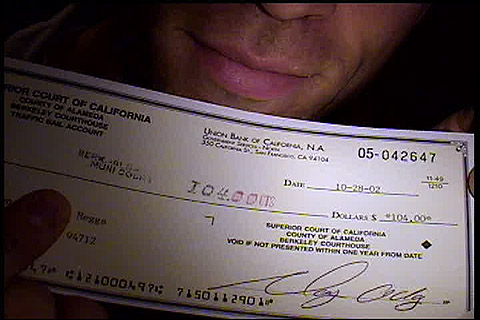
BCLU is considering filing suit, for which there are ample grounds.
Donate

$65.00 donated
in the past month
Get Involved
If you'd like to help with maintaining or developing the website, contact us.
Publish
Publish your stories and upcoming events on Indybay.